

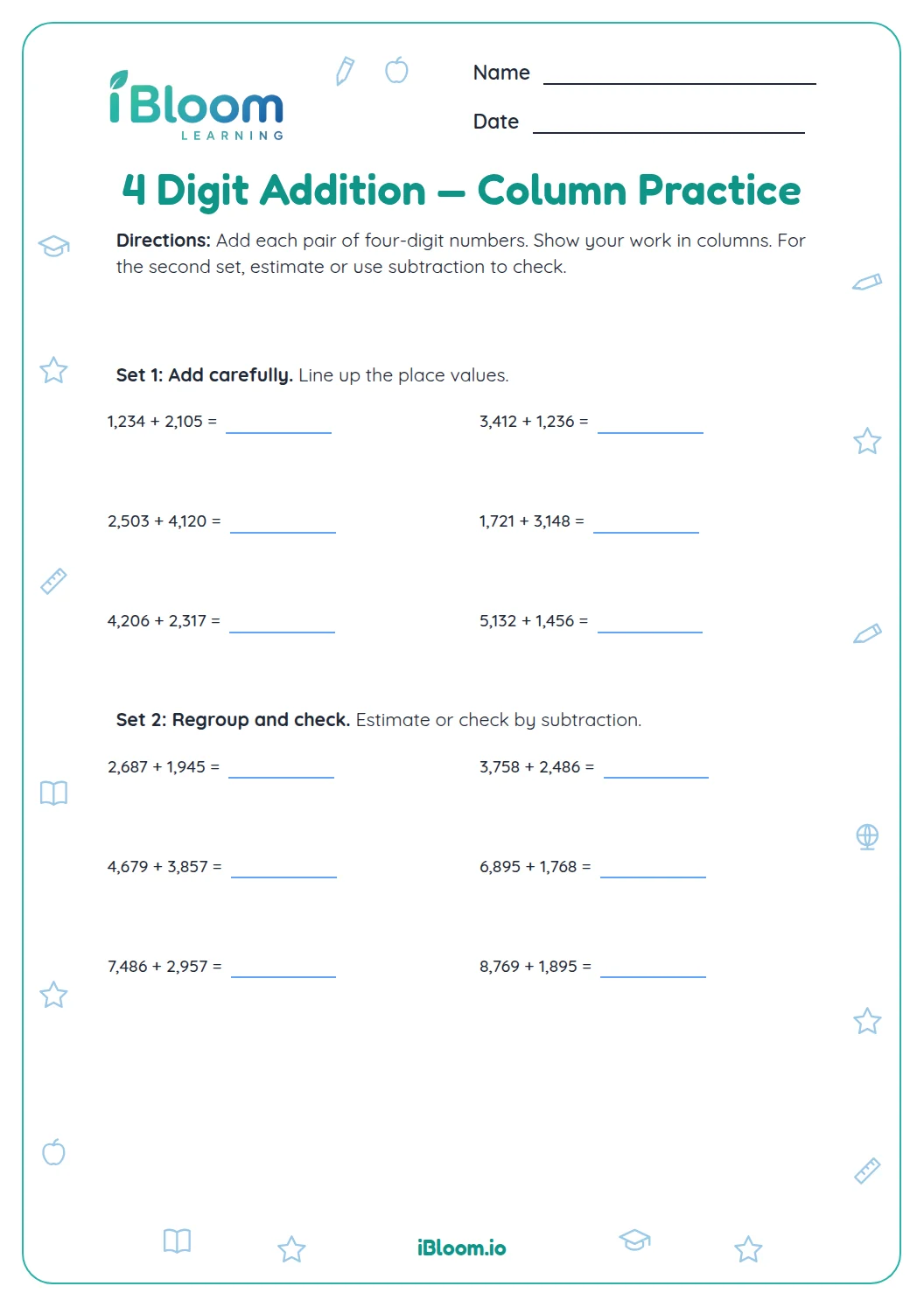
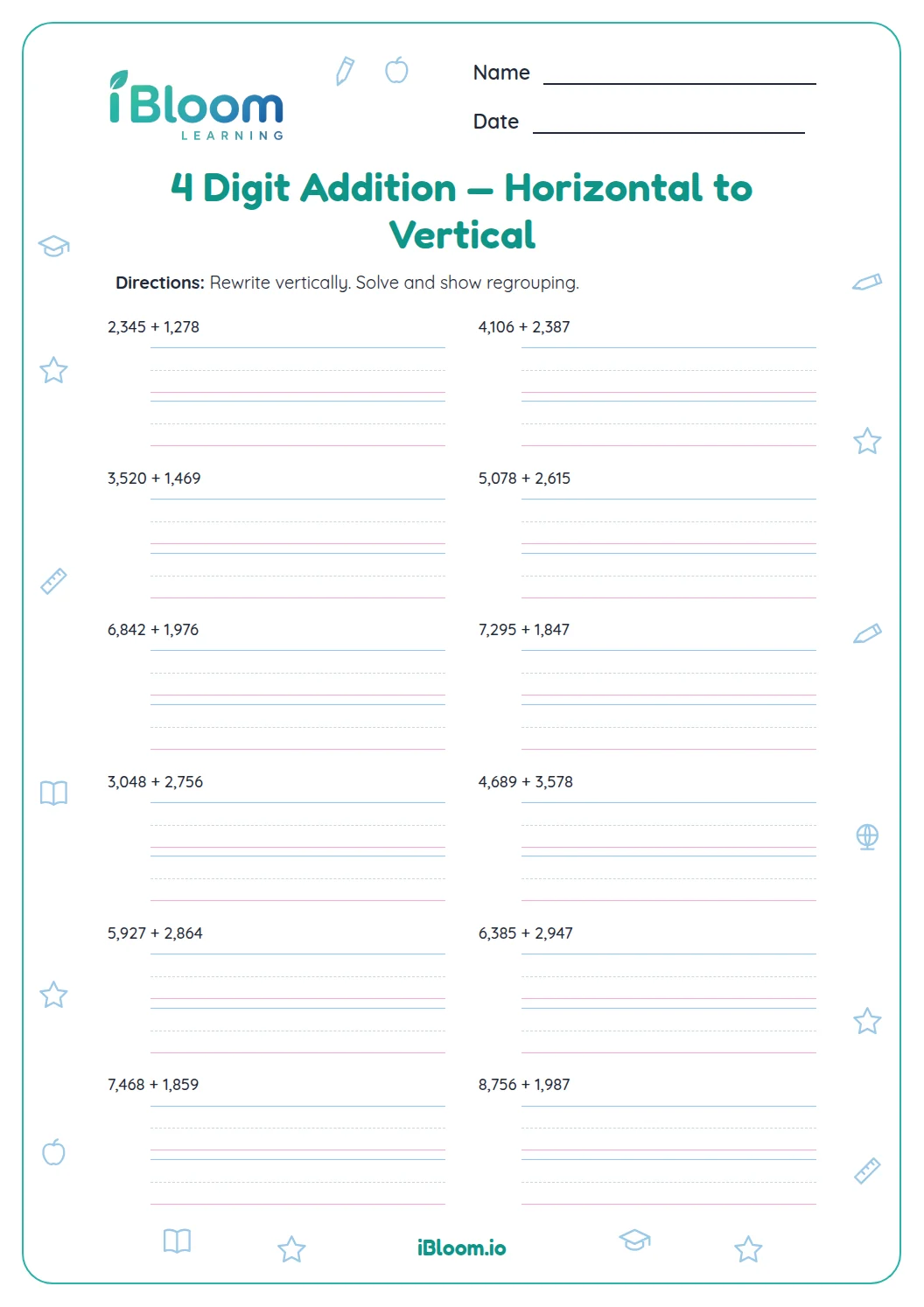
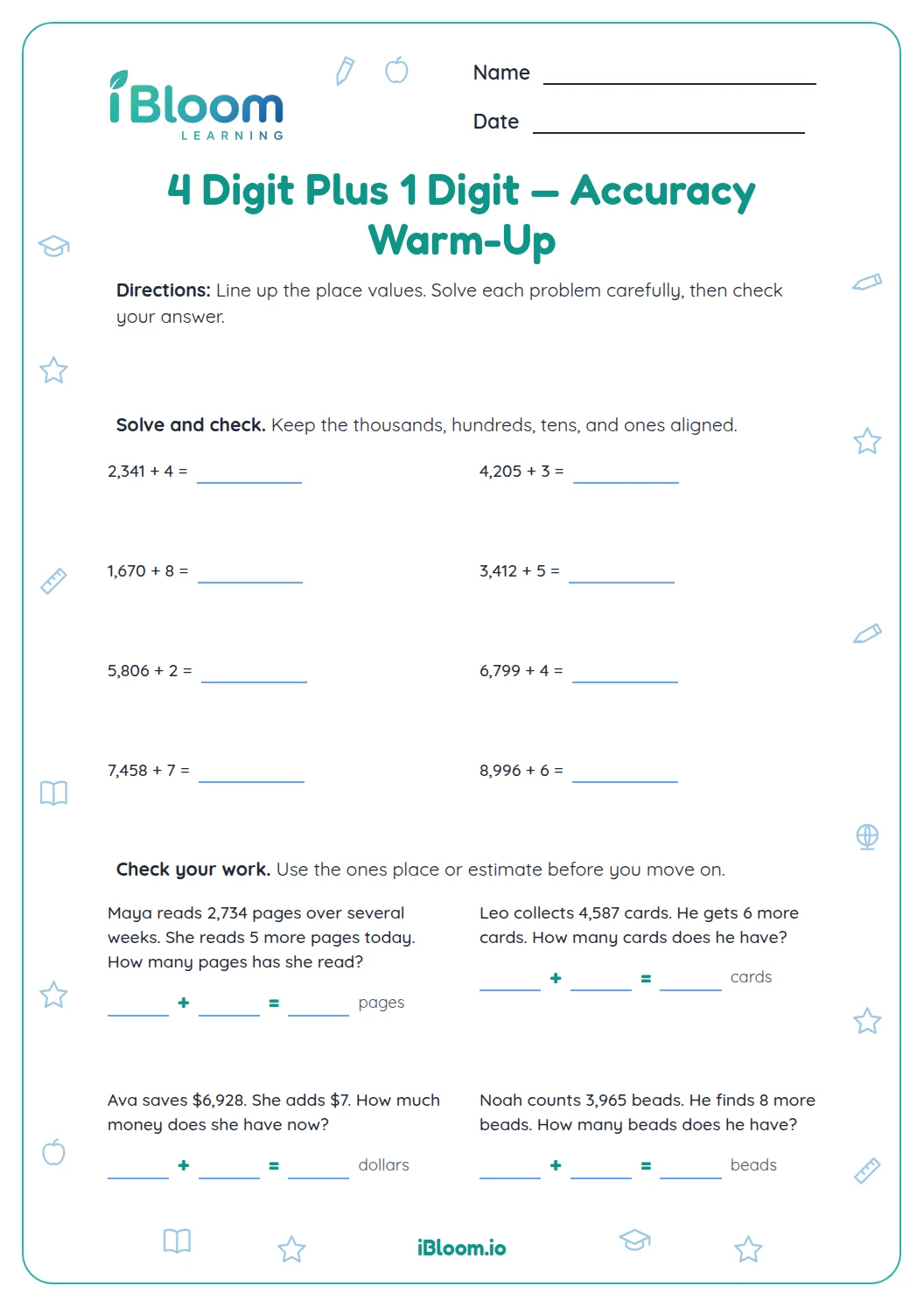


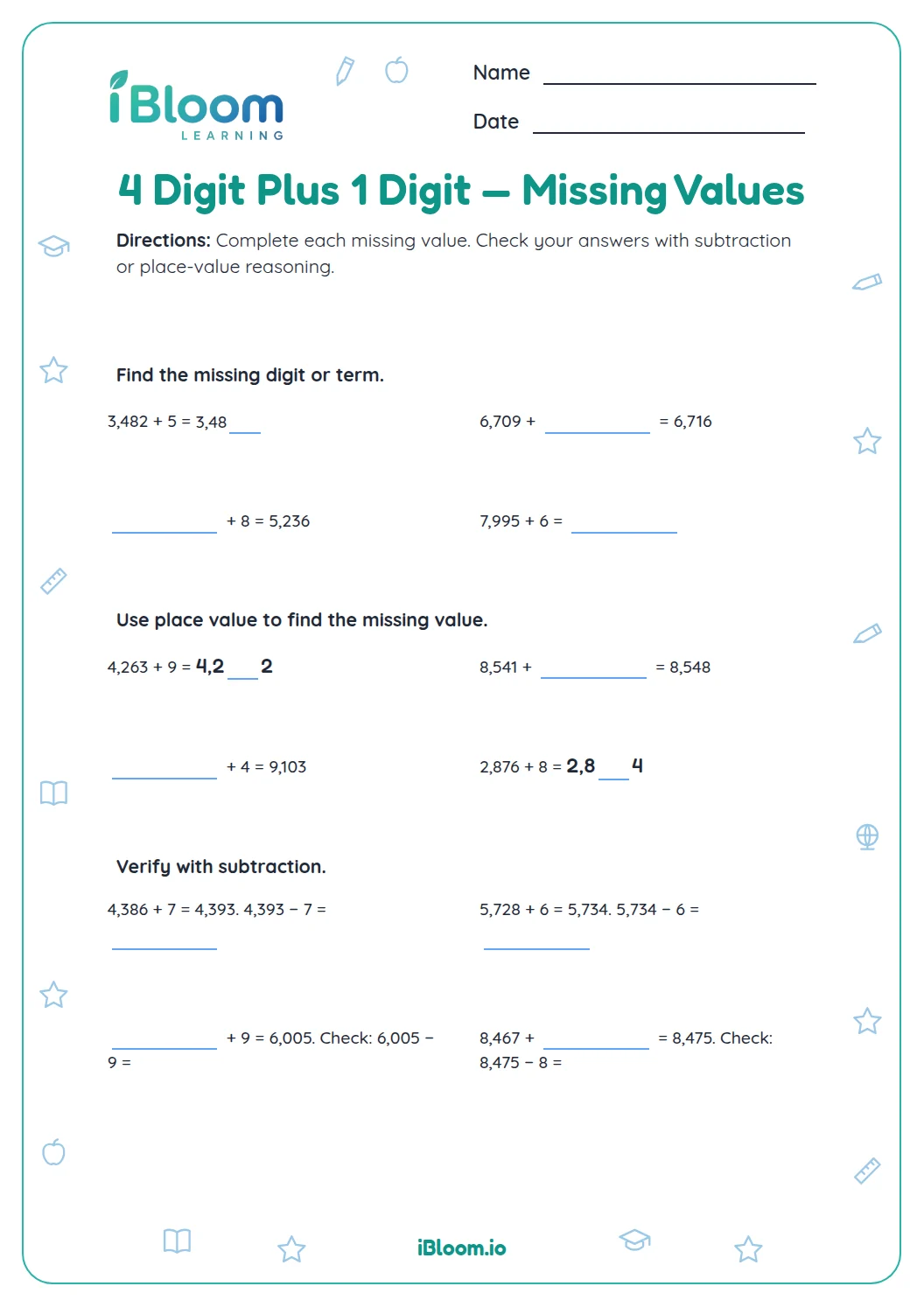
About this worksheet
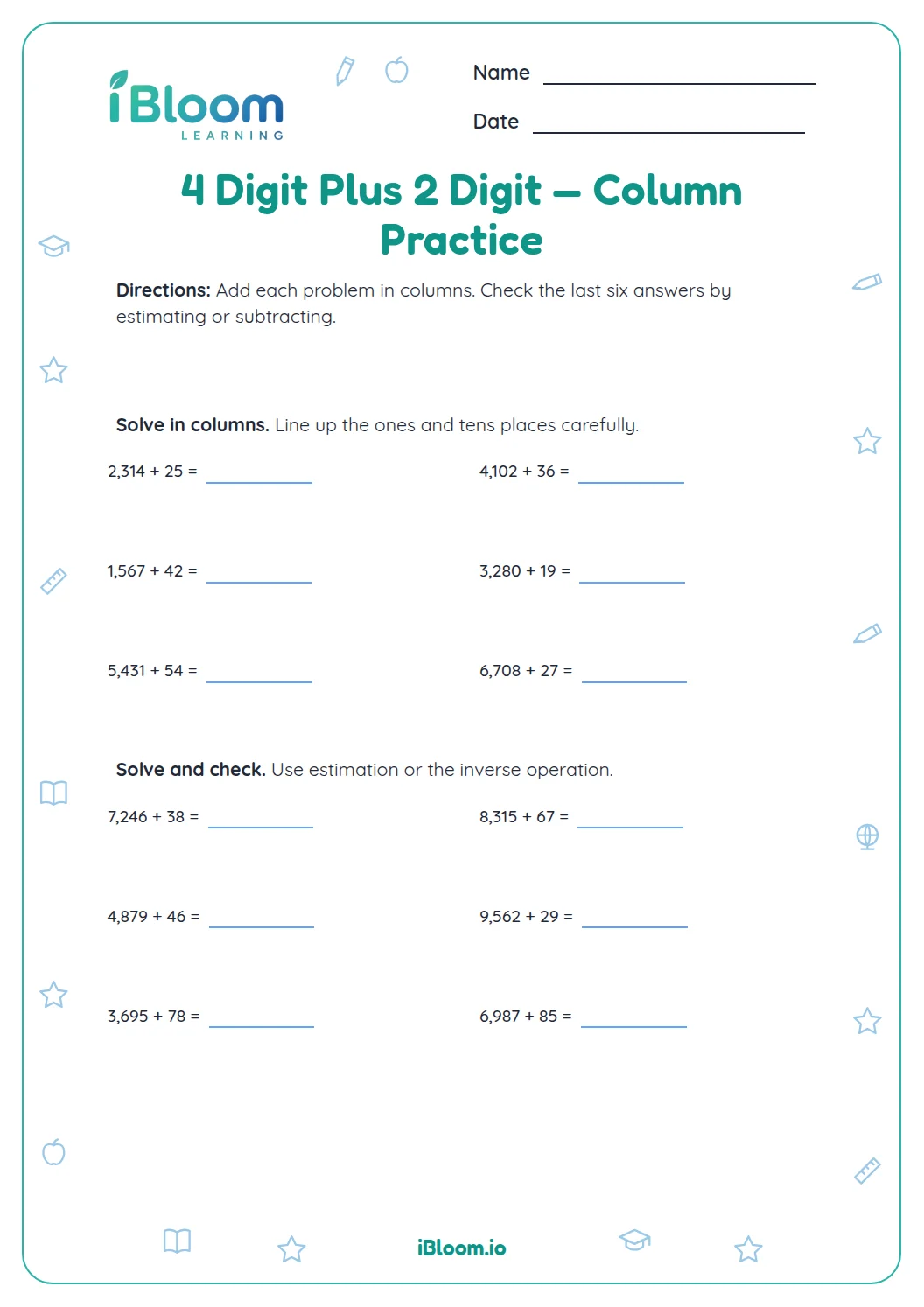
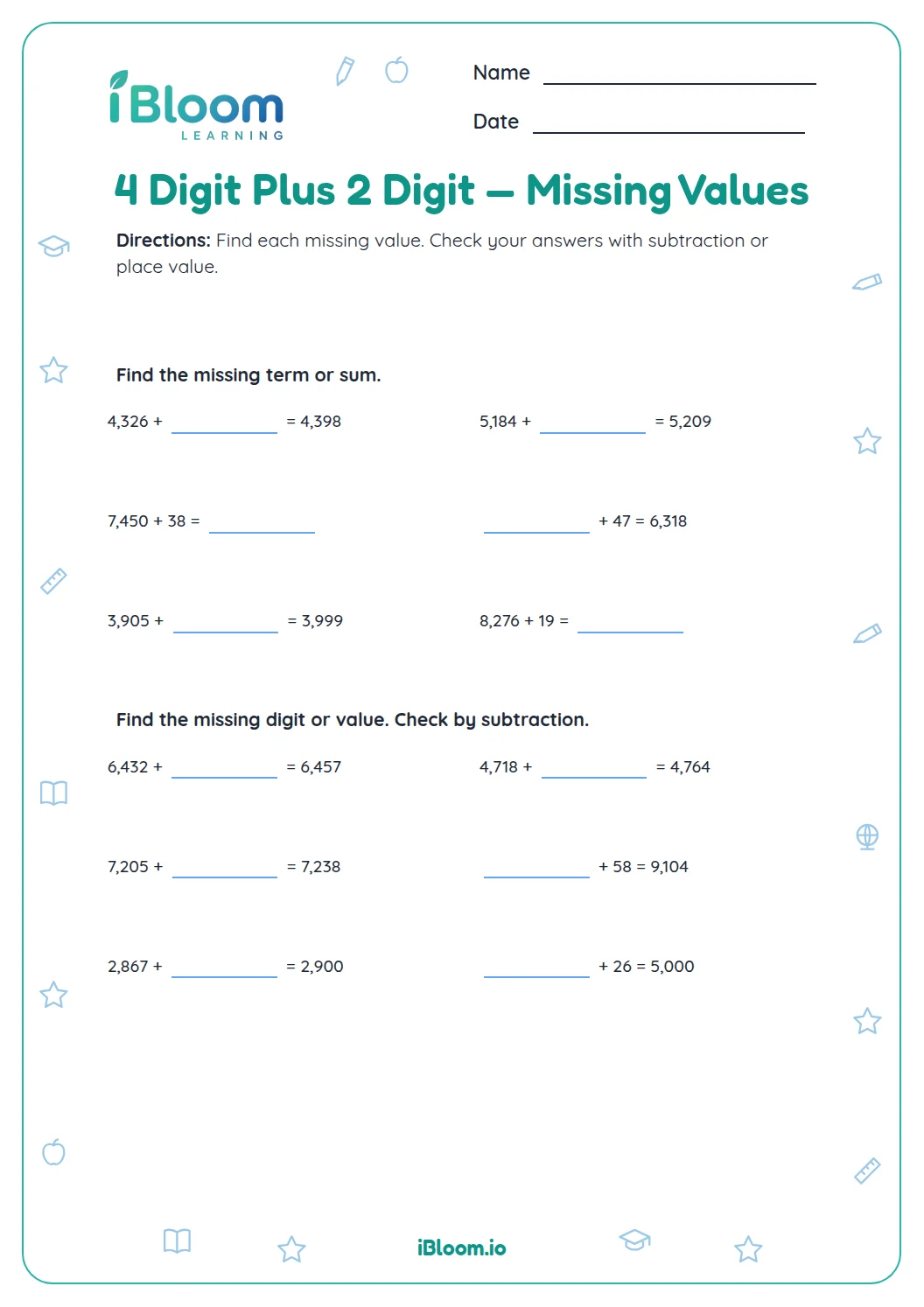
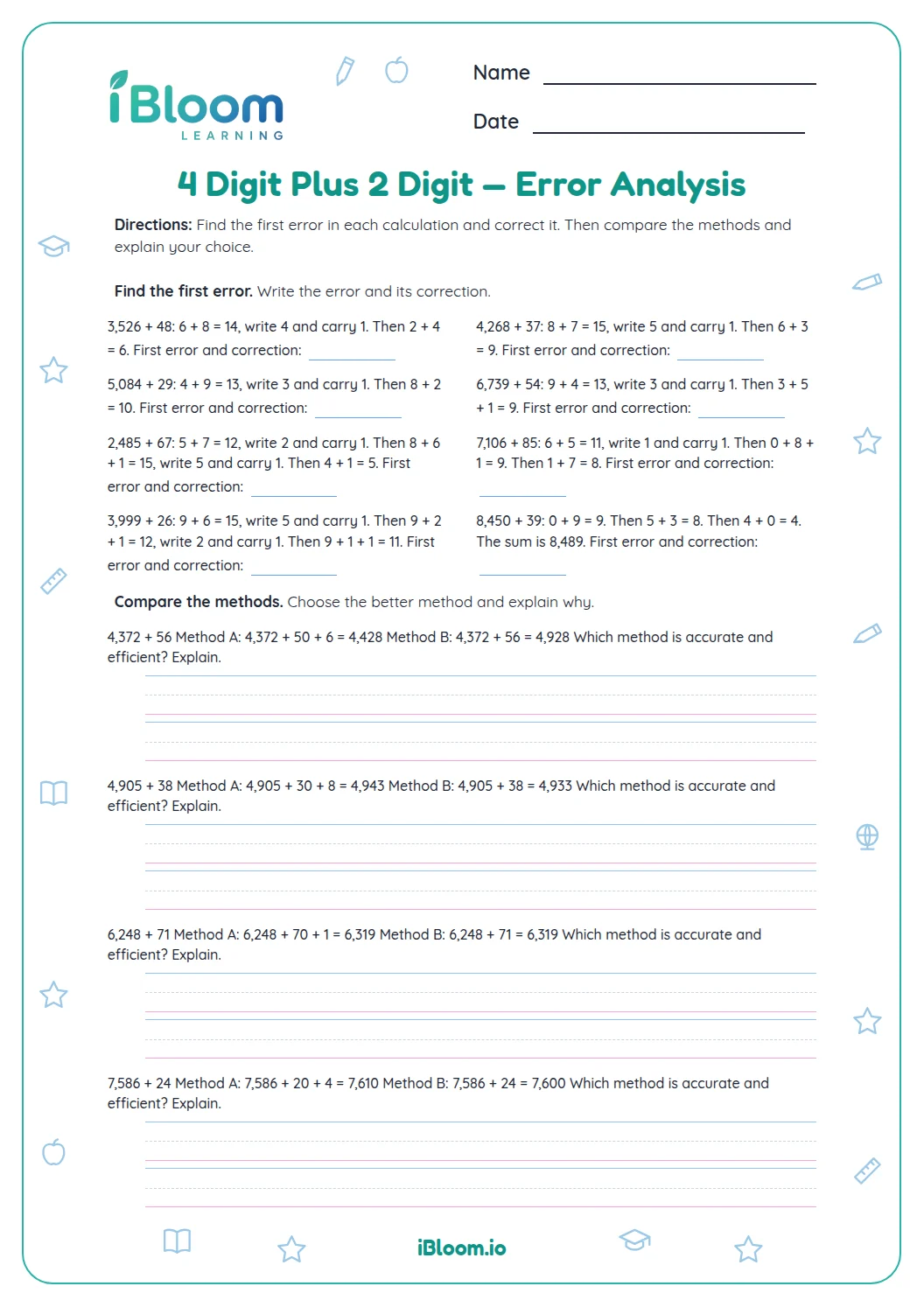
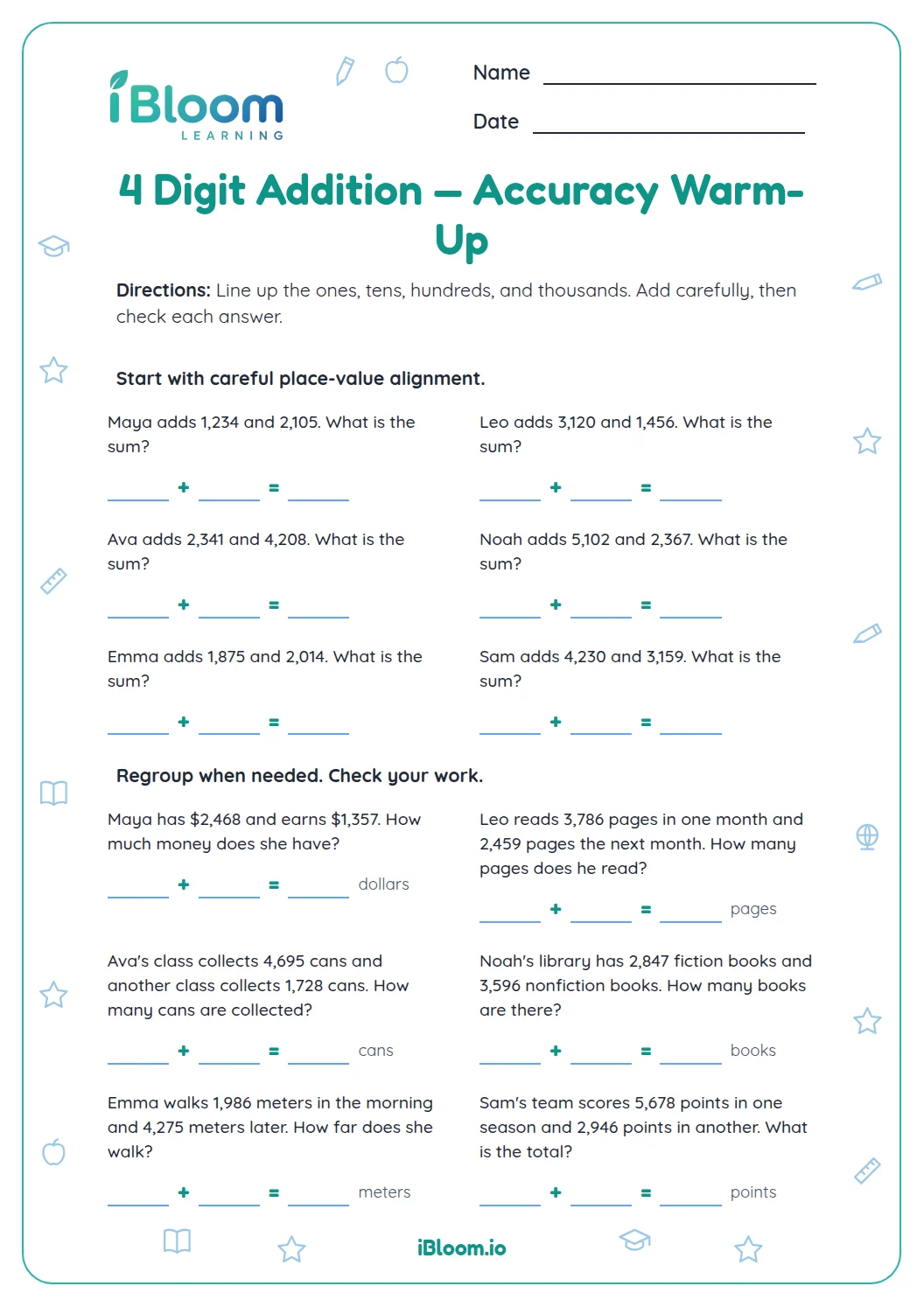
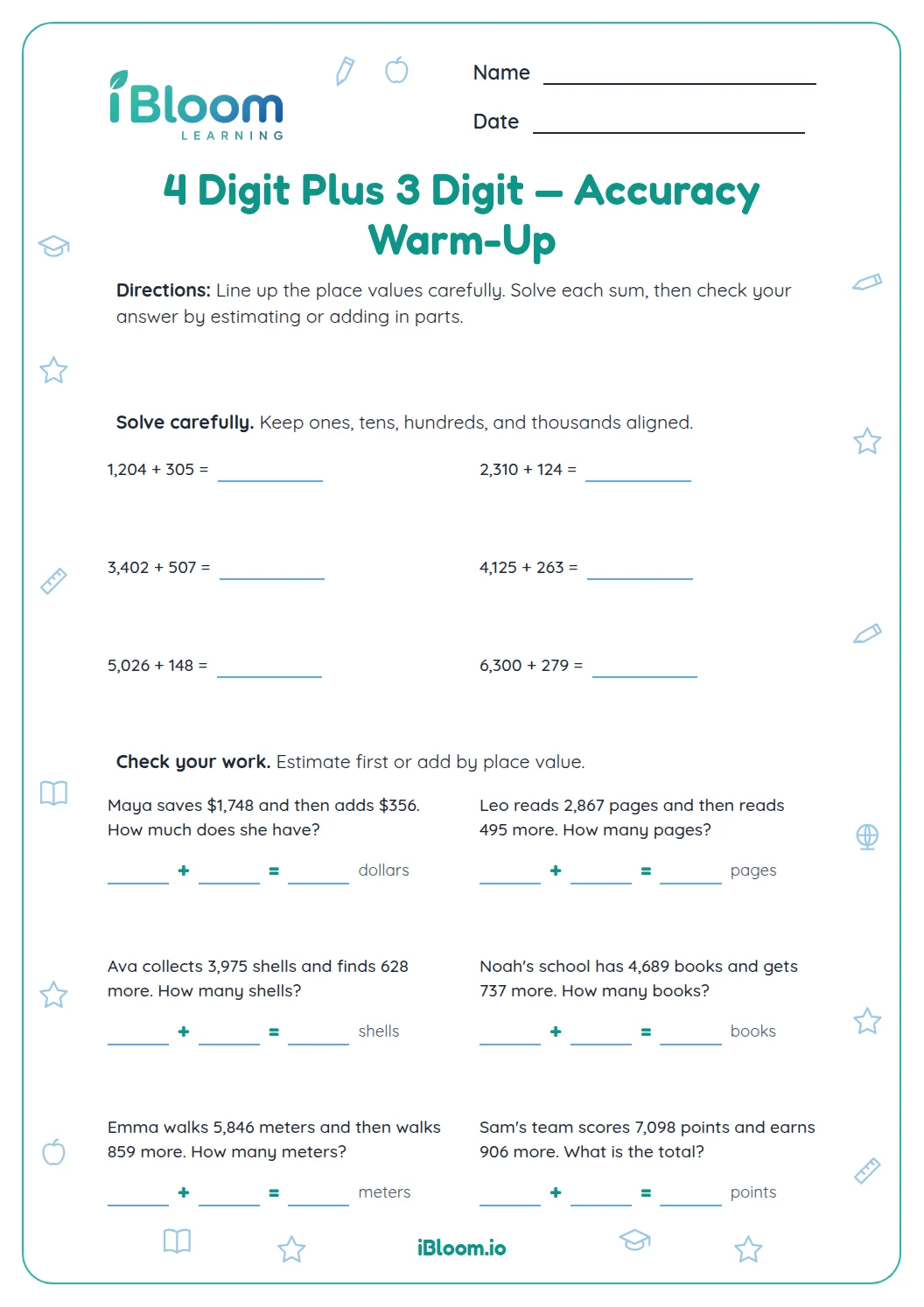
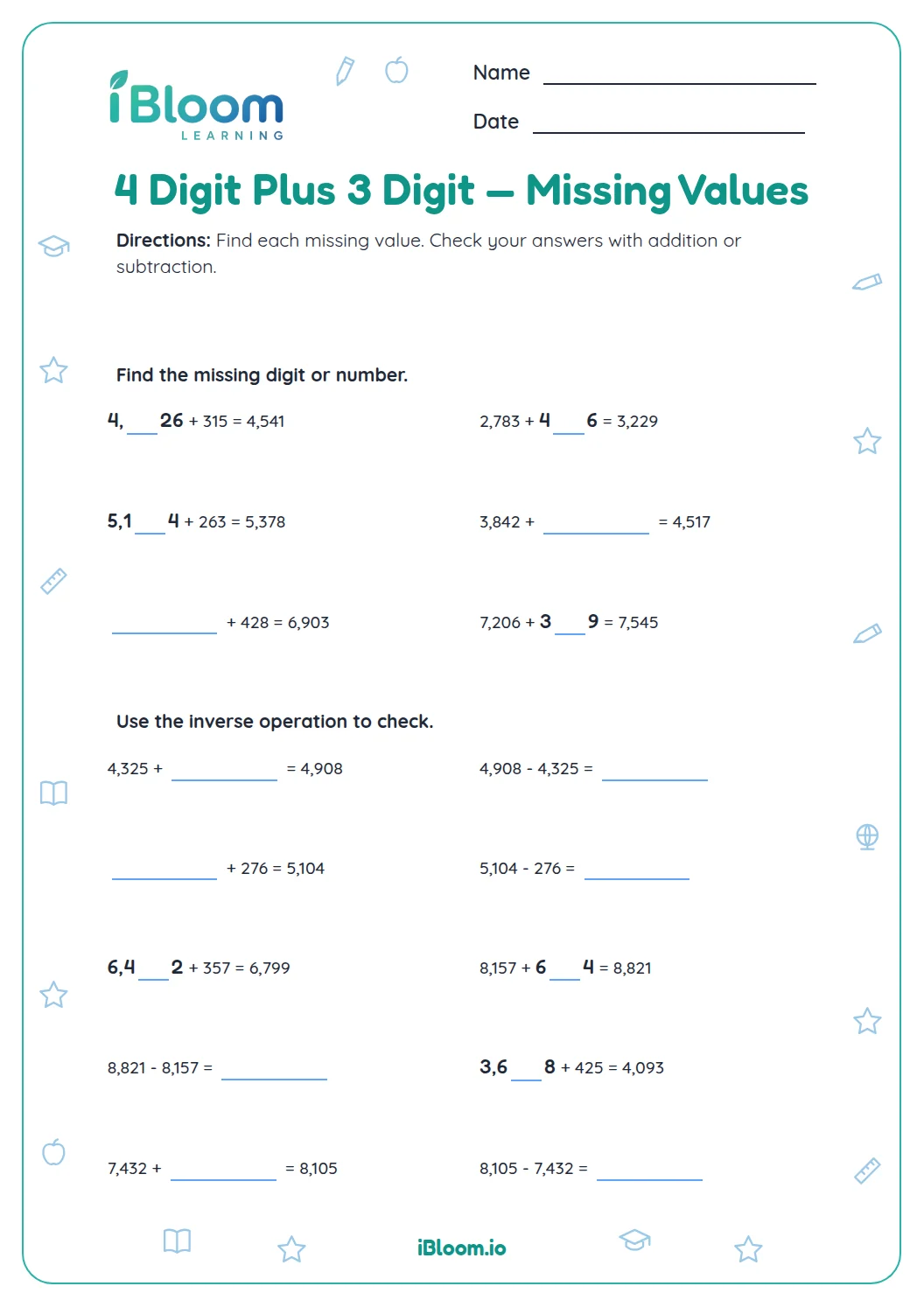
This printable warm-up gives students 16 four-digit plus two-digit problems. Ones and tens require regrouping in some items, while others let students focus on place-value alignment without carrying at every step. Students should prioritize careful work and check each total before trying for faster recall.
Aligned to 4.NBT.B.4
What is on this worksheet?
Fourteen short real-world problems give a four-digit amount and a two-digit amount to add. Students line up place values and record each total. Several sums need regrouping in the ones or tens column.
- Write each sum in the answer space.
- Keep ones under ones and tens under tens.
- Use the answer key to check each total.
How can I keep the addends lined up?
Write the two-digit addend directly under the ones and tens places. Add from right to left: ones, tens, hundreds, then thousands. When a place totals 10 or more, write the ones digit and carry the extra ten to the next place.
- Check each column before moving left.
- Include a carried ten in the next column.
- Estimate the total to catch a place-value slip.
How can an estimate help catch an error?
For 1,248 + 25, first add the exact amounts. Then estimate 1,248 as about 1,250 and 25 as about 30, giving about 1,280. The exact sum, 1,273, is close to that estimate.
How to use this worksheet
- 1Read the two amounts and identify the four-digit and two-digit addends.
- 2Write the addends so their ones and tens places line up.
- 3Add the ones, regrouping a ten when the total is 10 or more.
- 4Add the tens, including any carried ten, then finish the hundreds and thousands.
- 5Estimate the total and compare it with your exact answer.
Common mistakes and quick fixes
The mistake
Writing the two-digit addend under the thousands and hundreds places.
The fix
Align the last digits: ones under ones and tens under tens.
The mistake
Dropping a carry after adding the ones or tens.
The fix
Circle the carried digit and include it in the next column.
The mistake
Adding a carried ten after finishing the next column.
The fix
Add the carry before writing that column’s result.
Curriculum alignment
The activity practices the skill named in its title. The standard below describes the closest Common Core connection.
Fluently add and subtract multi-digit whole numbers using the standard algorithm.
On this sheet: All 14 problems add a two-digit whole number to a four-digit whole number and practice place-value alignment and regrouping.
Show the official wordingHide the official wording
Fluently add and subtract multi-digit whole numbers using the standard algorithm.
What to practice next
Make more practice
Questions parents and teachers ask
What does this addition worksheet practice?
Students add a two-digit number to a four-digit number in 14 short problems. They align place values, add from right to left, and regroup when a column total reaches 10. The answer key lists each sum for checking.
How should the addends be lined up?
Write the ones digits in the same column and the tens digits in the same column. The two-digit number sits beneath the last two places of the four-digit number. Good alignment keeps each digit in its correct place-value column.
When should a student regroup?
Regroup when the digits in a column add to 10 or more. Write the ones digit in that column and carry the extra ten to the next column. Include that carried amount in the next addition step before moving to the hundreds.
Can estimation help check the answer?
Yes. Round each addend to a nearby ten or hundred and add those estimates. The exact answer should be reasonably close. For 1,248 + 25, an estimate of about 1,280 helps reveal a misplaced digit or a missed carry.
How many problems are on the worksheet?
There are 14 four-digit plus two-digit addition problems across two worksheet pages. The answer key is separate. The set uses short real-world contexts while keeping the arithmetic focused on addition and place-value regrouping. Students can work through the problems at a careful pace.
What should I do if a sum is incorrect?
Compare the written columns with the answer key, starting at the ones place. Check whether a carried ten was recorded and added in the next column. Then estimate the total to see whether the corrected answer is a sensible size.