

About this worksheet
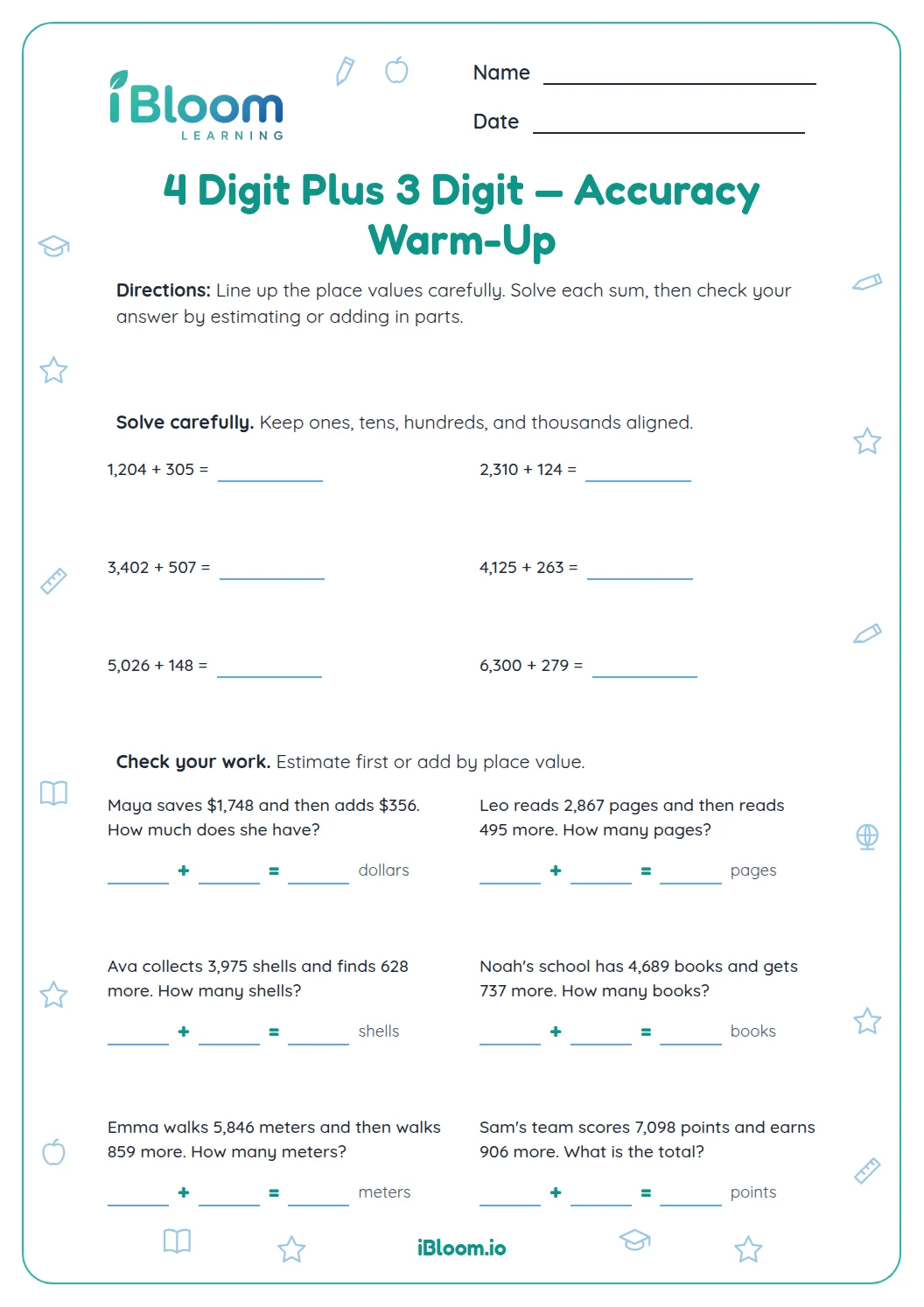
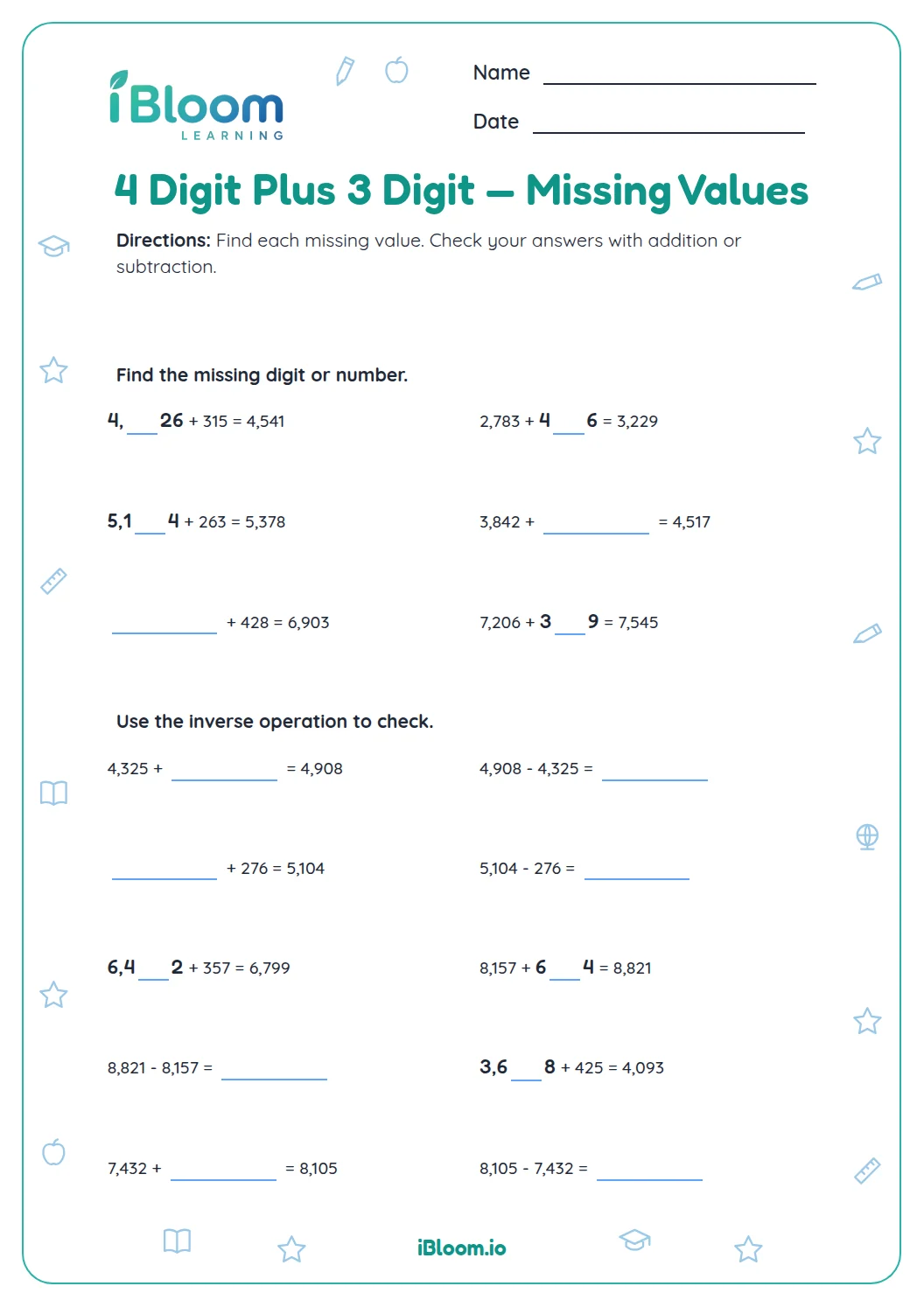
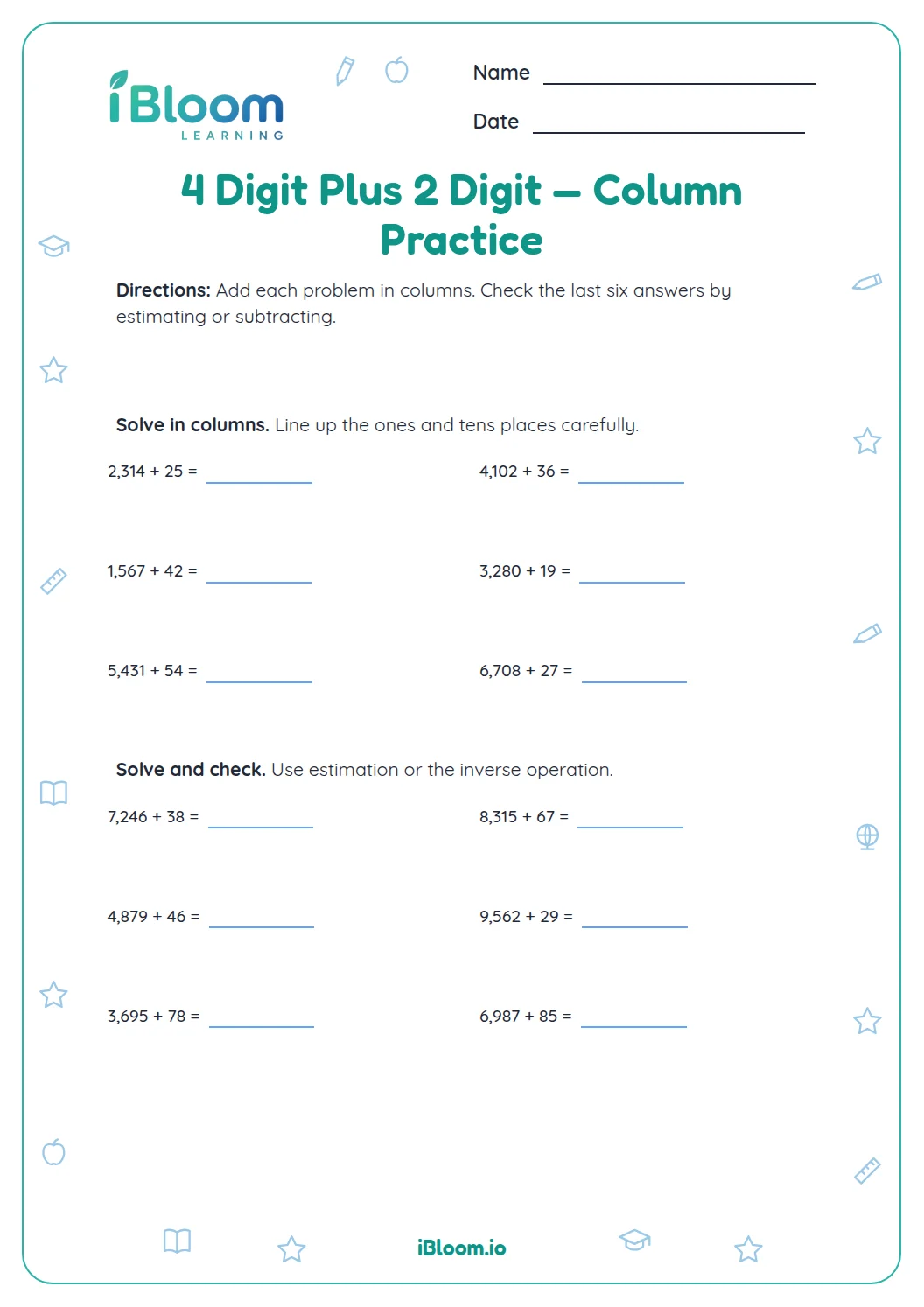
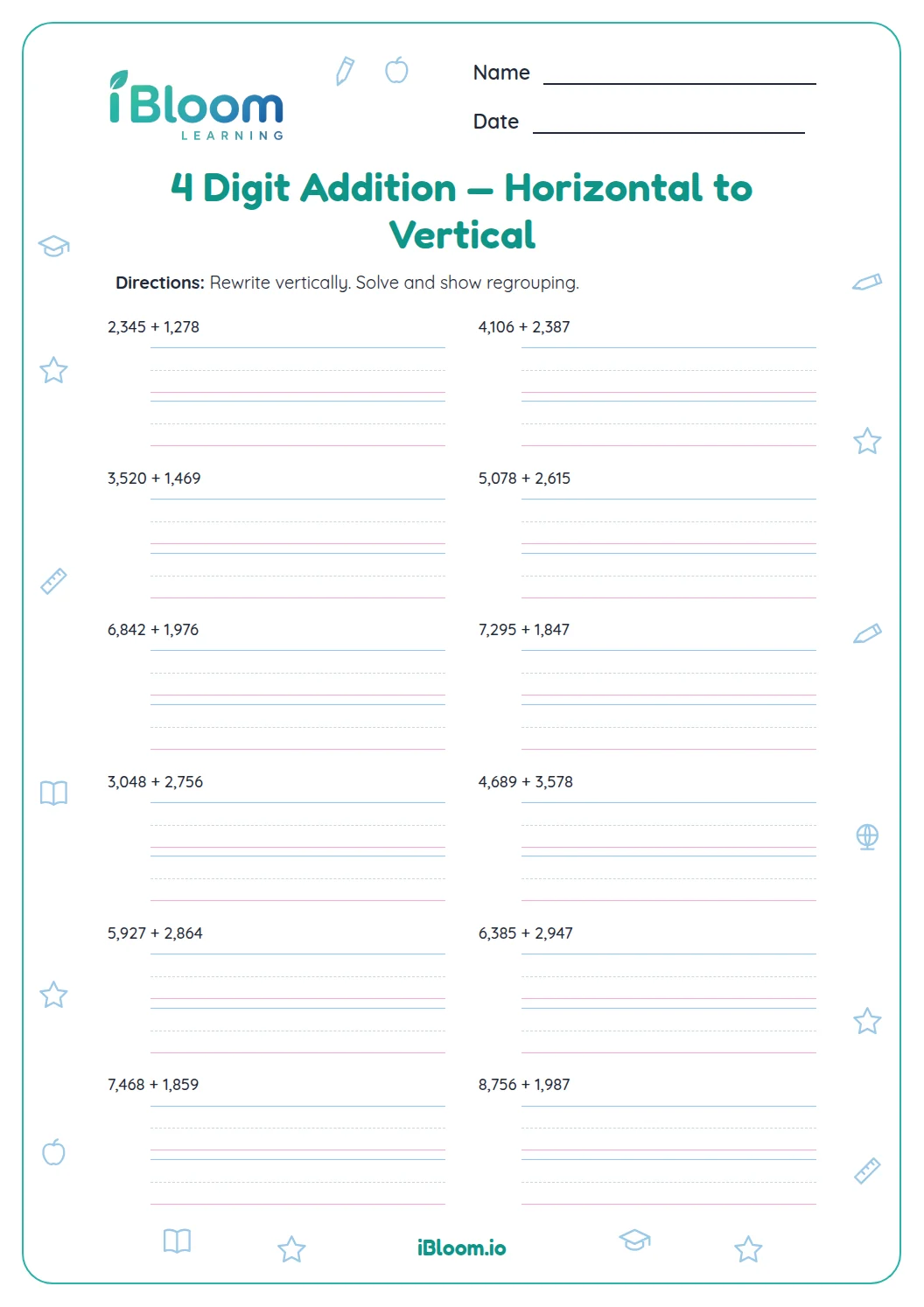
This free printable addition drill gives students in Grades 4–5 fourteen horizontal sums to rewrite vertically before solving. The first four build accurate alignment, the next six require regrouping, and the last four continue regrouping across place-value columns. Every problem pairs a four-digit number with a three-digit number and provides a grid for column work. Students practice the standard addition algorithm in Common Core 4.NBT.B.4. The answer key gives each total; adults can also inspect the written columns to see how the student used place value.
Aligned to 4.NBT.B.4
Where does the shorter number go?
The three-digit addend belongs under the hundreds, tens, and ones places of the four-digit addend. Its left edge will start one column farther right. Use one grid square for each digit so the place-value columns stay visible.
- 1Question 1: 2,413 + 526
- 2Place 6 under 3, 2 under 1, and 5 under 4.
- 3Ones: 3 + 6 = 9; tens: 1 + 2 = 3; hundreds: 4 + 5 = 9.
- 4Keep the 2 thousands: the sum is 2,939.
How should students record a regrouping?
Write the ones digit of a column total below that column. Record the extra ten as 1 in the next column to the left. In question 5, 8 + 5 gives 13 ones, so write 3 and carry 1 ten. Then 4 + 7 + 1 gives 12 tens.
The carried 1 has a different value in each position. Saying “one ten” or “one hundred” helps connect the written mark to the amount it represents.
How can students check a larger sum?
Part C asks students to continue regrouping across place-value columns. Question 14 ends at 10,334, so the answer needs five digits. A student should leave room at the left of the grid for the new place.
Check a total by subtracting the three-digit addend. For example, 10,334 − 748 = 9,586. A rough estimate can also reveal a misplaced addend, but the exact subtraction verifies the result.
How to use this worksheet
- 1Read the first horizontal sum and identify the ones digits.
- 2Copy both addends into the grid, placing one digit in each square.
- 3Add from right to left and label any carried amount above the next column.
- 4Complete Part B and Part C with the same alignment routine.
- 5Compare totals with the key, then check any mismatch by subtracting an addend.
Mistakes to notice and how to help
The mistake
Putting 526 under the leftmost digits of 2,413.
The fix
Align 6 with 3 first; then place the remaining digits to the left.
The mistake
Forgetting the carried ten in question 5.
The fix
Include the small 1 when adding 4 + 7 + 1 in the tens column.
The mistake
Leaving out the carried ten and writing 10,324 for the last sum.
The fix
After 6 + 8 = 14 ones, include the extra ten: 8 + 4 + 1 = 13 tens.
Common Core alignment
Align addends and use the standard algorithm to add multi-digit whole numbers.
On this sheet: All fourteen problems require students to rewrite horizontal addends in columns and add.
Show the official wordingHide the official wording
Fluently add and subtract multi-digit whole numbers using the standard algorithm.
What to practice next
Make more practice
Further reading
Questions parents and teachers ask
Does every problem need regrouping?
No. Part A has four sums without regrouping so students can establish the column layout first. Part B introduces regrouping, and Part C includes sums that cross a thousand boundary. Students should inspect each column rather than assume they must always carry a digit.
Why are the sums printed horizontally?
Students must decide where every digit belongs before they calculate. Copying a horizontal sum into the grid makes the alignment step visible. Ask your child to explain why the three-digit number starts farther right, then let them add using their own written column arrangement.
What should I check besides the final answer?
Check that ones, tens, and hundreds line up and that each carried amount enters the next column. A correct total can hide an unclear setup. Have the student point to the digits they added in one column and explain the value of any carried 1.
Is the final sum supposed to have five digits?
Yes. Question 14 is 9,586 + 748, which equals 10,334. The thousands column produces a new ten-thousands digit. Encourage your child to leave space at the left of the grid and to compare the answer with an estimate near ten thousand before checking the key.
Should I time this addition drill?
Timing is optional; accurate setup is the first goal for this sheet. Allow about twenty to twenty-five minutes for rewriting and solving the fourteen sums. If a student rushes past the alignment step, pause and review one grid before returning to the remaining problems.