




About this worksheet
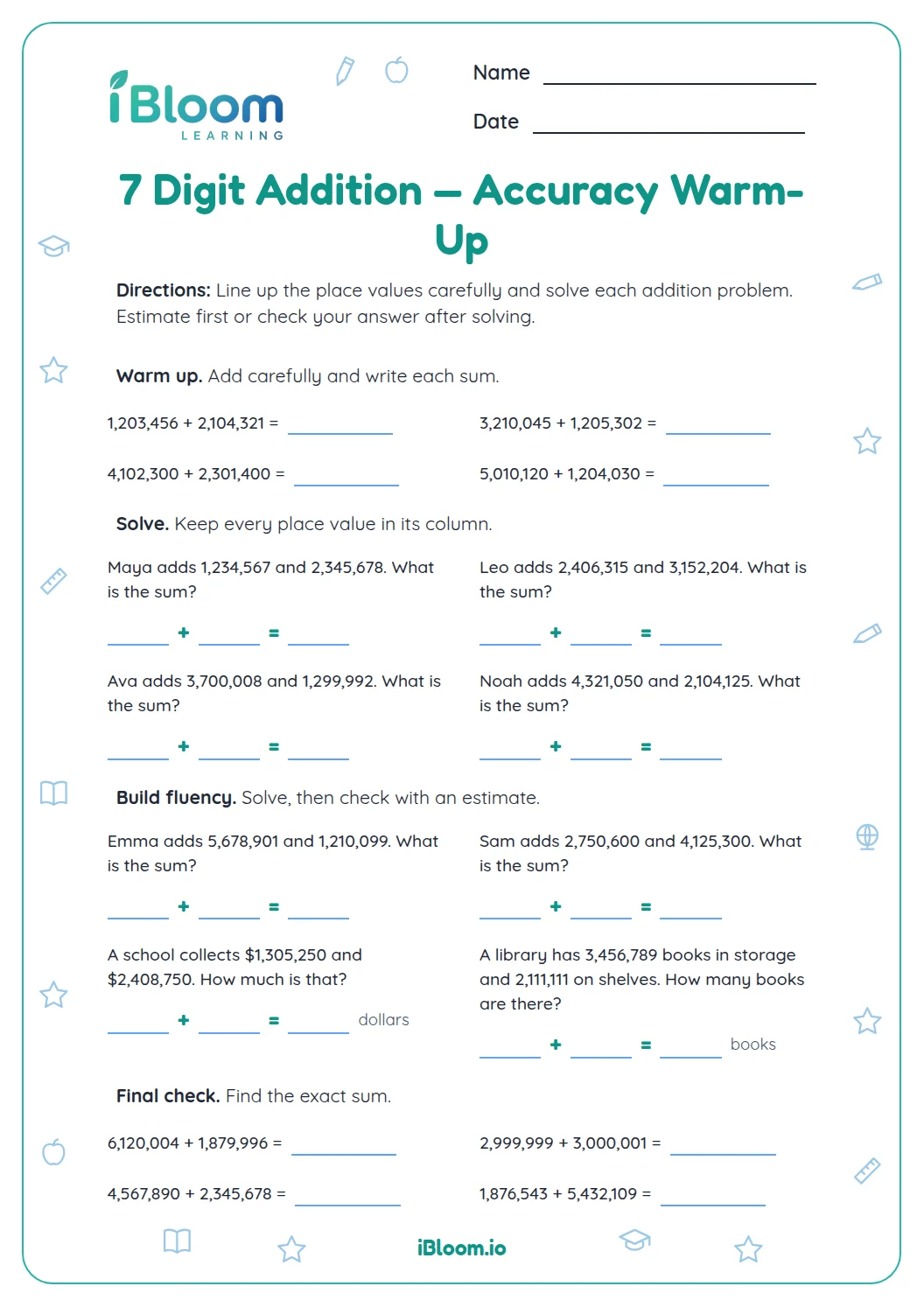
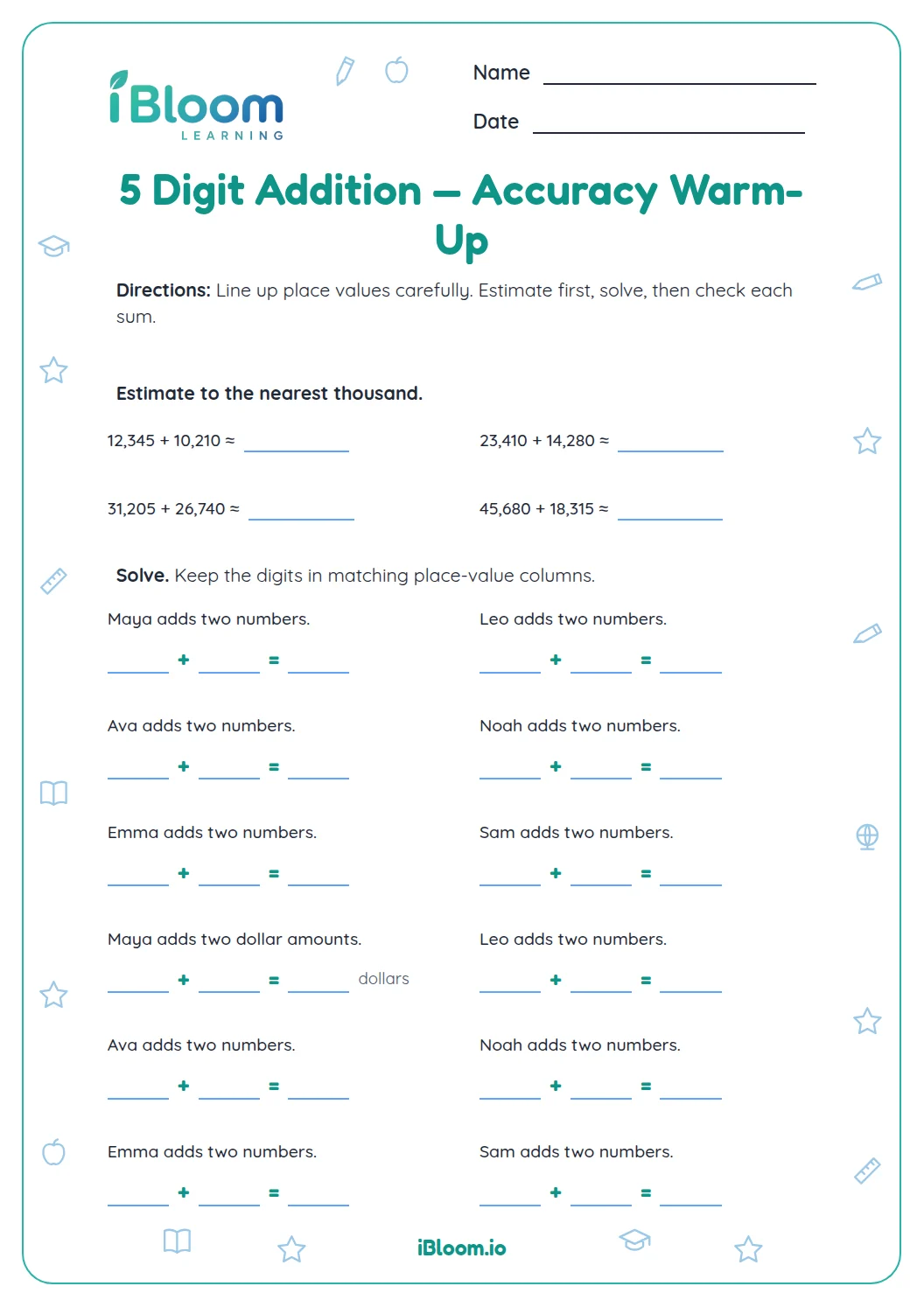
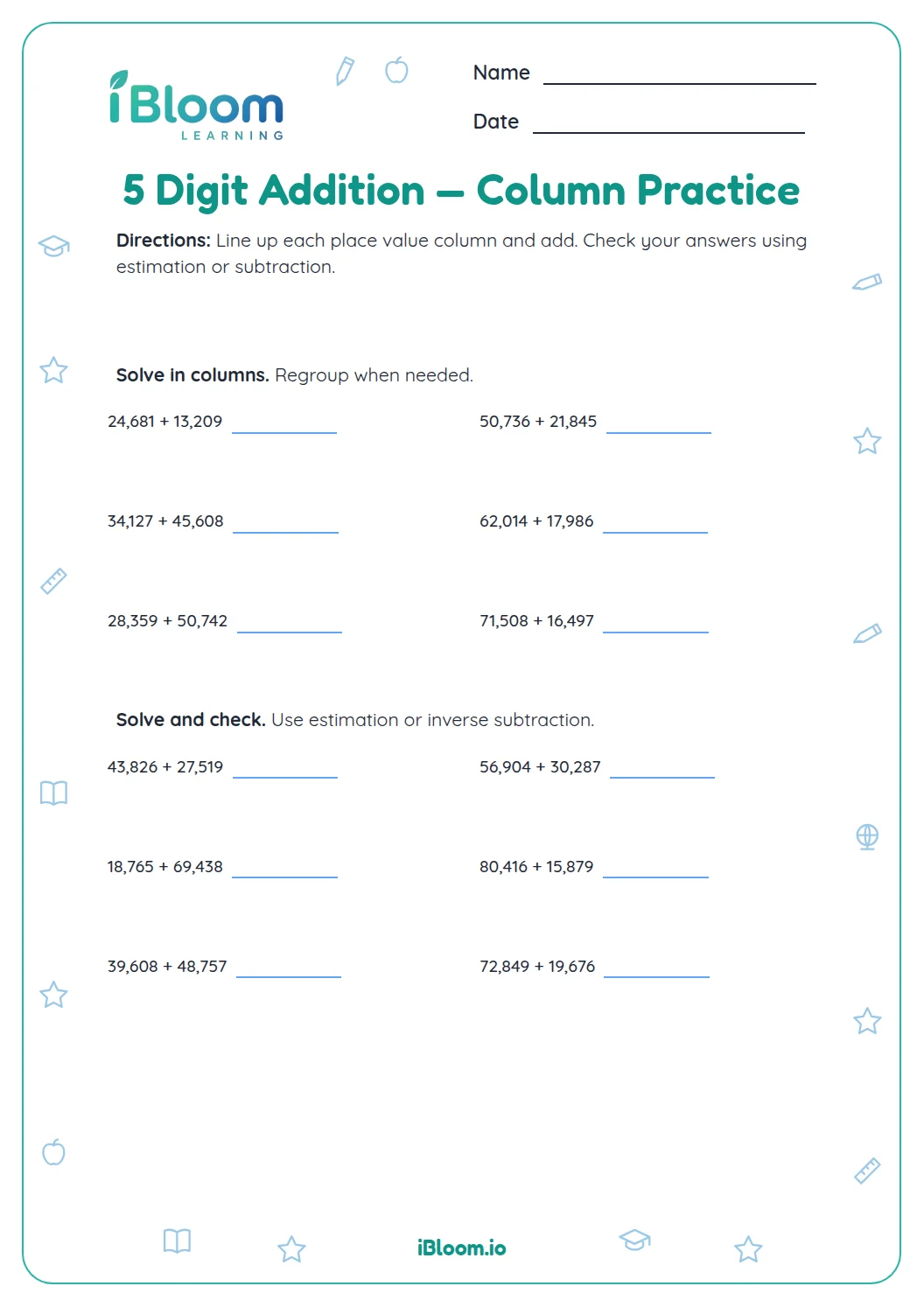
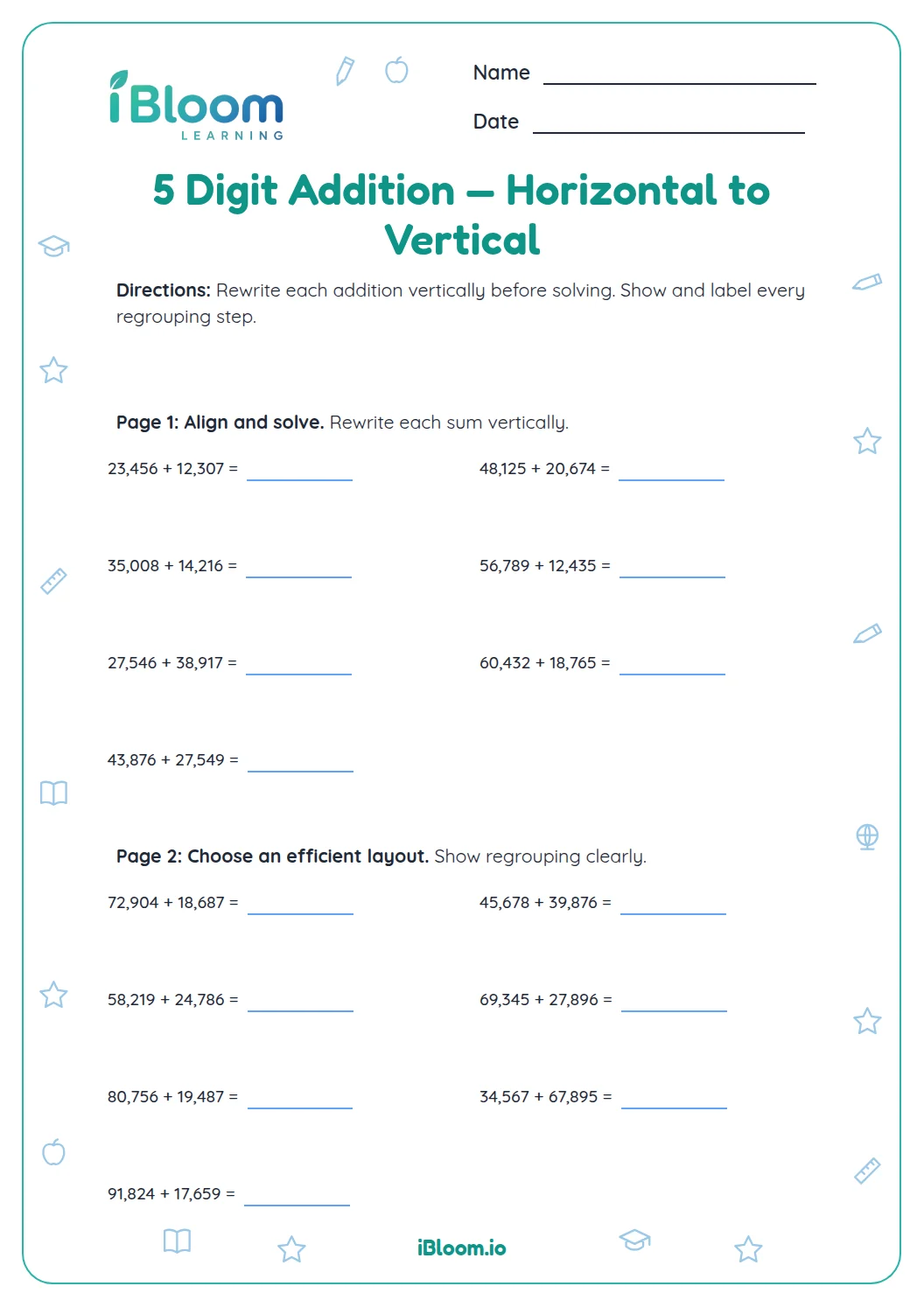
This free printable drill gives Grades 5–6 students fourteen problems with seven-digit addends. Part A starts with four sums that build accuracy; Part B adds four sums with zeros and longer chains of regrouping. Part C asks students to find four missing addends and check them by addition. Part D adds two estimation checks. The work practices the standard whole-number algorithm in Common Core 4.NBT.B.4. Students can line up the digits in the working space, record regrouped values, and compare each total with an estimate. The separate key gives exact answers and rounded estimates.
Aligned to 4.NBT.B.4
What makes this a mixed mastery drill?
The fourteen items move from direct sums to zeros, missing addends, and estimation. Both numbers in every direct addition have seven digits. Some totals have eight digits, so students need to allow space to the left of the millions column.
Part A has four sums, Part B has four more, and Part C has four missing values. Part C asks students to use subtraction to find a value and addition to verify it. Part D rounds each addend to the nearest million before adding the rounded values.
How do you add across a run of nines?
Question 7 shows a chain of regrouping. Work from ones to millions, adding each carried 1 to the next column. The six trailing nines each become zero; the final carry joins the millions column.
- 15,999,999 + 2,000,001
- 2Ones: 9 + 1 = 10; write 0 and carry 1.
- 3Tens through hundred-thousands: 9 + 0 + 1 = 10 each time.
- 4Millions: 5 + 2 + 1 = 8. The sum is 8,000,000.
How can students check a missing addend?
Subtract the known addend from the total, then put the result back into the original addition. In question 11, 10,000,000 − 6,875,432 gives 3,124,568; adding these two seven-digit values restores the total.
An estimate is a second check. A result near ten million is reasonable here. It helps detect a lost digit, while the exact addition checks the smaller place values.
Use the worksheet step by step
- 1Read both addends and name the millions digit before starting.
- 2Use the working space to stack each Part A and Part B problem with aligned ones.
- 3Add from right to left, writing small regrouping marks above the next column.
- 4For Part C, subtract to find the missing addend and add again to check.
- 5For Part D, round each addend to the nearest million, then add the rounded values.
- 6Compare the exact answers with the key and redo any column where a regrouped value was lost.
Mistakes to check and how to fix them
The mistake
Dropping the zero in 4,006,078 while copying.
The fix
Copy one three-digit group at a time, then compare every column with the prompt.
The mistake
Writing 15 in one column when its sum is fifteen.
The fix
Write 5 in that column and carry 1 into the next place value.
The mistake
Assuming the sum must also have seven digits.
The fix
Leave room for a new ten-millions digit; question 12 totals 10,000,001.
Common Core alignment
Add multi-digit whole numbers accurately using aligned columns and regrouping.
On this sheet: Students use the standard algorithm for eight sums and four missing addends, then estimate two sums.
Show the official wordingHide the official wording
Fluently add and subtract multi-digit whole numbers using the standard algorithm.
What to practice next
Make more practice
Further reading
Questions parents and teachers ask
How many addition problems are included?
There are fourteen problems: eight direct sums, four missing-addend equations, and two estimates. The direct sums provide space for vertical calculation. The missing-addend items ask students to recover a number and check it by addition. The last two questions round each addend before adding.
Does the drill include regrouping across zeros?
Yes. Part B includes zeros inside the addends and a chain of regrouping in 5,999,999 + 2,000,001. Students should preserve every zero when copying the numbers. Writing each carried value above the next column makes the exchanges easier to follow and check.
Should students complete this as a timed drill?
Timing is optional. Start by asking students to work accurately and explain one regrouping step. If you later record a completion time, keep the same accuracy expectations. This sheet includes missing addends and estimates as well as sums, so allow time for checking those final equations.
Why do some equations have eight-digit totals?
Adding two seven-digit numbers can produce a total of ten million or more. Question 8, for example, totals 10,666,005. The new digit belongs in the ten-millions column. Ask students to reserve an extra space to the left before they set up each calculation.
How should I use the answer key?
Use the key after students finish a part, then inspect the working for any mismatch. A correct total alone does not reveal how a student regrouped. For a wrong total, compare columns from right to left and find the first place where the calculation changed.