
About this worksheet
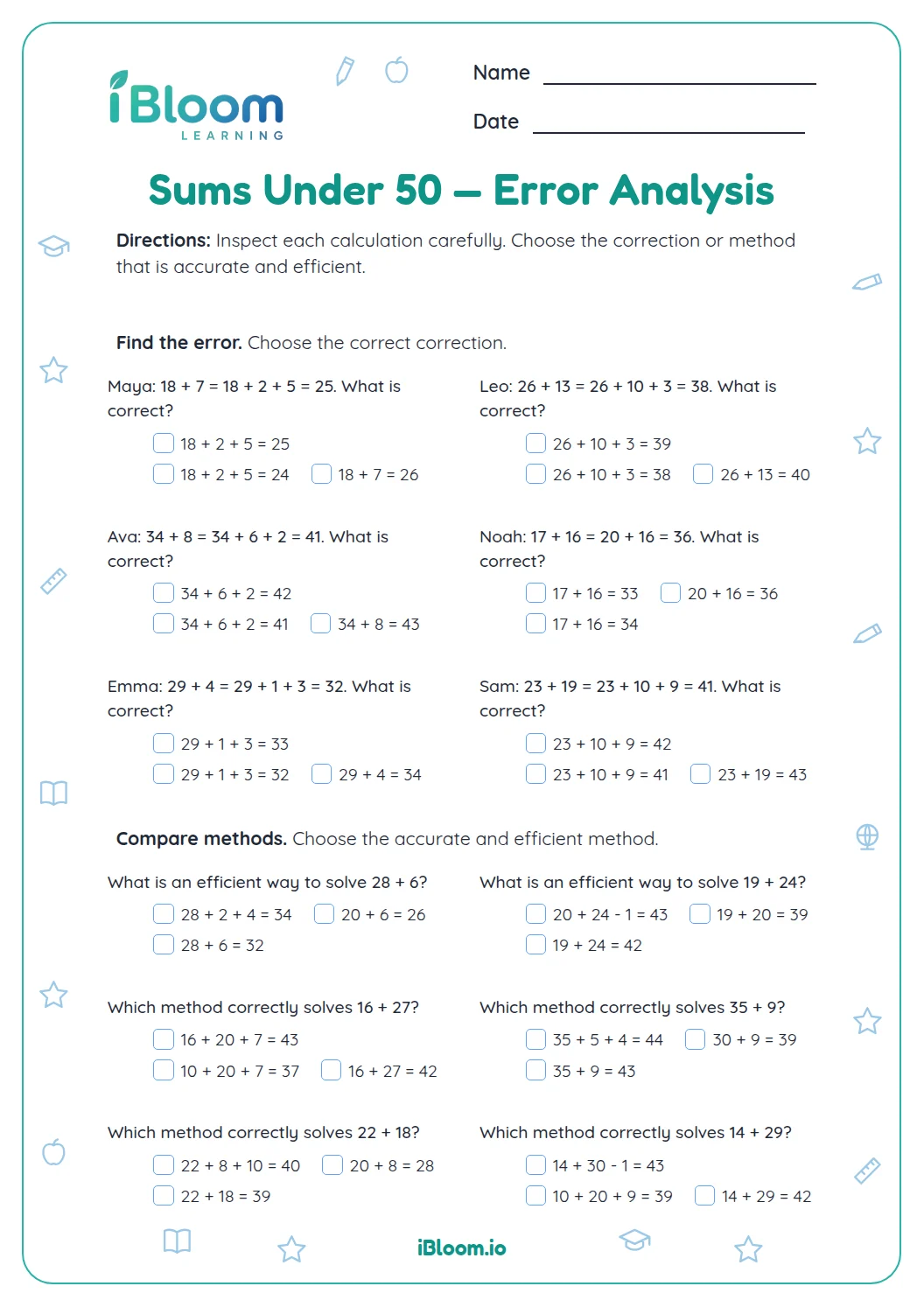
This Grade 2 printable turns sums under 50 into an error-analysis routine. Learners identify the first incorrect step in worked examples, correct totals, compare addition strategies, and explain two choices using numbers. The 14 questions emphasize addition facts, decomposing addends, and checking place value, in line with CCSS 2.NBT.B.5. Two worksheet pages and a separate answer key support careful review.
Aligned to 2.NBT.B.5
How do you find the first error in a worked sum?
Read each line in order and check whether it keeps the same amount. In question 1, the split is the first error: 7 is written as 2 + 4, which totals only 6. The later total follows from that incorrect split, but the original sum is 25.
Finding the first error matters because later lines may follow from the slip rather than introduce a new one.
- 118 + 7 = 18 + 2 + 4
- 2The first error is the split: 2 + 4 = 6, not 7.
- 3Correct split: 7 = 2 + 5
- 418 + 2 + 5 = 25
Which strategies keep the sum accurate?
Making a ten can simplify addition. For 23 + 9, take 7 from 9 to make 23 into 30, then add the remaining 2. This gives 32.
The strategy choices compare ways to decompose addends or check a sum. Children select a method, then explain why it preserves the value of the numbers.
How can an adult use the answer key?
For the first six questions, compare the selected line with the key and ask the learner to show the corrected step. Written answers are samples: accept different clear explanations that preserve the numbers and explain the place-value idea.
How to analyze an addition calculation
- 1Read the original addition sentence and the first rewritten line.
- 2Check that the addends have only been split, not changed.
- 3Recalculate each line in order and mark the first mismatch.
- 4Write the correct total for the sum.
- 5When choosing a method, follow each number through the steps.
Addition errors and quick corrections
The mistake
Changing 7 into 2 + 4 while trying to make the next ten.
The fix
Find the exact amount needed: 18 needs 2, so split 7 into 2 + 5.
The mistake
Adding the tens but dropping the remaining ones, such as turning 30 + 11 into 31.
The fix
Add the ones together first, then combine with the tens: 30 + 11 = 41.
The mistake
Accepting a result without checking every line in the strategy.
The fix
Recompute each equality from left to right and stop at the first line that changes the value.
Common Core alignment
The questions use addition strategies based on decomposing numbers and checking place value.
Add fluently within 100 using place-value strategies.
On this sheet: Learners analyze addition sums below 50 and check methods that decompose addends and make a ten.
Show the official wordingHide the official wording
Fluently add and subtract within 100 using strategies based on place value, properties of operations, and/or the relationship between addition and subtraction.
What to practice next
Make more practice
Further reading
Questions parents and teachers ask
Are the worked examples meant to contain realistic mistakes?
Yes. Each of the first six examples contains a realistic calculation slip, such as splitting an addend incorrectly or making an addition error. Learners choose where the first mistake appears, then can compare the corrected calculation with the answer key.
How many different question types are included?
There are 14 questions in three parts: six first-error checks, four corrected totals, and four strategy choices. The sheet takes two pages, followed by a separate answer key with the correct selections and corrected sums. Each first-error item asks which step first changes the value.
What is the making-a-ten strategy?
Make a ten by finding how many ones are needed to reach the next ten, splitting that amount from the second addend, and adding what remains. For 23 + 9, split 9 into 7 and 2: 23 + 7 = 30, then 30 + 2 = 32.
Should children show their reasoning for every answer?
The first-error and strategy-choice questions show the reasoning through a selected line or method. Ask the child to say how they checked a calculation before marking it. For example, they can describe how splitting an addend helps make the next ten.
What should count as a correct written explanation?
A correct explanation names a relevant action and keeps the math accurate. For example, it may say that 28 needs 2 to reach 30, so 7 is split into 2 and 5, leaving 30 + 5 = 35. The answer key offers samples, but equivalent clear wording works.