
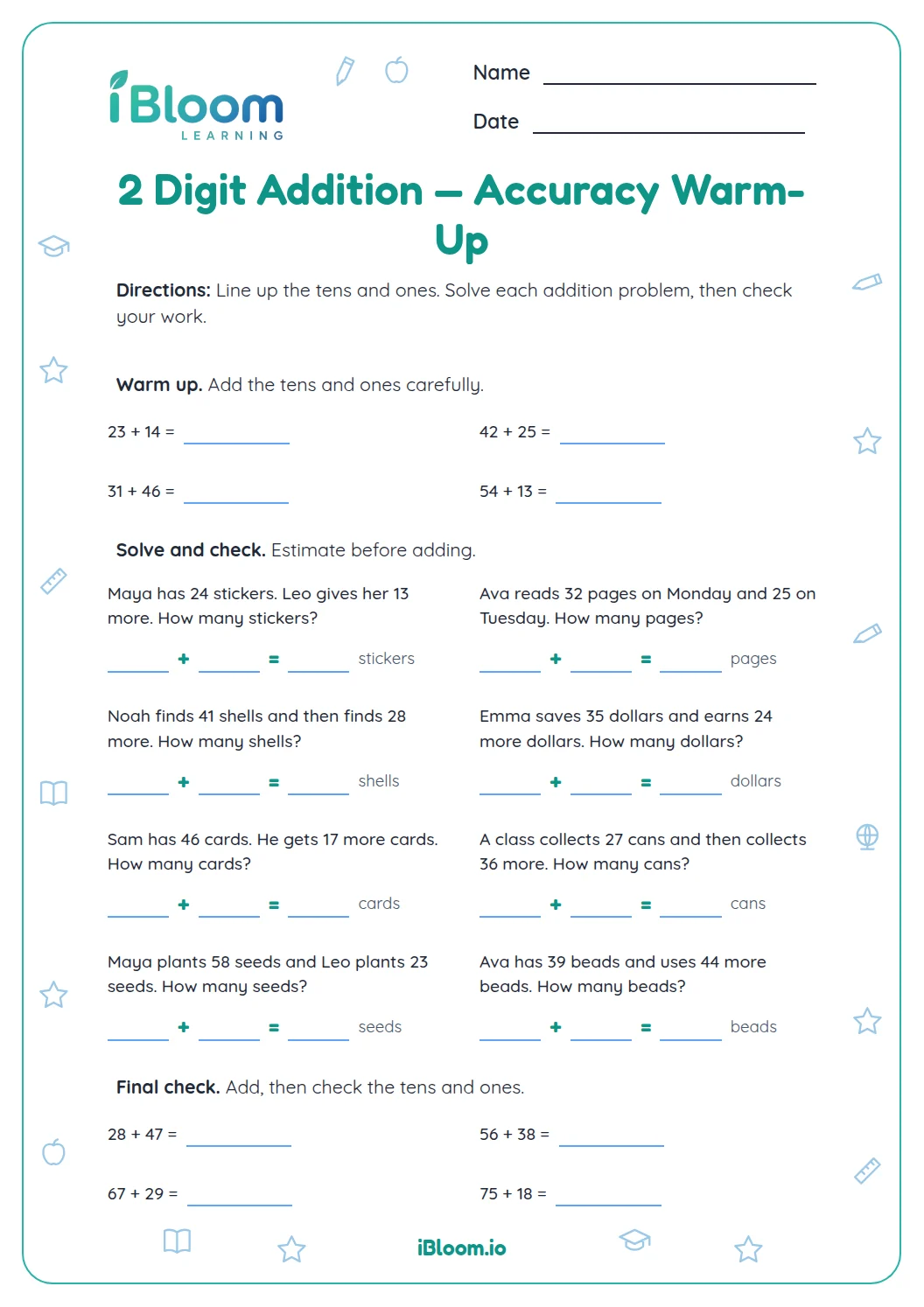
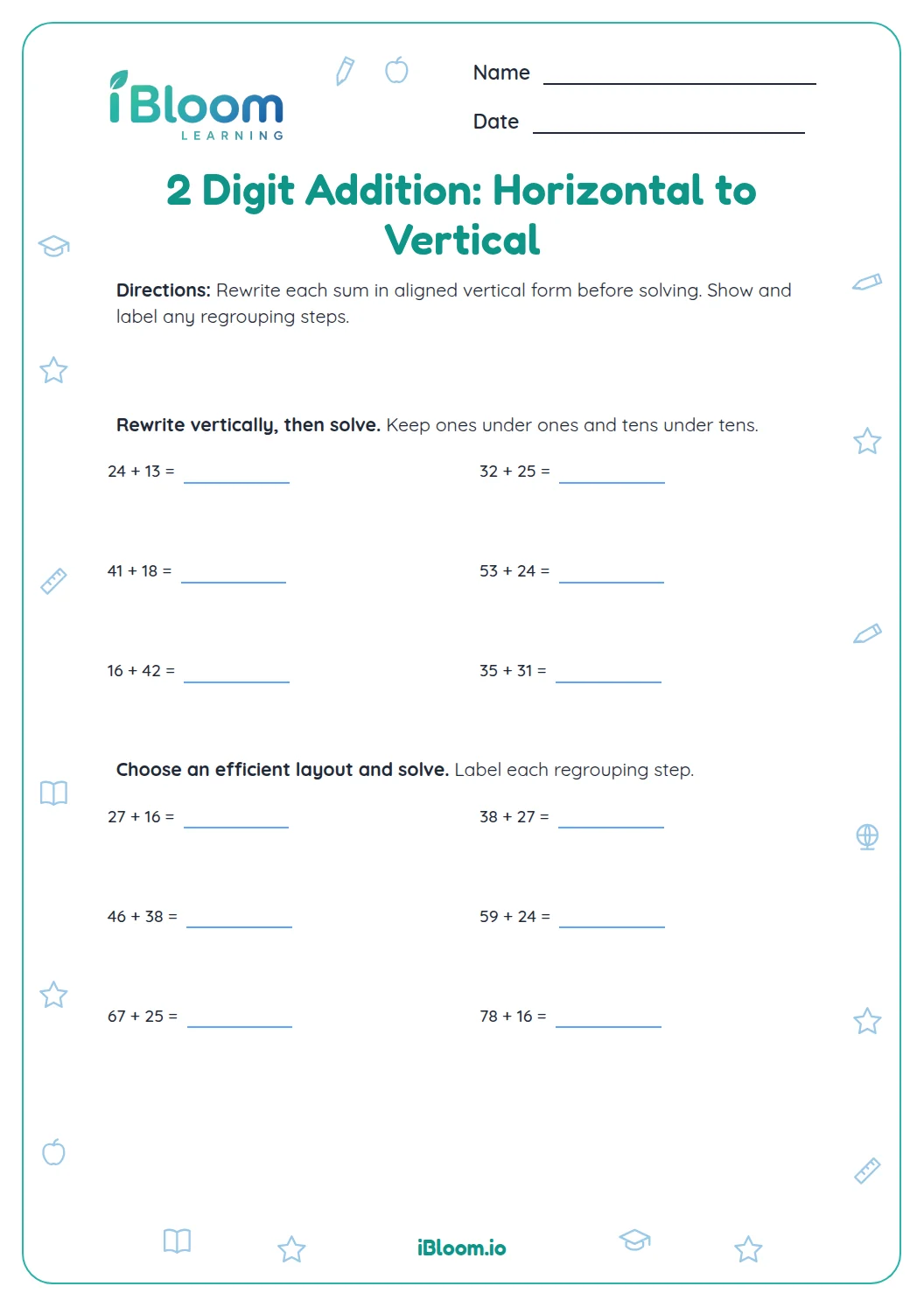
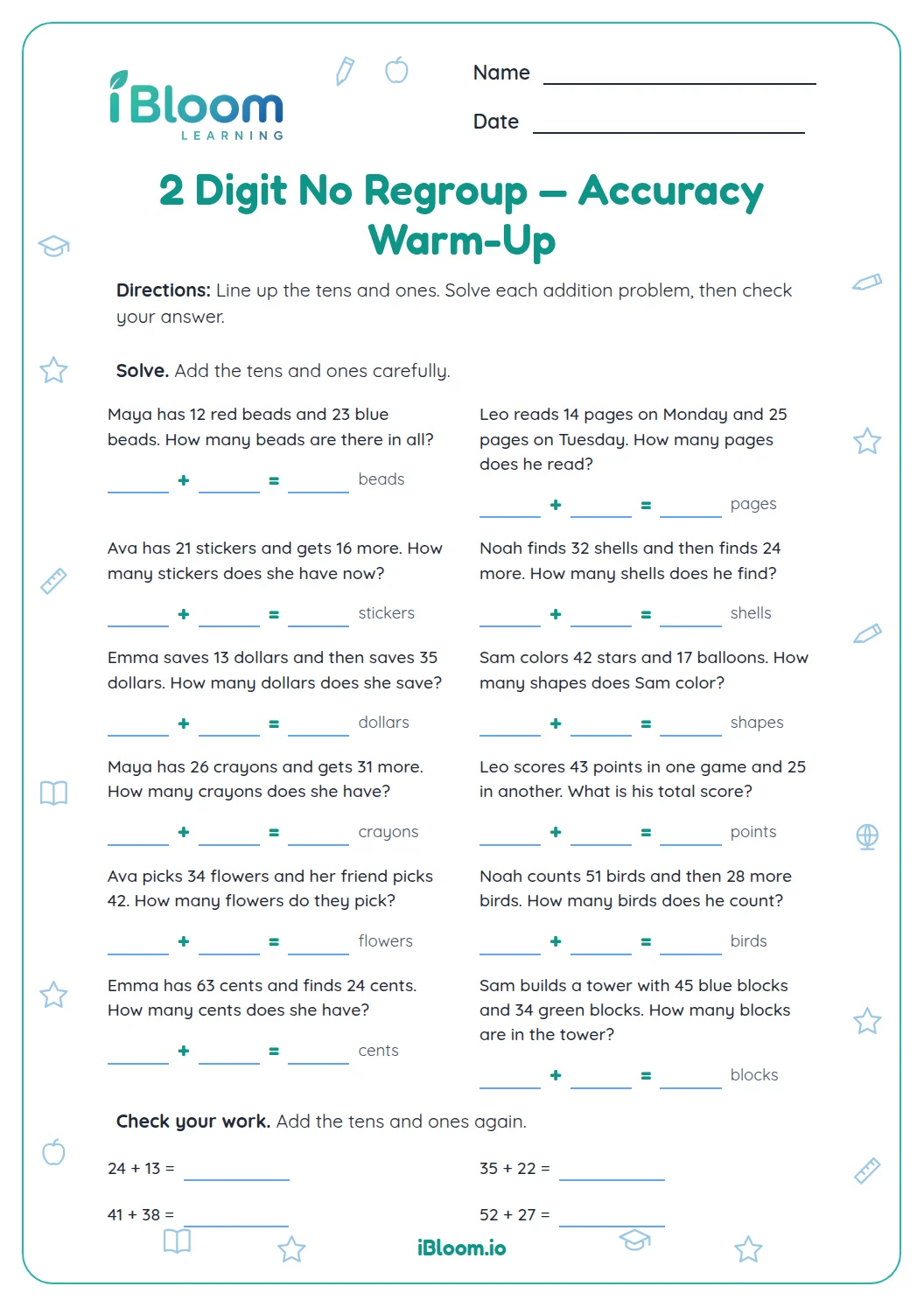
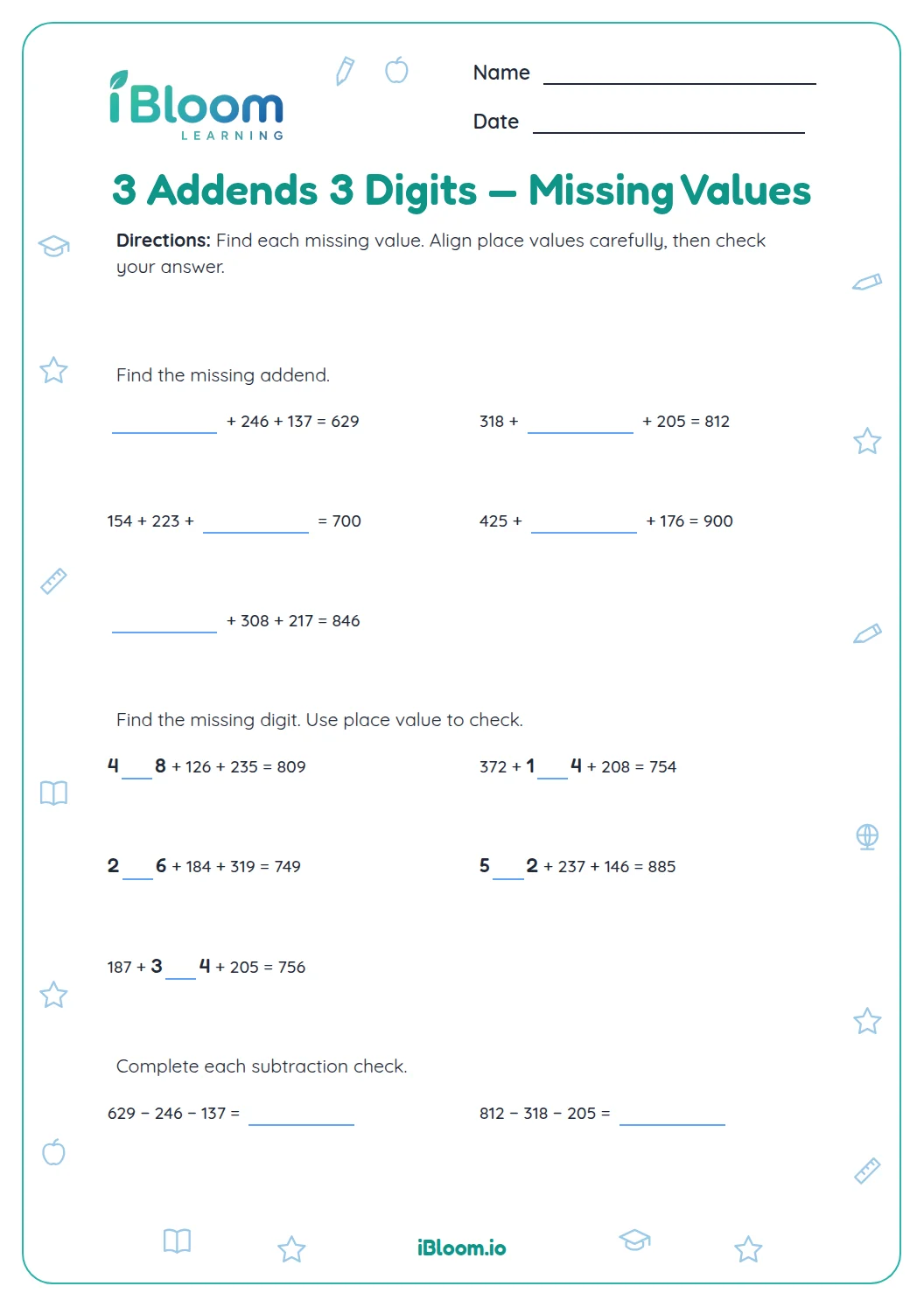
About this worksheet
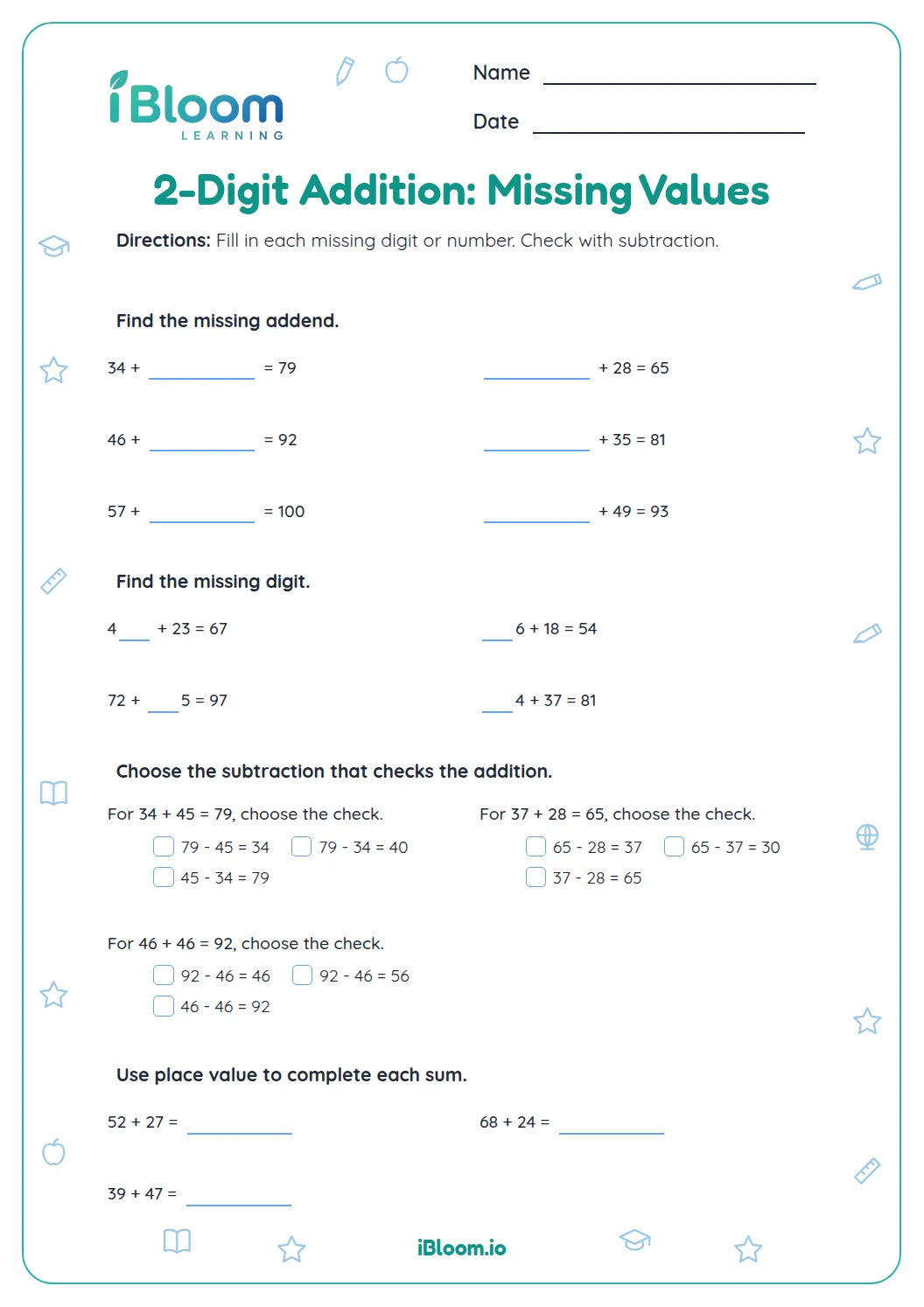
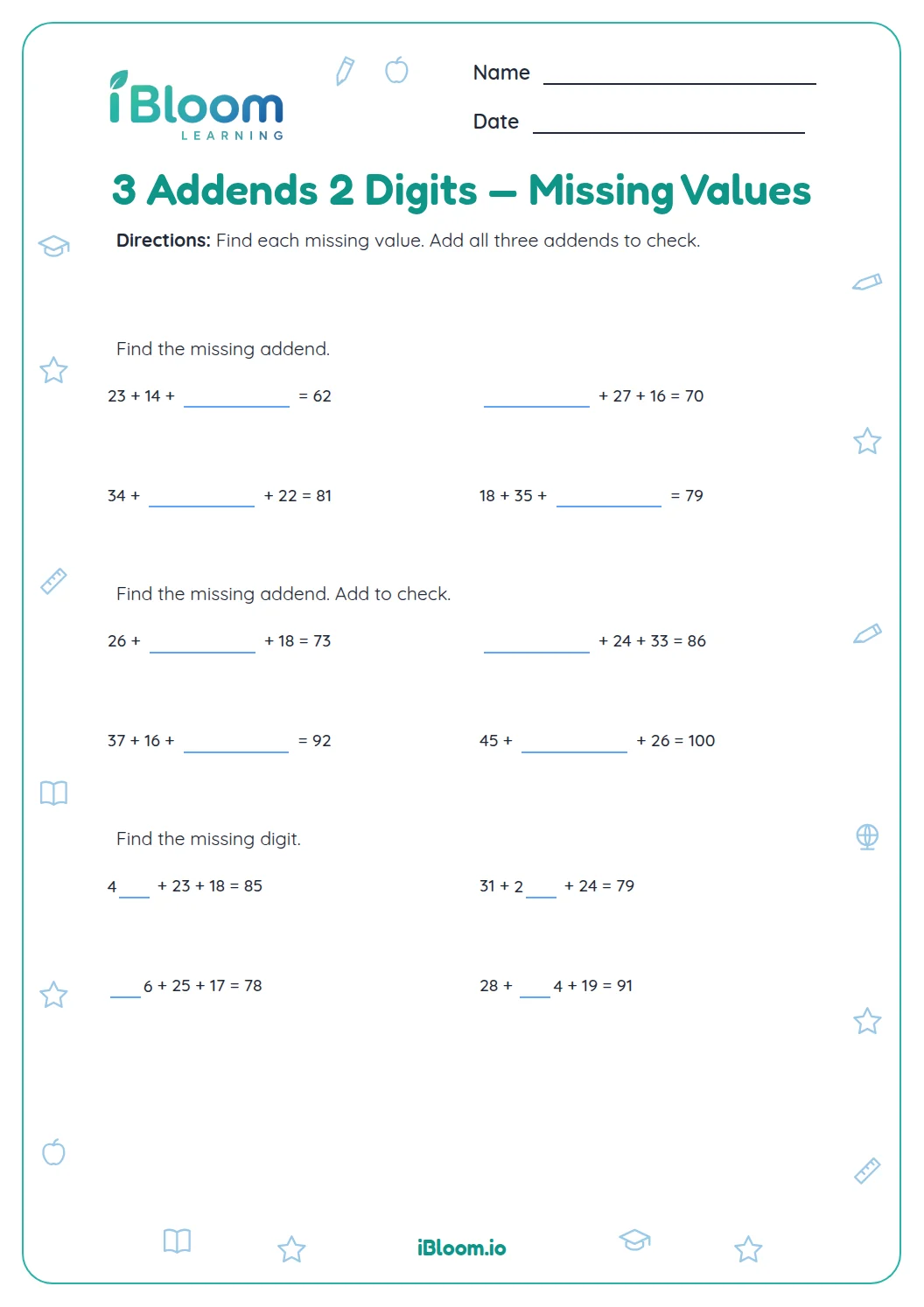
This Grade 3 printable practices finding a missing addend when a total and the other addends are known. The two-page sheet moves from rounded tens, to subtraction checks, to tens and hundreds named in place value; its separate two-page key gives the missing values. Children can use subtraction as the inverse of addition, then check by adding all parts.
Aligned to 3.NBT.A.2
How can subtraction find a missing addend?
When a total and the other addends are known, subtract the known amounts from the total. In question 1, 80 − 20 − 30 = 30, so the missing addend is 30.
- 120 + ___ + 30 = 80
- 280 − 20 = 60
- 360 − 30 = 30
- 4Check: 20 + 30 + 30 = 80
What practice is on the worksheet?
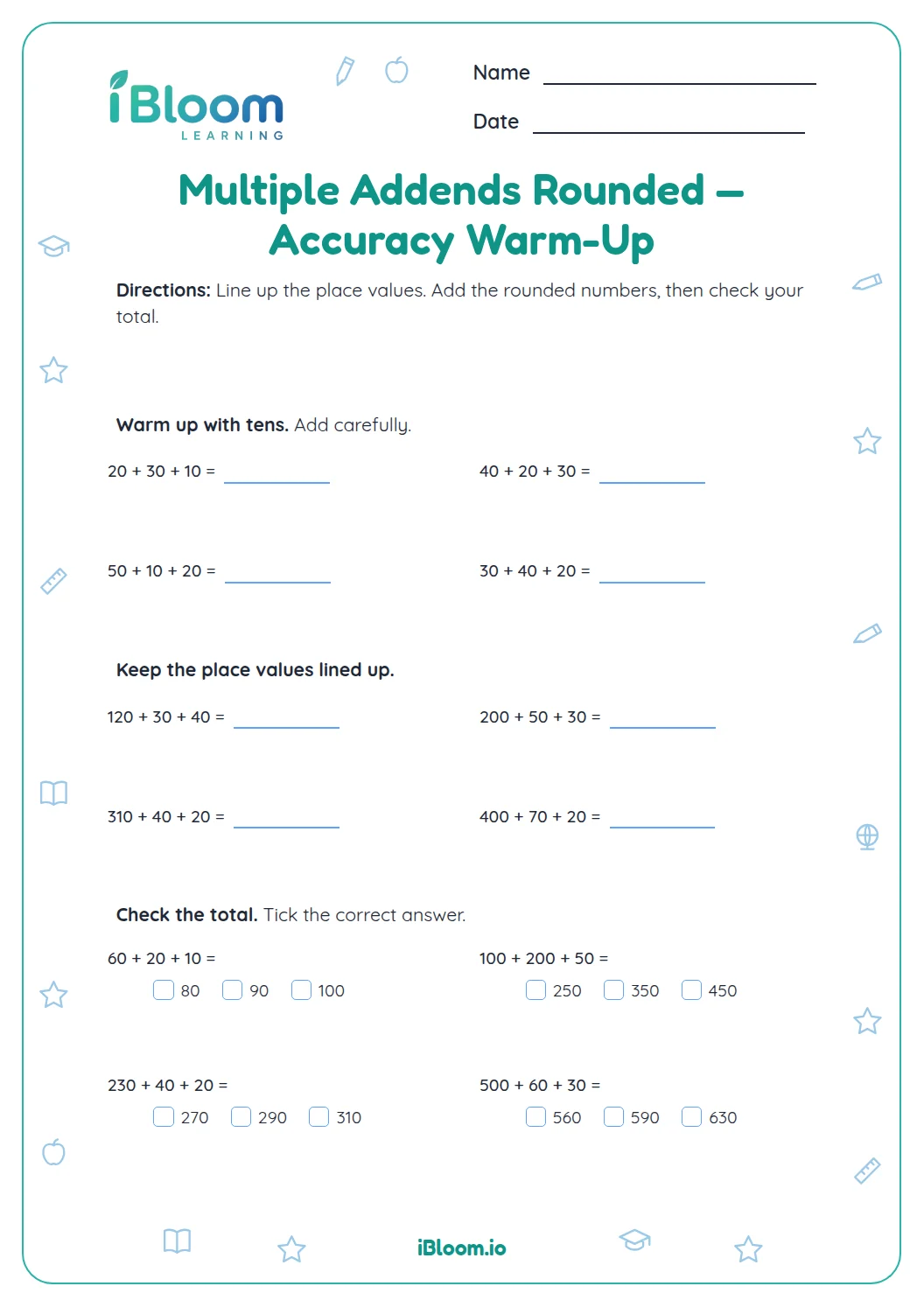
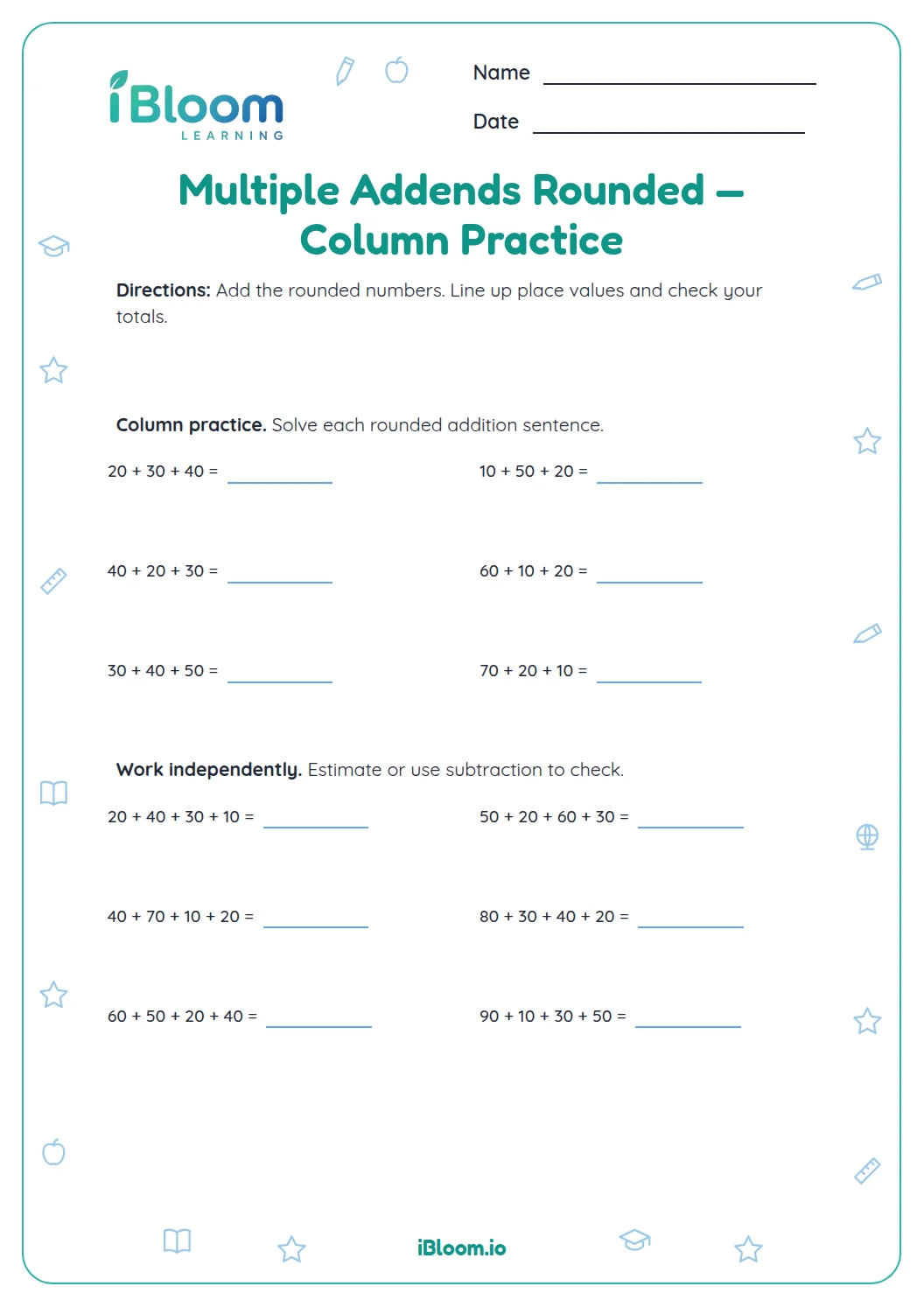
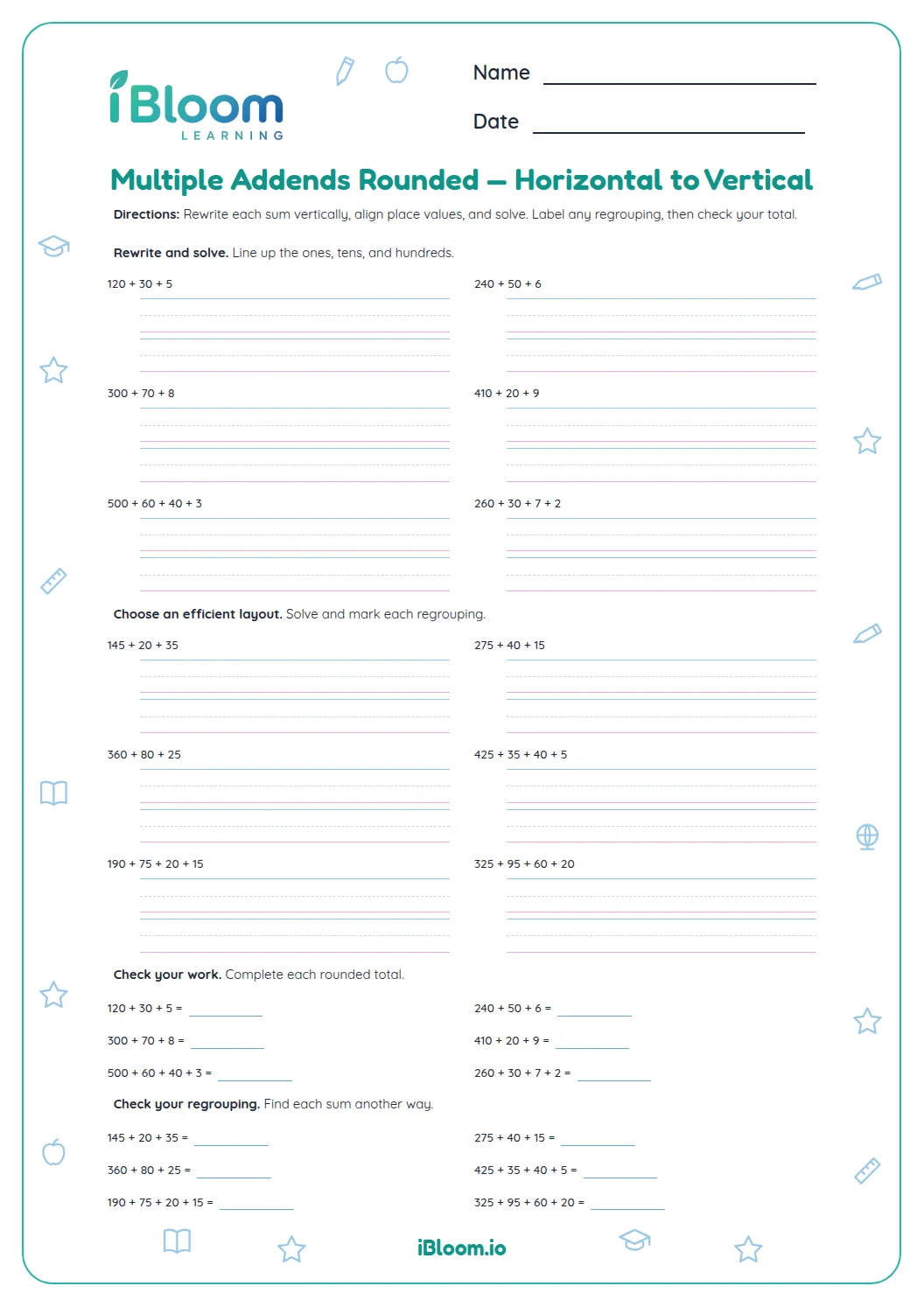
The first part uses equations with rounded tens. The next part uses subtraction to find what remains. The final part names tens and hundreds so you can reason about place value.
- Part A: find a missing addend in a sum.
- Part B: subtract known addends from a total.
- Part C: find missing tens or hundreds.
How does place value help with rounded addends?
Keep the unit attached to the number. In question 13, 3 tens + ___ tens + 2 tens = 9 tens, so 4 tens are missing.
How to use this worksheet at home or in class
- 1Read the total and each known addend.
- 2Subtract the known addends from the total.
- 3Write the missing amount in the same unit.
- 4Add all the parts to check the total.
Common mistakes and quick fixes
The mistake
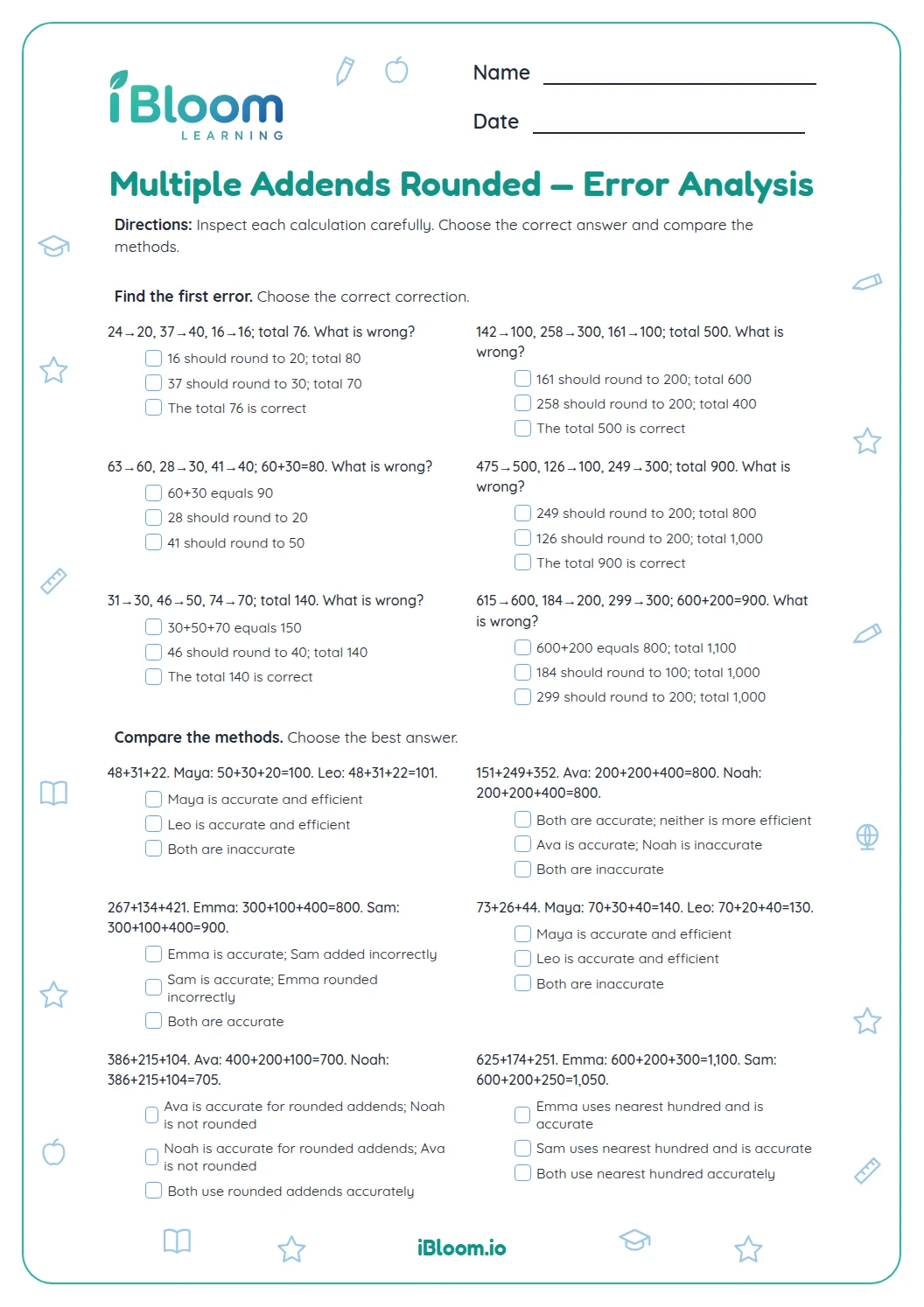
Rounding 46 to 40 because the tens digit is even.
The fix
Look at the ones digit, 6, so 46 rounds up to 50.
The mistake
Rounding only the total when the prompt asks to round each addend.
The fix
Round each number first, then add the rounded values.
The mistake
Adding tens and hundreds without matching place values.
The fix
Line up the rounded numbers by place value before adding.
Common Core alignment
This worksheet practices the following Common Core skill.
Add and subtract within 1,000 using place-value strategies.
On this sheet: The missing addends and subtraction checks use rounded tens and hundreds.
Show the official wordingHide the official wording
Fluently add and subtract within 1000 using strategies and algorithms based on place value, properties of operations, and/or the relationship between addition and subtraction.
What to practice next
Make more practice
Further reading
Questions parents and teachers ask
How do you find a missing addend?
Subtract the known addends from the total to find what remains. In question 1, the total is 80 and the known amounts are 20 and 30. Subtracting 20 and then 30 leaves 30. Add 20 + 30 + 30 to check that the parts make 80.
Does the worksheet use rounded numbers?
Yes. The equations use amounts that are multiples of ten or one hundred, and the final part names tens and hundreds directly. For example, question 13 asks for a number of tens, while question 17 uses hundreds as whole-number amounts.
Why use subtraction to check addition?
Subtraction reverses addition. When you take the known addends away from the total, the amount left is the missing addend. You can then add all three amounts to make sure they return to the given total. Add the values again to confirm that the original total is correct.
How many problems are included?
There are 20 problems in three parts: six missing-addend equations, six subtraction checks, and eight place-value sums. The final part uses tens and hundreds, so children can keep track of the unit as they find each value. This lets children compare the different kinds of practice on the page.
Is an answer key included?
Yes. A separate answer key lists the missing value for every problem. Children can use it to check their work after completing the sums, subtraction equations, and place-value problems. The numbered entries make it easy to locate each response when reviewing work.