
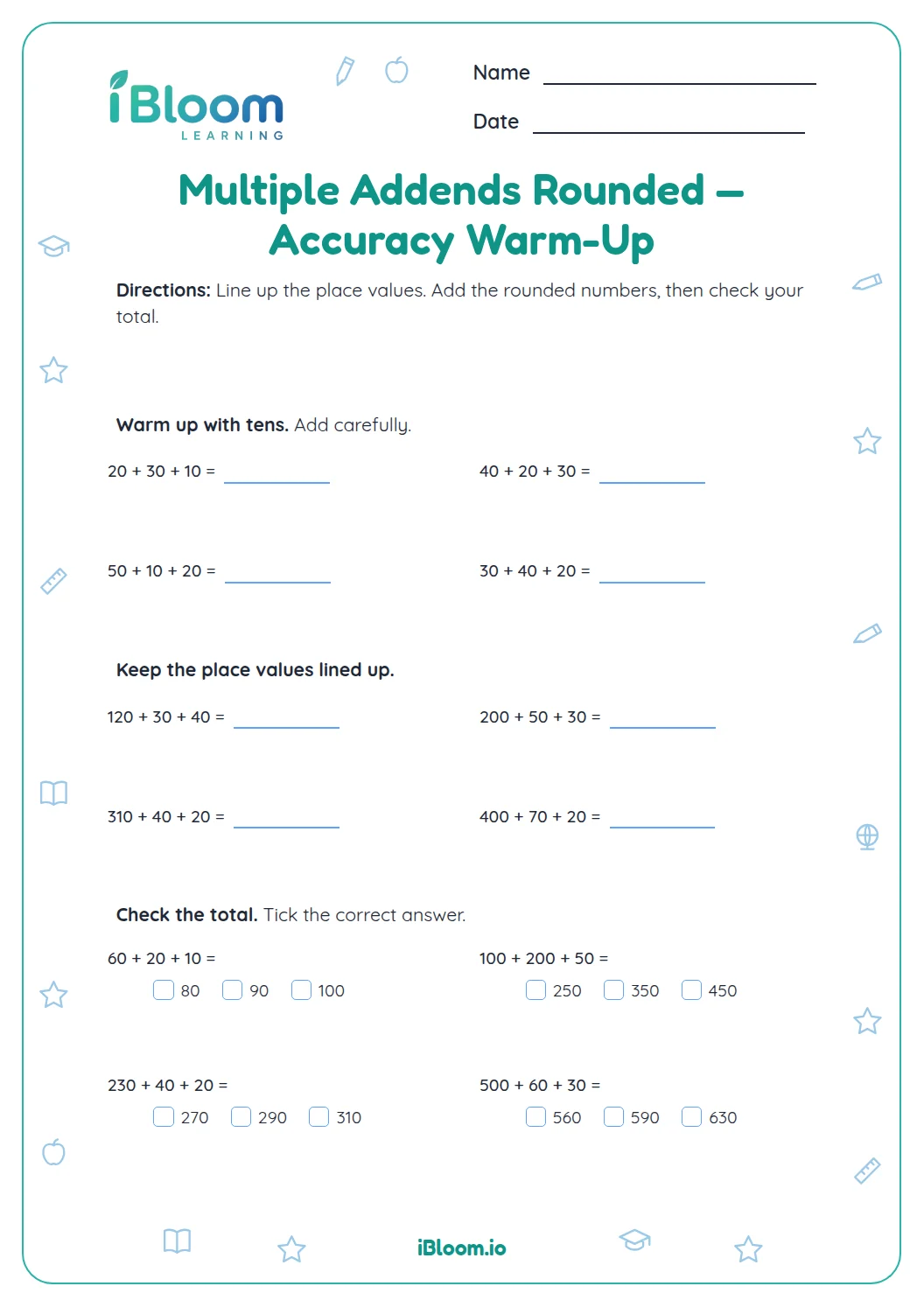
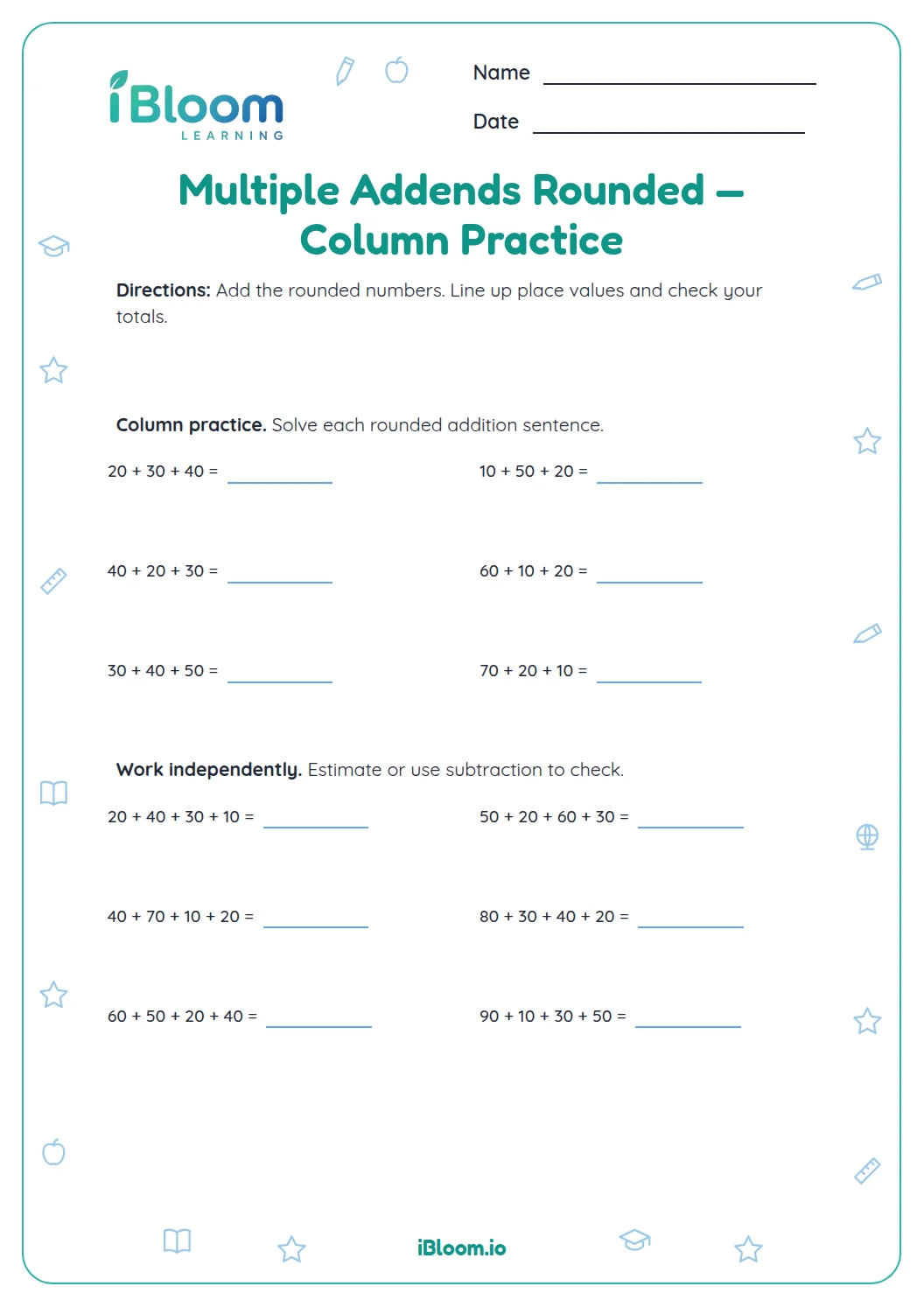
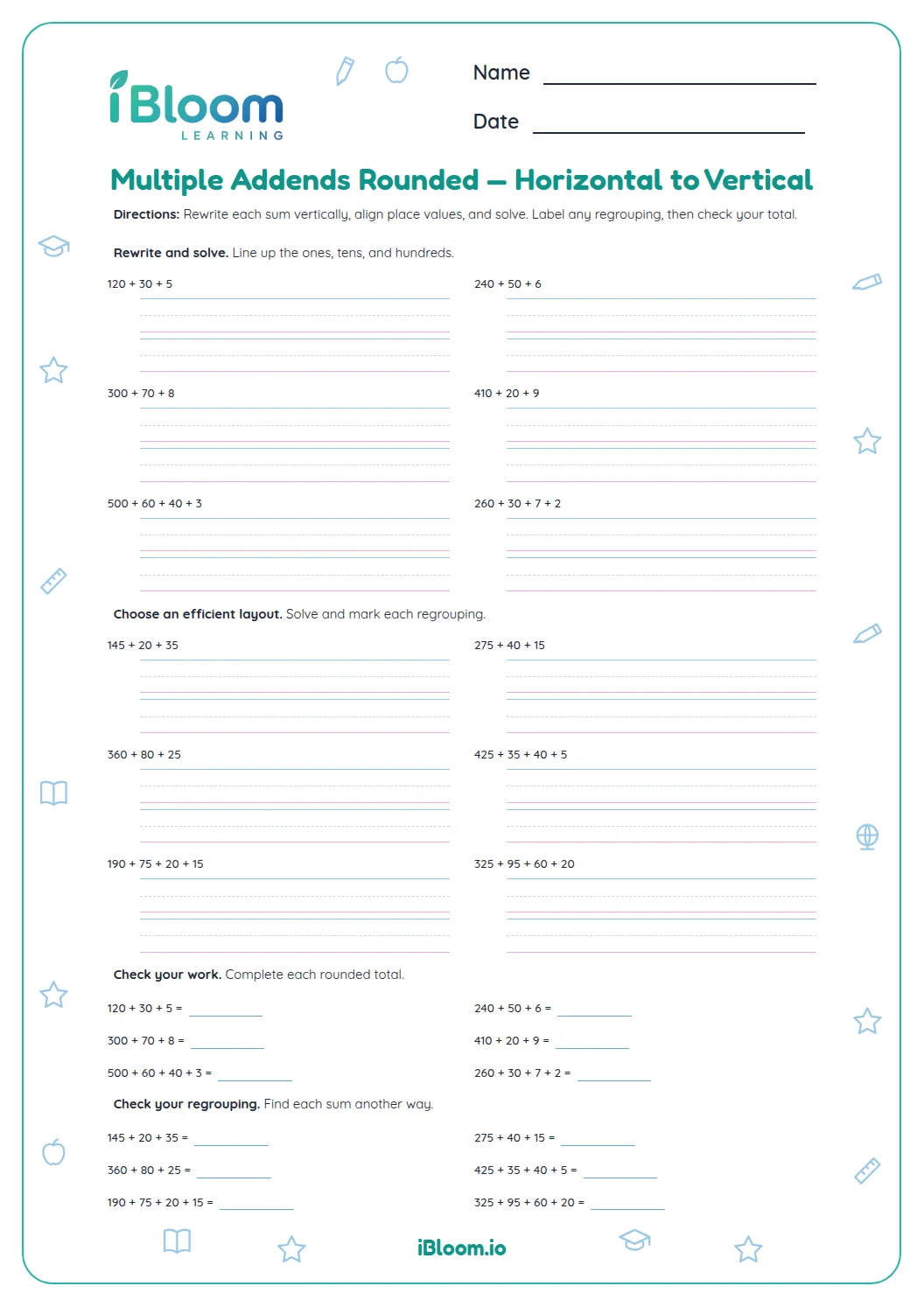
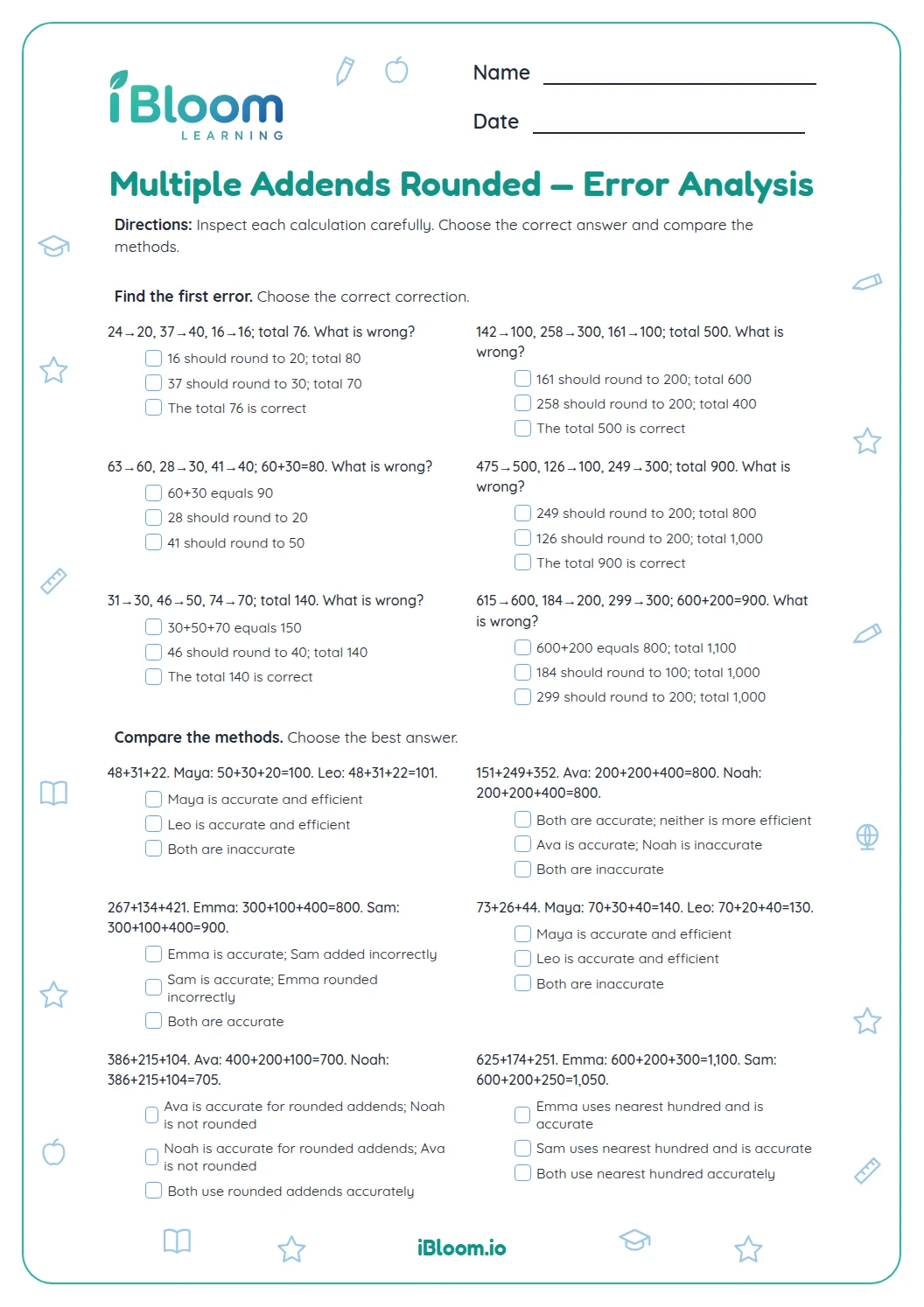
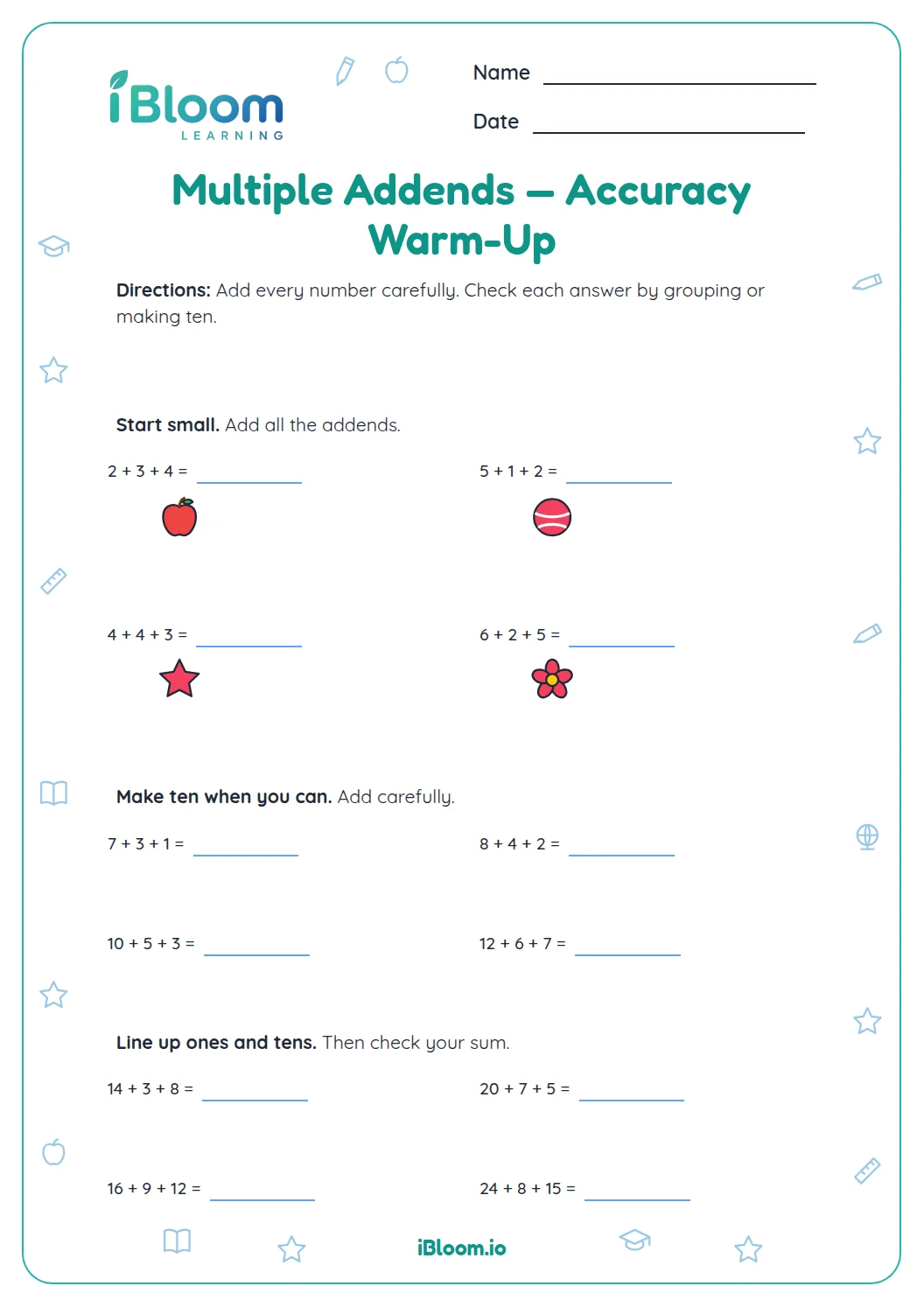
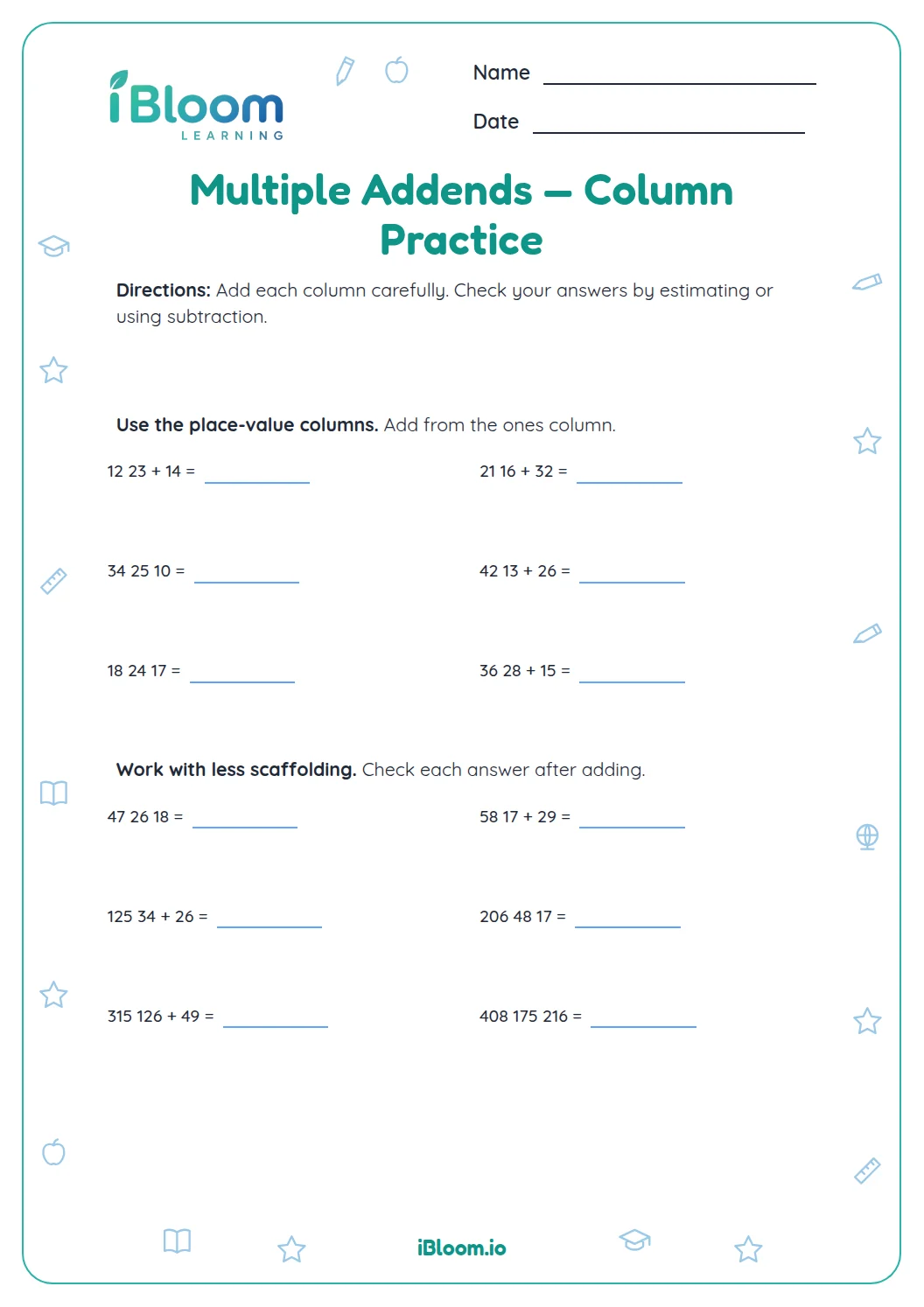
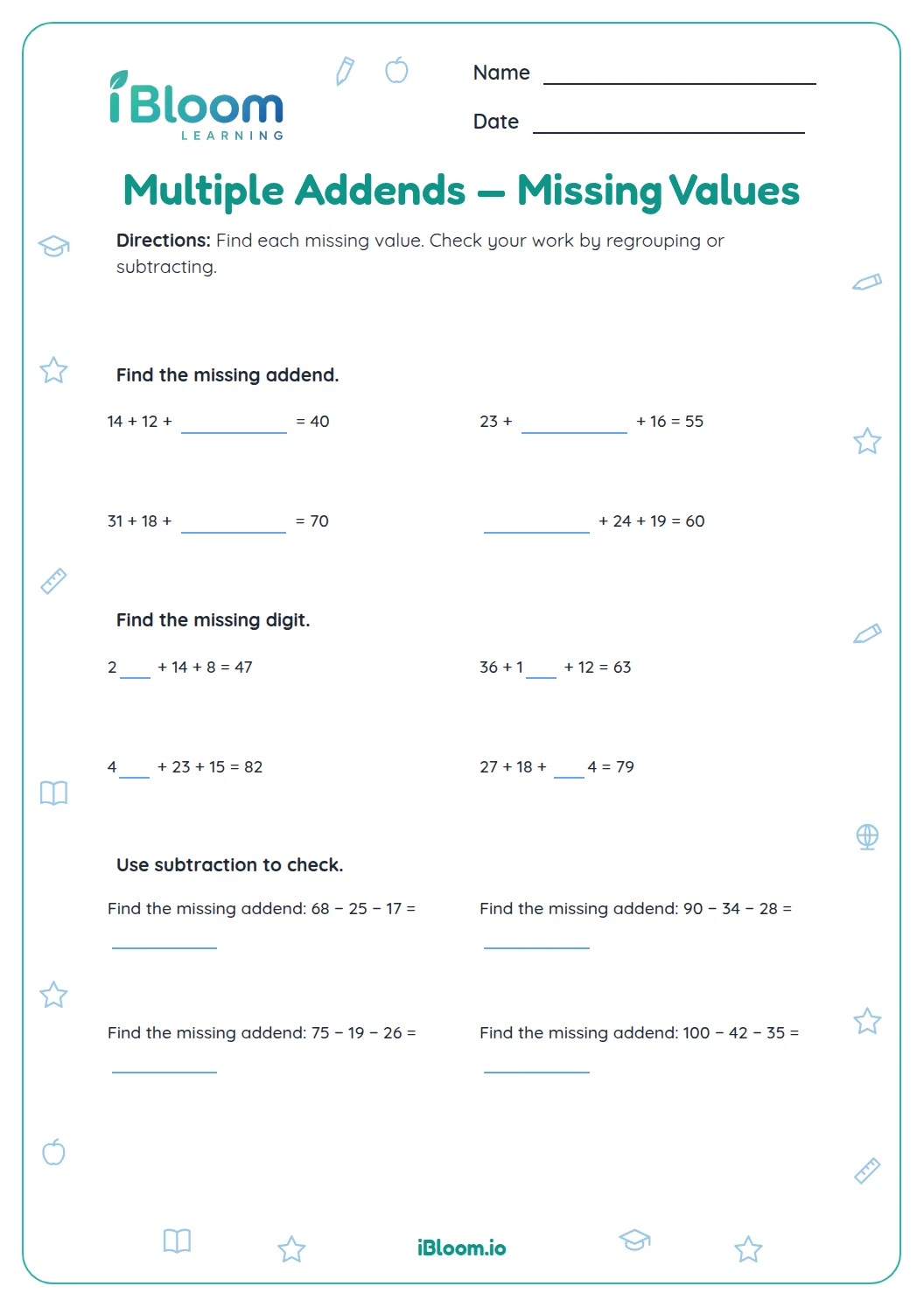
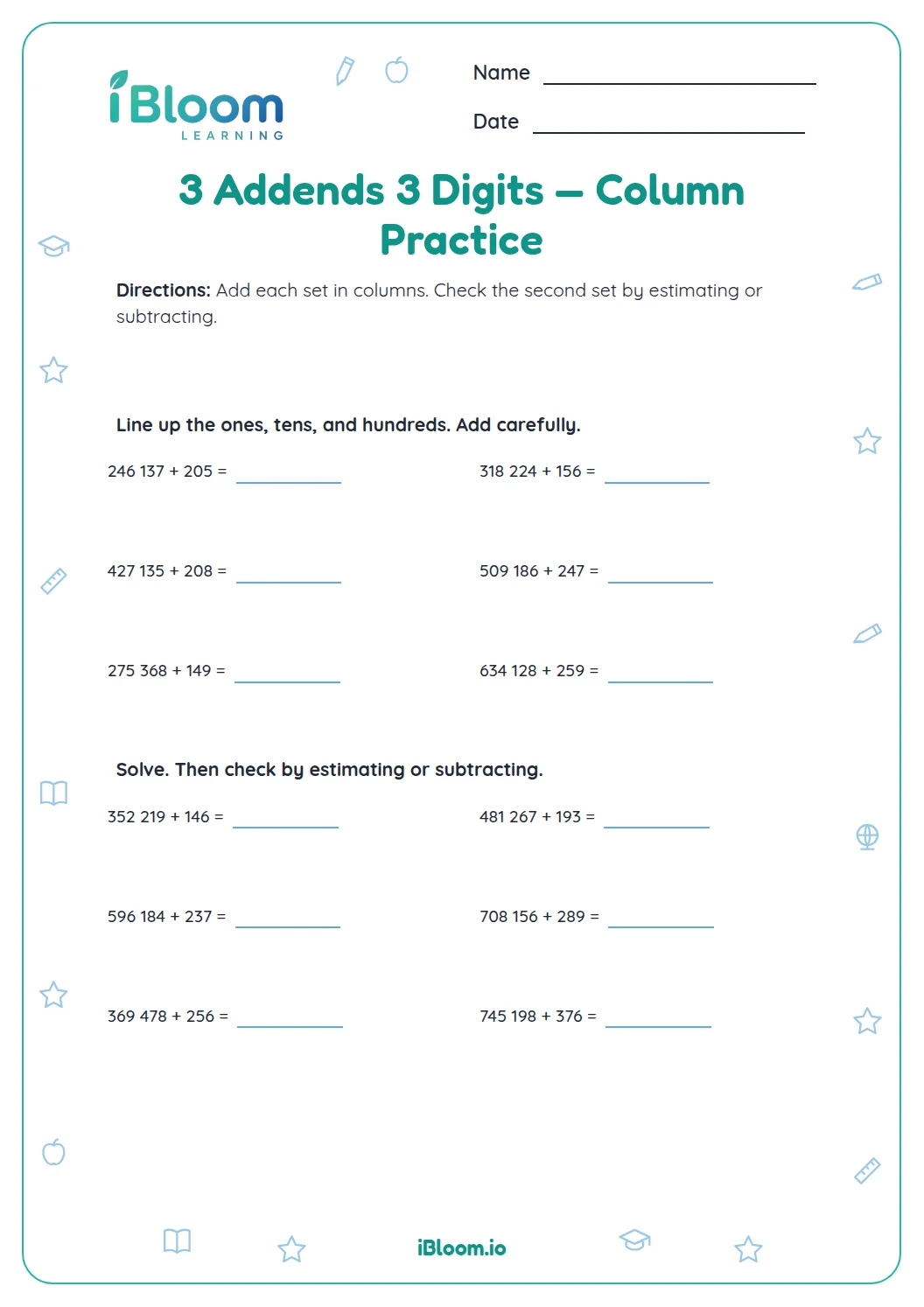
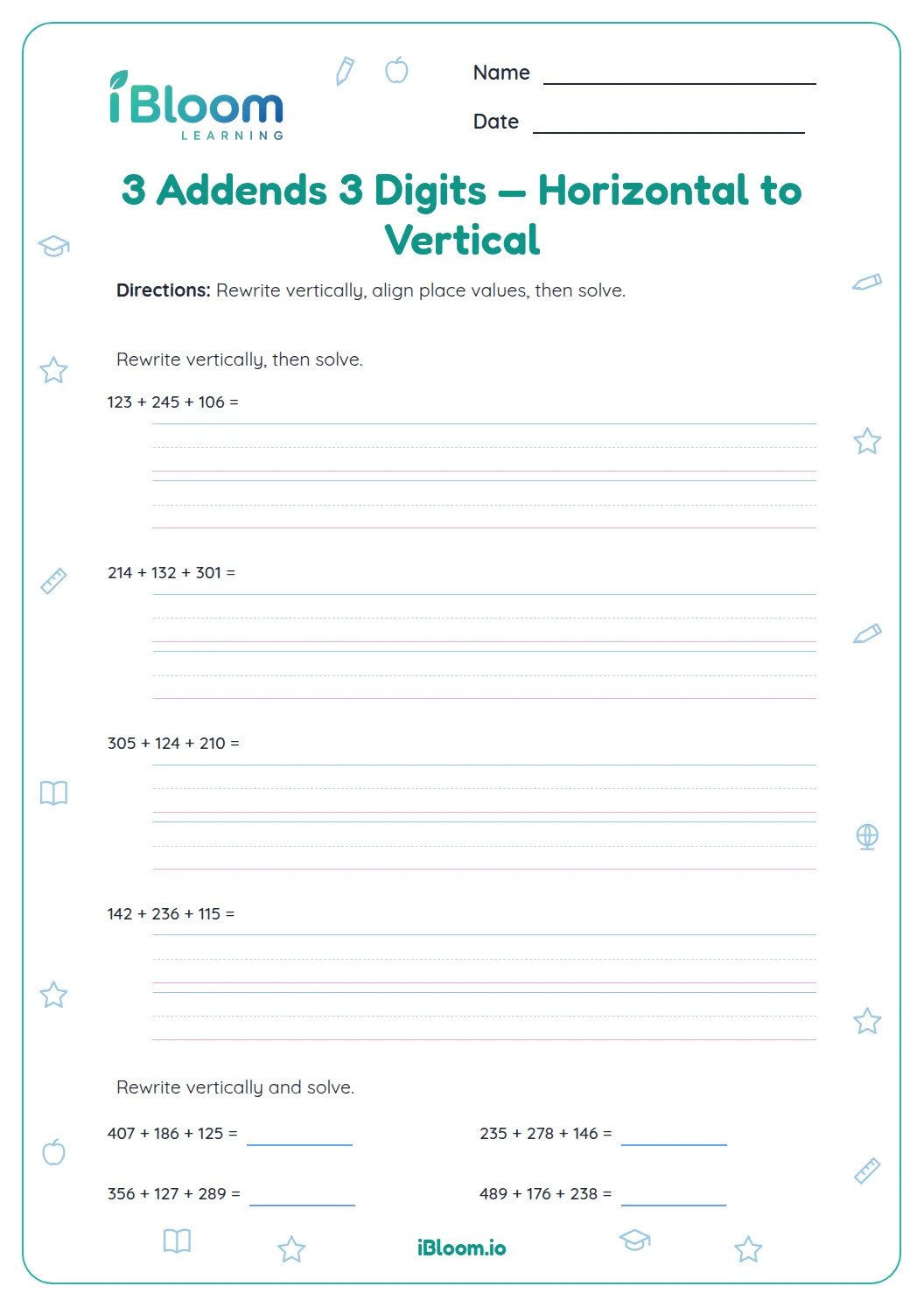
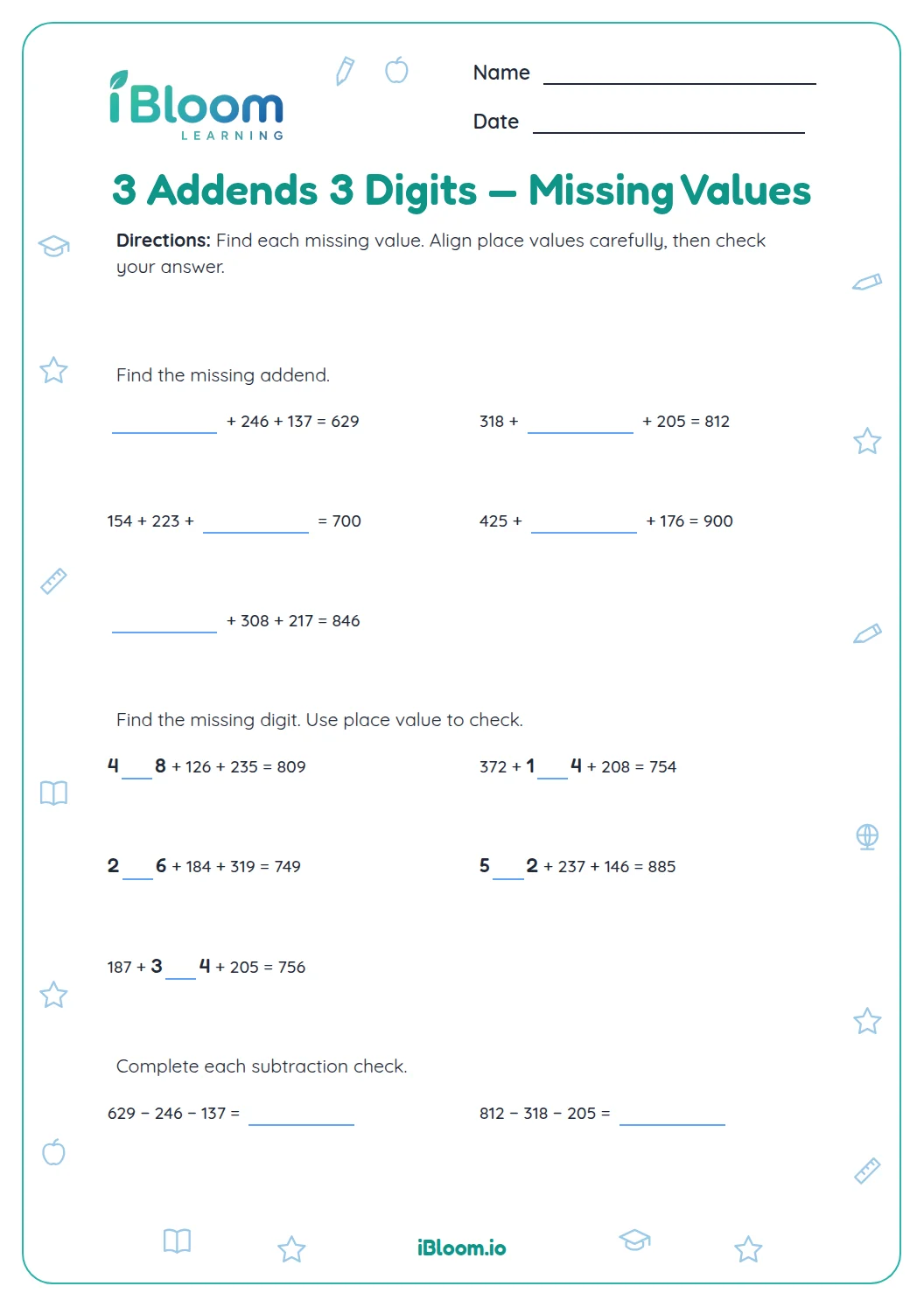
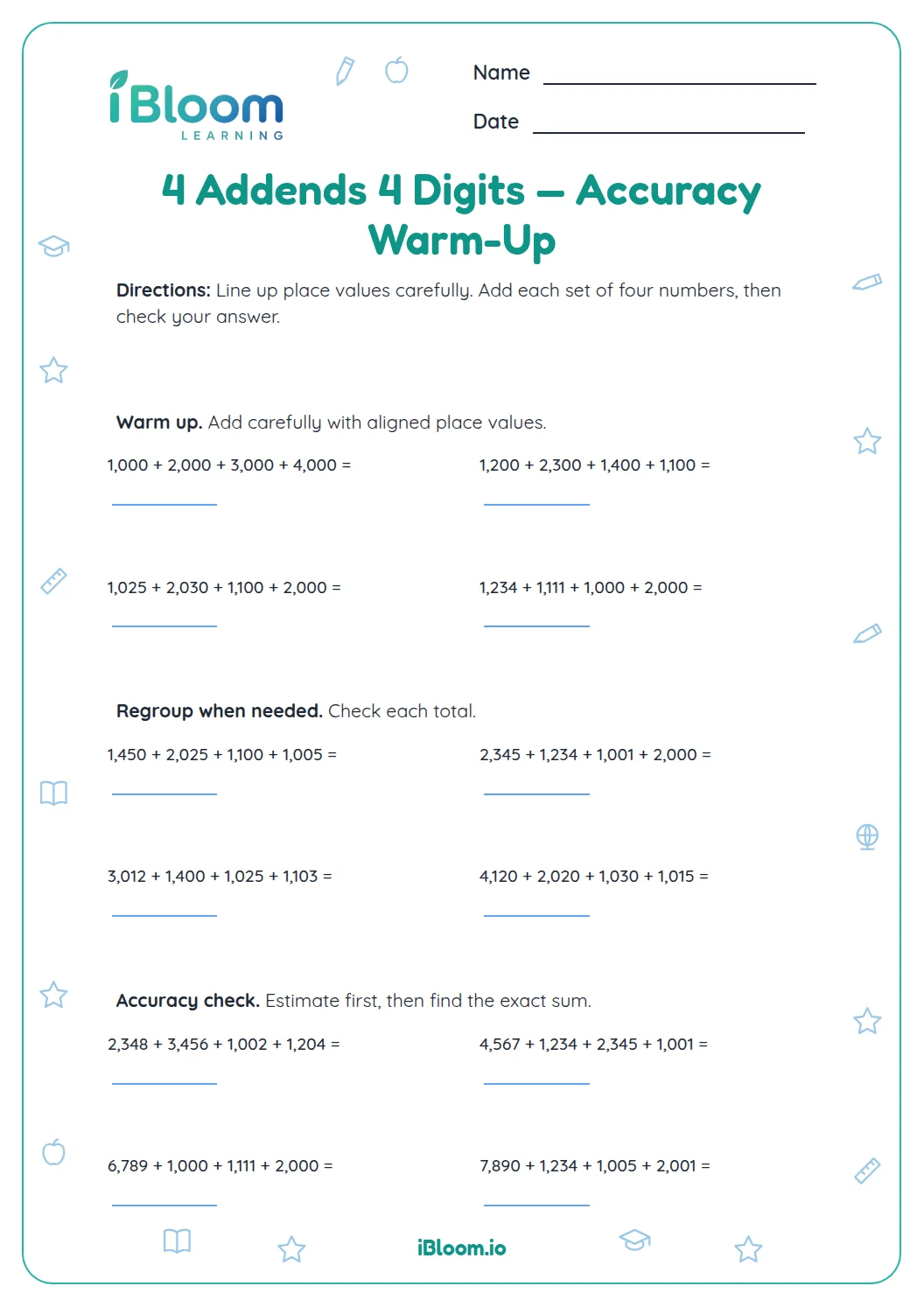
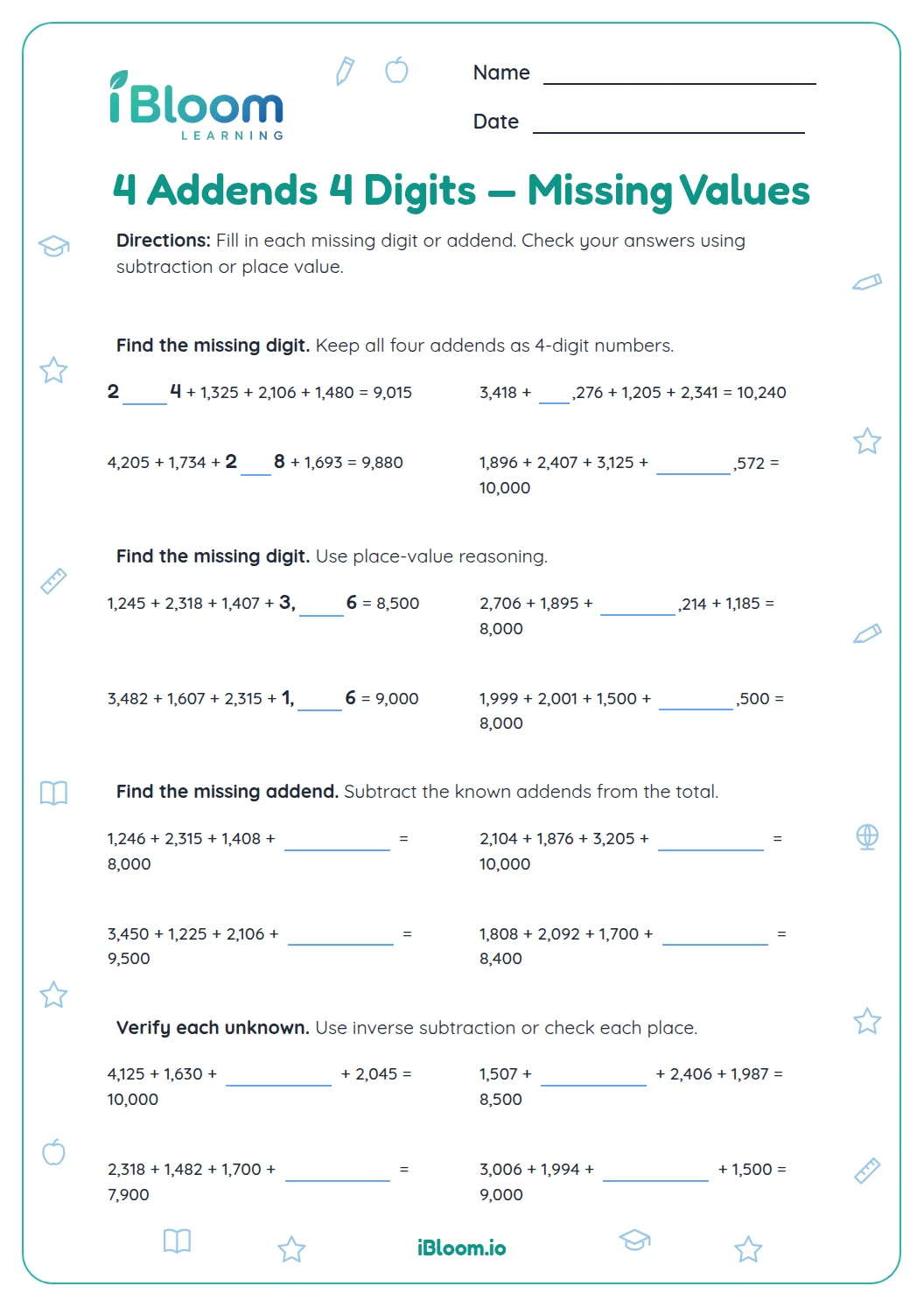
About this worksheet
This Grade 4 printable has 16 questions on adding multiple whole-number addends. It practices CCSS 4.NBT.B.4 through exact sums, estimates made by rounding each addend, and missing-addend equations. Students work with tens, hundreds, and thousands, then check that every addend and place value is included. A separate answer key lists the correct sums, estimates, and missing values.
Aligned to 4.NBT.B.4
How can you add several numbers accurately?
Add each value while keeping place values aligned. You can also pair numbers that make a friendly total before adding the rest. For question 1, 40 + 30 = 70, and 70 + 20 = 90.
The larger items use the same process with hundreds and thousands.
- 140 + 30 + 20 = 90
- 240 + 30 = 70
- 370 + 20 = 90
How do rounding estimates help you check a sum?
Round each addend to the place named in the question, then add the rounded values. In question 7, 68 + 31 + 22 becomes 70 + 30 + 20, so the estimate is 120. An estimate helps you judge whether an exact total is reasonable.
- Questions 1–6: find exact sums
- Questions 7–10: estimate sums after rounding each addend
- Questions 11–16: find a missing addend
How do you find a missing addend?
Subtract the known addends from the total, or count up from their sum. In question 11, 30 + 50 = 80, and 150 − 80 = 70, so the missing addend is 70. Check by adding all three values back to the total.
How to use this worksheet
- 1Read whether the item asks for an exact sum, an estimate, or a missing addend.
- 2Add every known addend and keep place values aligned.
- 3For estimates, round each addend to the place named before adding.
- 4For a missing addend, subtract the known values from the total.
- 5Check the result by adding all the values or comparing with the estimate.
Common mistakes and quick fixes
The mistake
Skipping an addend in a long sum
The fix
Touch each addend as you include it, then recount the values.
The mistake
Rounding the total instead of each addend
The fix
Round every addend first, as the estimate prompt directs.
The mistake
Forgetting place value when regrouping
The fix
Keep ones under ones, tens under tens, and hundreds under hundreds.
Common Core alignment
This practice connects the named skill to a grade-level Common Core expectation.
Add multi-digit whole numbers accurately using place value.
On this sheet: Students find sums of several multi-digit addends, using place value to regroup.
Show the official wordingHide the official wording
Fluently add and subtract multi-digit whole numbers using the standard algorithm.
What to practice next
Make more practice
Further reading
Questions parents and teachers ask
How many questions are on this drill?
There are 16 questions in three parts: six exact sums, four estimates made by rounding each addend, and six missing-addend equations. This variety follows the source sheet’s mix of solving, checking reasonableness, and finding an unknown value. The answer key gives each result.
How do students estimate a sum?
Round every addend to the place named in the prompt, then add those rounded values. In question 7, 68, 31, and 22 round to 70, 30, and 20, giving an estimate of 120. The estimate is a quick check for an exact total.
Can students add from left to right?
Yes. Students can add from left to right or group values that make a friendly total, as long as every addend is counted. For question 1, either 40 + 30 + 20 or 40 + 20 + 30 gives 90. The answer key shows the total.
How do I find a missing addend?
Add the known addends, then subtract their sum from the total. In question 11, 30 + 50 = 80, and 150 − 80 = 70, so the missing number is 70. Adding 70 + 30 + 50 checks the equation.
What is the estimate for question 10?
Round 1,473 to 1,500, 2,521 to 2,500, and 1,189 to 1,200. Their estimated sum is 5,200. The worksheet asks for an estimate here, so students add the rounded values rather than finding the exact total first. The answer key confirms the estimate.