

About this worksheet
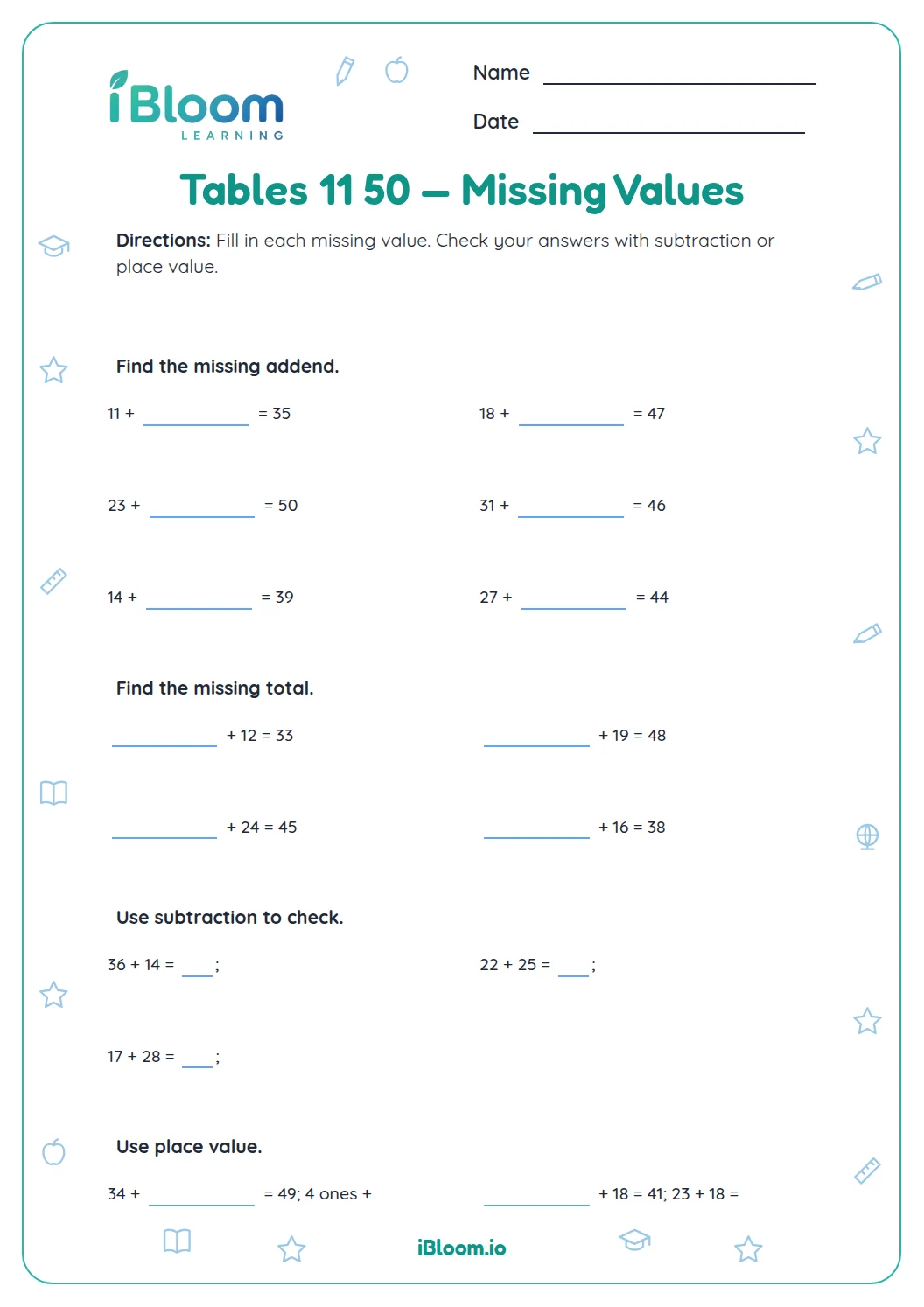
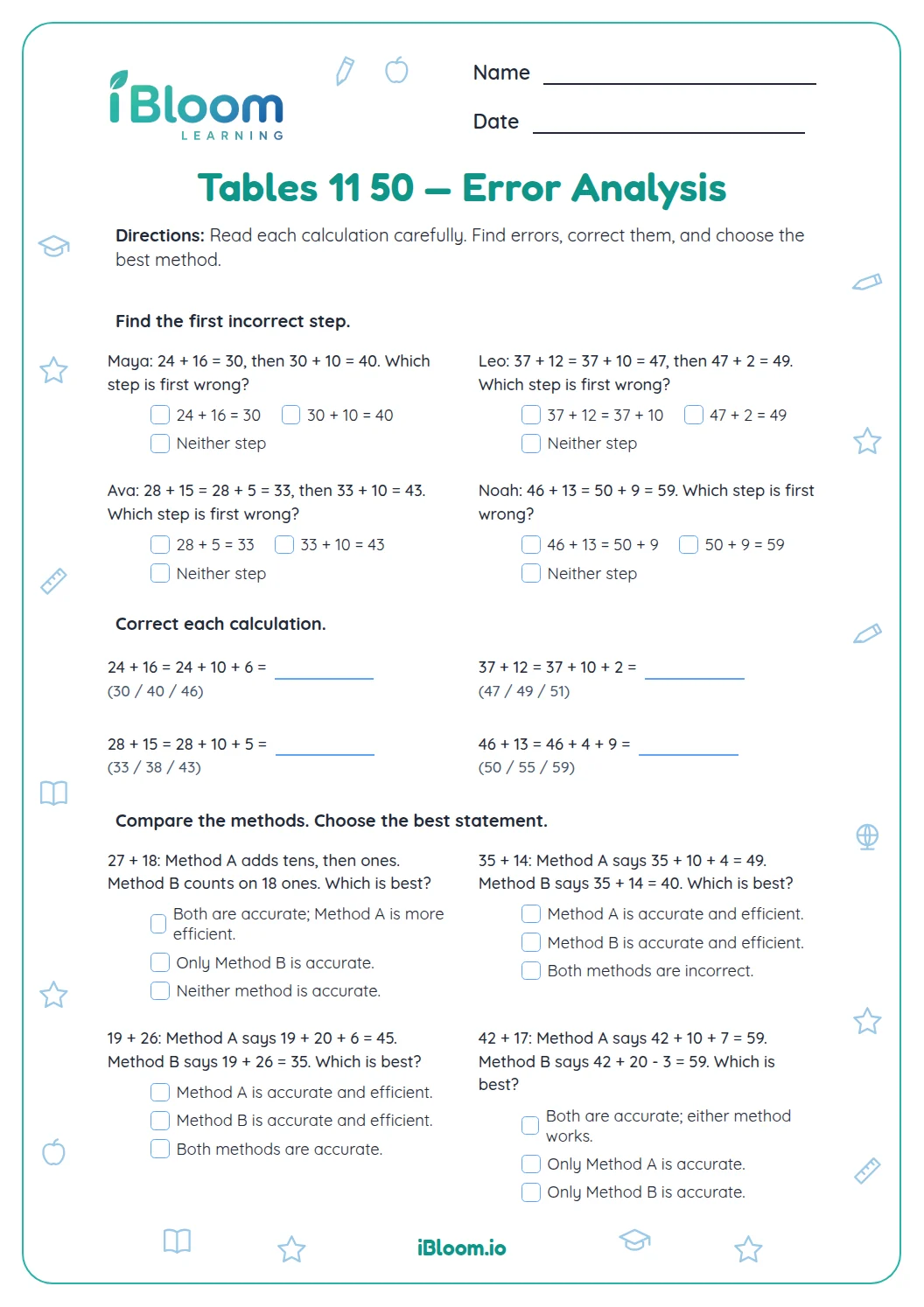
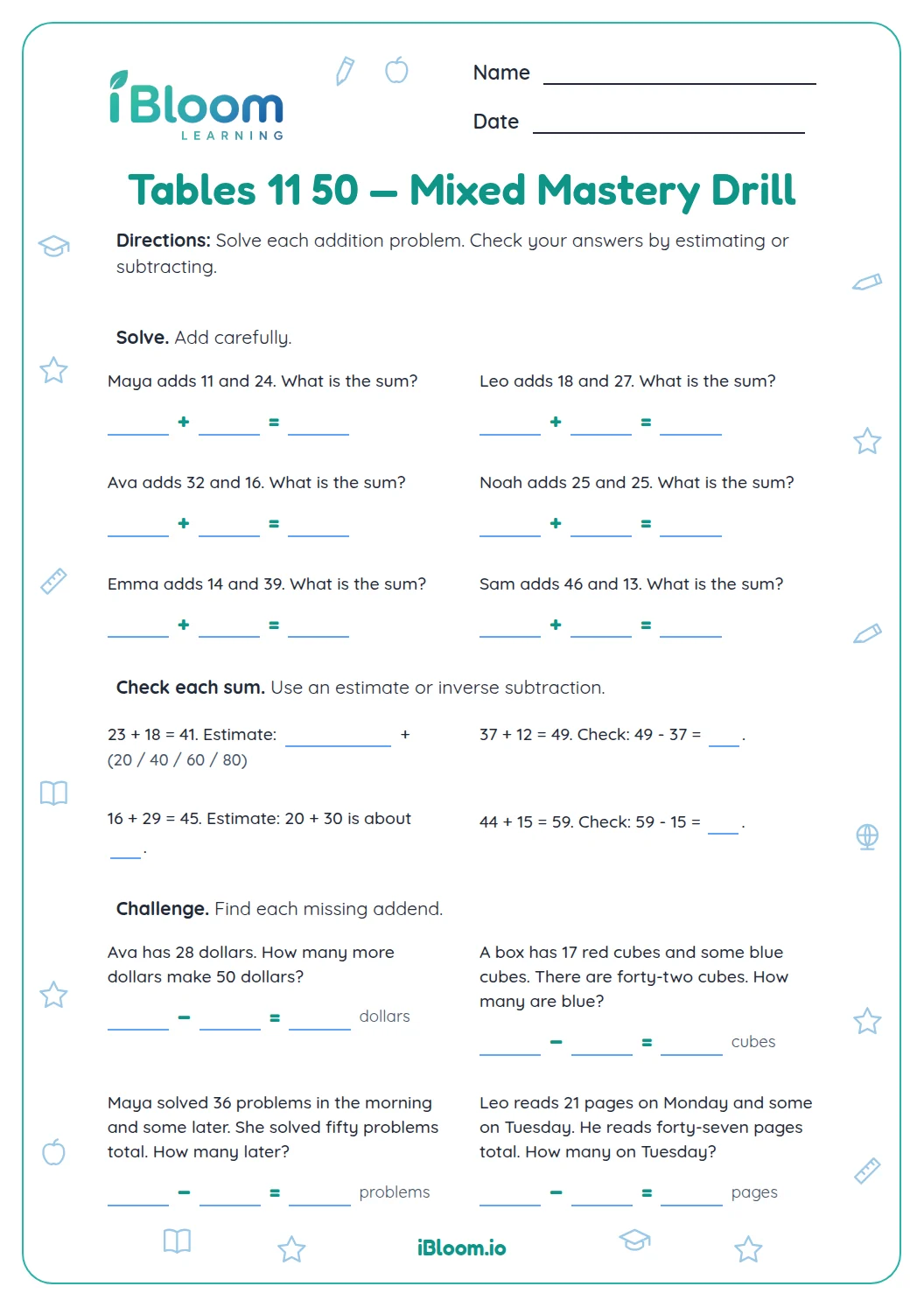
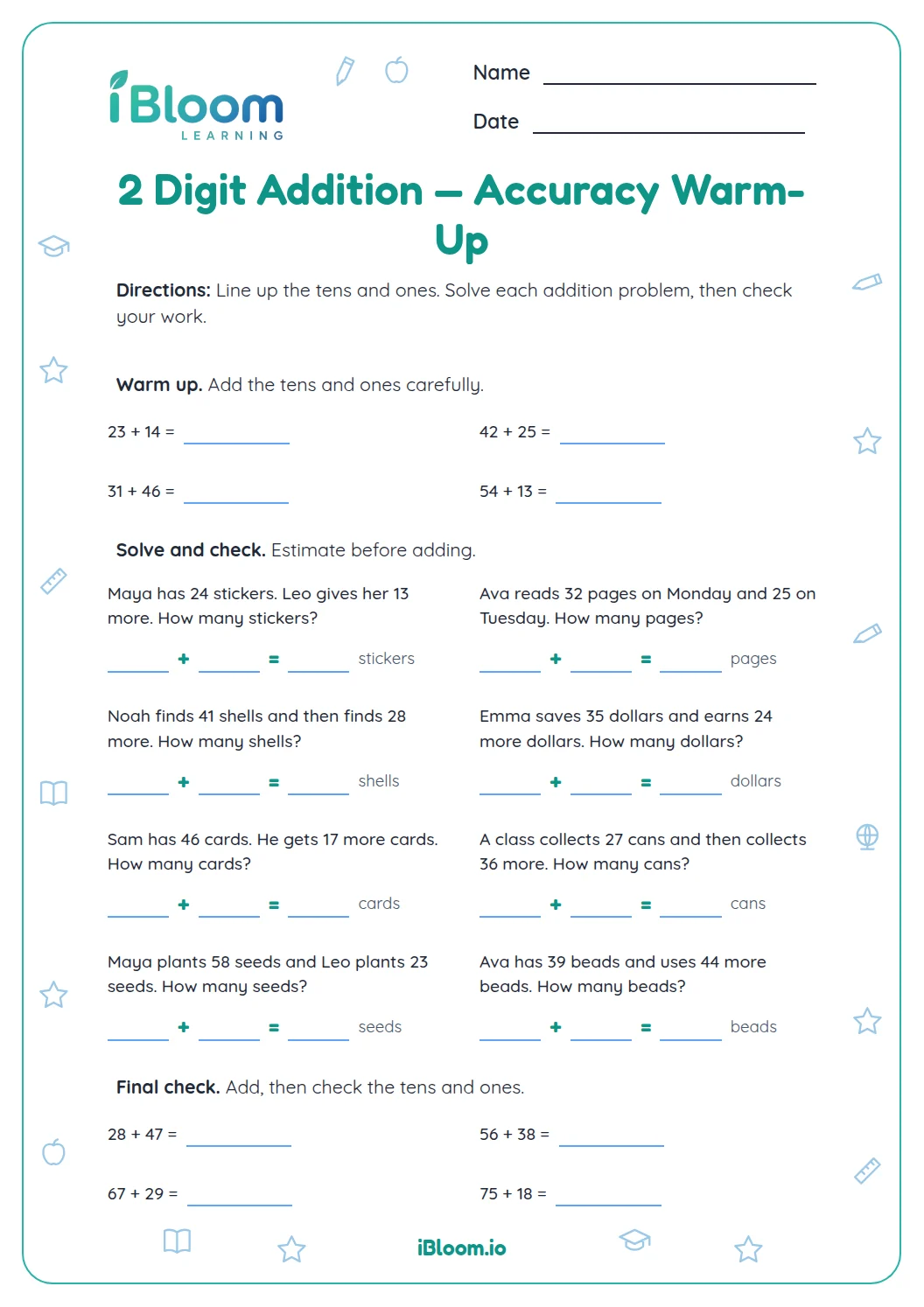
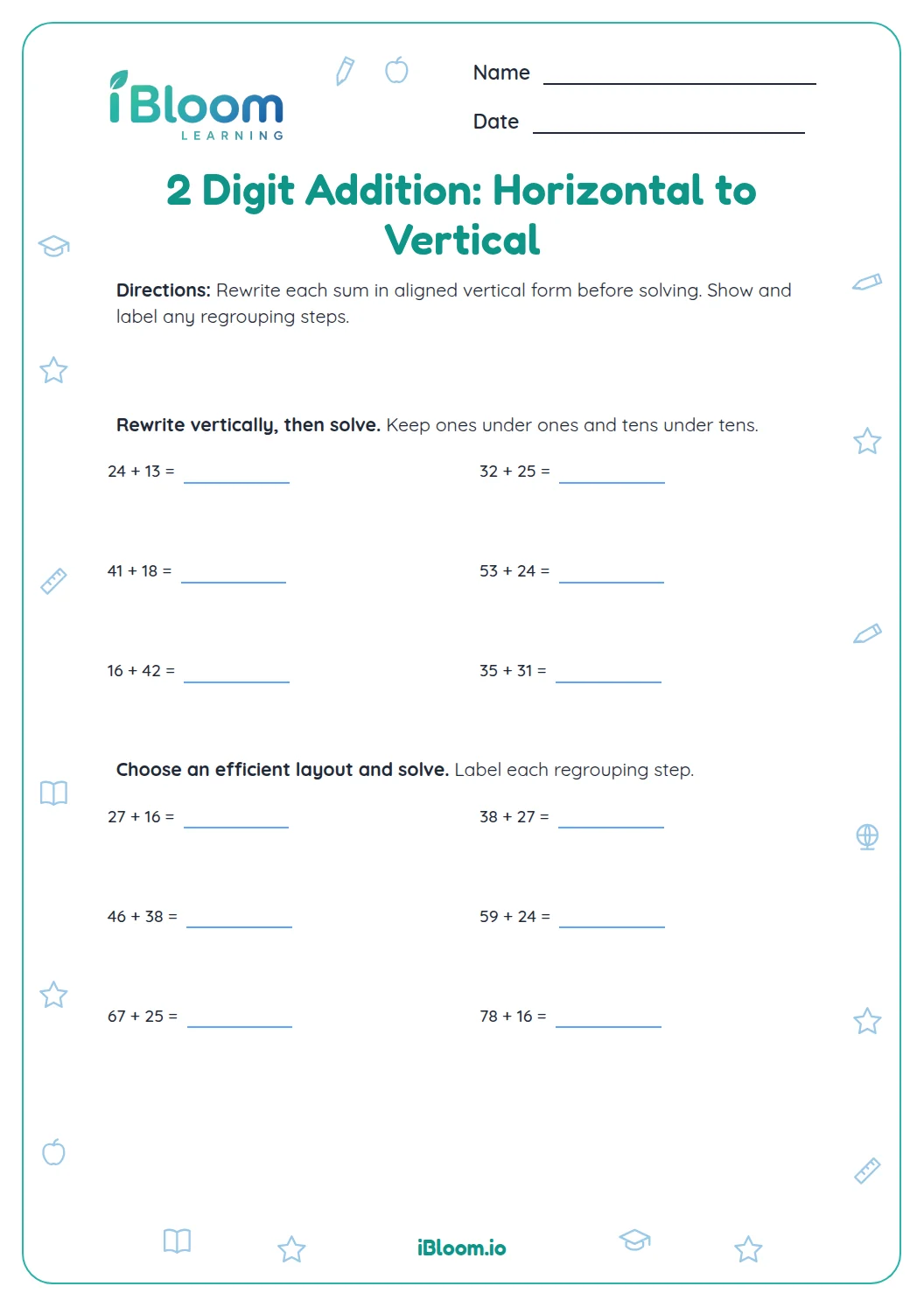
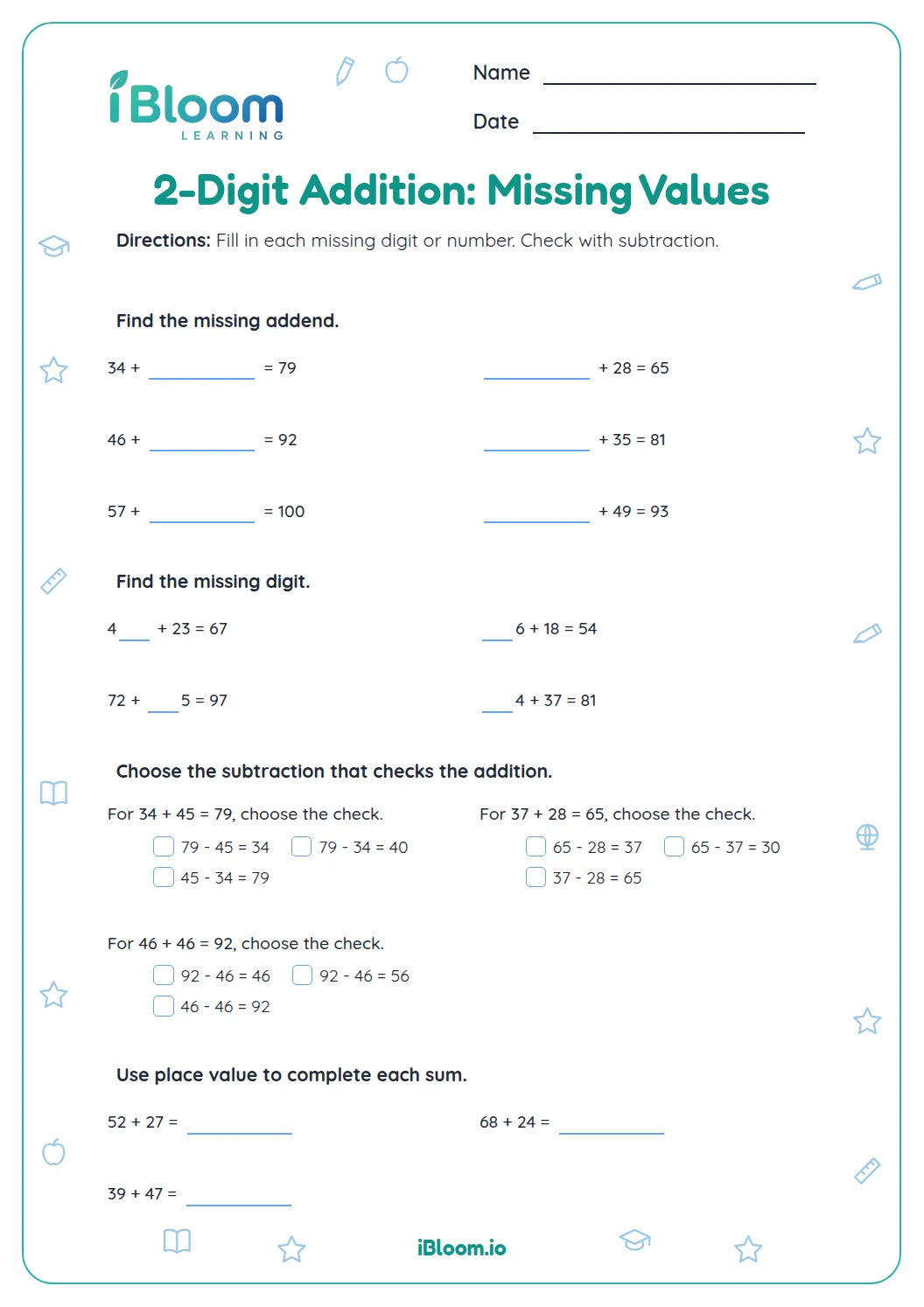
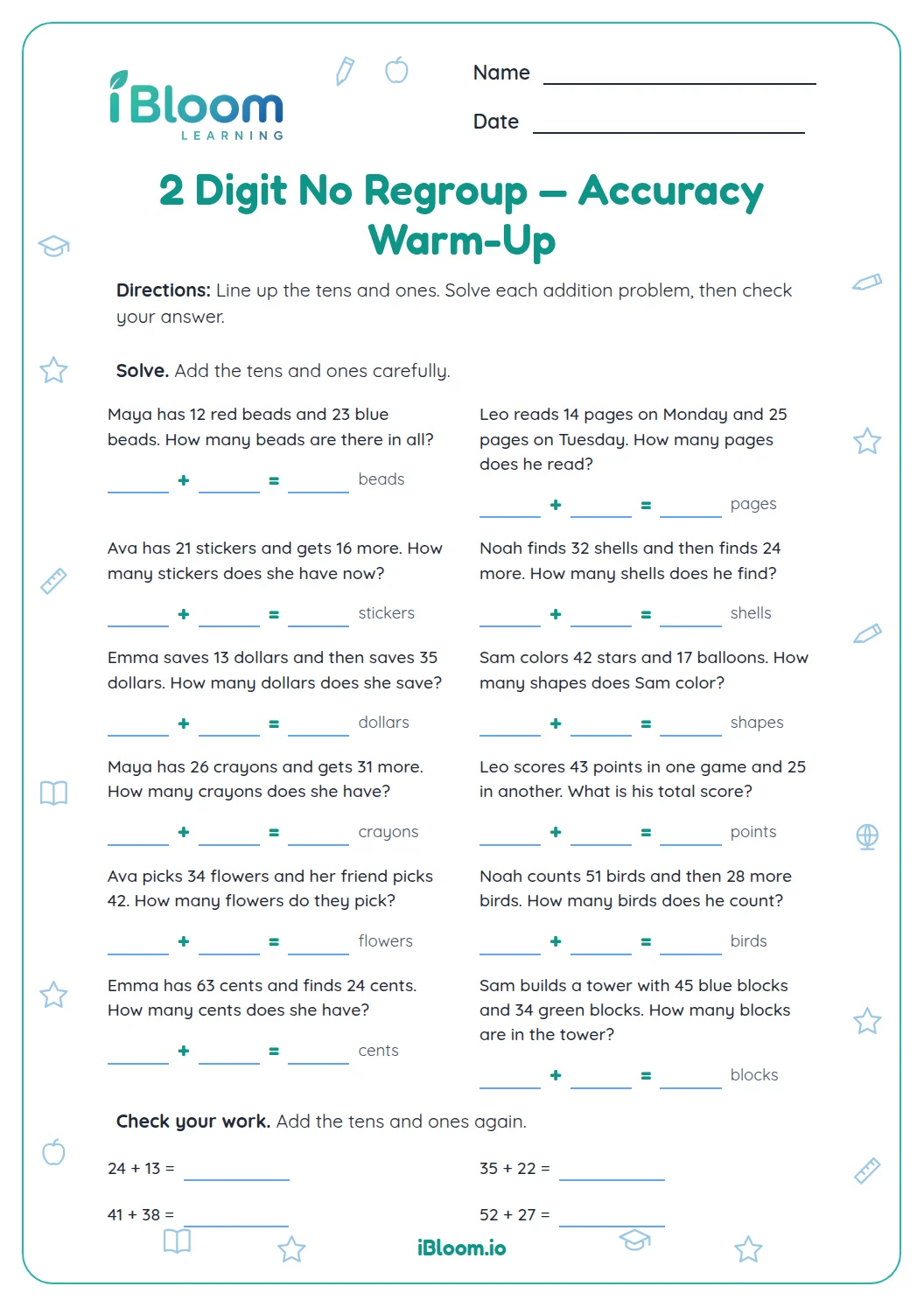
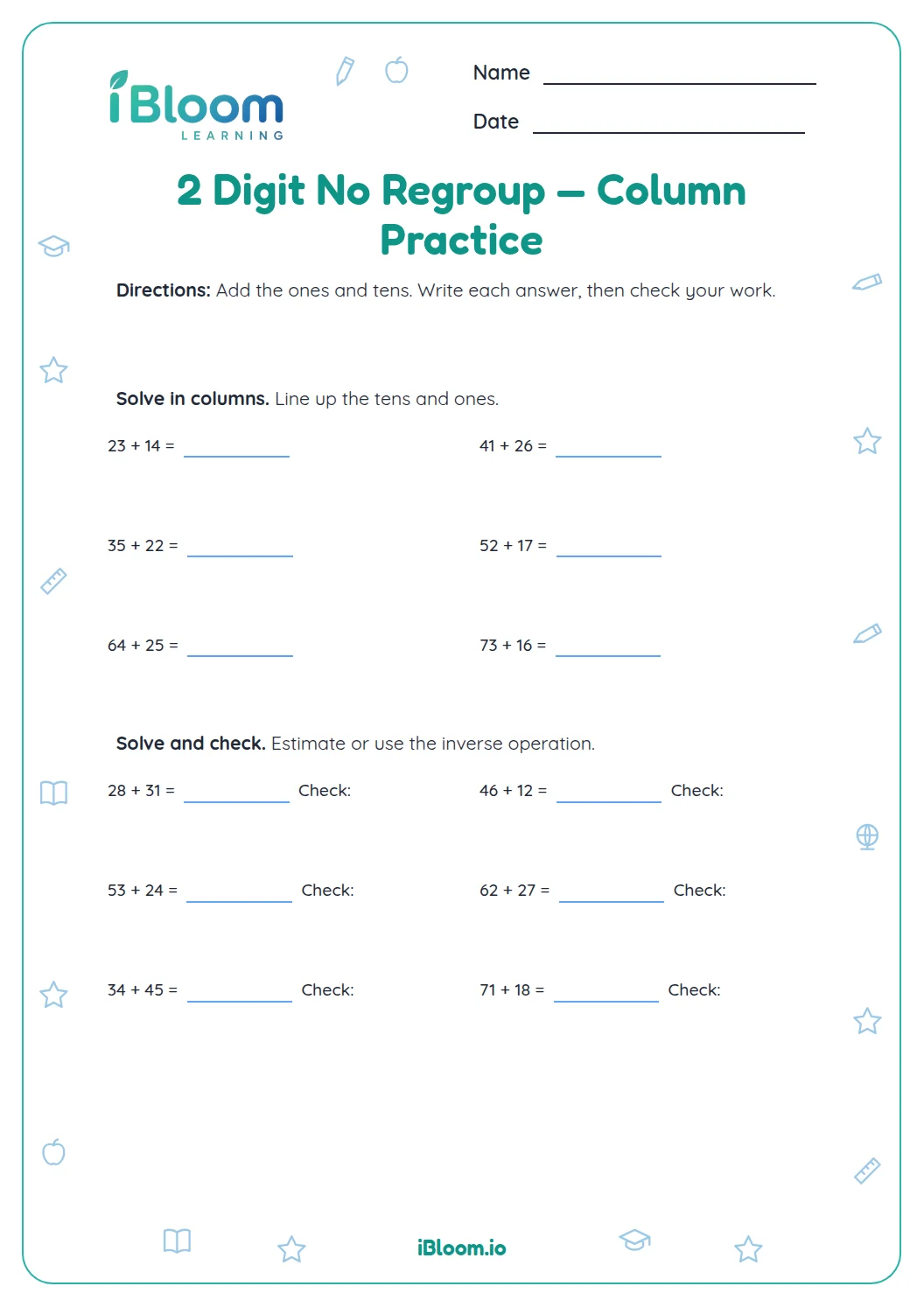
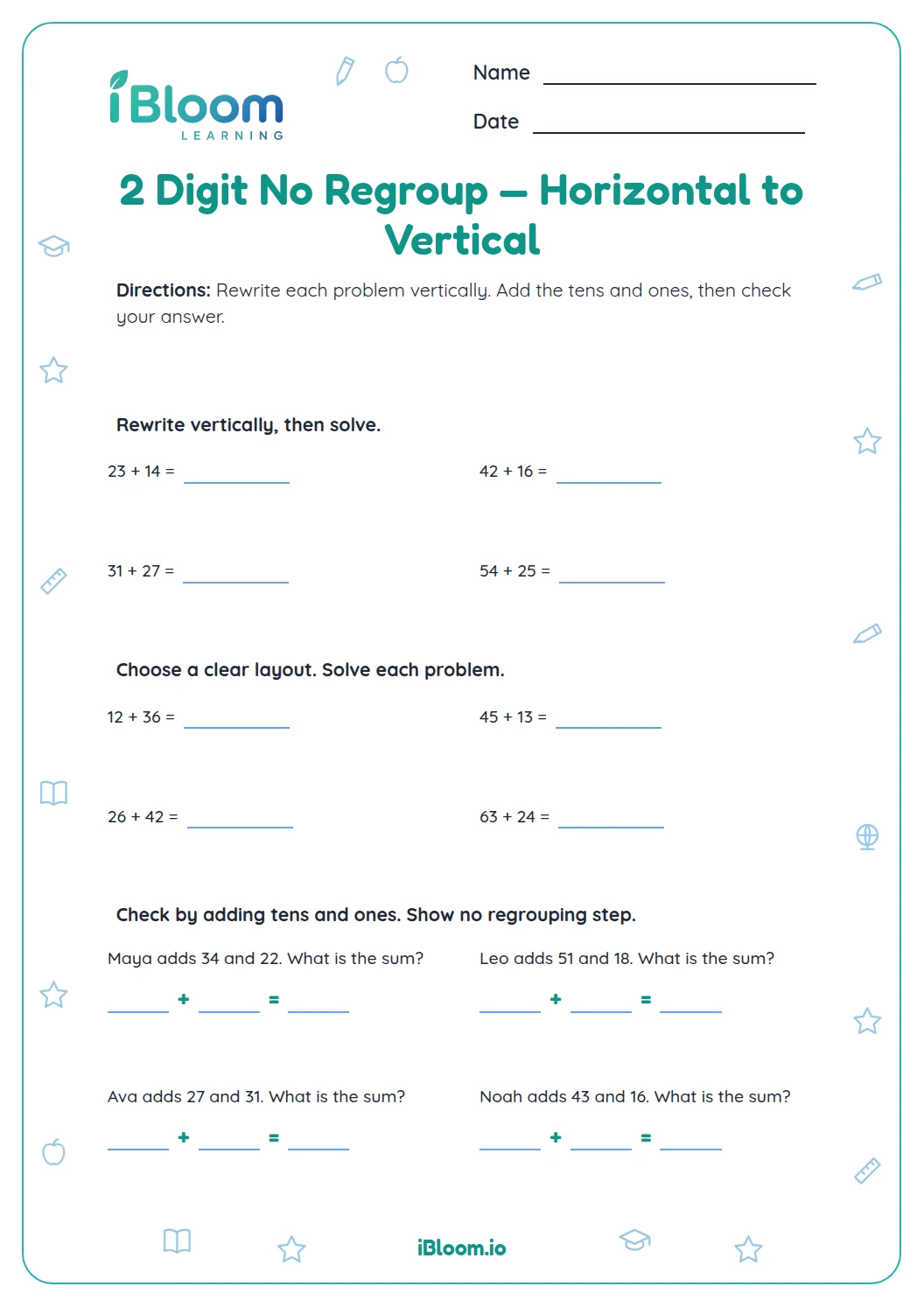
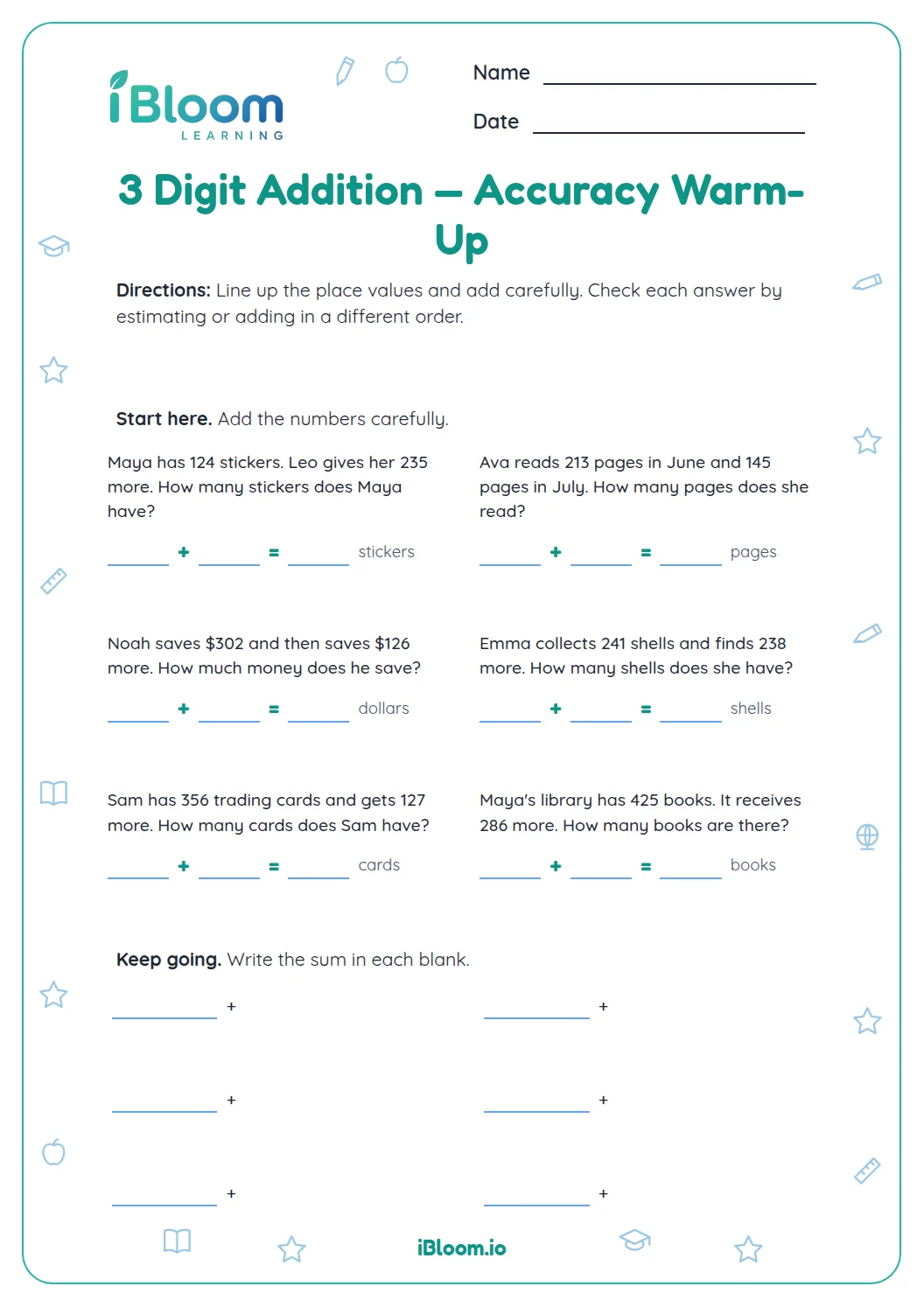
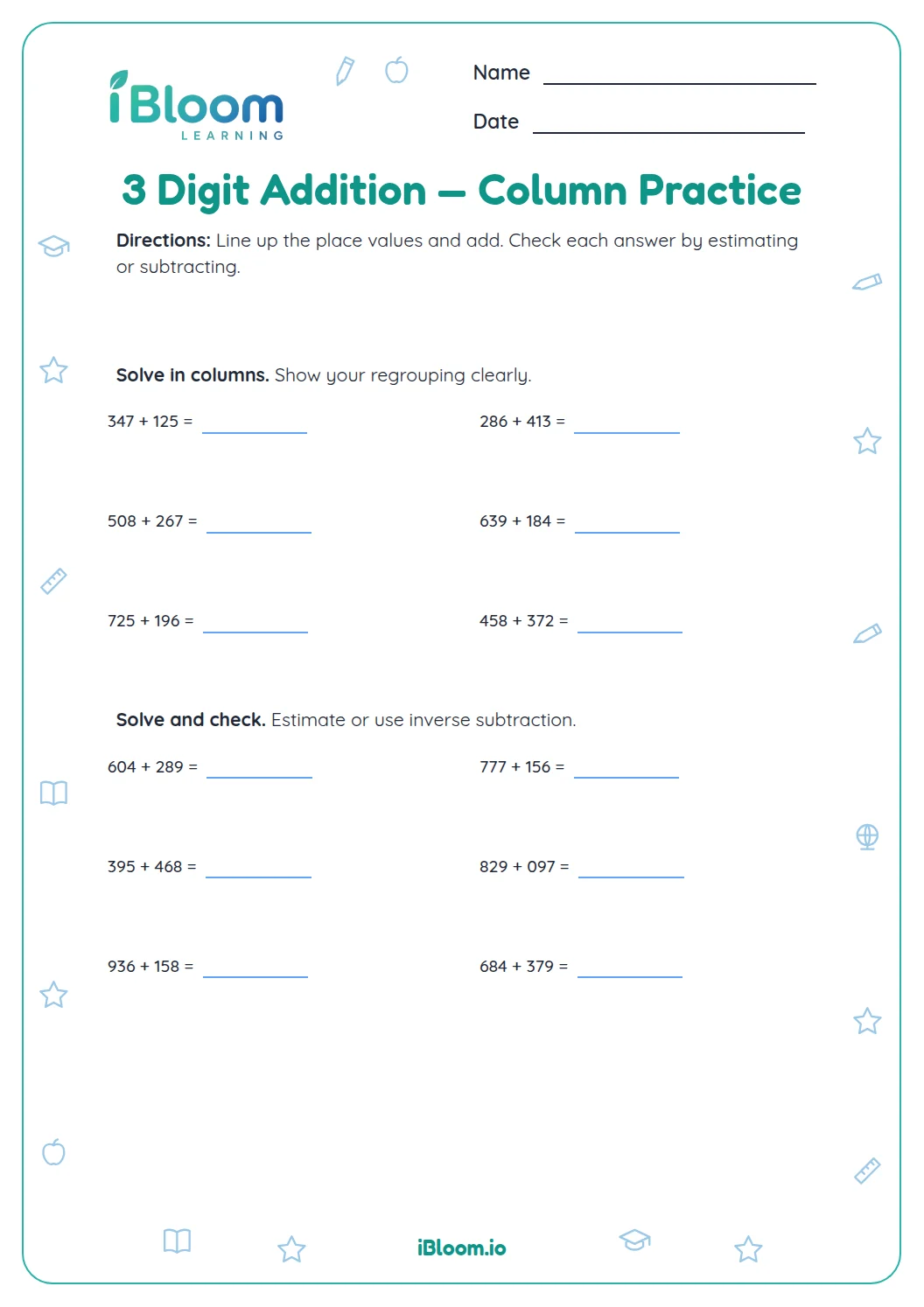
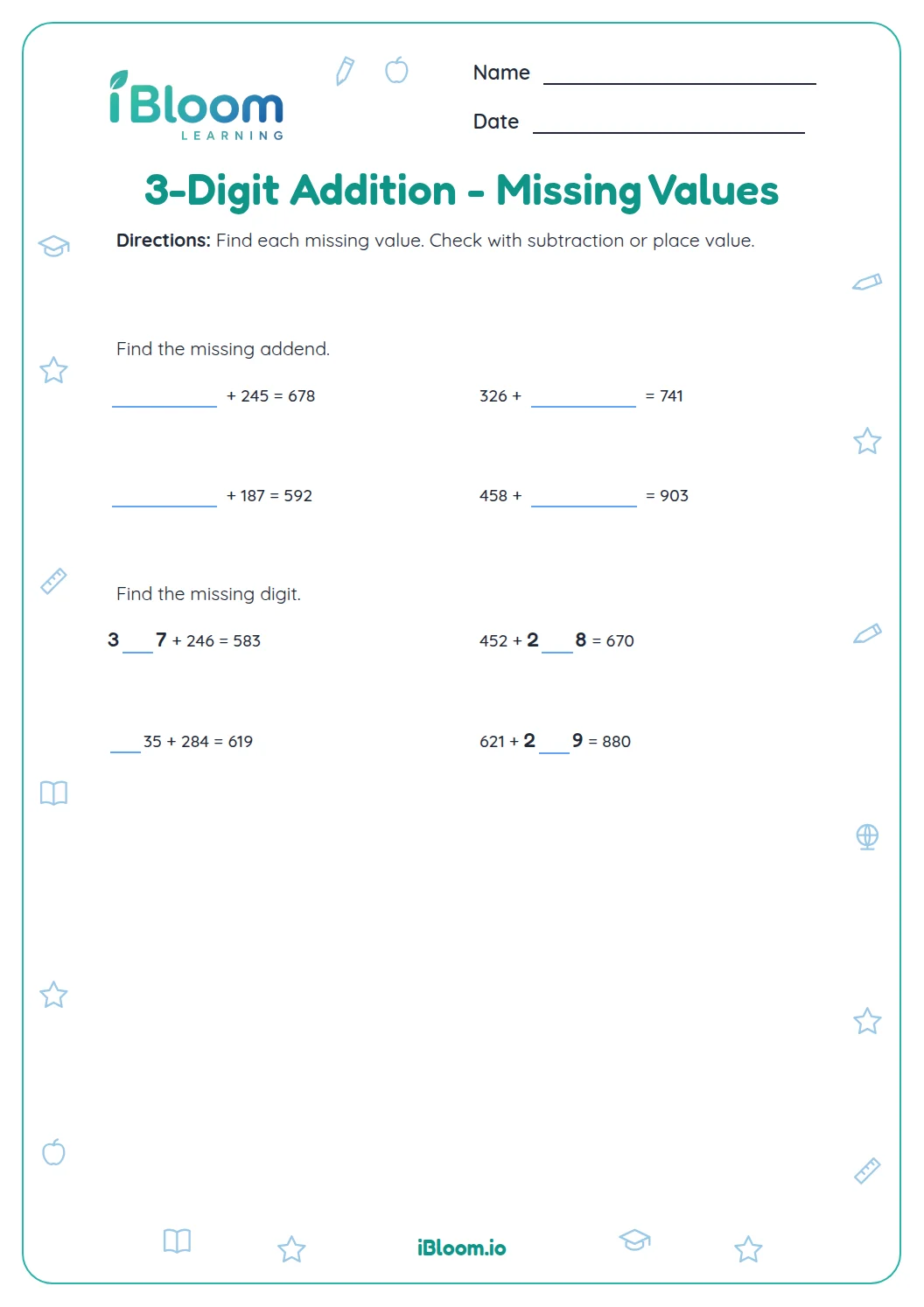
This printable column-practice sheet uses two addends from 11 to 50 in every problem. Learners line up the digits, add with and without regrouping, and check a result with subtraction. It contains 20 questions over three worksheet pages and a separate three-page answer key. Its place-value addition work aligns with CCSS 2.NBT.B.5.
Aligned to 2.OA.B.2 and 2.NBT.B.5
How do you add two-digit numbers in columns?
Line up the ones digits and the tens digits. Add the ones first. If their total is ten or more, regroup one ten into the tens column. Then add the tens and include the regrouped ten.
- 113 + 39
- 2Ones: 3 + 9 = 12; write 2 ones and regroup 1 ten.
- 3Tens: 1 + 3 + 1 = 5 tens.
- 4The sum is 52.
What will children practice?
The 20 problems use two addends from 11 through 50. Learners set up the first sums in columns, practice regrouping in the next sections, and finish with larger sums plus an inverse check. The three-page key gives all 20 sums.
How can an adult support the practice?
Ask the learner to explain the place or operation that matters before calculating. Use the answer key to check the result and the reasoning.
How to use this worksheet
- 1Write each addend vertically with matching places aligned.
- 2Add the ones digits.
- 3Regroup a ten if the ones total is 10 or more.
- 4Add the tens digits and the regrouped ten.
- 5Check by subtracting one addend from the sum.
Mistakes to watch for
The mistake
Misaligning the tens digits.
The fix
Write ones directly beneath ones and tens beneath tens.
The mistake
Writing 12 in the ones column instead of regrouping.
The fix
Write 2 ones and carry 1 ten to the tens column.
The mistake
Forgetting the regrouped ten.
The fix
Add the small regrouped ten with both tens digits.
Common Core alignment
This worksheet practices the place-value and operations ideas described below.
Add within 20 fluently as a foundation for larger sums.
On this sheet: The sheet reinforces addition facts through ones-place sums while working with two-digit addends.
Show the official wordingHide the official wording
Fluently add and subtract within 20 using mental strategies. By end of Grade 2, know from memory all sums of two one-digit numbers.
Add two-digit numbers using place-value strategies.
On this sheet: All questions add two numbers from 11 to 50, with and without regrouping.
Show the official wordingHide the official wording
Fluently add and subtract within 100 using strategies based on place value, properties of operations, and/or the relationship between addition and subtraction.
What to practice next
Make more practice
Further reading
Questions parents and teachers ask
Are both addends from 11 to 50?
Yes. Every problem uses two addends in that range, such as 13 + 39 or 44 + 28. The sum can be greater than 50 because the range describes the numbers being added, not the answer. The page title uses “11–50” to name this addend range.
What is regrouping in addition?
Regrouping exchanges ten ones for one ten. In question 9, 3 + 9 makes 12 ones, so write 2 in the ones place and add 1 to the tens column. The sum is 52. Learners have working grids under each problem to show the steps.
How many questions are included?
There are 20 sums in four parts across three worksheet pages. The first section sets up column addition, and later sections add more regrouping and checking. A separate three-page answer key gives each result in question order, making it easy to check a completed page.
How should children check a sum?
Use subtraction to undo addition. For 13 + 39 = 52, subtract 39 from 52; the result should be 13. This inverse check can reveal a regrouping slip. The last section asks learners to solve the sums and use subtraction to check one result.
Why can a sum go above 50?
The addends stay between 11 and 50, but their total can be larger than either number. For example, 44 + 28 = 72. The range refers to the two numbers being added. This is why some answers on the sheet are greater than 50.