

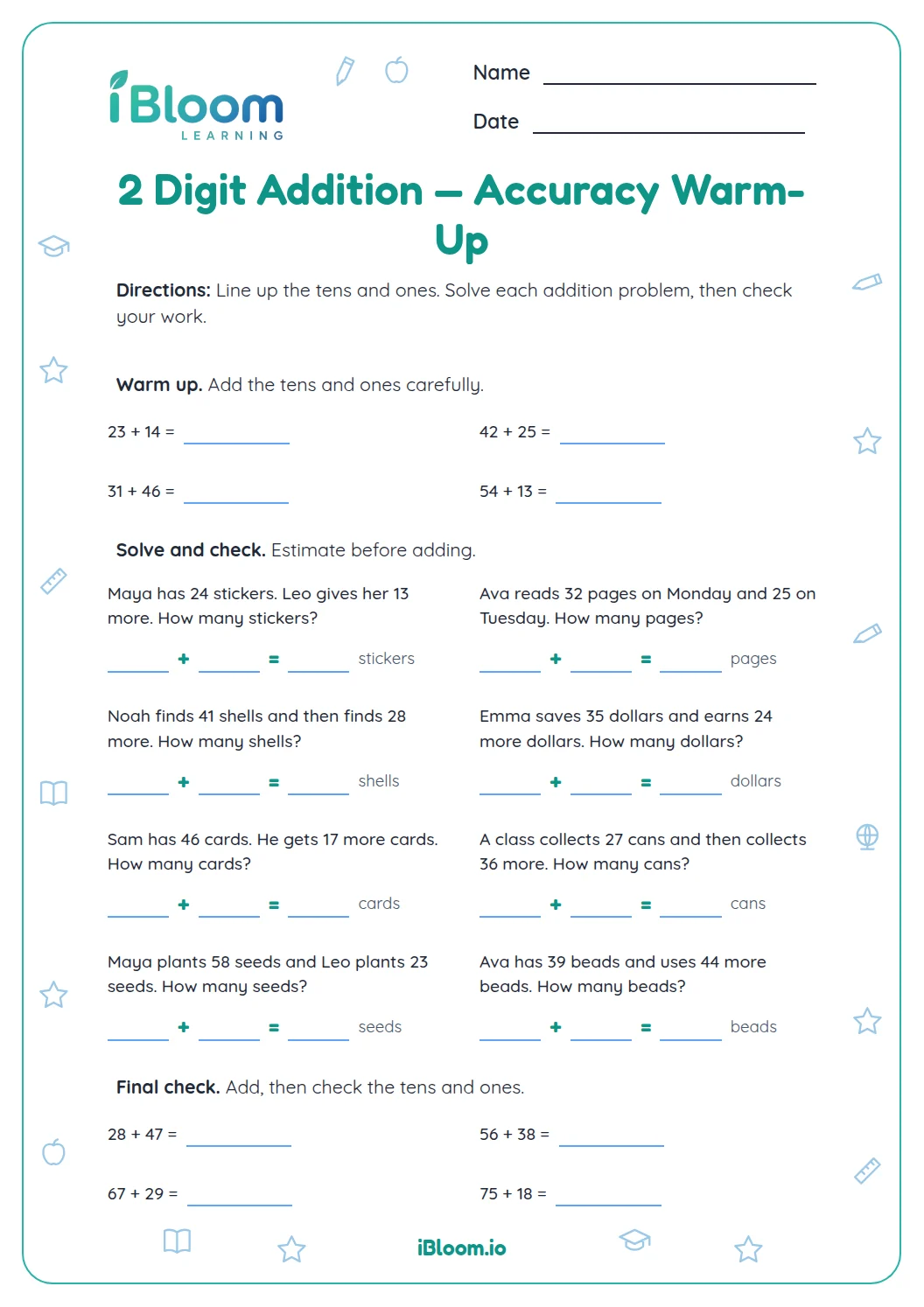
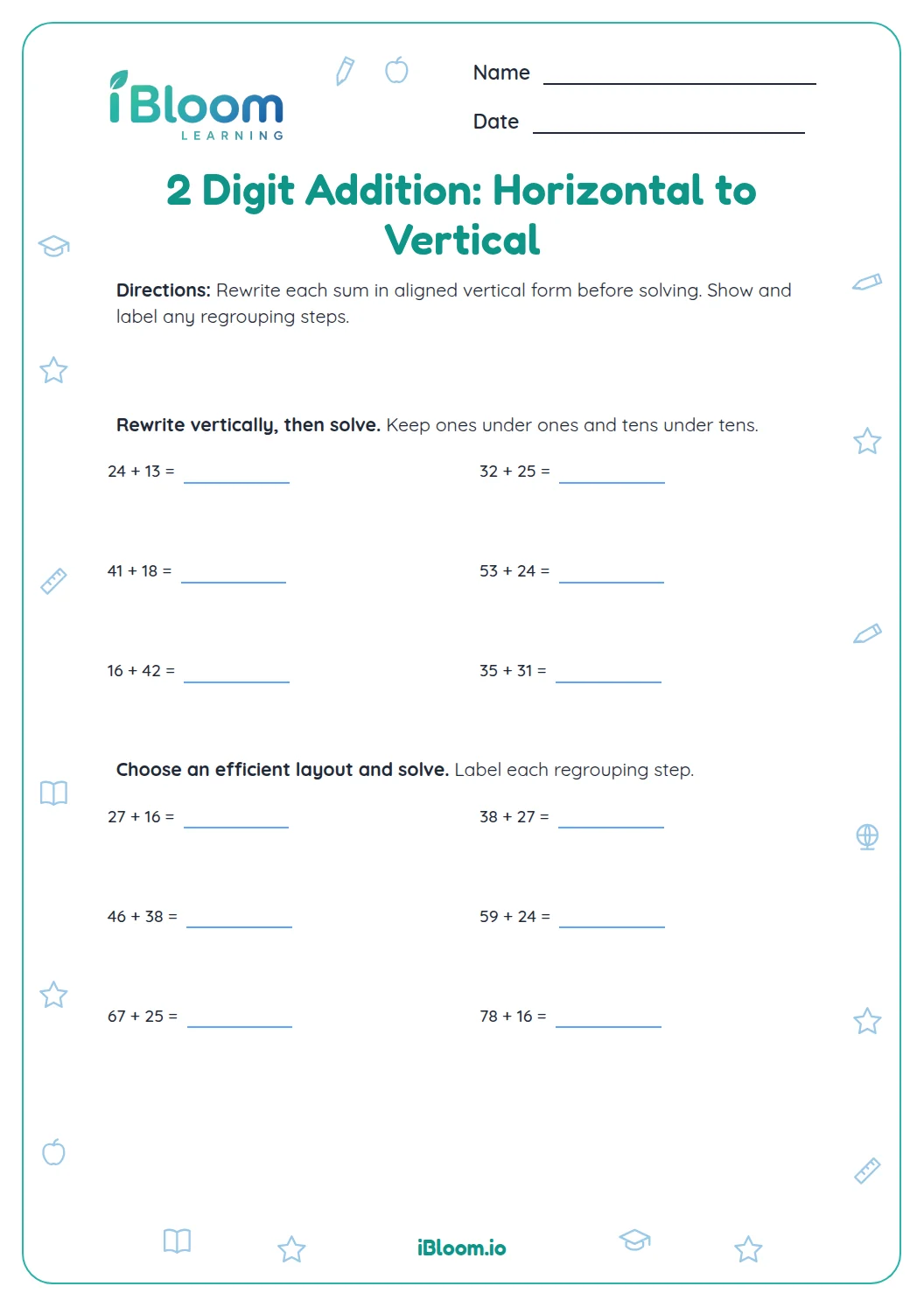
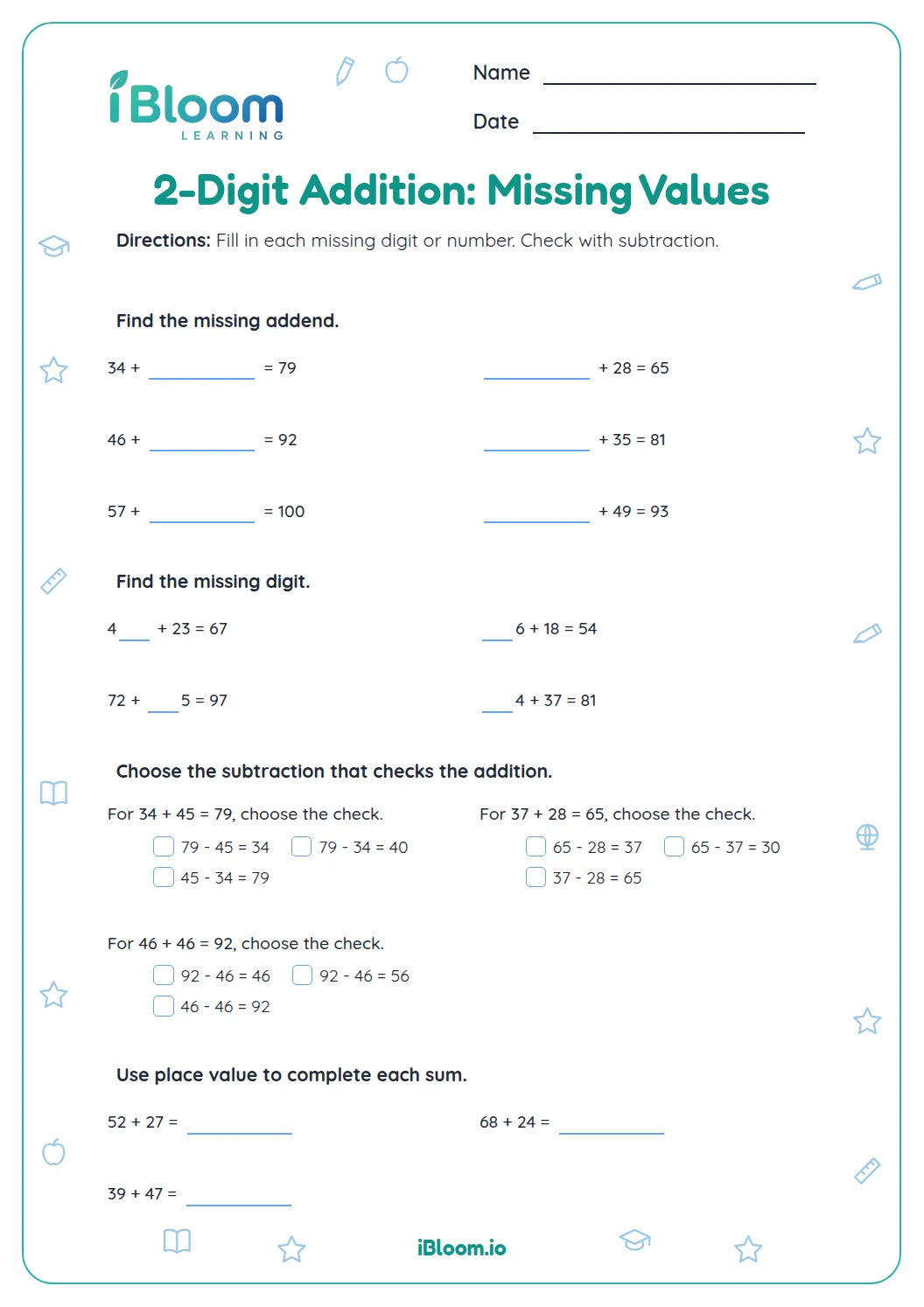
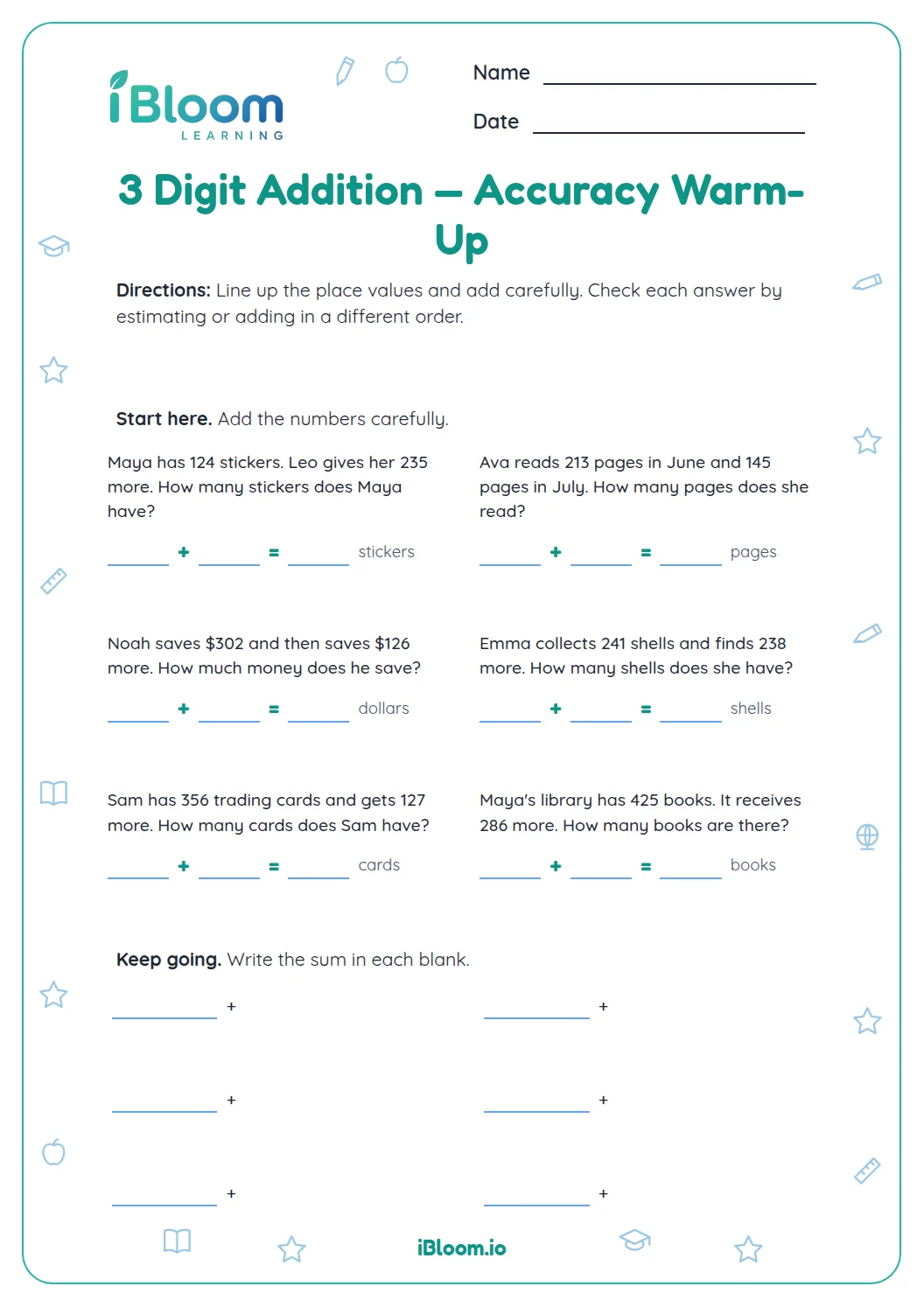
About this worksheet
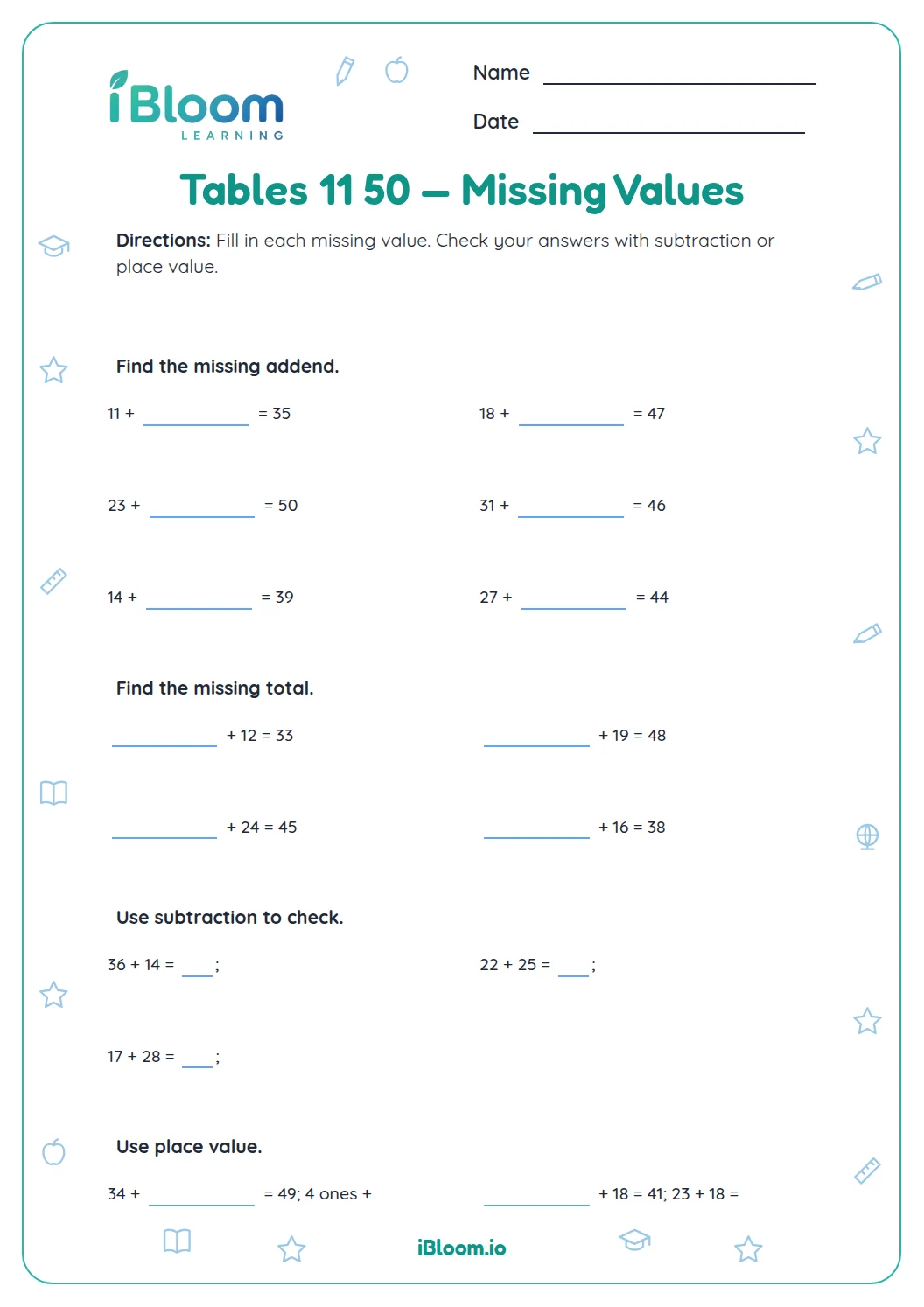
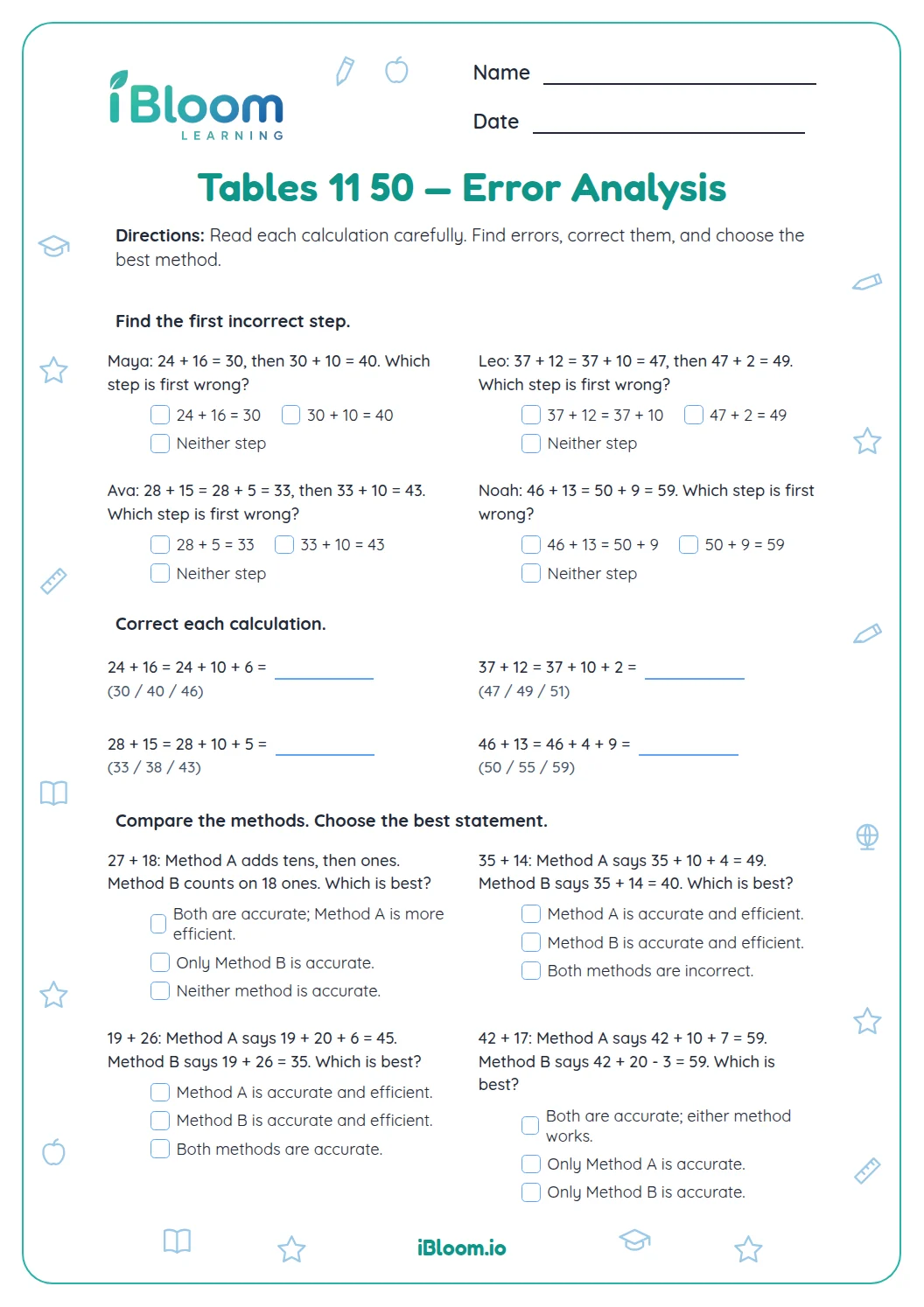
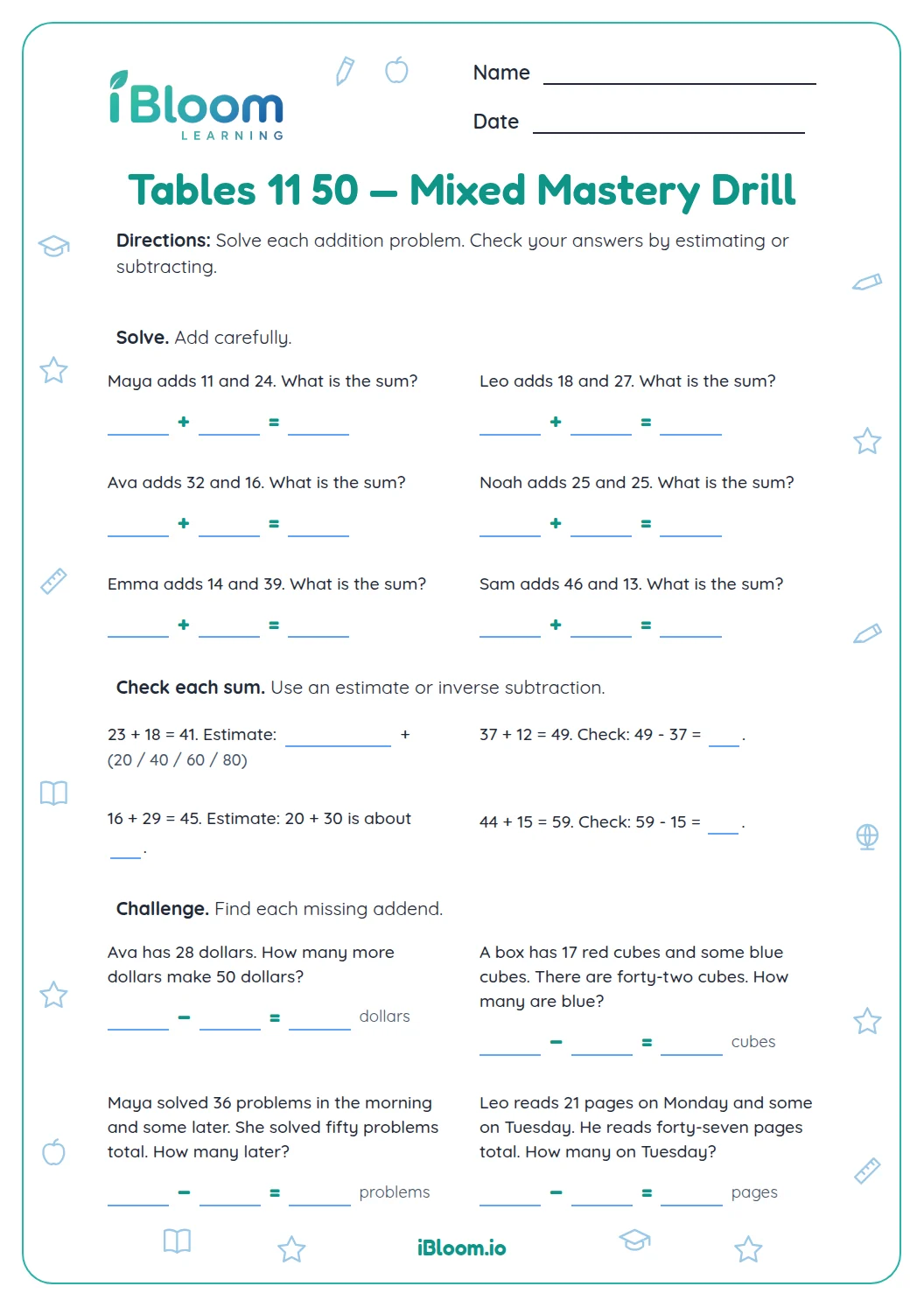
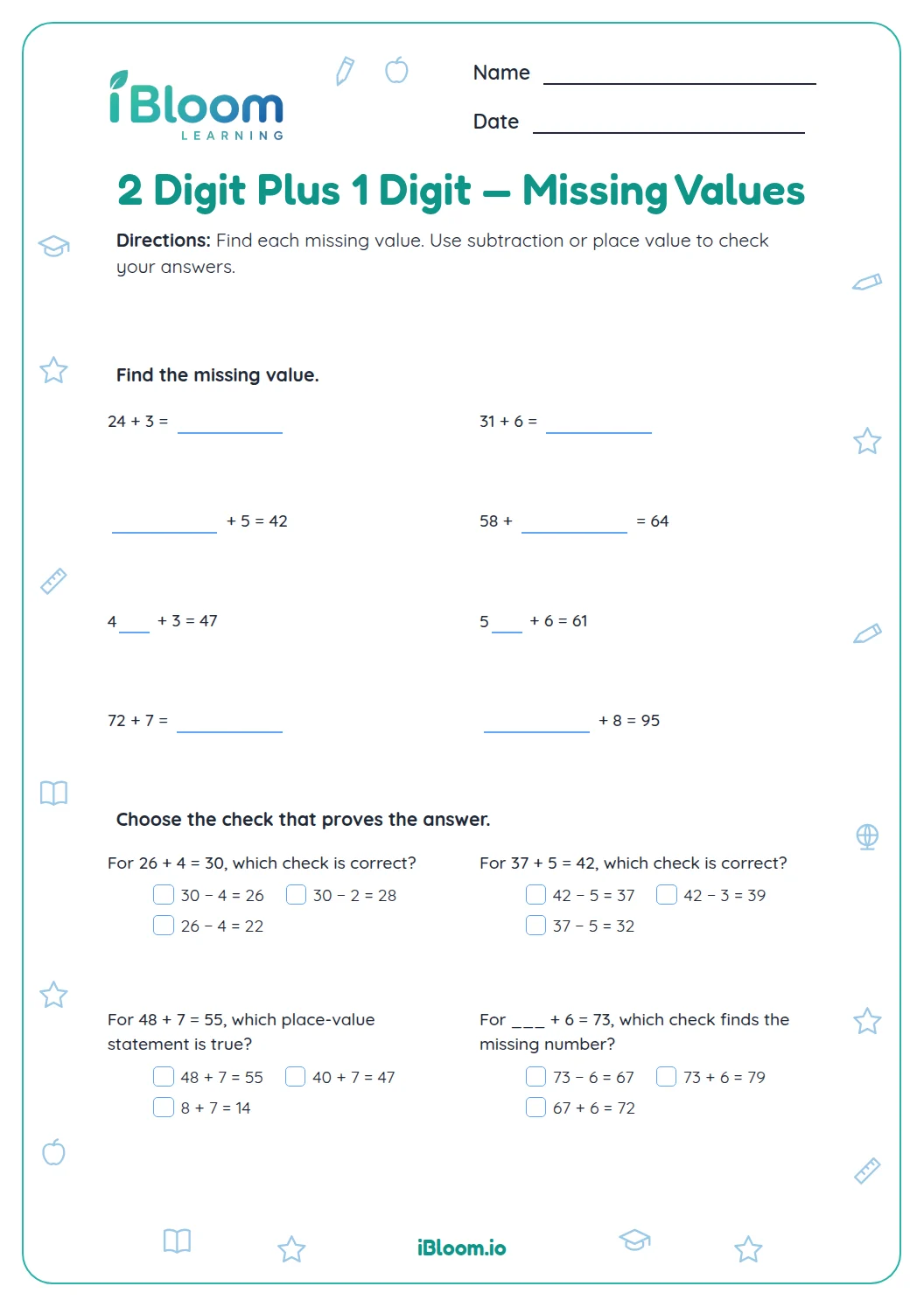
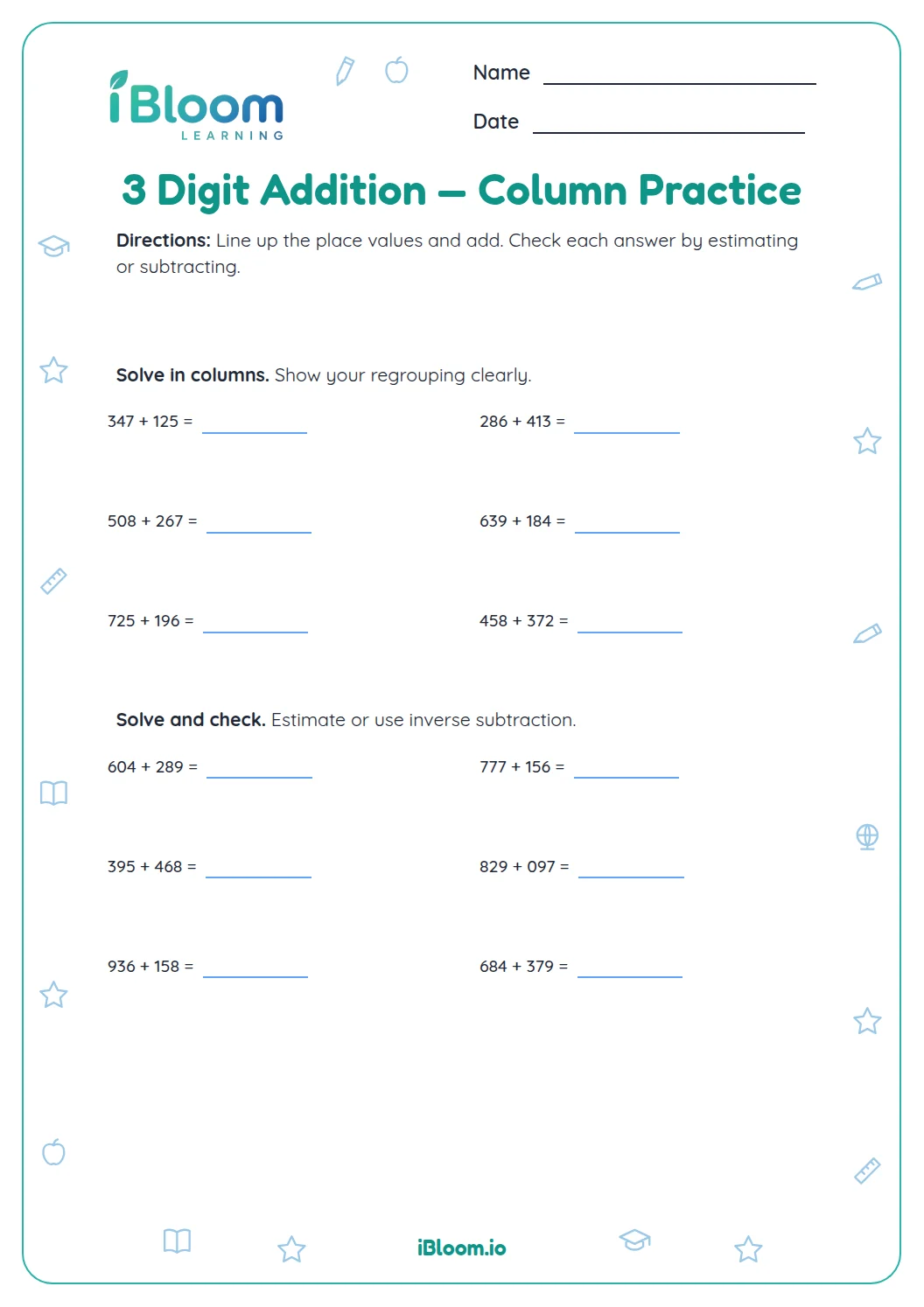
This printable addition warm-up is for learners practicing two-digit sums with addends from 11 to 50. It has 16 equations in two parts: the first mixes sums that do and do not require regrouping, and the second focuses on regrouping ten ones as one ten. Each problem leaves room to work, and a separate answer key lists the totals. The practice aligns with CCSS 2.NBT.B.5.
Aligned to 2.NBT.B.5
How do tens and ones help with addition?
Break each two-digit addend into tens and ones. Add the tens, then the ones. If the ones make 10 or more, trade ten ones for one ten and combine again.
- 111 + 24
- 210 + 20 = 30
- 31 + 4 = 5
- 430 + 5 = 35
When do you regroup?
The second set has ones digits that add to 10 or more. Rename those ones as one ten, add that ten to the tens, and keep any ones left over.
What does this warm-up include?
Part A has eight sums with addends from 11 through 50 and a mix of regrouping situations. Part B has eight more pairs, each with ones digits that total at least 10. The answer key lists each total.
- Part A: 8 sums with varied ones
- Part B: 8 sums that all require regrouping
- A separate answer key lists all totals
How to use this worksheet
- 1Read both addends before calculating.
- 2Add the tens and ones in separate groups.
- 3Look at the ones sum to decide whether to regroup.
- 4Trade each full group of ten ones for one ten.
- 5Check the tens and ones in your total.
Common mistakes and quick fixes
The mistake
Adding the tens but forgetting the ones.
The fix
Write or say the tens sum and ones sum separately before joining them.
The mistake
Keeping 13 ones as 13 ones after regrouping.
The fix
Rename 13 ones as 1 ten and 3 ones.
The mistake
Adding a regrouped ten twice.
The fix
Once the ten is added to the tens column, leave only the extra ones in the ones column.
Common Core alignment
The equations use place-value strategies to add within 100.
Use place value and addition strategies to add within 100.
On this sheet: Each pair uses two addends from 11 to 50 and sums within 100.
Show the official wordingHide the official wording
Fluently add and subtract within 100 using strategies based on place value, properties of operations, and/or the relationship between addition and subtraction.
What to practice next
Make more practice
Further reading
Questions parents and teachers ask
What range are the addends in?
Both addends in each question are between 11 and 50, inclusive. The 16 sums vary in whether the ones can be combined directly or need regrouping, and all totals stay below 100. Learners can split each number into tens and ones to work accurately.
How many questions are included?
The worksheet contains 16 equations arranged as a focused addition drill. The answer key lists each total, so an adult can check the work without crowding the student sheet. The questions use varied pairs rather than repeating one addition fact.
Which problems require regrouping?
A problem needs regrouping when its ones digits add to 10 or more. For example, 45 + 18 has 5 + 8 = 13 ones, so one ten is moved into the tens total. The answer key can help identify which sums to revisit.
Can a child use mental math?
Yes. Children may split each addend into tens and ones, add the tens first, then add the ones. Writing the steps is helpful when regrouping, and the worksheet leaves the method open while keeping each equation short and readable during practice.
What is the answer to the first problem?
The first problem is 11 + 24. Add 10 + 20 to make 30, then add 1 + 4 to make 5. The total is 35. This example shows how place value helps make two-digit addition easier to follow during checking.
Is there a separate answer key?
Yes. The answer key lists all 16 totals. An adult can print the worksheet without the key, or keep it nearby for checking and discussing regrouping. Each result is a whole number under 100, so the sums stay in range.