




About this worksheet
This Grade 3–4 division worksheet gives students focused practice with division facts for 6. Part A has eight quotients, Part B has four equal-sharing stories, and Part C has four related multiplication and division equations. The separate key supports checking each result. The sheet practices CCSS 3.OA.B.6.
Aligned to 3.OA.B.6
What does a division fact by 6 ask?
A fact such as 42 ÷ 6 asks how many groups of 6 make 42. Thinking 6 × 7 = 42 helps identify the quotient 7.
- 142 ÷ 6 = ___
- 2Ask: 6 times what number is 42?
- 36 × 7 = 42, so the quotient is 7.
How can multiplication help with division?
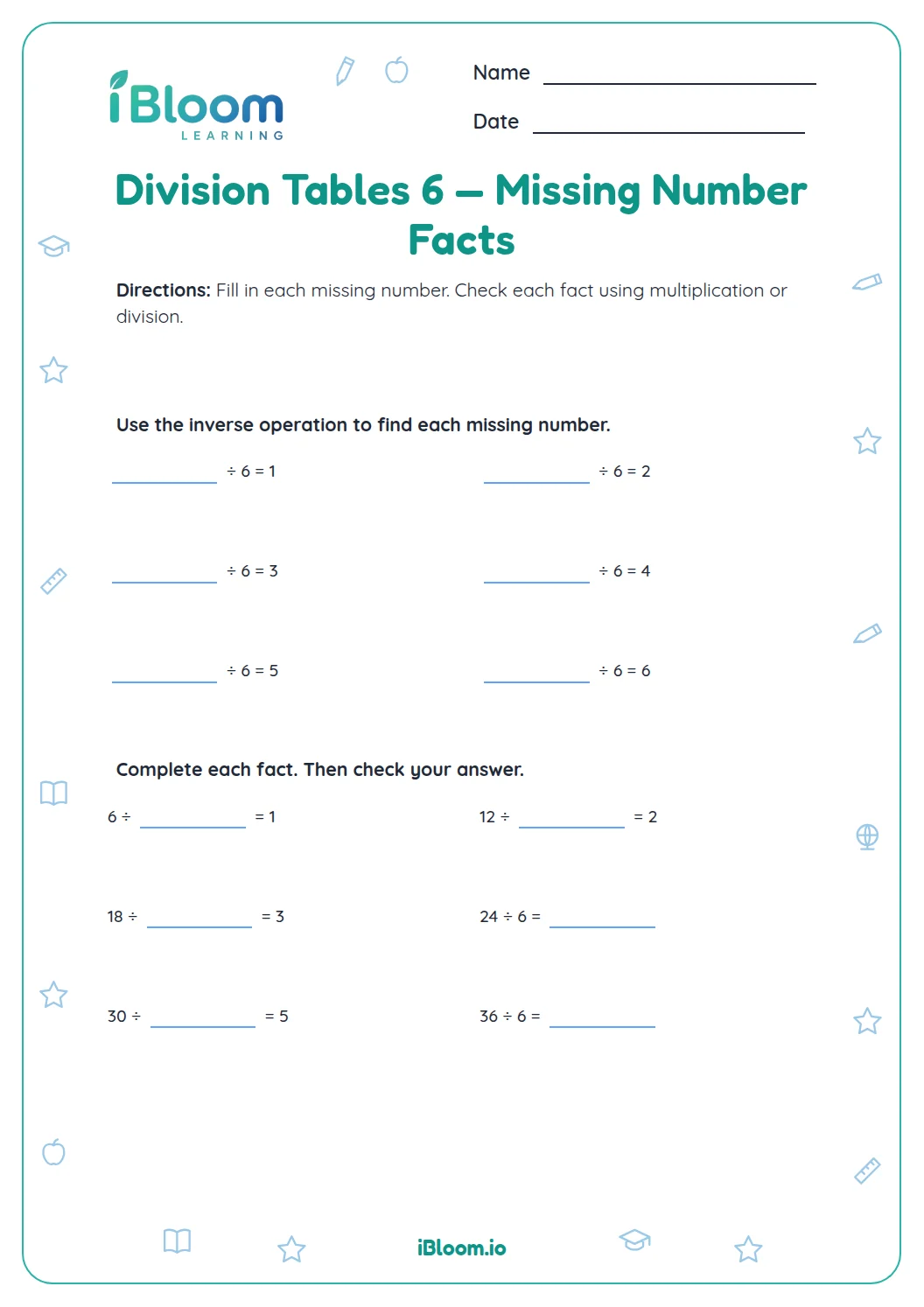
Multiplication and division undo each other. In Part B, a blank can stand for a factor, dividend, divisor, product, or quotient. Read the whole equation before deciding what is missing.
- 16 × ___ = 24
- 224 ÷ 6 = 4
- 3The missing factor is 4.
What is in the warm-up?
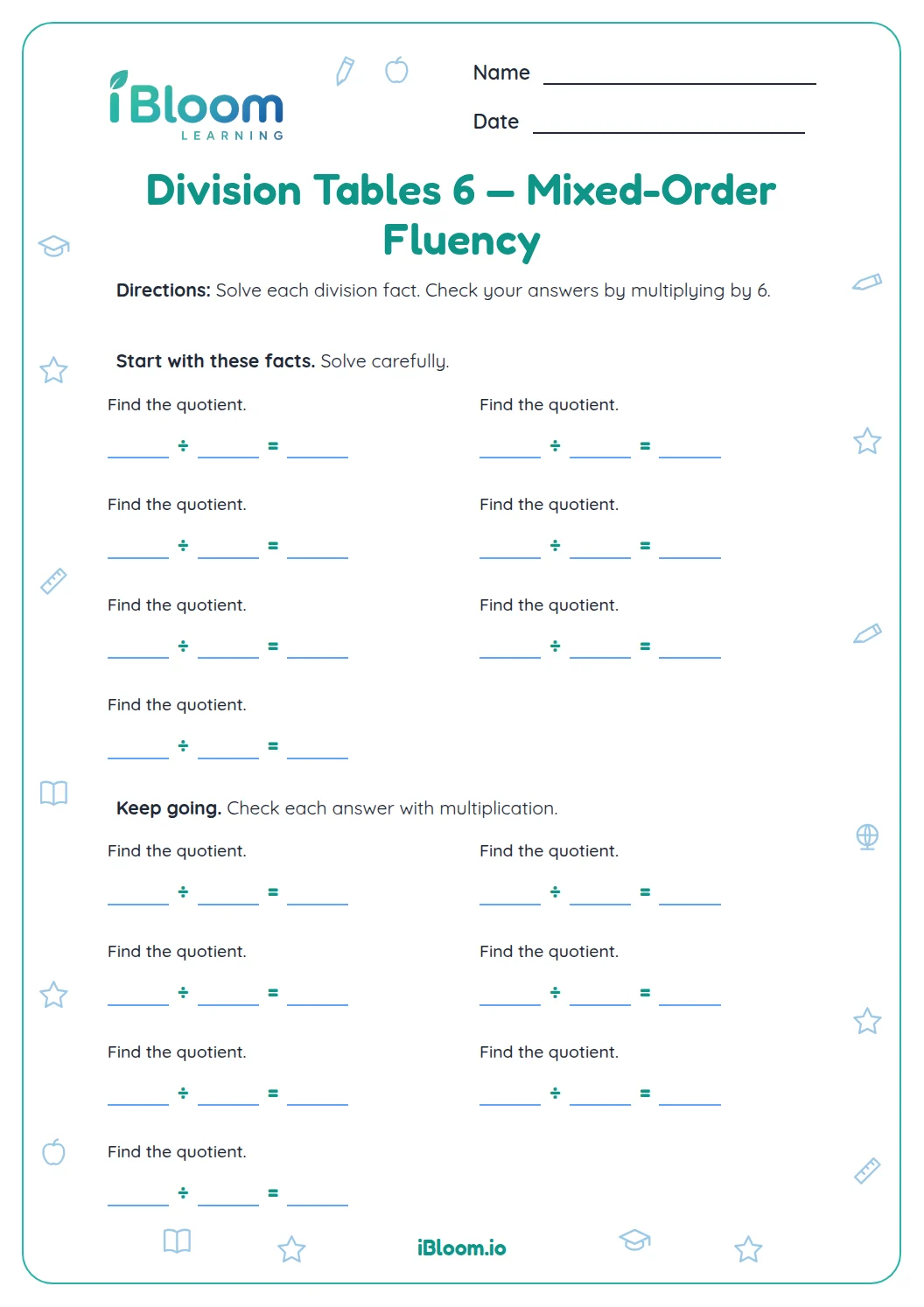
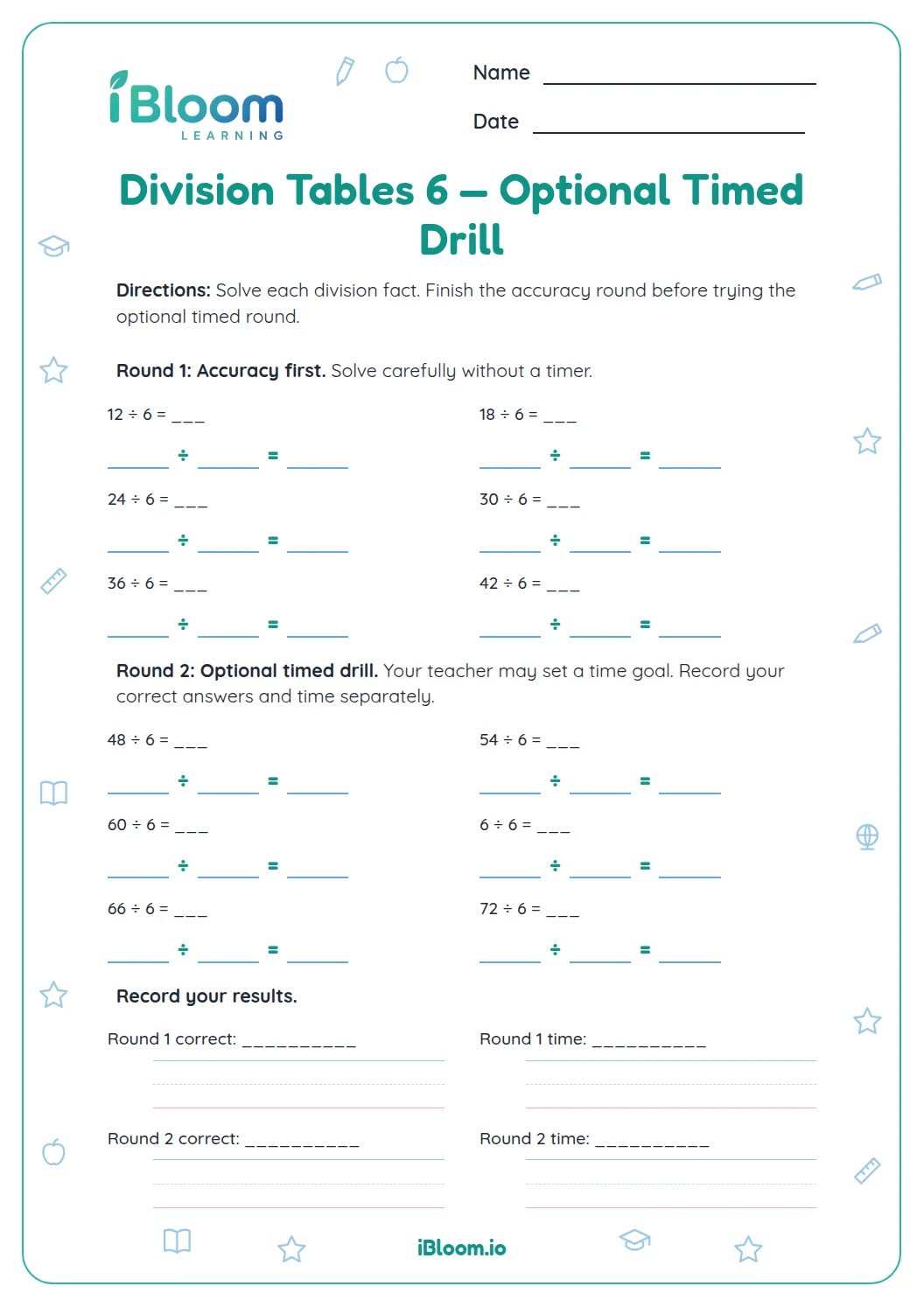
Part A has eight quotients from the 6s table. Part B uses eight different missing-number equations to vary the direction of the same fact relationships.
- Part A: eight division facts
- Part B: eight related multiplication and division equations
- Answer key: all 16 answers
How to use this warm-up
- 1Read the operation sign before solving.
- 2For division, ask how many groups of 6 make the dividend.
- 3For a missing factor, use the product and the known factor.
- 4For a missing divisor, check which divisor makes the quotient true.
- 5Write one number in each blank.
- 6Check division with multiplication and use the separate key to review.
Common mistakes and quick fixes
The mistake
Dividing the divisor by the dividend.
The fix
Say the equation aloud and ask how many groups of 6 make the dividend.
The mistake
Treating a missing factor like a missing product.
The fix
Use the known factor and product to find the missing factor.
The mistake
Ignoring the operation sign in a related fact.
The fix
Circle × or ÷ before solving, then verify the complete equation.
Common Core alignment
The practice builds multiplication and division fact fluency within 100.
Understand division as an unknown-factor problem and solve with multiplication facts.
On this sheet: Students use multiplication facts to find quotients and missing numbers.
Show the official wordingHide the official wording
Understand division as an unknown-factor problem. For example, find 32 ÷ 8 by finding the number that makes 32 when multiplied by 8.
What to practice next
Make more practice
Further reading
Questions parents and teachers ask
Which facts are on this worksheet?
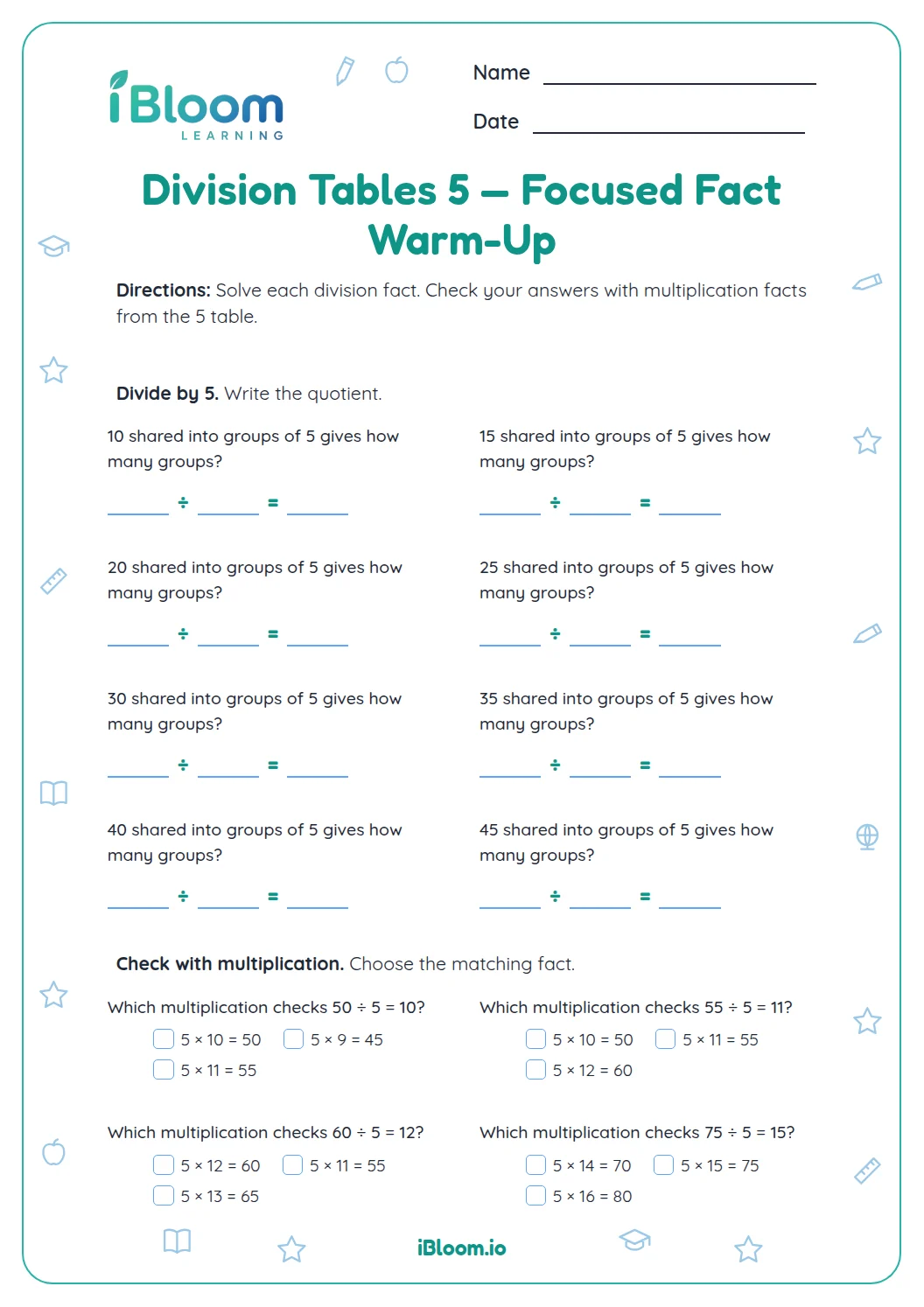
Part A has eight division facts with 6 as the divisor. Part B has four equal-sharing stories, and Part C has four related equations with a missing factor, dividend, divisor, or quotient. Together, they give practice with the division table for 6 in more than one form.
How can a student check a division answer?
Multiply the quotient by the divisor. For example, if 42 ÷ 6 = 7, check that 7 × 6 equals 42. The worksheet includes four sharing stories where students can write a division equation before giving the quotient.
Is this for Grade 3 or Grade 4?
The saved page is tagged for Grades 3 and 4. The questions stay within 100 and focus on division facts for 6, with related multiplication equations to connect the operations. Students can use the matching multiplication fact to check each quotient and build accuracy with the facts.
Is an answer key included?
Yes. A separate answer key lists all 16 answers. Students can solve the fact section, write a division equation for each sharing story, then substitute each number into the related equation before checking their work. The key also helps an adult review any missed fact.
How long does the warm-up take?
About 10 minutes is a useful estimate for the 16 items, including four sharing stories. Students can write a matching multiplication equation beside a quotient to check the relationship and build fluency with the facts for 6. Pause to talk through a story if needed.