




About this worksheet
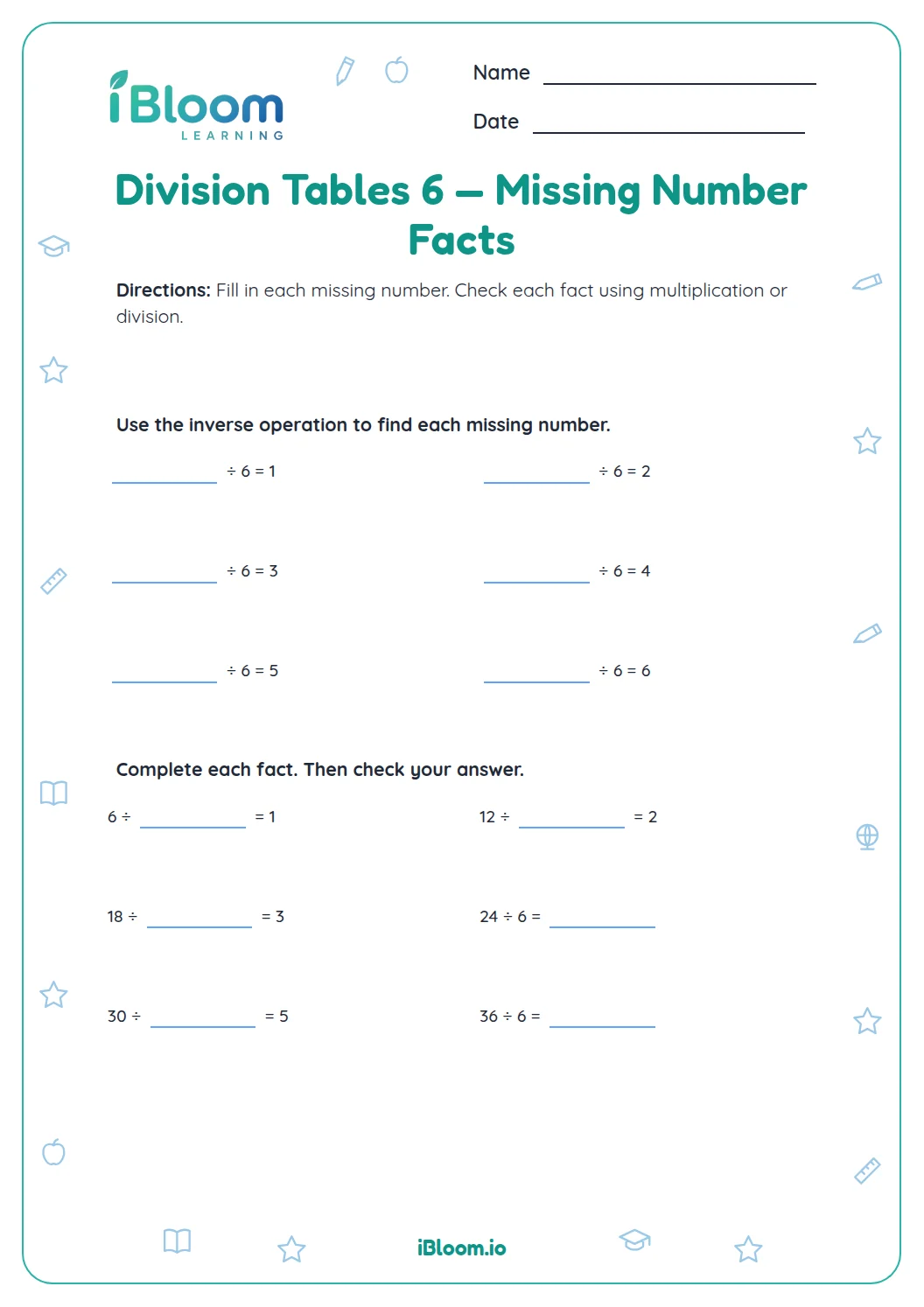
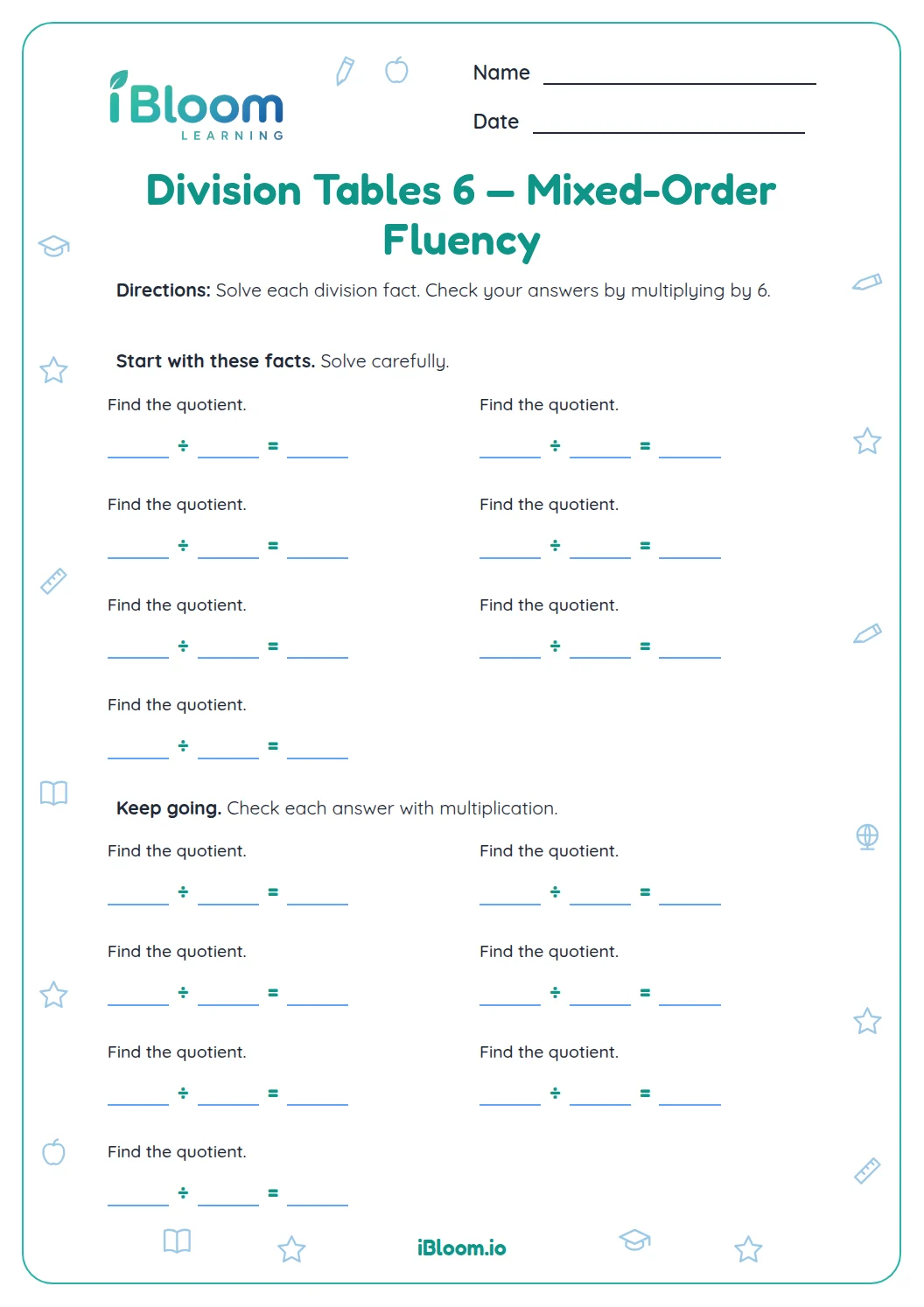
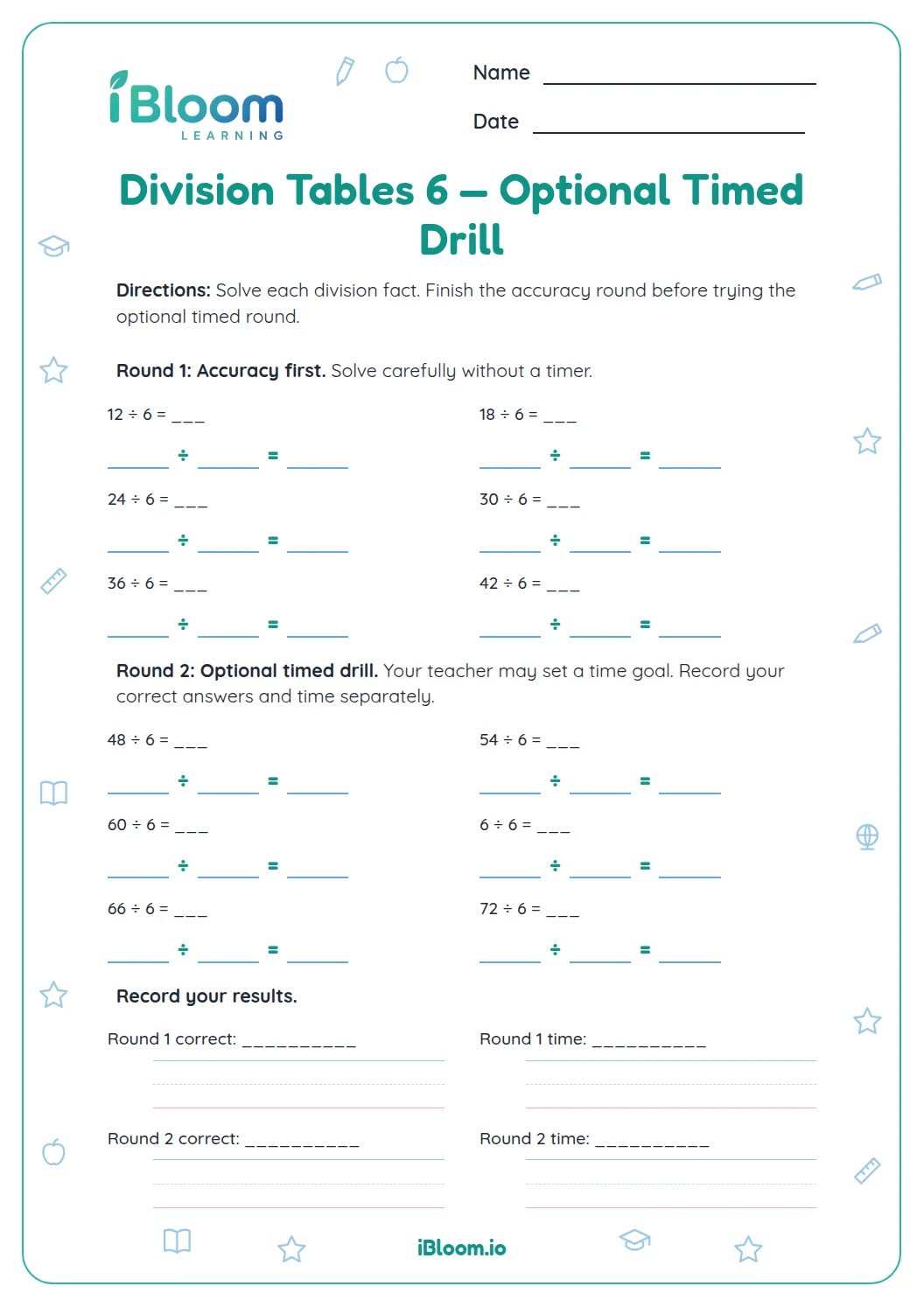
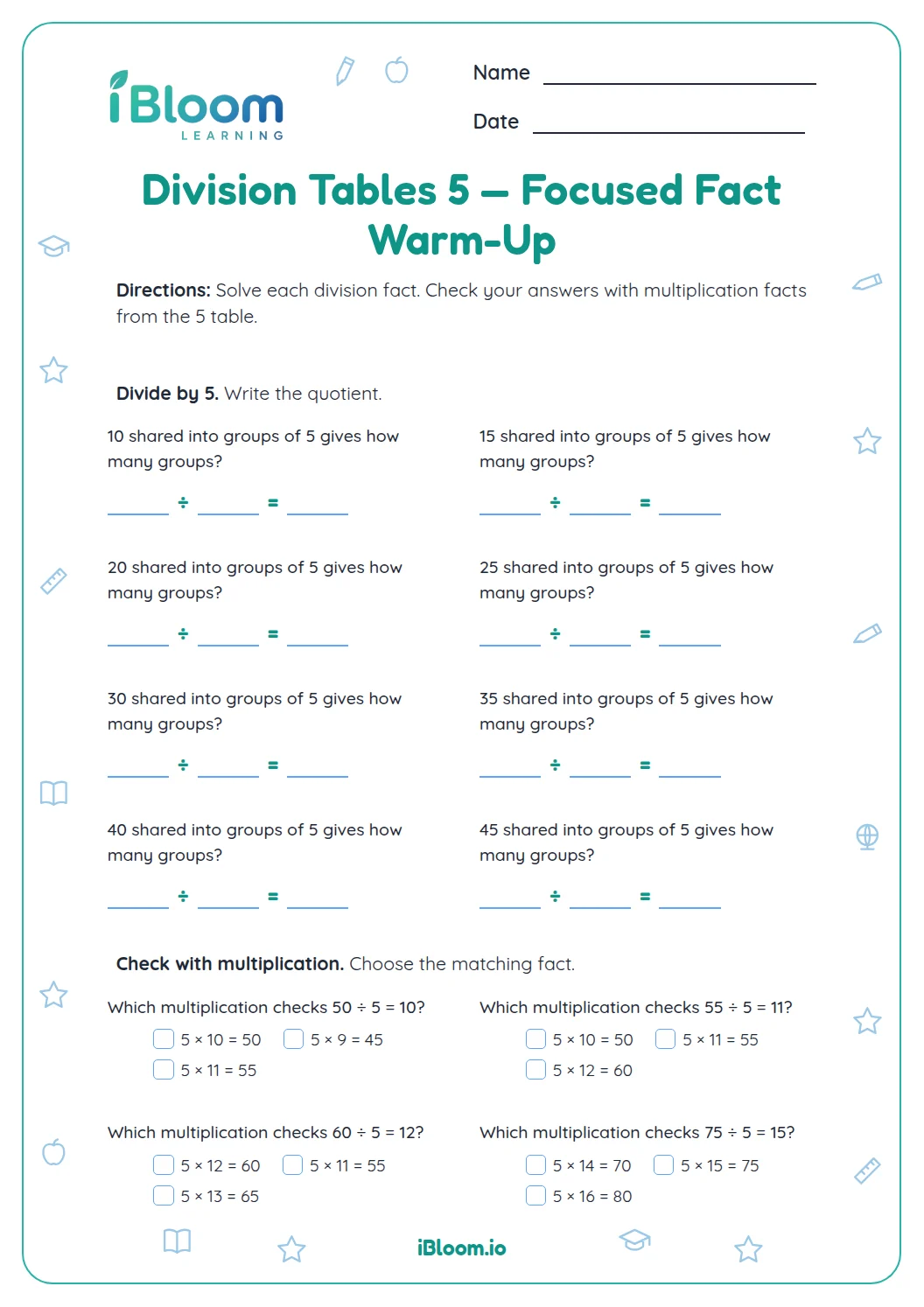
This printable division mastery check gives Grade 3 learners 16 facts with 6 as the divisor. The dividends vary from 6 to 60, and the order mixes easier facts with larger products so students must recall each quotient. A separate answer key makes checking quick. It practices CCSS 3.OA.C.7.
Aligned to 3.OA.C.7
How does multiplication check a division fact?
For 42 ÷ 6, ask which number multiplied by 6 makes 42. Since 6 × 7 = 42, the quotient is 7.
- 1For 42 ÷ 6, ask which number multiplied by 6 makes 42. Since 6 × 7 = 42, the quotient is 7.
How is the practice organized?
Part A includes each quotient from 1 through 10 once. Part B uses six equal-sharing or grouping situations with the same divisor.
How can the answer key support review?
After finishing, compare each response with the key. For a missed item, reread the prompt and use the relevant relationship or text detail to correct it.
How to use this worksheet
- 1Read the directions and look over the parts.
- 2Try the first item in each part slowly.
- 3Use the key idea to solve the remaining items.
- 4Check each result against the prompt.
- 5Use the answer key to review any missed items.
Common mistakes and quick fixes
The mistake
Using 6 ÷ dividend instead of dividend ÷ 6.
The fix
Read the dividend first and ask what number times 6 gives it.
The mistake
Confusing 48 ÷ 6 with 6 ÷ 8.
The fix
Check the order by multiplying the quotient by the divisor.
The mistake
Guessing a quotient without checking.
The fix
Multiply your answer by 6; the product should match the dividend.
Common Core alignment
This worksheet gives focused practice with the standards below.
Recall division facts and use multiplication to check quotients.
On this sheet: Recall division facts and use multiplication to check quotients.
Show the official wordingHide the official wording
Fluently multiply and divide within 100, using strategies such as the relationship between multiplication and division (e.g., knowing that 8 × 5 = 40, one knows 40 ÷ 5 = 8) or properties of operations. By the end of Grade 3, know from memory all products of two one-digit numbers.
What to practice next
Make more practice
Further reading
Questions parents and teachers ask
Which division facts are included?
The first ten items include each quotient from 1 through 10 once for division by 6. Six more questions use sharing or equal groups, with dividends from 6 to 60. Together, they practice the full sixes division table in number sentences and short contexts.
How can a learner check a quotient?
Multiply the quotient by 6 and check that the product is the dividend. For example, 42 ÷ 6 = 7 checks because 7 × 6 = 42. In a story problem, the quotient also tells how many groups or how many objects belong in each group.
Is this worksheet timed?
No timer is needed. Learners can focus on correct recall and use multiplication to check. After correcting the page, they may try it again later and compare how easily the sixes facts come to mind. This gives a clear chance to review the skill.
What grade is this for?
The page is designed for Grade 3. It practices division facts within 100, using 6 as the divisor, and connects those facts to multiplication and equal groups. This gives a clear chance to review the skill. The related multiplication fact helps verify the quotient.
Does it include an answer key?
Yes. The separate answer key lists the ten division quotients and the six story answers in worksheet order. Learners can check after finishing, then use the related multiplication fact to repair any response that does not match. This gives a clear chance to review the skill.