




About this worksheet
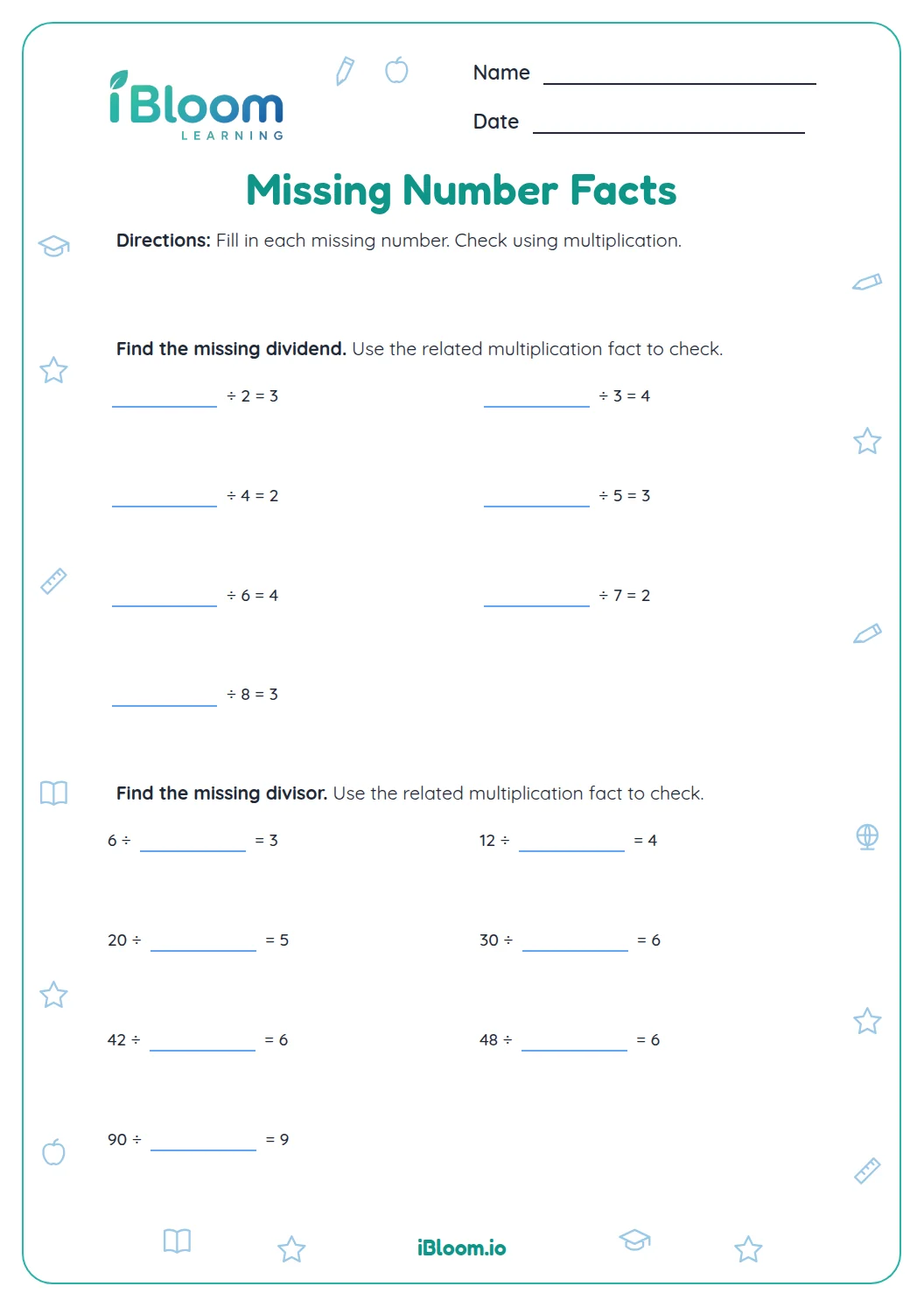
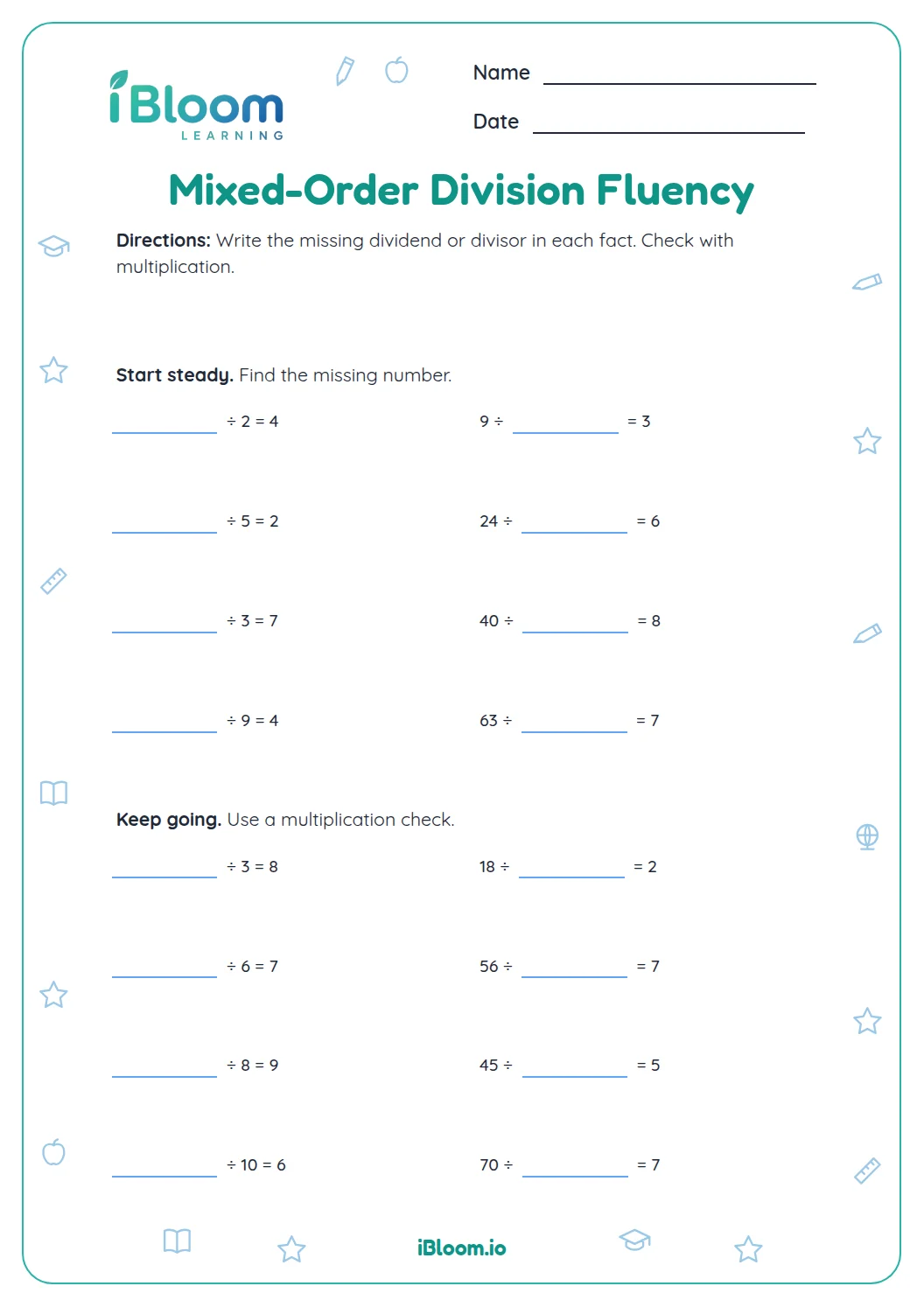
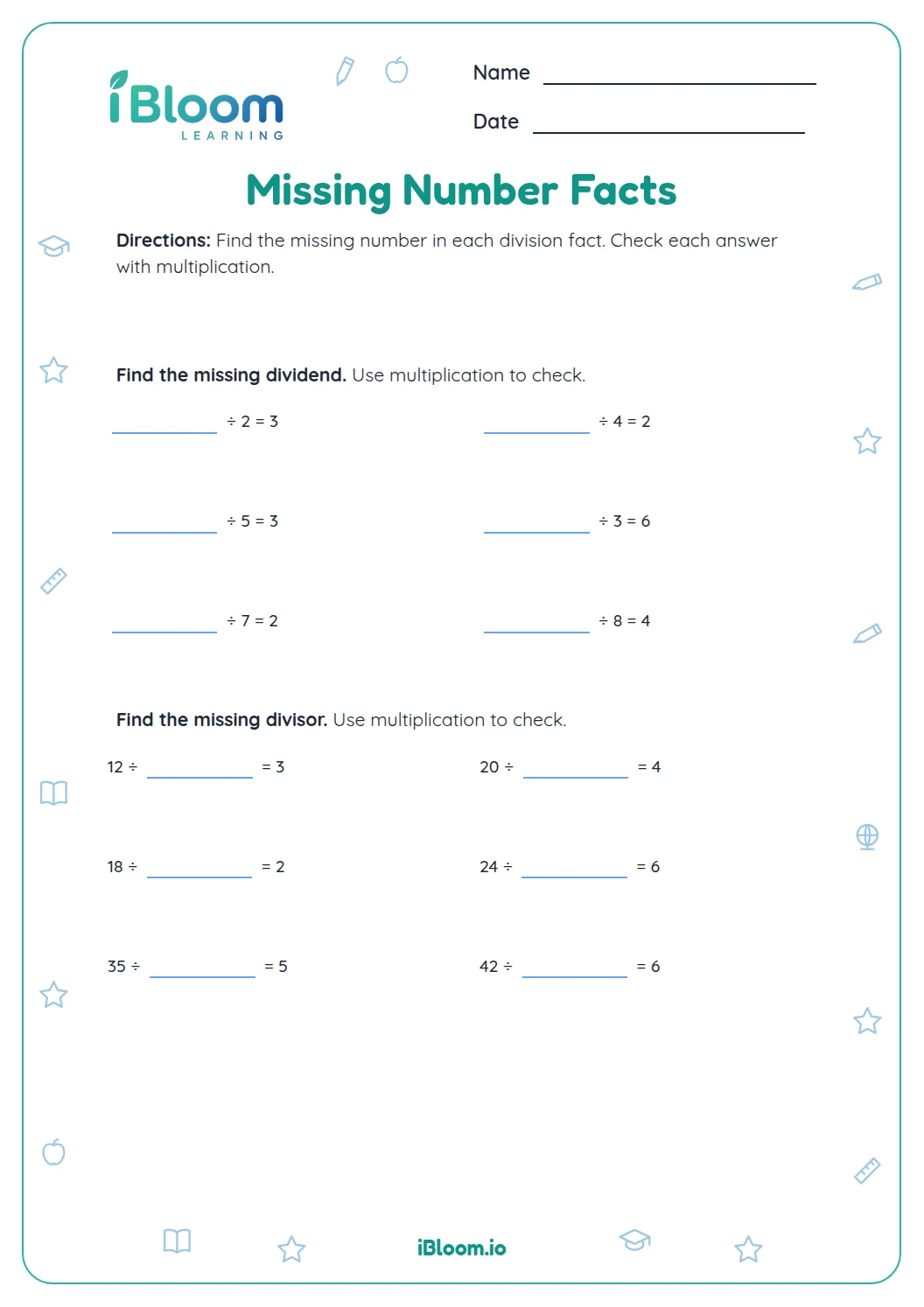
This Grade 3 division printable has 16 missing-number equations. The first eight ask for a dividend; the next eight ask for a divisor. Learners can check each fact with multiplication, and a separate answer key provides all the missing numbers.
Aligned to 3.OA.A.4
How do you find a missing dividend?
The dividend is the number being divided. In question 1, ___ ÷ 6 = 4. Multiply the divisor by the quotient: 6 × 4 = 24, so the missing dividend is 24.
- 1___ ÷ 6 = 4
- 26 × 4 = 24
- 3The missing dividend is 24.
How do you find a missing divisor?
The divisor tells how many equal groups or what group size is used. For 36 ÷ ___ = 9, ask what number times 9 equals 36. Since 4 × 9 = 36, the missing divisor is 4.
How can multiplication check a division fact?
Multiply the divisor by the quotient. Their product should equal the dividend. For 56 ÷ 7 = 8, check 7 × 8 = 56. This related multiplication fact works for both kinds of missing-number questions.
How to solve each division fact
- 1Locate the missing number and identify dividend or divisor.
- 2For a missing dividend, multiply divisor by quotient.
- 3For a missing divisor, find the factor that pairs with the quotient to make the dividend.
- 4Write the number in the blank.
- 5Multiply divisor by quotient to check the equation.
Common missing-number mistakes
The mistake
Dividing the quotient by the divisor to find a dividend.
The fix
Multiply divisor by quotient to recover the dividend.
The mistake
Putting the quotient in the divisor blank.
The fix
Find the number that multiplied by the quotient gives the dividend.
The mistake
Skipping the check.
The fix
Multiply divisor by quotient and confirm that the result is the dividend.
Common Core alignment
The questions practice 3.OA.A.4 by applying the target skill in each item.
Determine the unknown number in a multiplication or division equation.
On this sheet: Each item asks learners to find a missing dividend or divisor in a division equation.
Show the official wordingHide the official wording
Determine the unknown whole number in a multiplication or division equation relating three whole numbers. For example, determine the unknown number that makes the equation true in each of the equations 8 × ? = 48, 5 = _ ÷ 3, 6 × 6 = ?
What to practice next
Make more practice
Further reading
Questions parents and teachers ask
What kinds of missing numbers does this division sheet include?
The 16 equations are split between missing dividends and missing divisors. In the first eight, the dividend is unknown; in the last eight, the divisor is unknown. Every fact uses whole numbers and a divisor or quotient within 10.
How do I find a missing dividend?
Multiply the divisor by the quotient. For ___ ÷ 6 = 4, calculate 6 × 4 to get 24. Check by dividing 24 by 6. Questions 1 through 8 use this related multiplication fact to find each missing dividend.
How do I find a missing divisor?
Use the dividend and quotient to find the number that makes the division equation true. In 36 ÷ ___ = 9, the missing divisor is 4 because 4 × 9 = 36. Questions 9 through 16 practice this type of unknown.
Does the worksheet have an answer key?
Yes. A separate answer key gives the missing number for each equation. Learners can also use multiplication to check every response: divisor times quotient should equal the dividend. This check works whether the missing value is the dividend or divisor.
How long does the division practice take?
Plan for about 15 minutes for 16 short equations, with time to check the facts. Learners may work through the missing-dividend section first and then the missing-divisor section. Pause to review the inverse multiplication relationship if an equation is difficult.