


About this worksheet
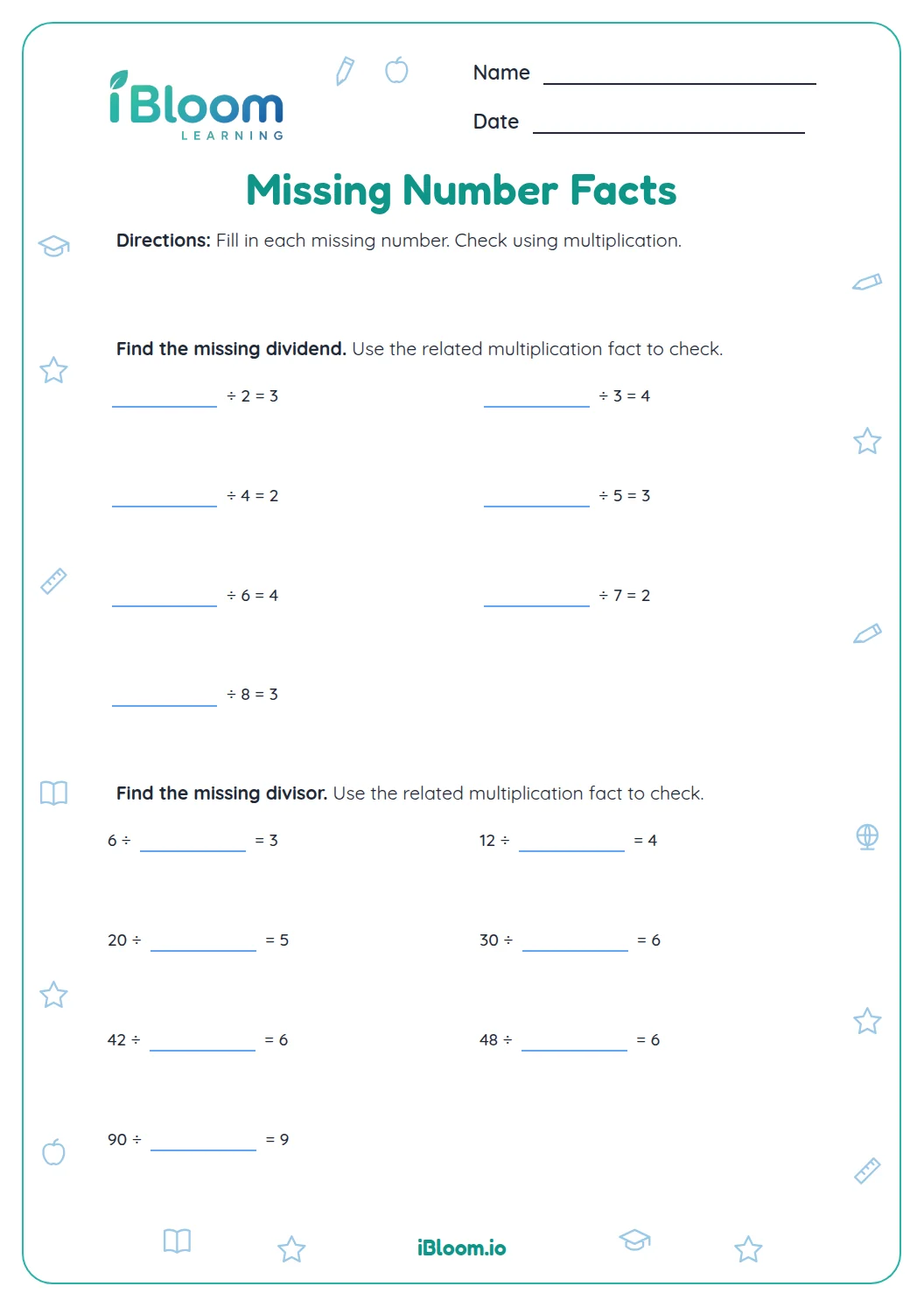
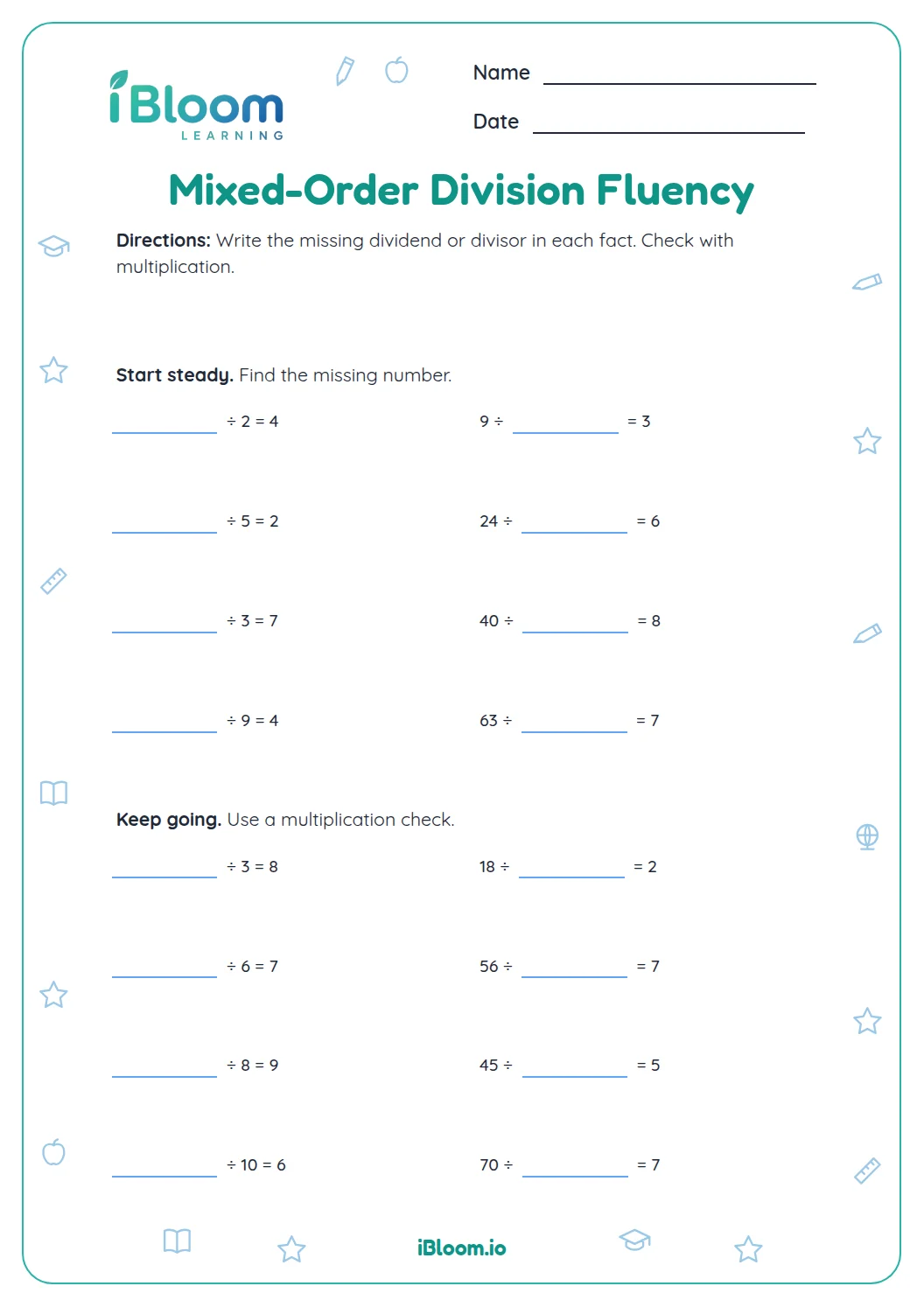
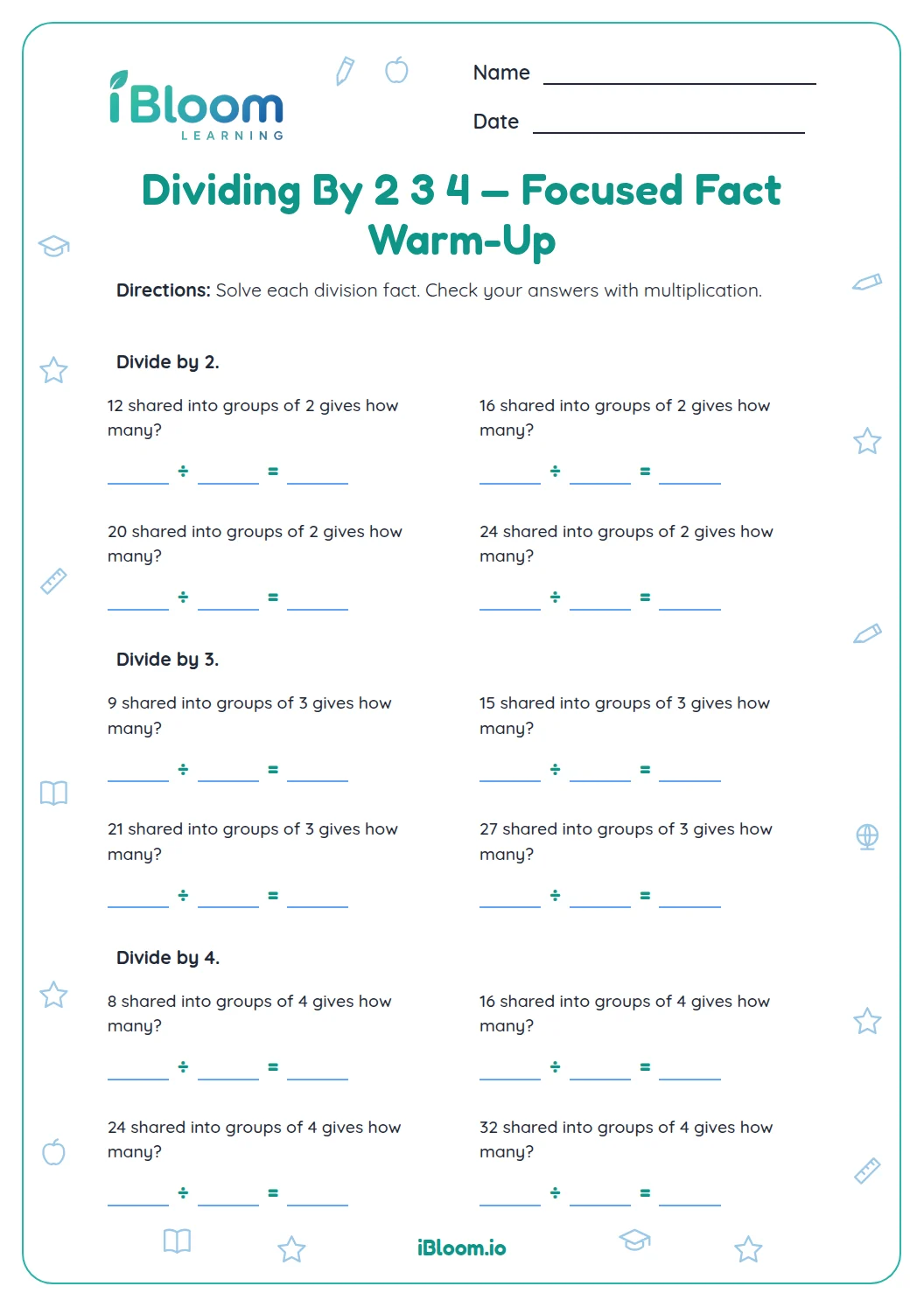
This Grade 3 division worksheet has 20 facts with missing quotients, dividends, and divisors. Students use multiplication to check each relationship, and may complete the drill without timing. A separate answer key lists each missing number.
Aligned to CCSS.MATH.CONTENT.3.OA.C.7
How do you find a missing quotient?
Use the related multiplication fact. In 36 ÷ 4 = ___, ask which number multiplied by 4 makes 36; that number is 9.
How do you find a missing dividend?
Multiply the divisor and quotient. For ___ ÷ 7 = 6, compute 7 × 6 to find the missing dividend, 42.
How do you find a missing divisor?
Find the number that divides the dividend into the stated quotient. For 56 ÷ ___ = 8, use 8 × 7 = 56, so the missing divisor is 7.
How can students check each fact?
- 1Identify whether the quotient, dividend, or divisor is missing.
- 2Use a related multiplication fact to find the unknown.
- 3Write the missing number in the blank.
- 4Read the full division sentence to check it.
- 5Compare answers with the key; timing is optional.
Which division slips should students watch for?
The mistake
Multiplying the dividend by the quotient to find a divisor.
The fix
Use divisor × quotient = dividend and solve for the missing factor.
The mistake
Switching the dividend and divisor.
The fix
The dividend is the number being divided; it comes before ÷.
The mistake
Rushing to finish before checking.
The fix
Multiply the divisor and quotient to confirm the dividend.
Curriculum alignment
This worksheet practices the grade-level skill named in its title.
Use multiplication and division relationships to solve division facts within 100.
On this sheet: The activities directly practice this skill.
Show the official wordingHide the official wording
Fluently multiply and divide within 100, using strategies such as the relationship between multiplication and division (e.g., knowing that 8 × 5 = 40, one knows 40 ÷ 5 = 8) or properties of operations. By the end of Grade 3, know from memory all products of two one-digit numbers.
What to practice next
Make more practice
Further reading
Questions parents and teachers ask
What kinds of missing numbers appear?
The 16 items include missing quotients, missing dividends, and missing divisors. Students first complete quotient facts, then find a dividend, and then work with missing divisors and mixed facts. Each answer is a whole number in a familiar division fact.
Do students need a timer?
No. The title calls timing optional, and students can solve the facts without a timer. If timing is used, it can be a low-pressure way to repeat familiar facts after accuracy is established. The worksheet itself asks students to focus on solving and checking.
How can I check a missing dividend?
Multiply the divisor by the quotient. In ___ ÷ 7 = 6, multiply 7 by 6 to get 42. Then substitute 42 and check that 42 divided by 7 equals 6. Students can point to the clue or place-value step they used so the check also reinforces the skill.
How can I check a missing divisor?
Use the multiplication fact that has the dividend as its product. For 56 ÷ ___ = 8, ask what number times 8 equals 56. The missing divisor is 7, because 7 × 8 = 56. Students can point to the clue or place-value step they used so the check also reinforces the skill.
Is an answer key included?
Yes. The answer key lists the missing value for each of the 16 facts. Students can use it after attempting the page, then review a missed item by writing its related multiplication fact. Students can point to the clue or place-value step they used so the check also reinforces the skill.