


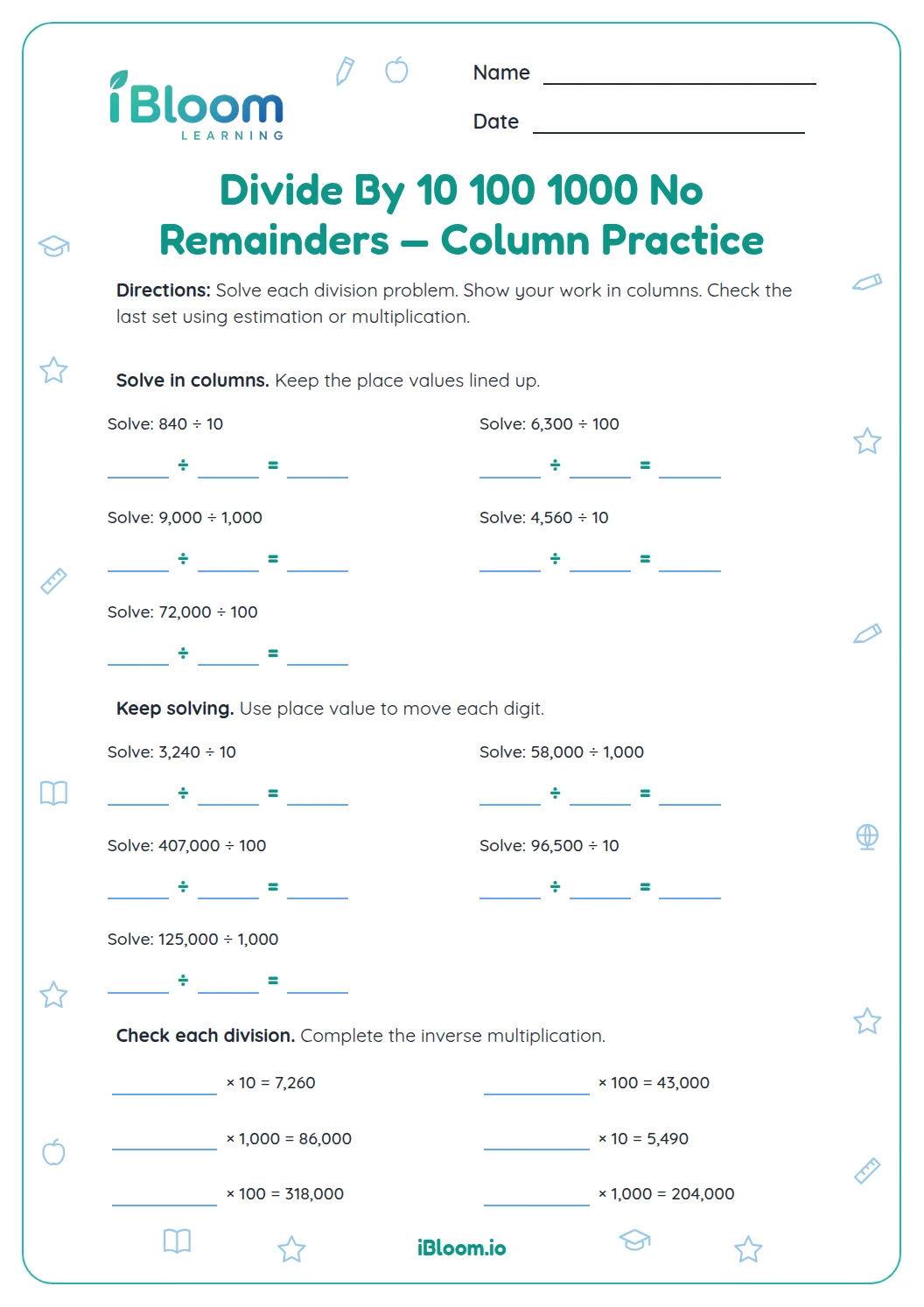
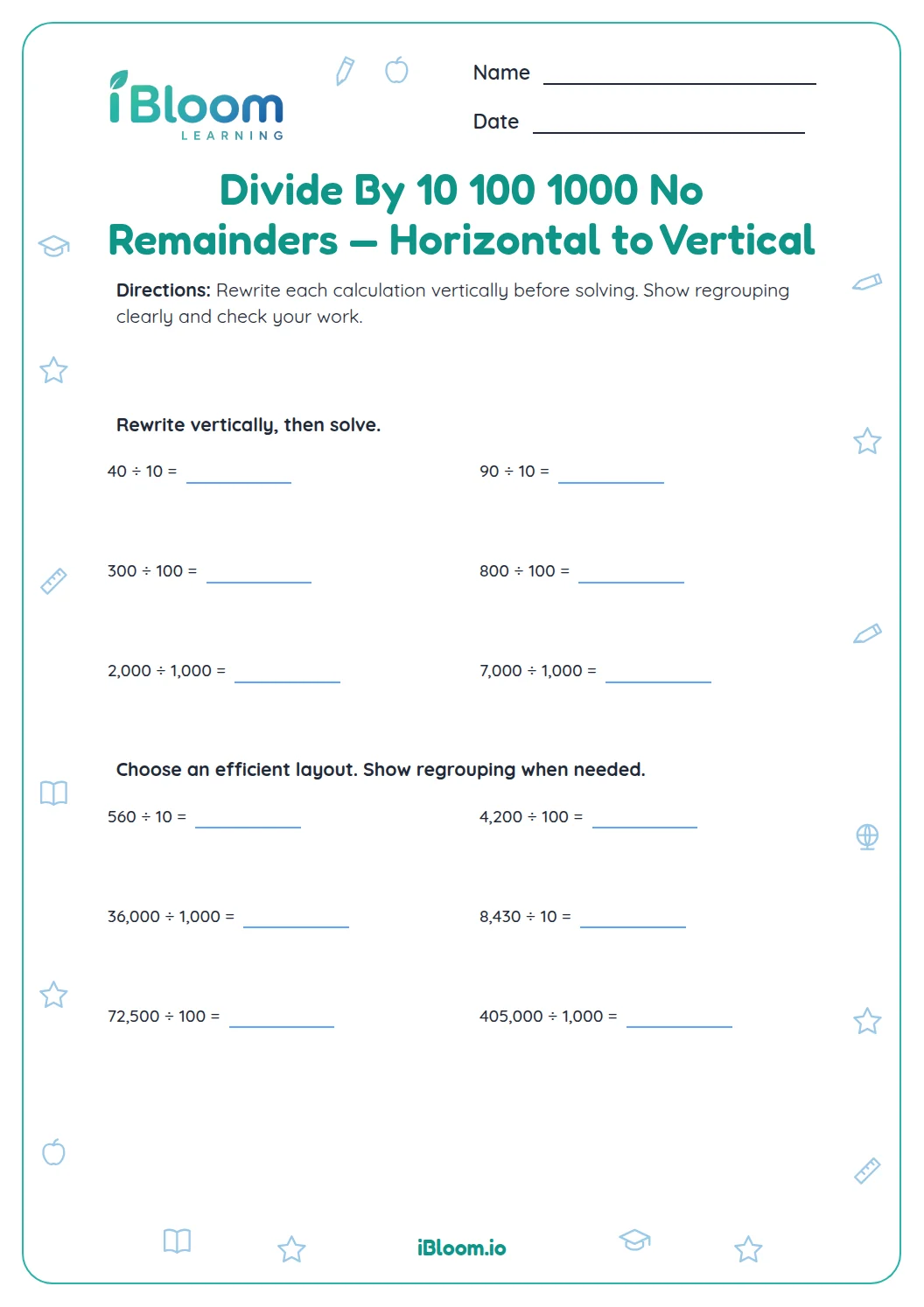

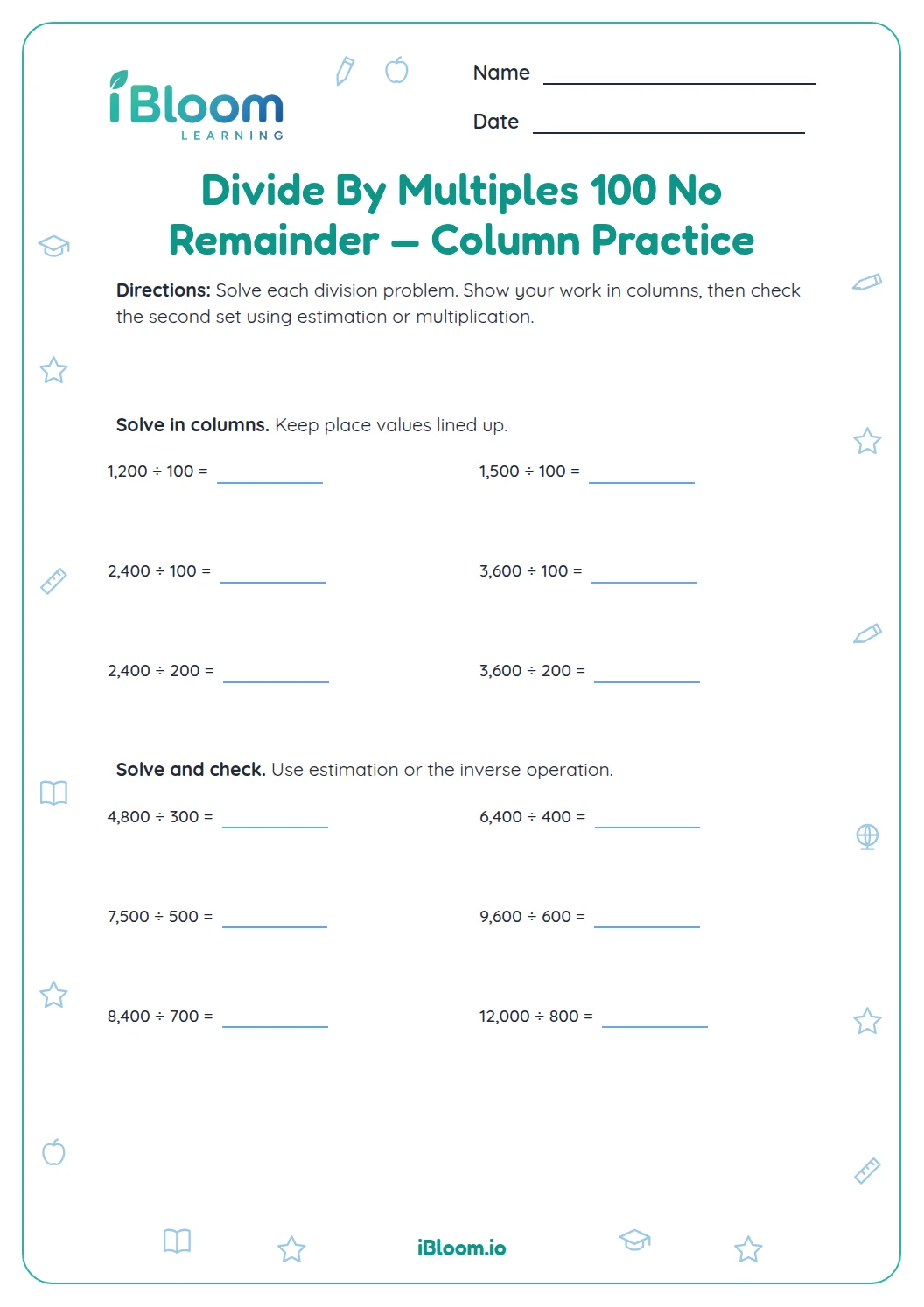


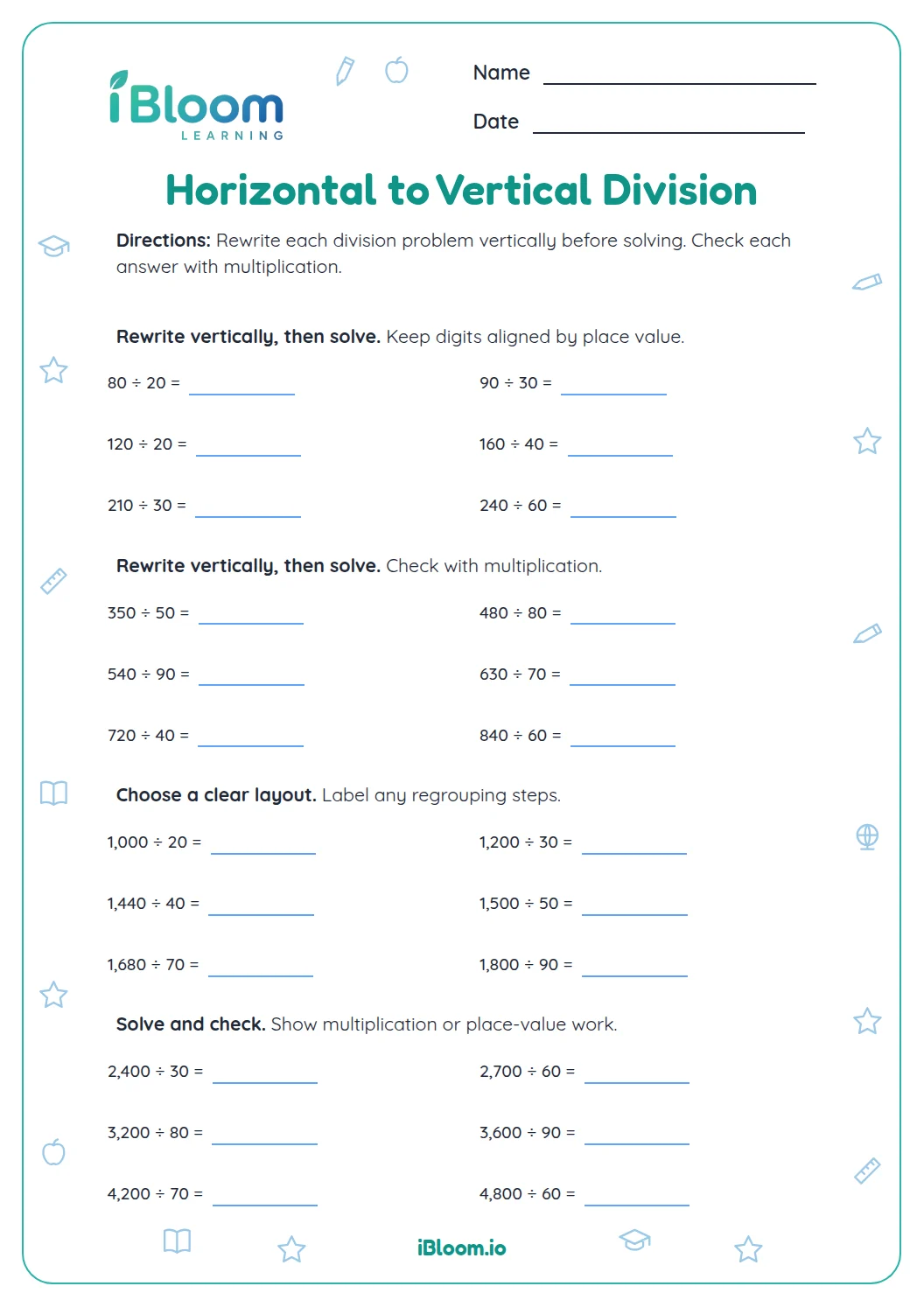


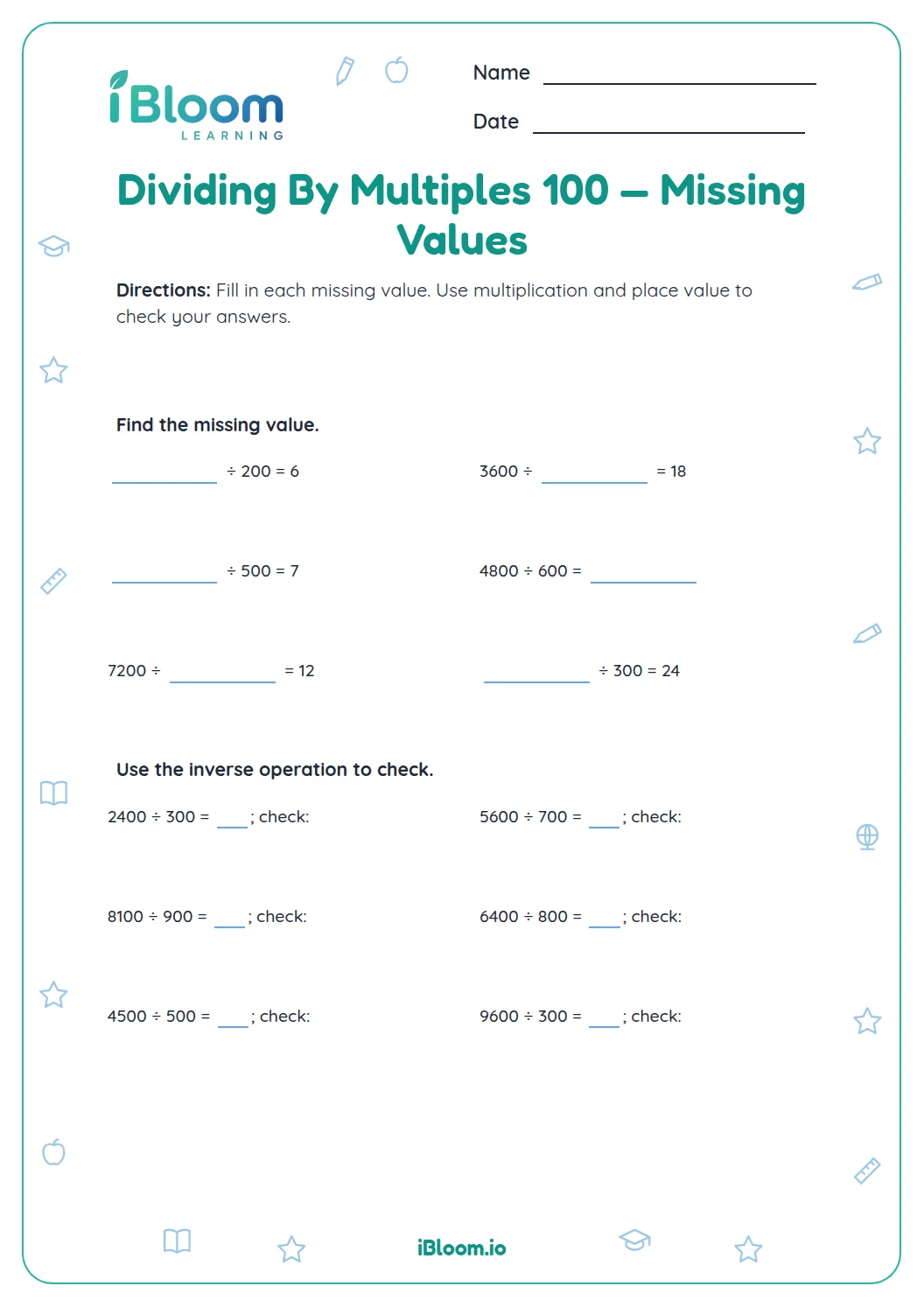
About this worksheet
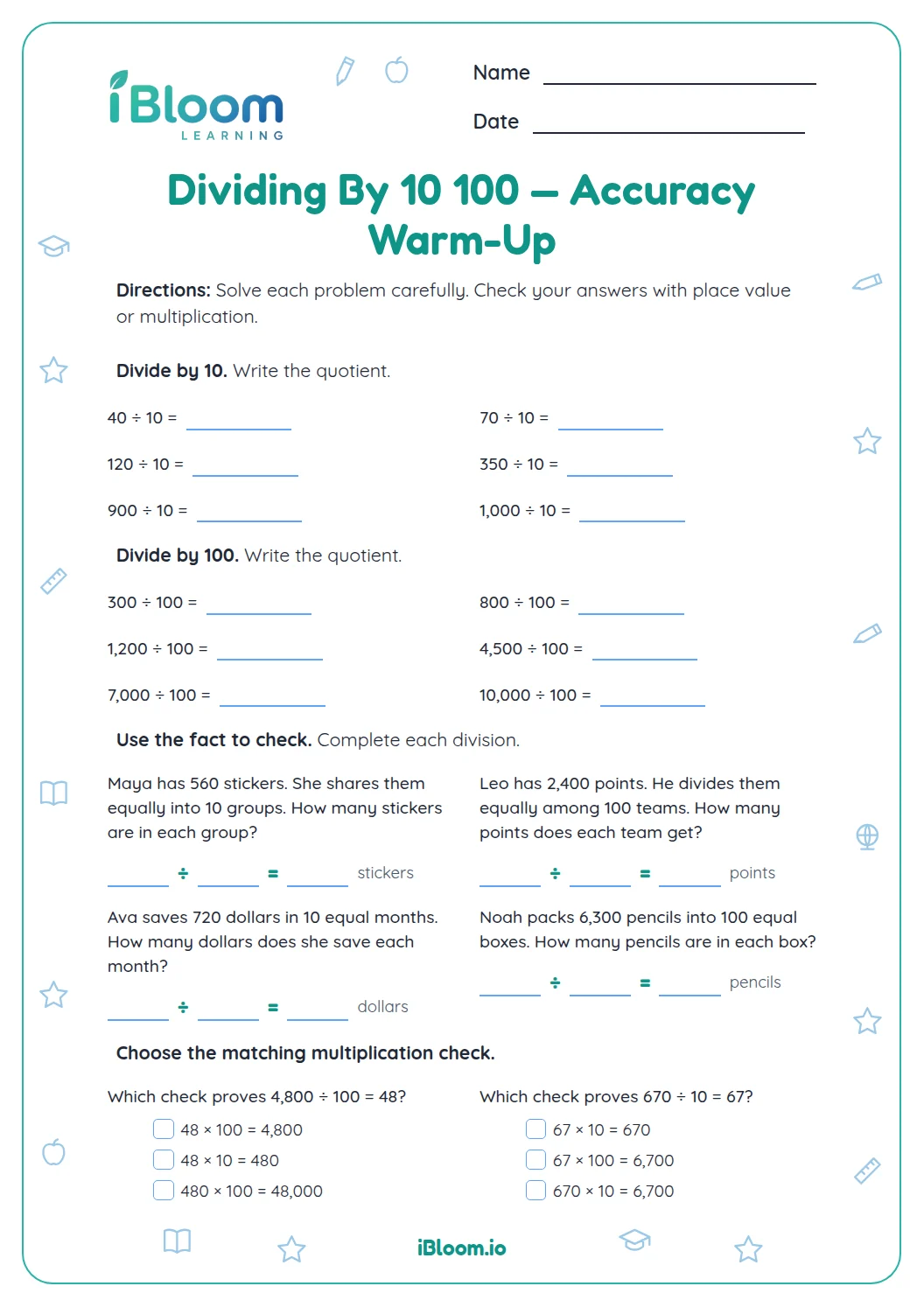
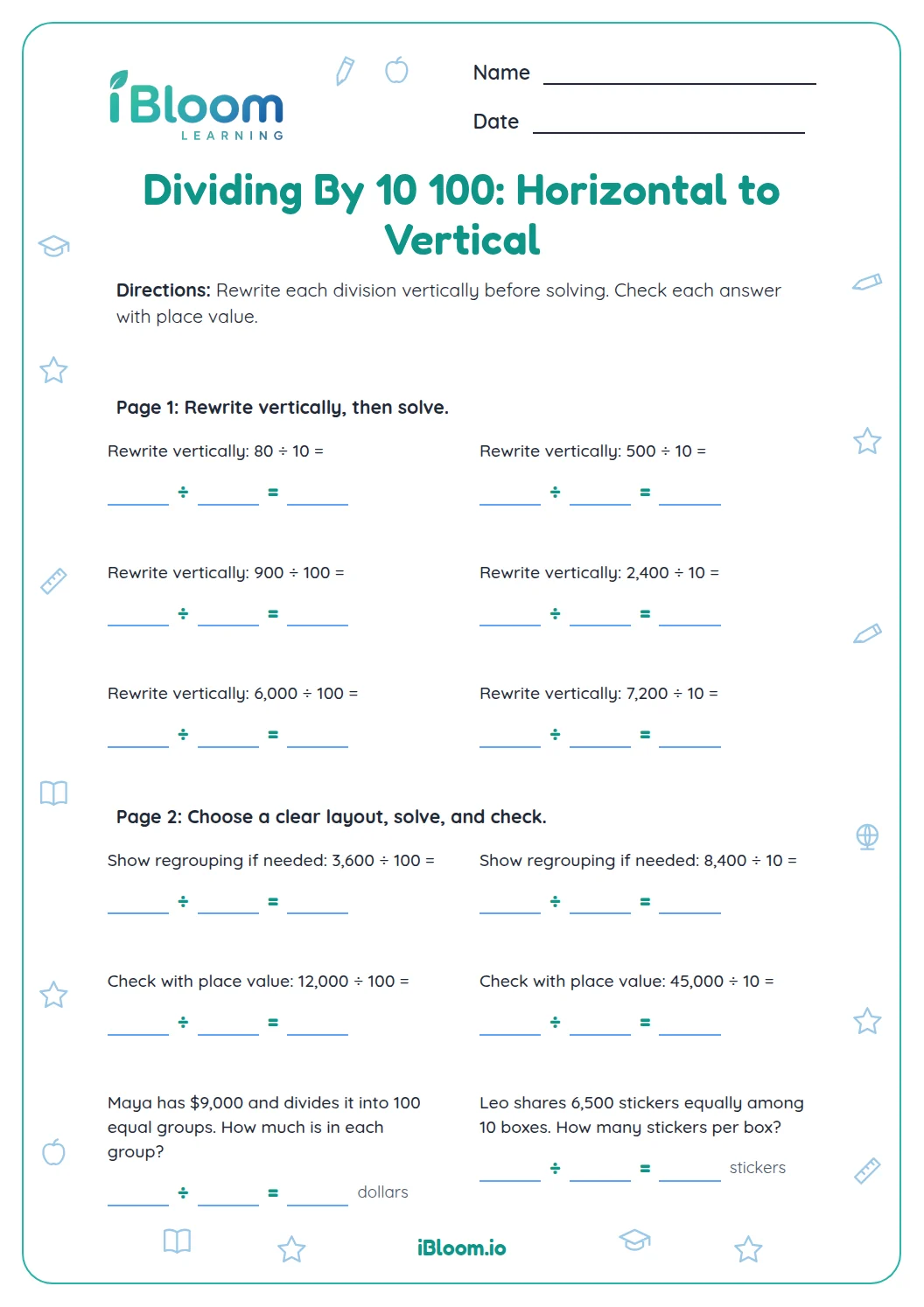
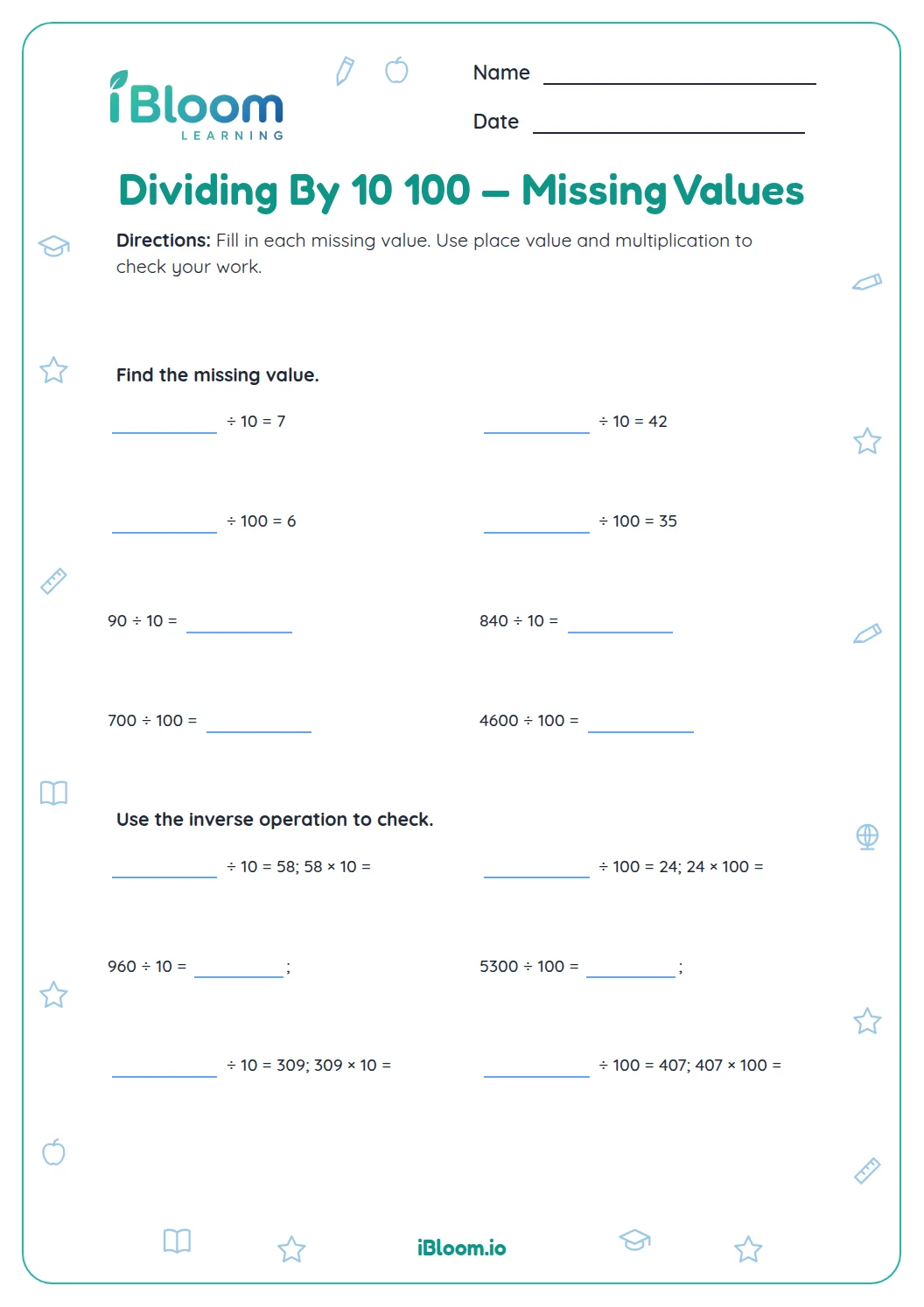
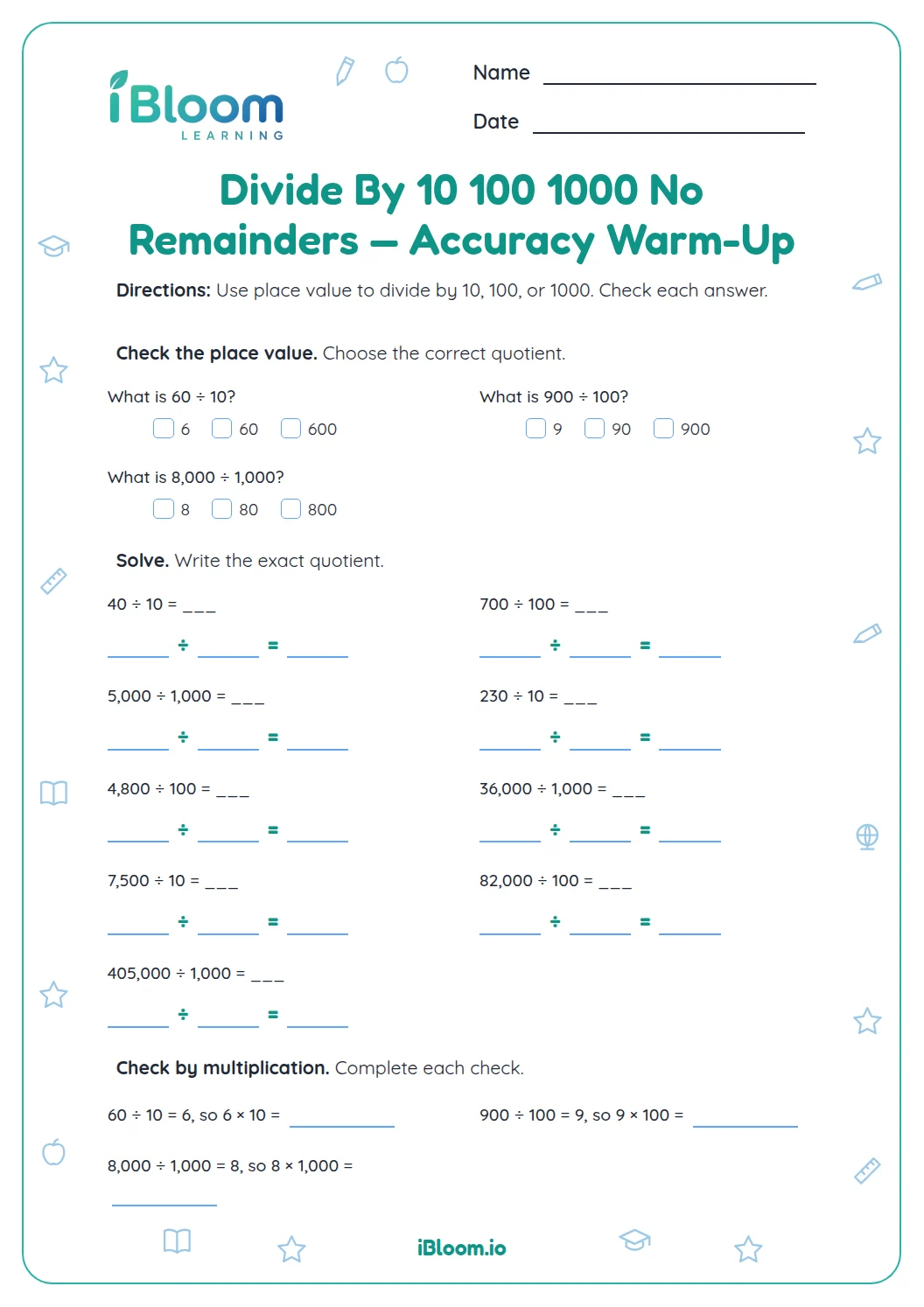
This free printable worksheet gives Grades 4–6 learners 16 questions about dividing whole numbers by 10 and 100. Part A finds quotients and missing dividends; Part B checks believable quotient errors; Part C verifies division with multiplication and applies it to equal sharing. A separate answer key is included. It practices the place-value patterns in 5.NBT.A.2.
Aligned to 5.NBT.A.2
How can place value help divide by 10 or 100?
Dividing by 10 makes a whole-number quotient ten times smaller; dividing by 100 makes it one hundred times smaller. In 3,600 ÷ 100, the quotient is 36. Check: 36 × 100 = 3,600.
Part A has six quotient and missing-dividend problems. Part B checks five plausible slips. Part C uses multiplication checks; Part D finds missing dividends and solves one equal-sharing question.
- 13,600 ÷ 100 = 36
- 2Multiply 36 × 100.
- 3The product is 3,600, so the quotient checks.
What errors does Part B help catch?
The choices include shifting digits the wrong number of places, leaving the number unchanged, or reporting a different quotient. Estimate the size of the answer, then use multiplication to test the selected quotient.
Part C moves from a multiplication check to missing dividends and a sharing context.
How can an adult check the place-value reasoning?
Ask the learner to say whether the divisor is 10 or 100 before solving. Then have them multiply the quotient by that divisor; the product should return to the dividend.
How to use this worksheet
- 1Read whether the divisor is 10 or 100.
- 2Estimate how many places the quotient shifts.
- 3Solve each equation and write the quotient.
- 4For an error choice, compare the proposed quotient with the dividend.
- 5Multiply quotient by divisor to check.
Common mistakes and quick fixes
The mistake
Shifting digits only one place when dividing by 100.
The fix
Name both place-value places before writing the quotient.
The mistake
Keeping the dividend unchanged.
The fix
Estimate a quotient smaller than the starting whole number.
The mistake
Choosing a plausible quotient without checking.
The fix
Multiply it by 10 or 100 and compare with the dividend.
Curriculum alignment
Learners use place-value patterns and multiplication checks while dividing by powers of 10.
Learners use place-value patterns to divide whole numbers by 10 and 100.
On this sheet: The questions practice place-value patterns for powers of 10 and explain the quotient through inverse multiplication.
Show the official wordingHide the official wording
Explain patterns in the number of zeros of the product when multiplying a number by powers of 10, and explain patterns in the placement of the decimal point when a decimal is multiplied or divided by a power of 10.
What to practice next
Make more practice
Further reading
Questions parents and teachers ask
How does this worksheet practice division by 10 and 100?
Part A asks learners to find quotients and missing dividends. Part B presents common place-value slips to correct, Part C checks division with multiplication, and Part D practices missing dividends and equal sharing. The answer key gives the correct values.
How can I check a quotient?
Multiply the quotient by the divisor. For example, 36 × 100 = 3,600, so 36 is the quotient of 3,600 ÷ 100. This inverse-operation check is used directly in Part C and can also help review any answer from Parts A or B.
What mistakes are included in Part B?
The choices model believable place-value errors, such as moving digits the wrong number of places or leaving them unchanged. Learners select the correct quotient for each dividend, then can test it by multiplication. The examples make the error analysis part of the actual computation.
Who is this page for?
The page is labeled for Grades 4–6 and focuses on whole-number division by 10 and 100. Its first part gives direct quotients, then asks learners to evaluate errors and use multiplication. An adult can invite the learner to explain why each quotient is reasonable.
How many questions and pages are included?
There are 16 questions arranged in four parts. The printable has two rendered pages: one for practice and one for its separate answer key. The questions include direct division, five error-analysis choices, inverse-operation checks, missing dividends, and one equal-sharing problem. Learners can use the key to review each response after completing the practice.
Why are multiplication questions on a division sheet?
Multiplication reverses division, so it provides a direct way to test a quotient. If a quotient multiplied by 10 or 100 returns to the dividend, the division equation is consistent. Part C practices this check after the quotient and correction work.