





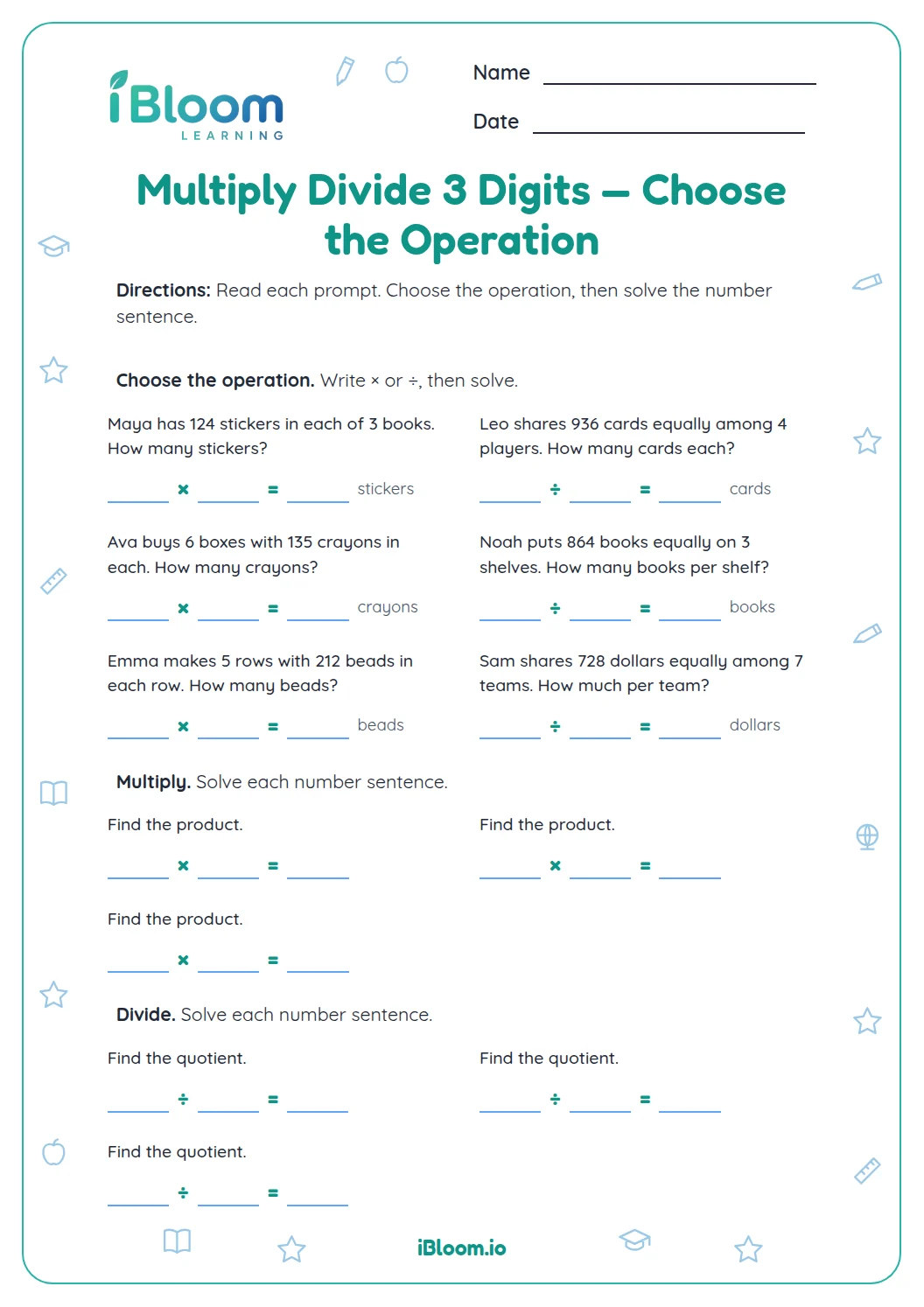


About this worksheet
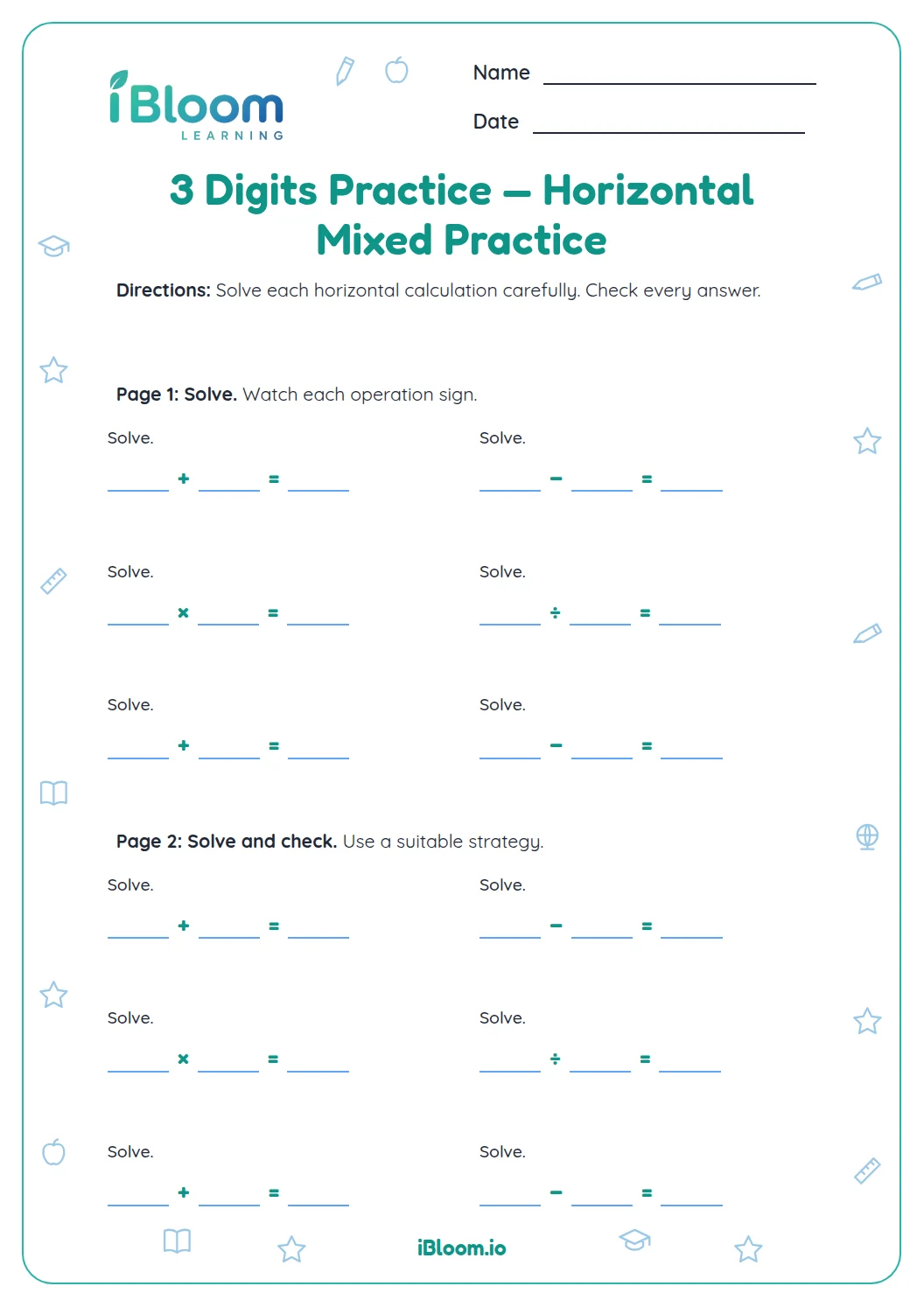
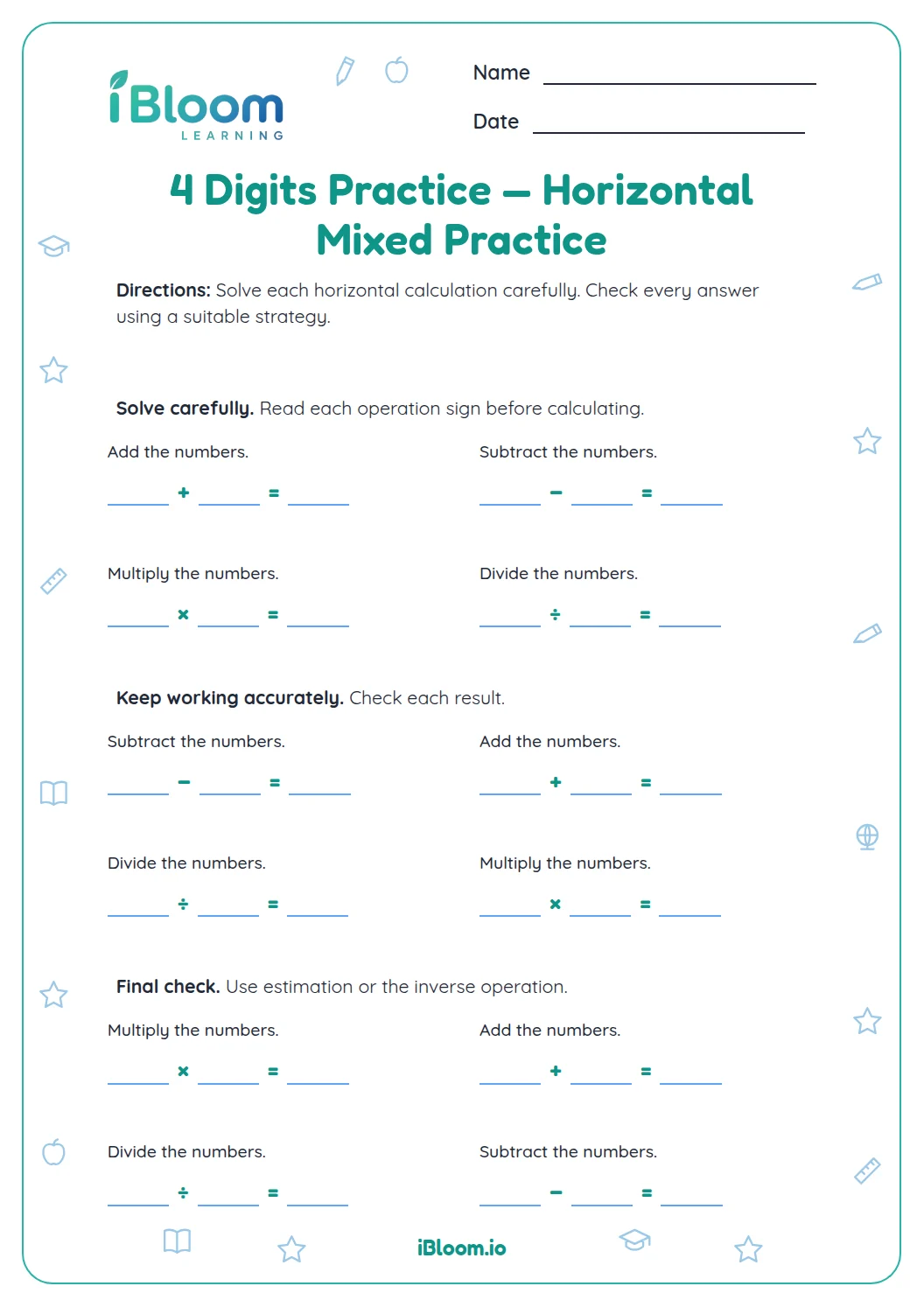
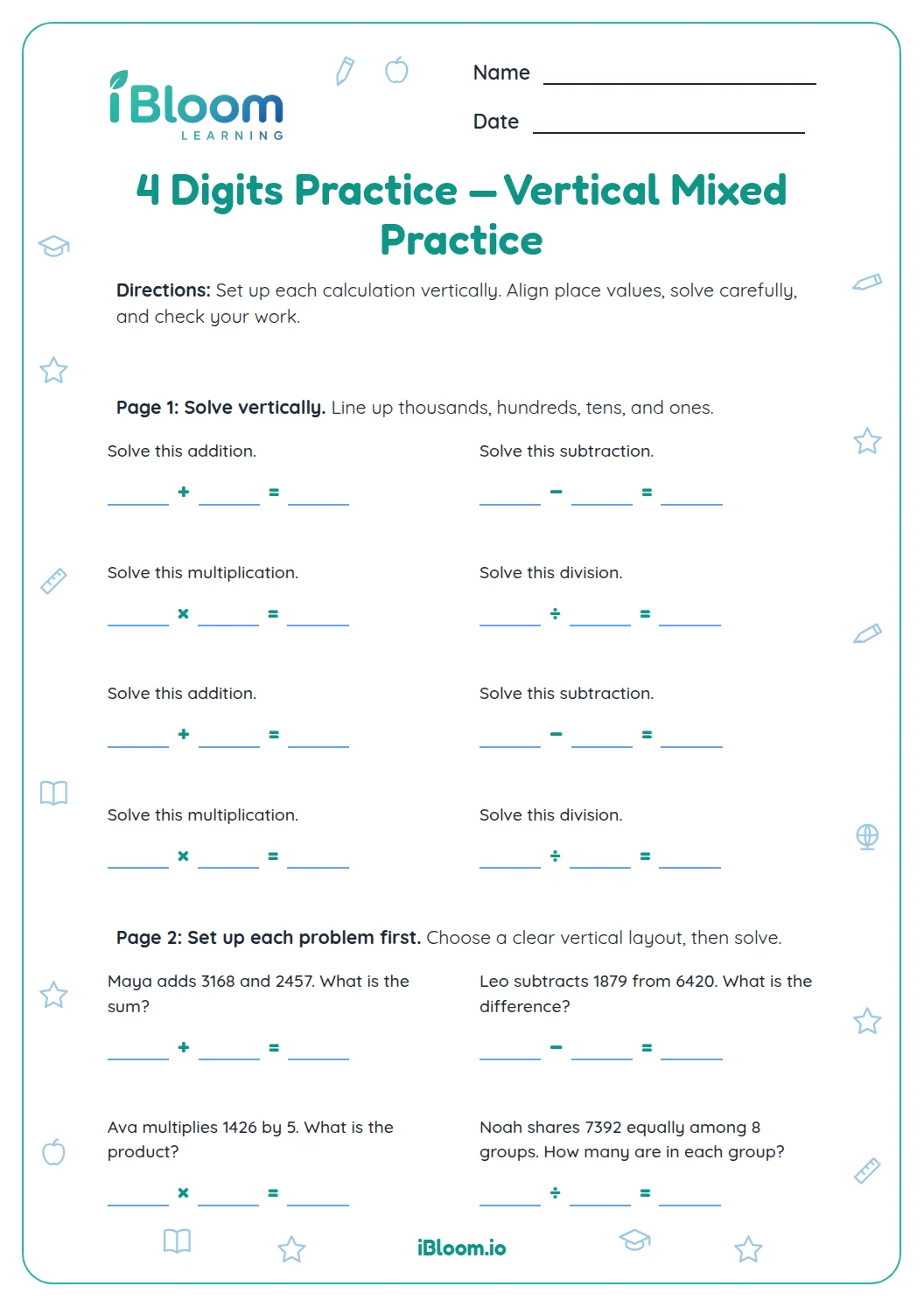
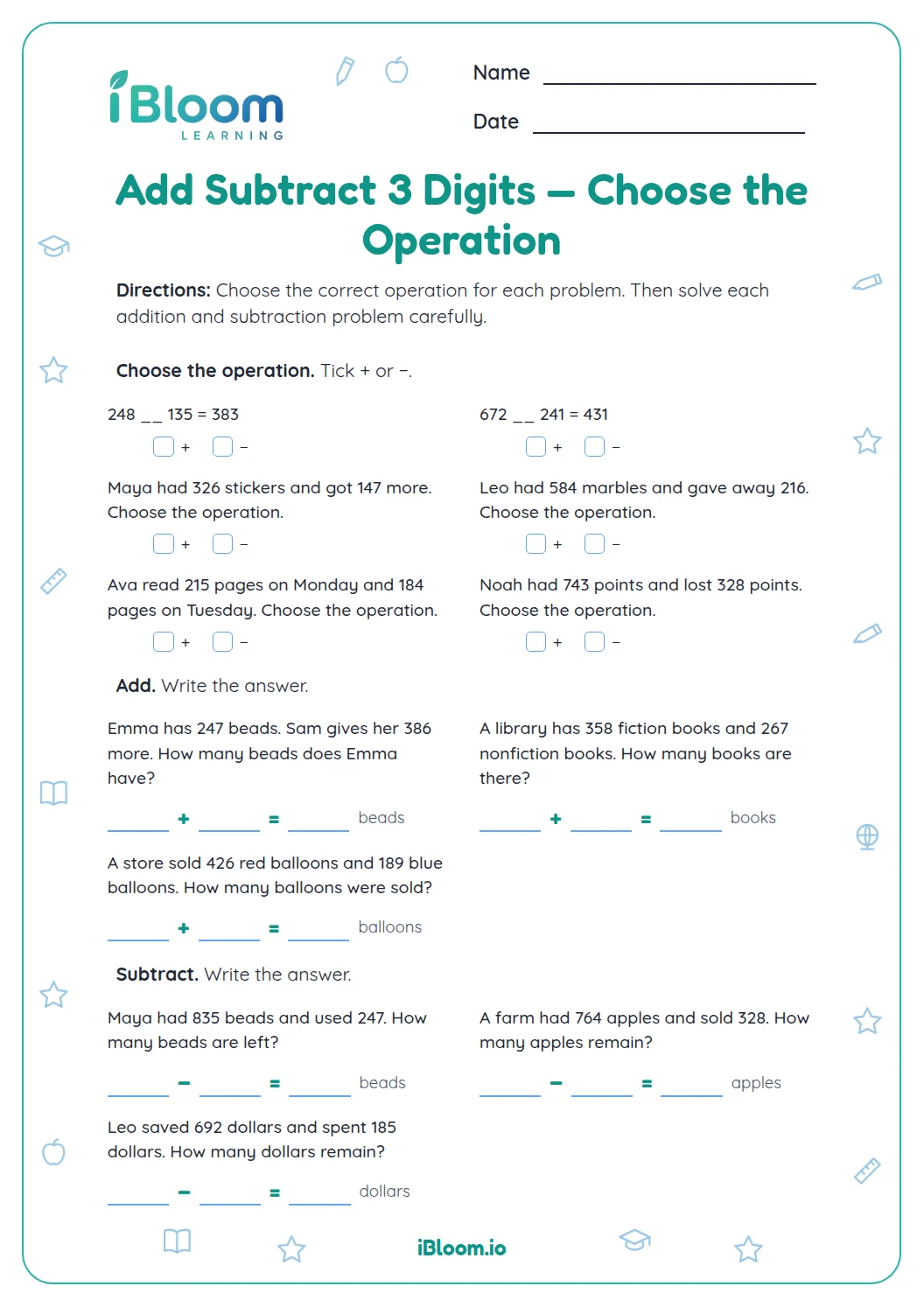
This free printable gives Grade 4 students focused practice with three-digit numbers in all four operations. The 16 problems move through addition and subtraction with regrouping, multiplication by one digit, and division with exact answers or a remainder. Students can set out each calculation vertically and keep hundreds, tens and ones aligned. The answer key shows the result for every item, including the remainder in the final division problem.
Aligned to 4.NBT.B.4 and 4.NBT.B.5
What operations are on the page?
The sheet groups four calculations at a time, so students can settle into one operation before changing strategies. Addition and subtraction include regrouping; multiplication uses a one-digit factor; division uses a one-digit divisor.
- Parts A–B: three-digit addition and subtraction
- Part C: multiply three-digit numbers by one digit
- Part D: divide by one digit; one problem has a remainder
How should students set up a vertical calculation?
Write one number beneath the other with ones under ones, tens under tens, and hundreds under hundreds. Keep the operation sign at the left. For multiplication and division, use a clear line for carrying, partial products, or quotient digits.
- 1704 − 268
- 2Regroup one hundred as 10 tens, then regroup one ten as 10 ones.
- 3704 − 268 = 436
How do you check a division answer with a remainder?
Multiply the quotient by the divisor, then add the remainder. The total should equal the dividend, and the remainder must be smaller than the divisor. For question 16, 241 × 4 = 964 and 964 + 3 = 967.
How to use the worksheet
- 1Read the operation heading before starting each group.
- 2Set up each calculation with matching place values.
- 3For subtraction, check whether a place needs regrouping.
- 4For multiplication, record carried values clearly.
- 5Check division by multiplying the quotient and adding any remainder.
Common mistakes and quick fixes
The mistake
Placing a tens digit under the ones column.
The fix
Line up the rightmost digits first, then check each column before calculating.
The mistake
Subtracting the smaller digit from the larger digit in every column without regrouping.
The fix
When the top digit is too small, regroup from the next place before subtracting.
The mistake
Writing a remainder equal to or greater than the divisor.
The fix
Share one more group if possible; the remainder must be less than the divisor.
Common Core alignment
These Grade 4 standards align with the addition, subtraction and multiplication calculations on the sheet.
Add and subtract multi-digit whole numbers accurately.
On this sheet: Parts A and B give four three-digit addition and subtraction calculations each, including regrouping.
Show the official wordingHide the official wording
Fluently add and subtract multi-digit whole numbers using the standard algorithm.
Multiply up to four-digit whole numbers by a one-digit number.
On this sheet: Part C multiplies three-digit numbers by one digit.
Show the official wordingHide the official wording
Multiply a whole number of up to four digits by a one-digit whole number, and multiply two two-digit numbers, using strategies based on place value and the properties of operations. Illustrate and explain the calculation by using equations, rectangular arrays, and/or area models.
What to practice next
Make more practice
Further reading
Questions parents and teachers ask
How many problems are on this worksheet?
There are 16 problems, with four for each operation. Addition and subtraction use three-digit numbers, multiplication uses a one-digit factor, and division uses a one-digit divisor. The final division problem has a remainder, so students can practice checking that the remainder is smaller than the divisor.
Does the division section include remainders?
Three division problems divide evenly, and one leaves a remainder. For 967 ÷ 4, the quotient is 241 and the remainder is 3. To check it, multiply 241 by 4 to get 964, then add 3 to return to 967.
Should students show their work?
Yes. The worksheet is designed for vertical calculations, so use the open space to line up digits and record regrouping, carried values, partial products or quotient steps. Showing the steps makes it easier to spot whether an error came from place value or from the operation itself.
What is the answer to 704 − 268?
The answer is 436. Regroup 704 as 6 hundreds, 9 tens and 14 ones; subtracting 268 then gives 4 hundreds, 3 tens and 6 ones. This is question 5 in the subtraction group and is also shown as the worked example above.
How can a student check the multiplication problems?
Use the inverse operation when practical: divide the product by the one-digit factor and see whether the original three-digit number returns. For example, 236 × 4 = 944, and 944 ÷ 4 = 236. Careful place-value alignment also helps catch carrying slips.