






About this worksheet
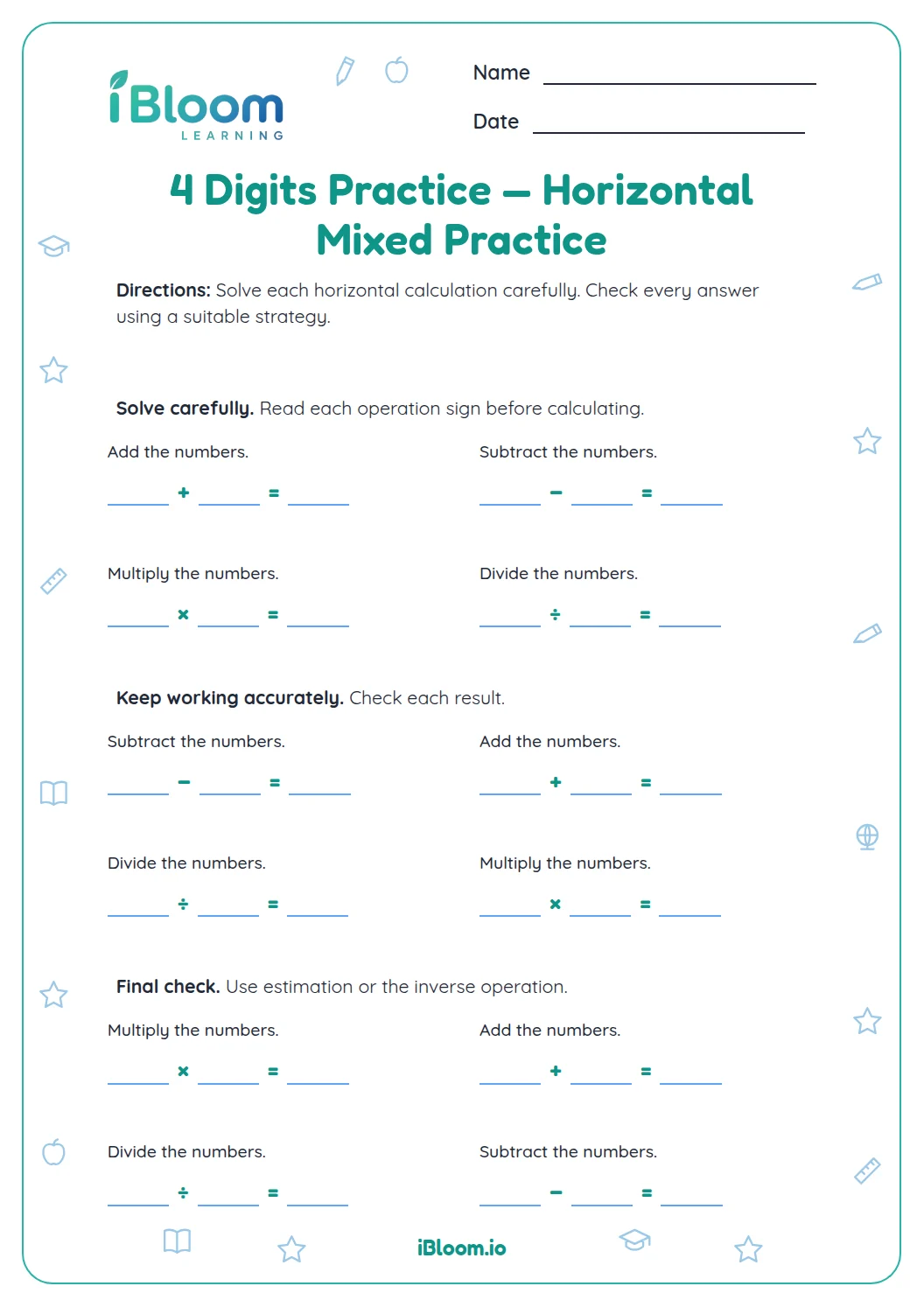
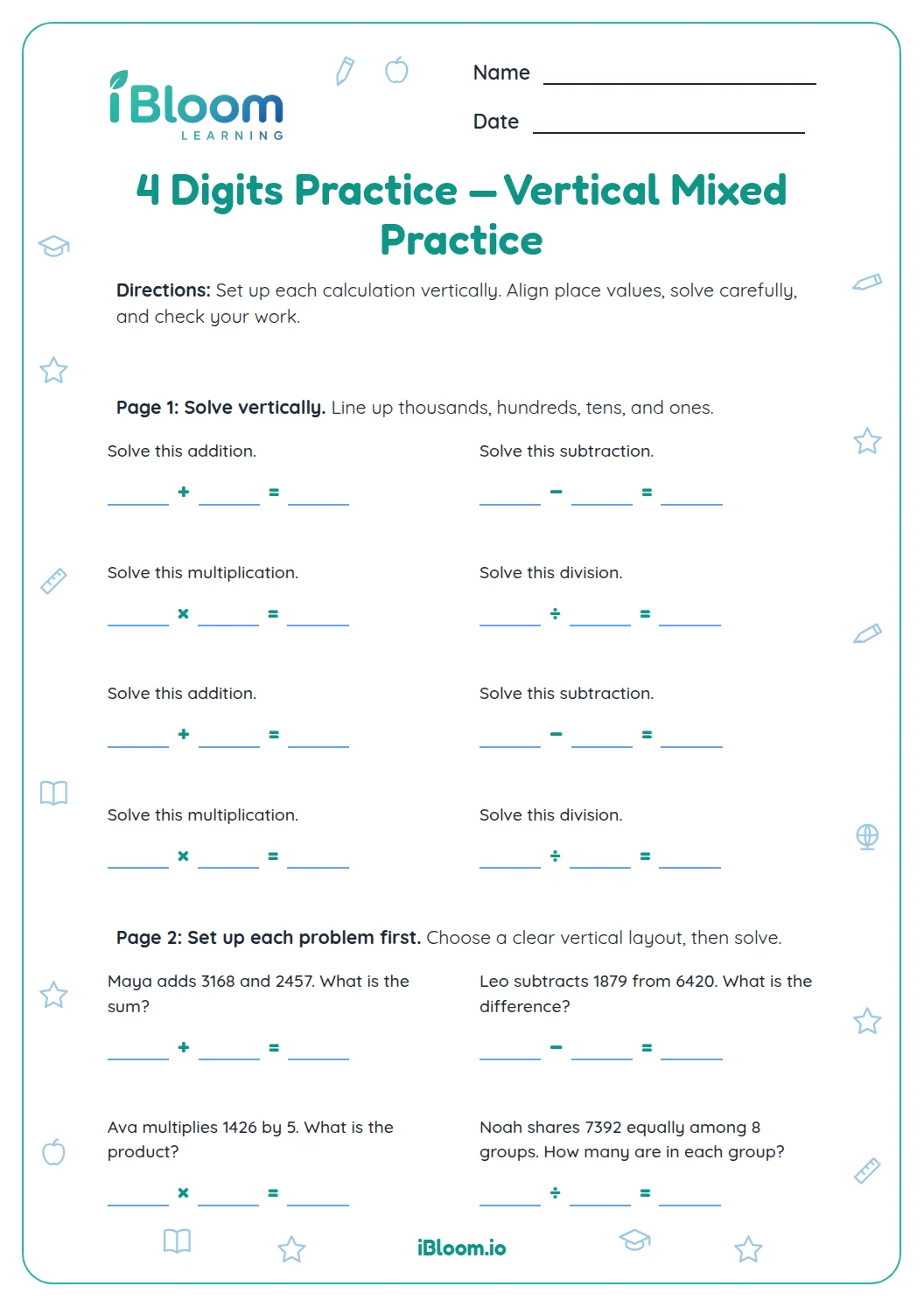
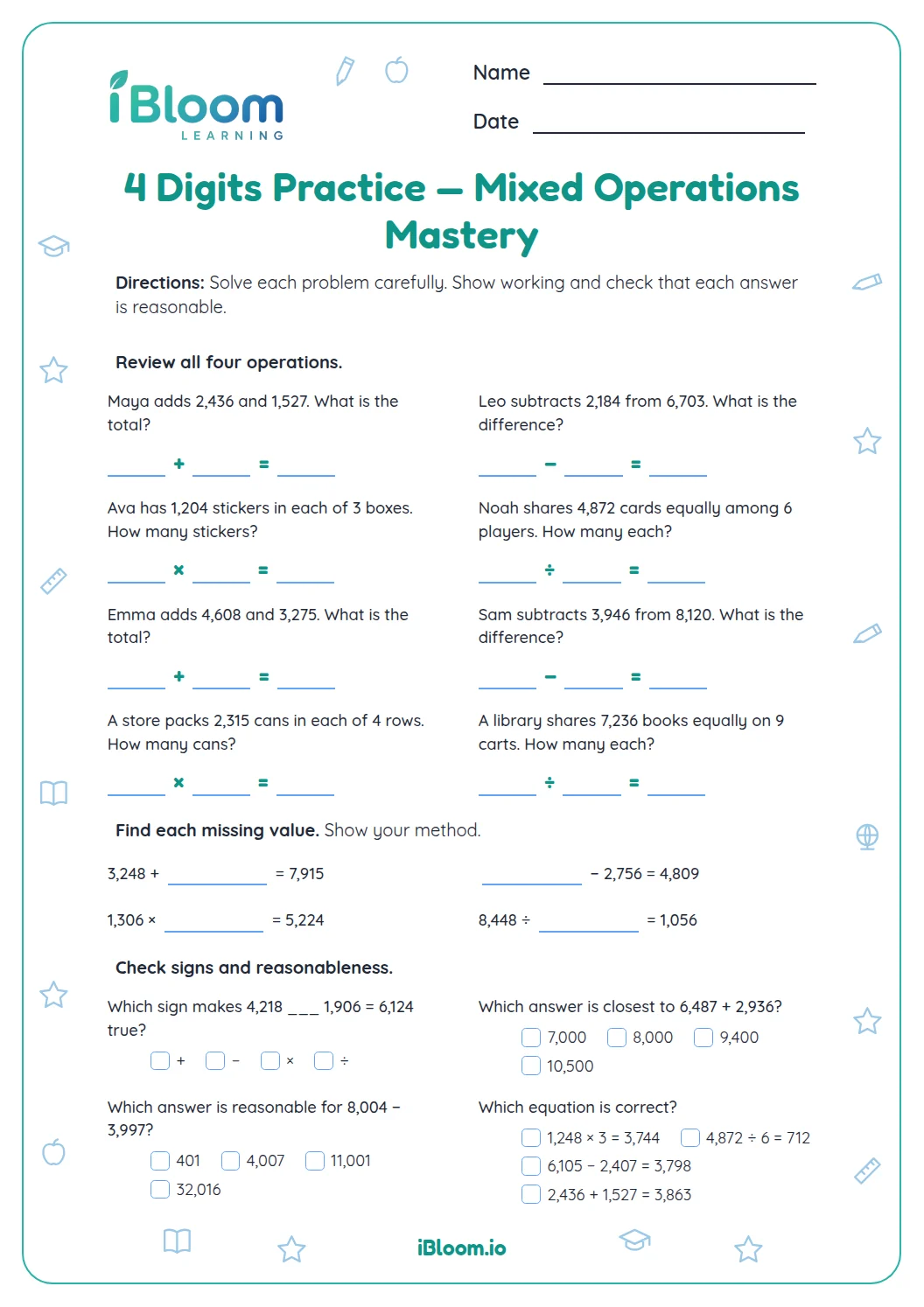
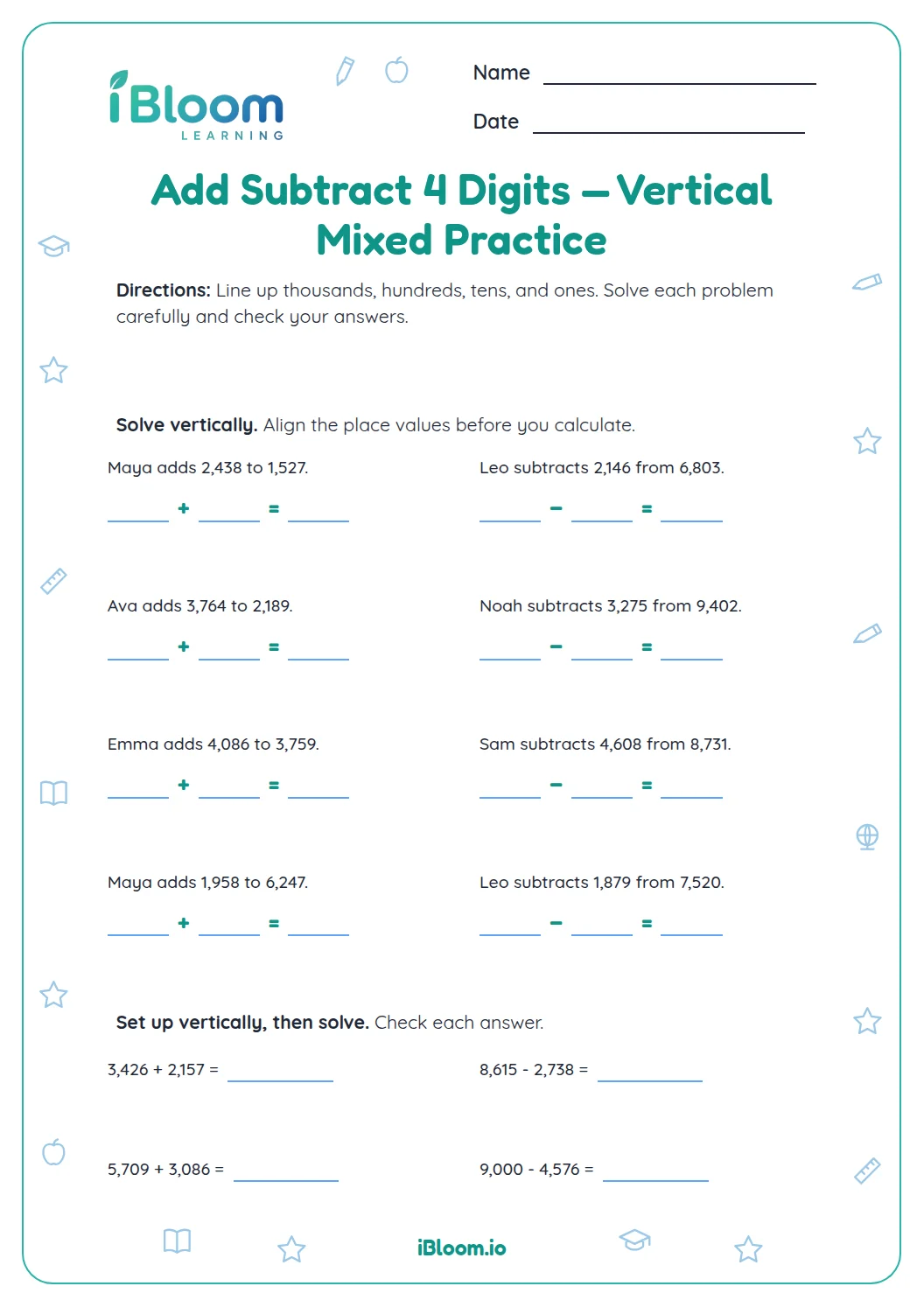
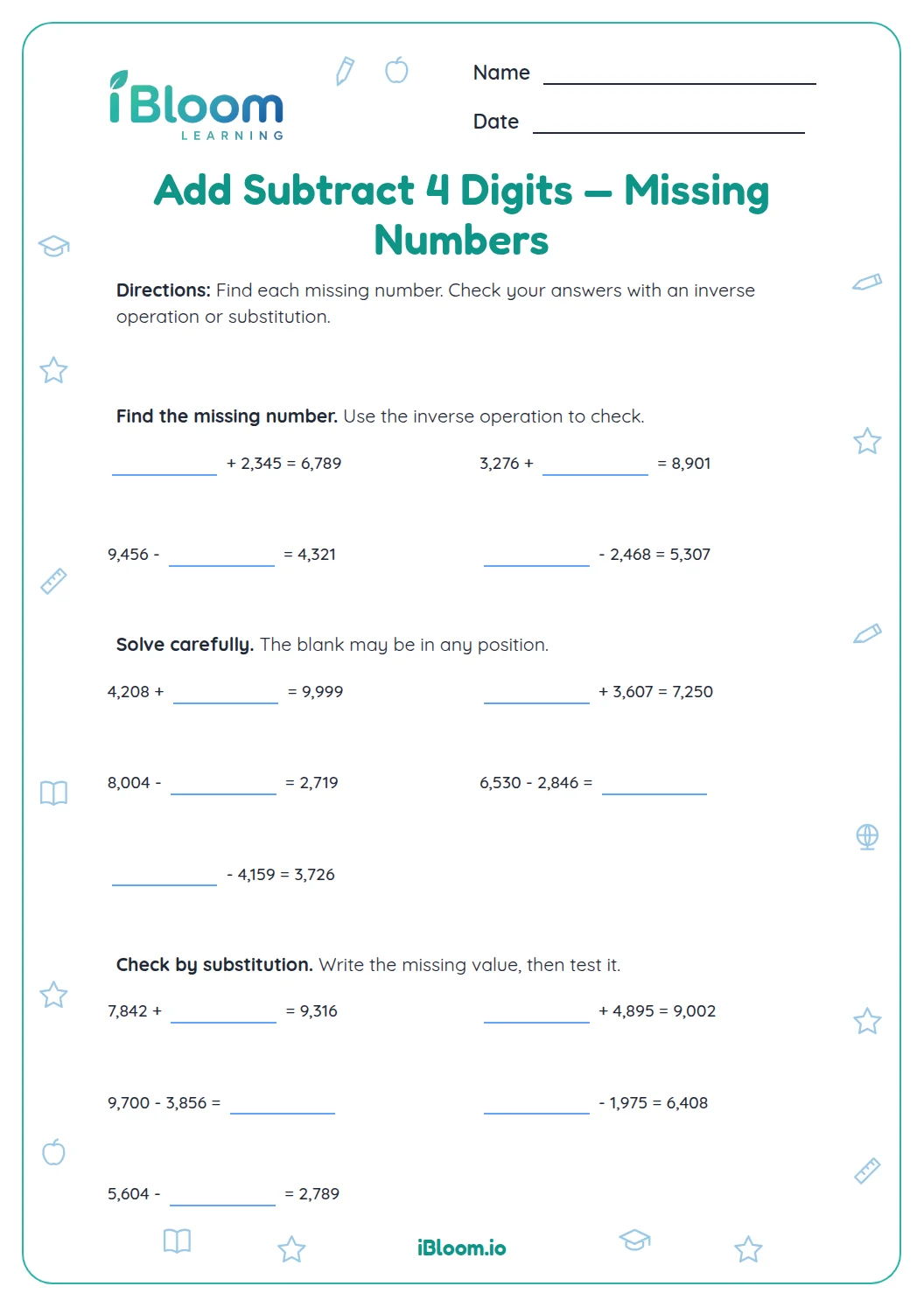
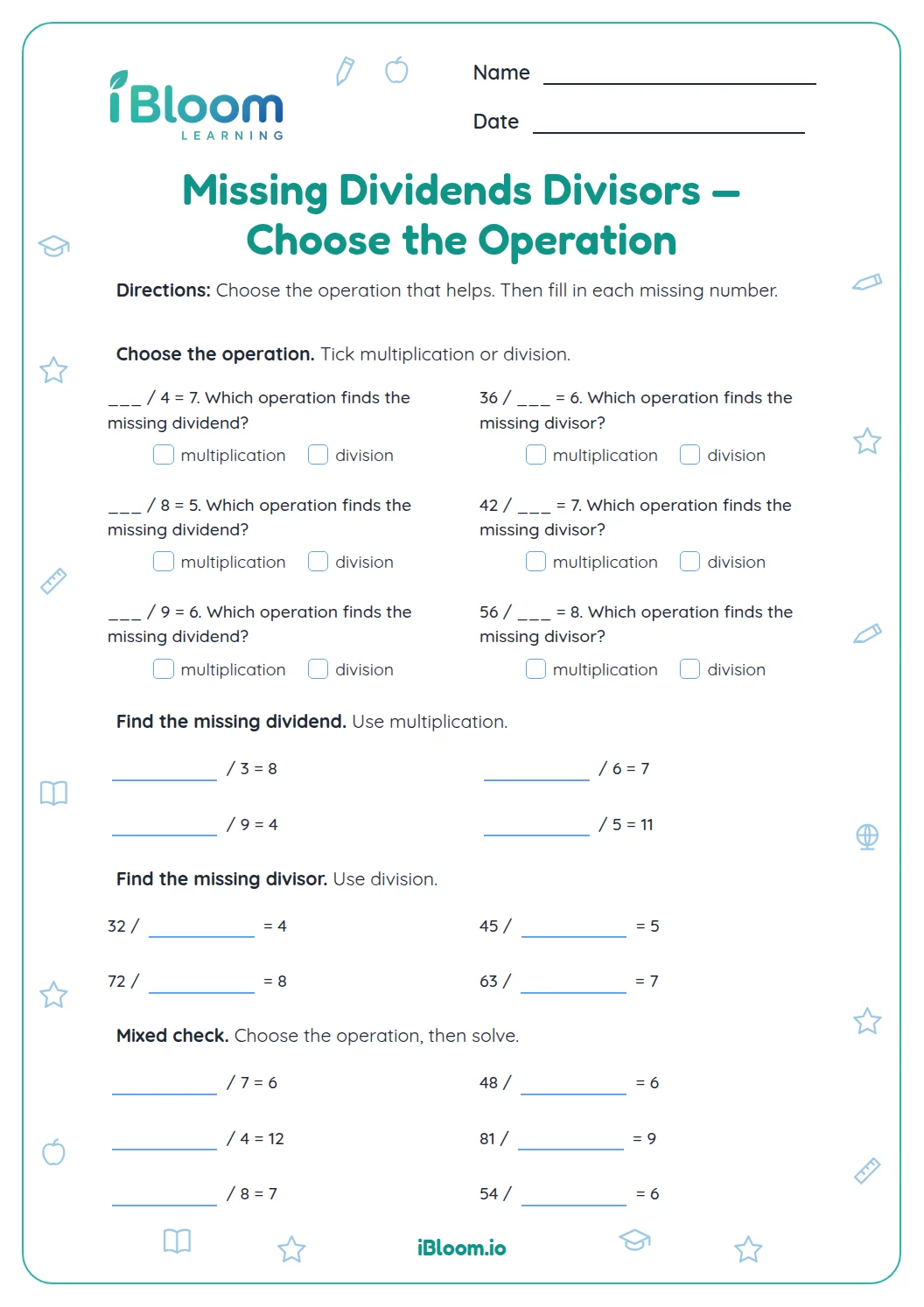
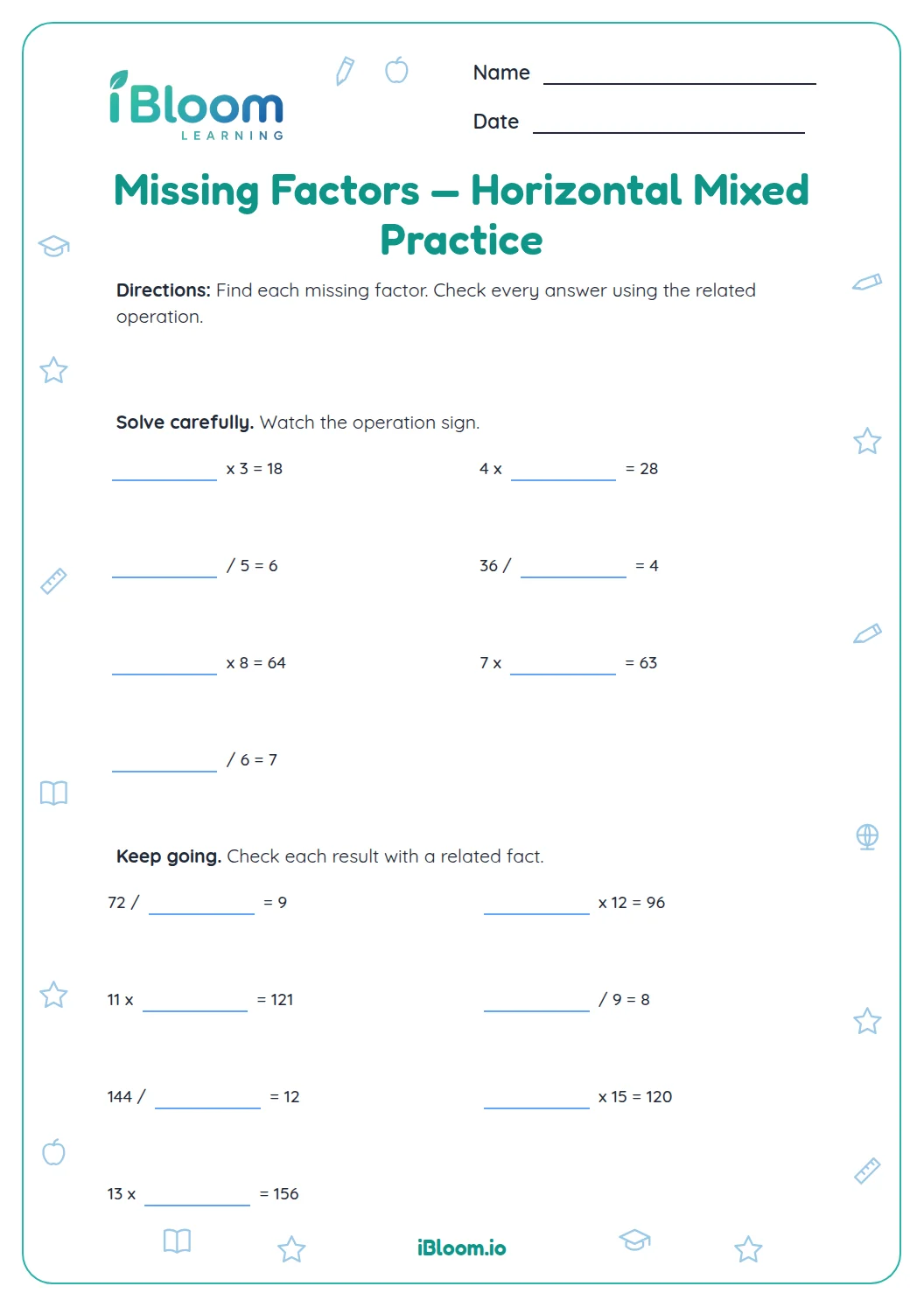
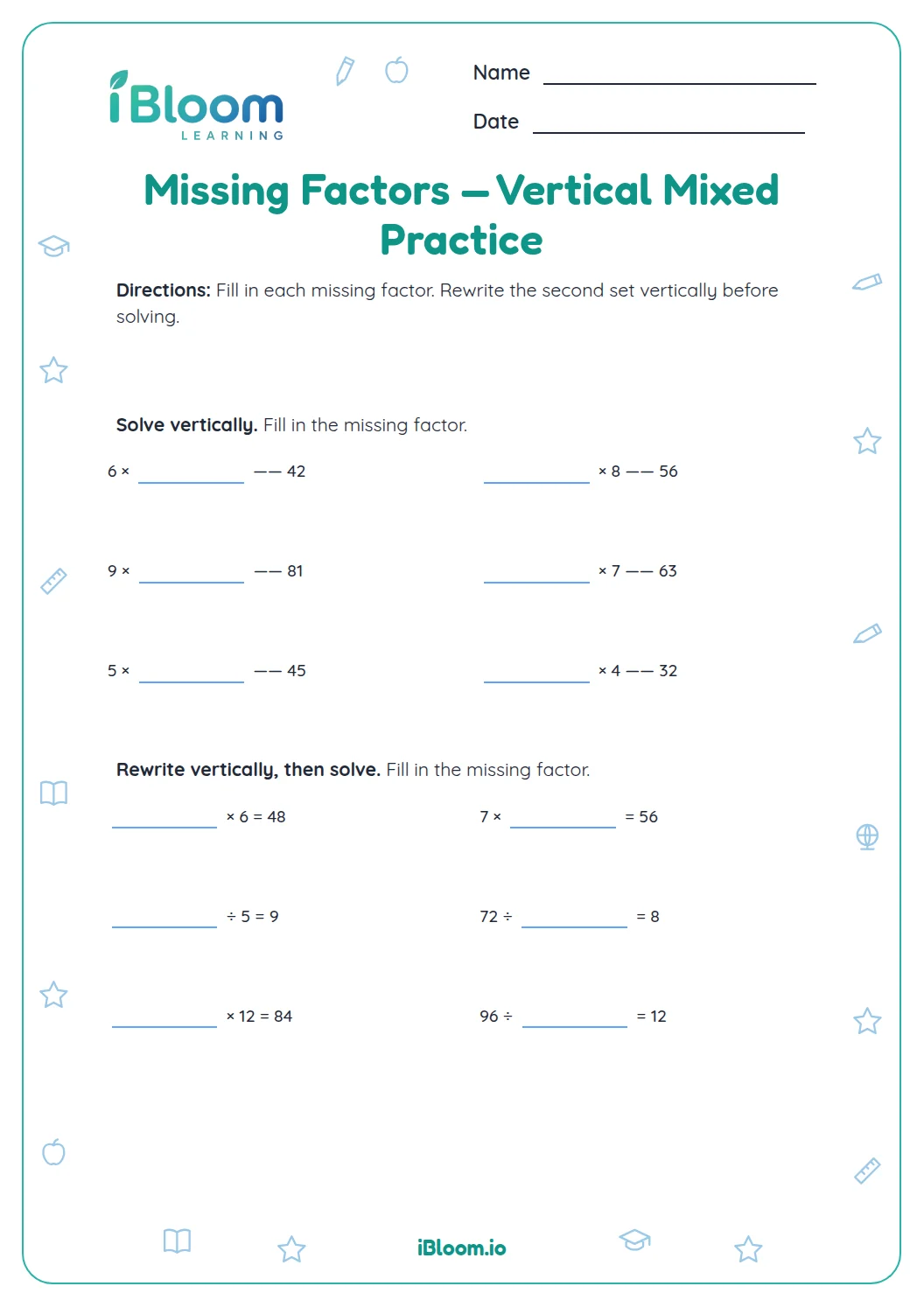
This Grades 3–6 printable mixed-operations page gives students 16 four-digit equations with one missing number. The first part practices addition and subtraction; the second half moves to multiplication and division, with each equation structured so the unknown has one clear value. Students can check addition and subtraction with the inverse operation, then check multiplication and division with related facts. An answer key is included. The work connects to CCSS 4.NBT.B.4 and 4.NBT.B.6.
Aligned to 4.NBT.B.4 and 4.NBT.B.6
How do you find a missing addend?
If a sum and one addend are known, subtract the known addend from the sum. If both addends are known, add them to find the missing sum. Keep digits lined up by place value, including zeros.
For question 2, subtract 2,648 from 7,905. The result, 5,257, is the missing addend because 5,257 + 2,648 = 7,905.
- 17,905 − 2,648 = 5,257
- 2Check: 5,257 + 2,648 = 7,905
Which inverse operation helps with subtraction?
Addition checks subtraction. In question 7, the missing starting number must be 2,986 more than 4,217. Add those numbers to get 7,203, then subtract 2,986 to confirm.
How can a multiplication fact reveal a missing factor?
Divide the product by the known factor. In question 10, 6,219 ÷ 3 = 2,073. Multiply 2,073 by 3 to check that the product is 6,219.
How do you check a missing quotient?
Multiply the quotient by the divisor to recover the dividend. For question 13, 1,428 × 6 = 8,568, so 8,568 ÷ 6 = 1,428. If the unknown is the dividend, multiply the divisor by the known quotient.
How to use this worksheet
- 1Read the whole equation and mark the operation sign.
- 2Name what is missing: sum, addend, difference, factor, product, dividend, or quotient.
- 3Use the inverse operation when one number in the fact is unknown.
- 4Line up place values for four-digit addition and subtraction.
- 5Check by putting your answer back into the original equation.
Common mistakes and quick fixes
The mistake
Subtracting the known addend from the wrong number.
The fix
Use the sum as the starting number when you undo addition.
The mistake
Reversing subtraction order.
The fix
For ___ − 2,986 = 4,217, add the subtrahend and difference to recover the minuend.
The mistake
Dividing the product by the unknown factor incorrectly.
The fix
Divide by the factor that is shown, then multiply your result to check.
Curriculum alignment
These Common Core standards connect to the multi-digit operations practiced on this page.
Use place value and the standard algorithm to add and subtract multi-digit numbers.
On this sheet: The addition and subtraction parts ask students to solve multi-digit equations with missing values.
Show the official wordingHide the official wording
Fluently add and subtract multi-digit whole numbers using the standard algorithm.
Use place value and multiplication or division relationships to divide multi-digit numbers.
On this sheet: The division section finds whole-number quotients and missing dividends with four-digit dividends and one-digit divisors.
Show the official wordingHide the official wording
Find whole-number quotients and remainders with up to four-digit dividends and one-digit divisors, using strategies based on place value, the properties of operations, and/or the relationship between multiplication and division. Illustrate and explain the calculation by using equations, rectangular arrays, and/or area models.
What to practice next
Make more practice
Further reading
Questions parents and teachers ask
How do I find a missing addend?
Subtract the known addend from the sum. In question 2, 7,905 − 2,648 = 5,257, so 5,257 is the missing addend. Put it back into the addition equation to check. Put the result back into the original equation to confirm it.
What operation checks subtraction?
Addition checks subtraction. For question 7, add the difference 4,217 to the subtrahend 2,986. Their sum is 7,203, the missing minuend. Subtracting 2,986 from 7,203 returns 4,217. This check works because addition reverses subtraction. Reversing the order would change the subtraction fact and produce a different result.
How do I find a missing multiplication factor?
Divide the product by the factor that is already shown. Question 10 is ___ × 3 = 6,219, so compute 6,219 ÷ 3 = 2,073. Multiplying 2,073 × 3 checks the result. Multiplication reverses division when the numbers divide evenly.
How can division help me check an answer?
Use multiplication. A quotient times its divisor should equal the dividend. For question 13, 1,428 × 6 = 8,568, so 1,428 is the quotient in 8,568 ÷ 6. The dividend is the number being split into equal groups.
Why are there four parts?
Each part focuses on one operation, so students can settle into a strategy before switching. Addition comes first, then subtraction, multiplication, and division. Reading the sign before solving helps prevent carrying a strategy from one part into the next. The sections build a steady routine before the operation changes.
What can we try after this page?
The Missing Dividends Divisors page narrows practice to division equations, while Missing Factors extends the multiplication work. The four-digit addition and subtraction page is useful for extra place-value practice with the first two parts. Those pages focus the same inverse-operation idea on one skill.