







About this worksheet
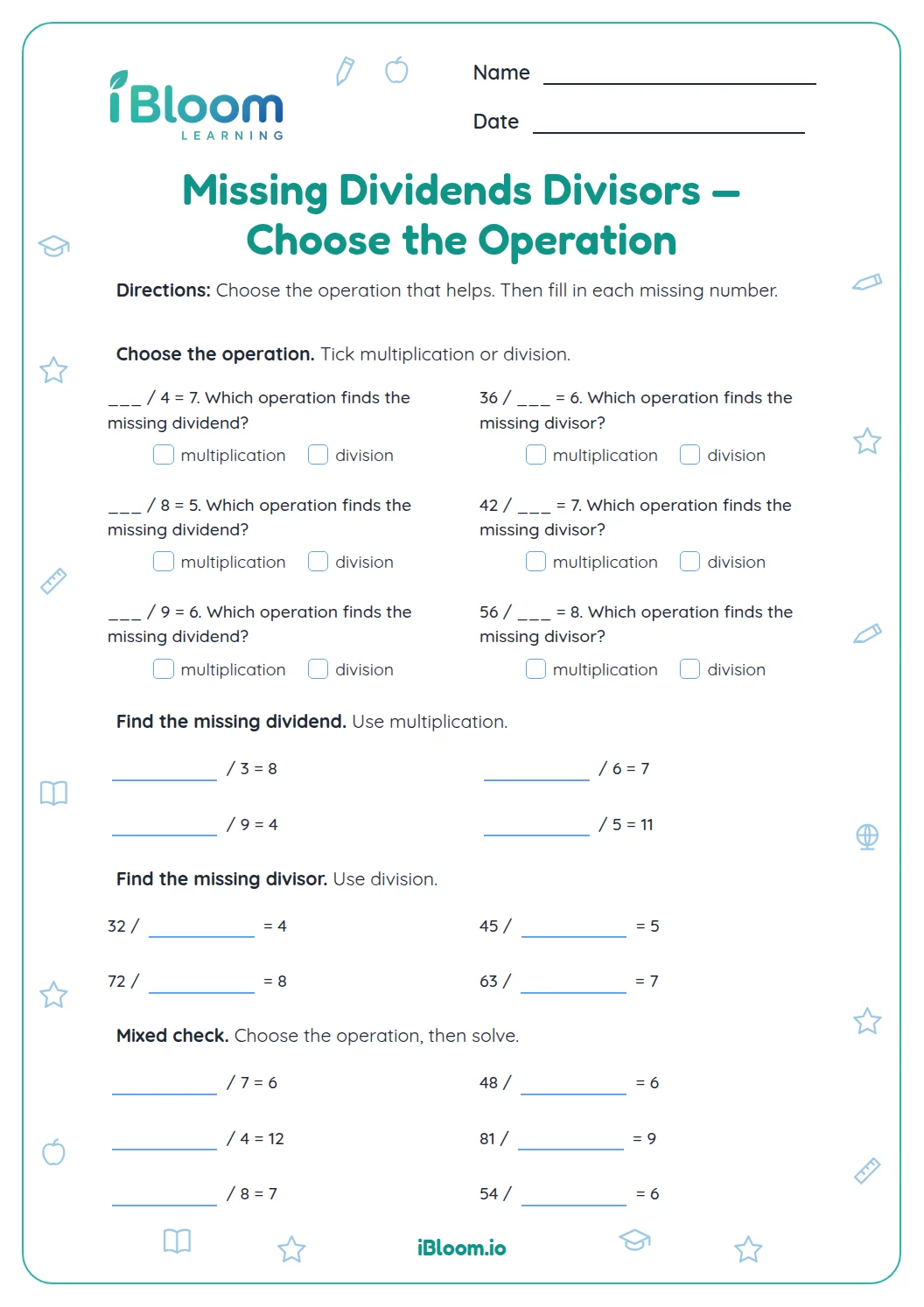
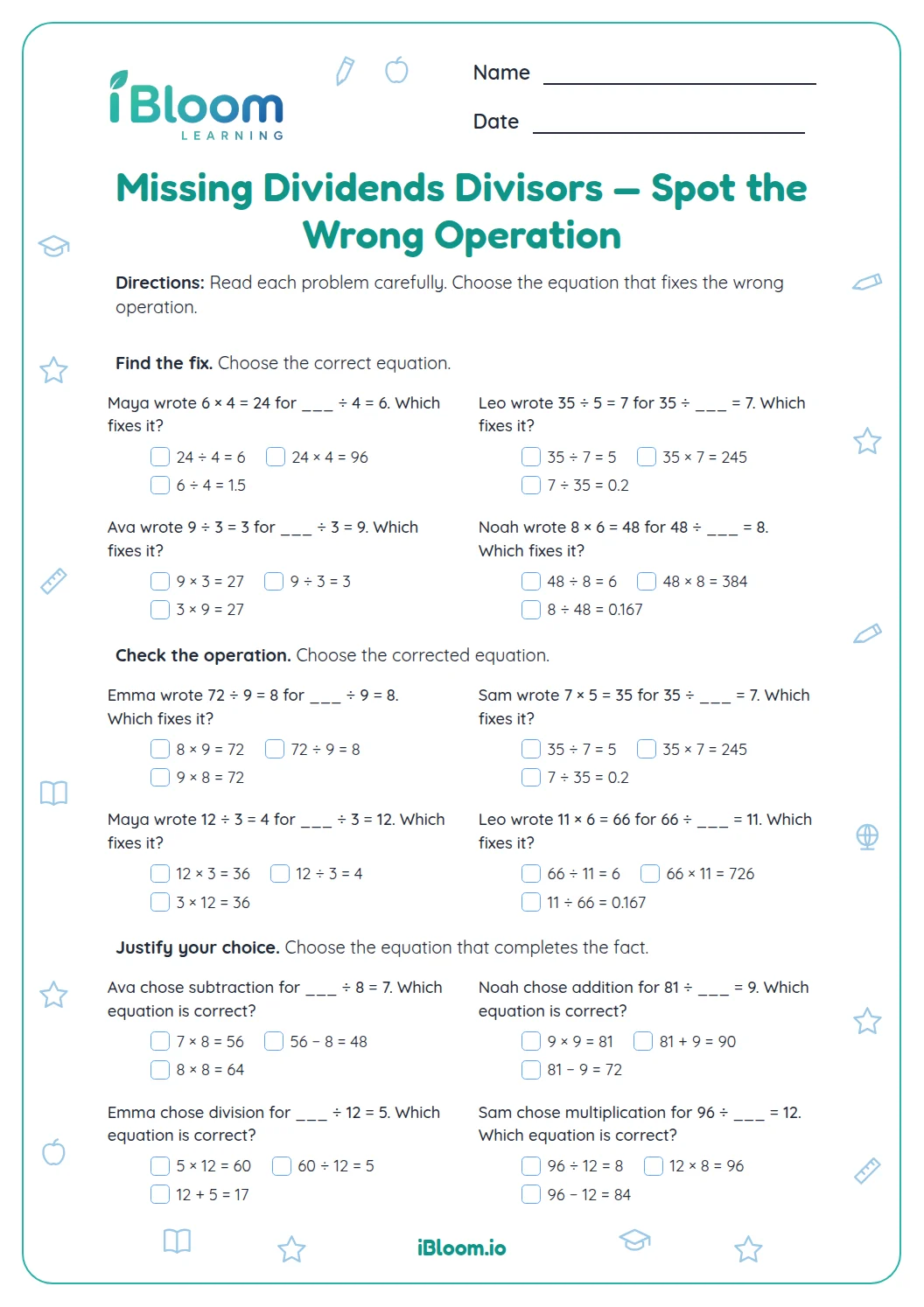
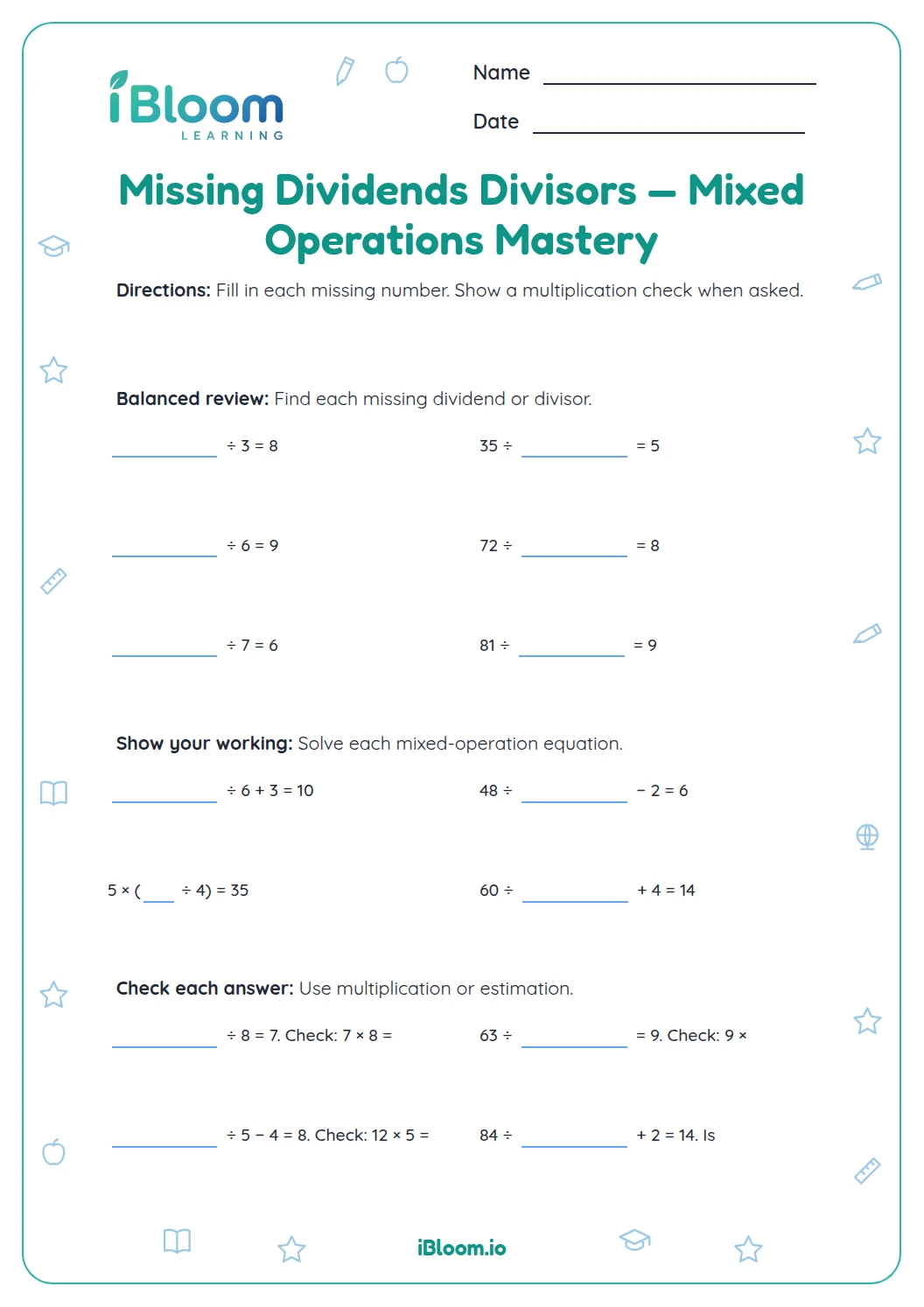
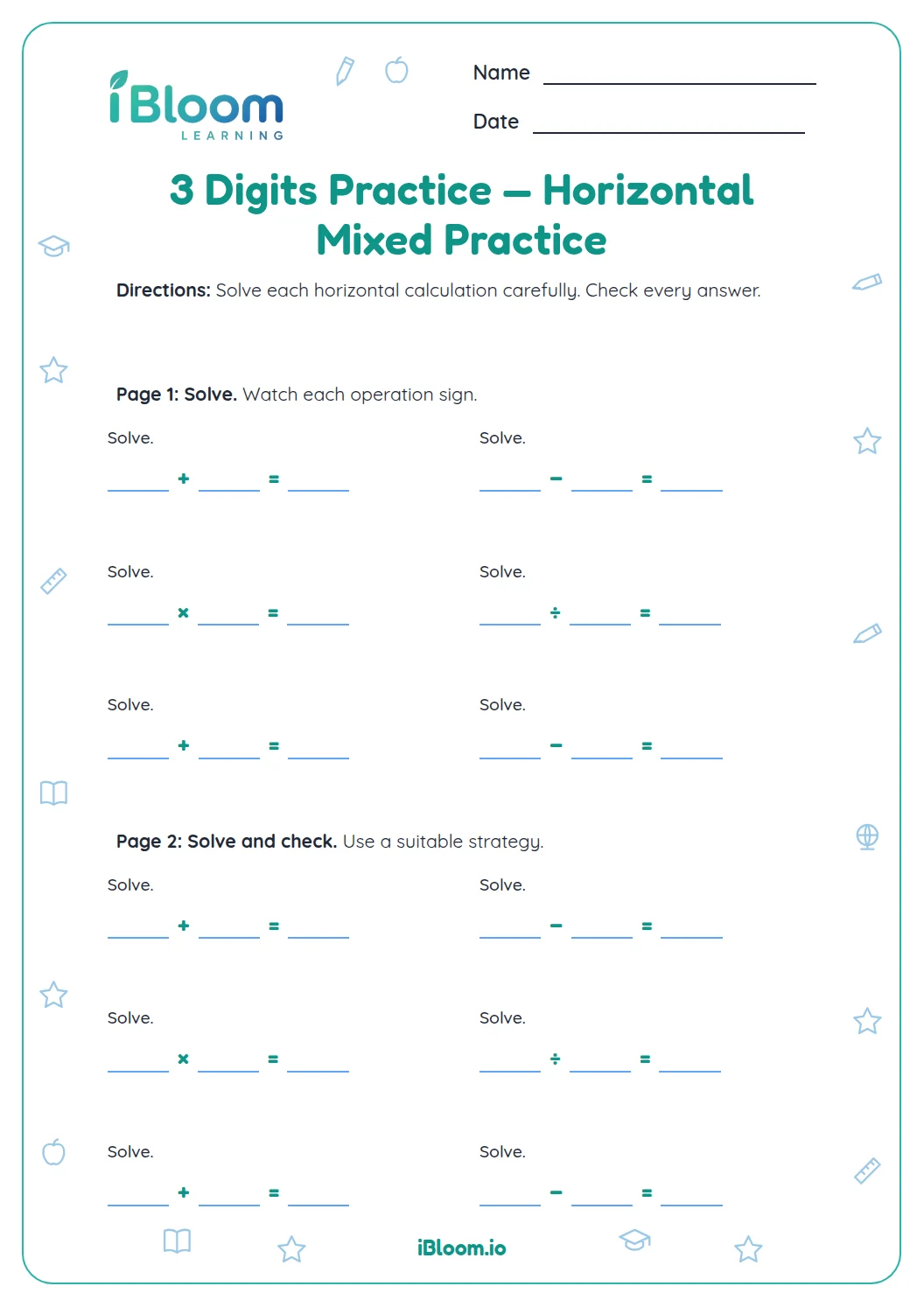
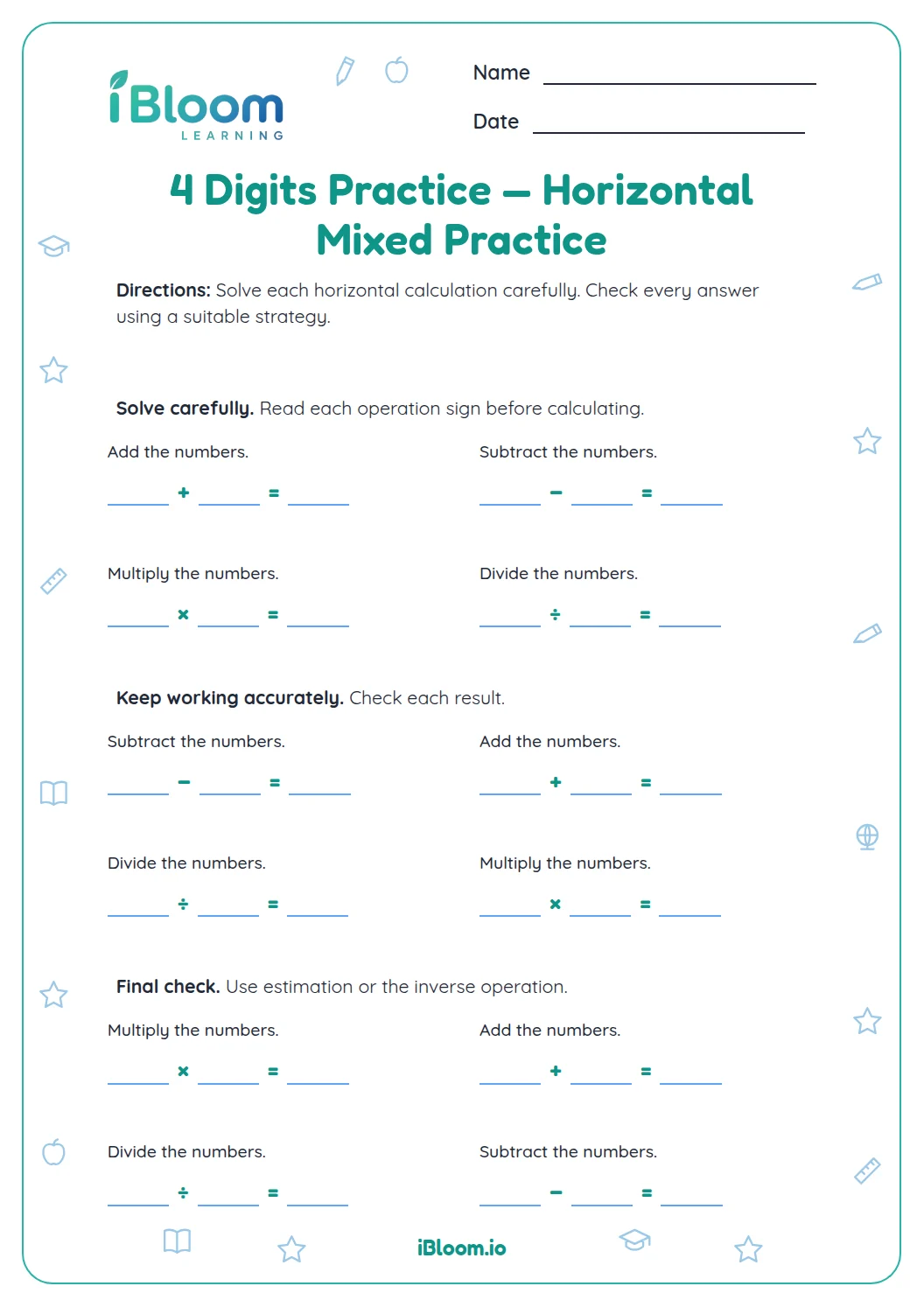
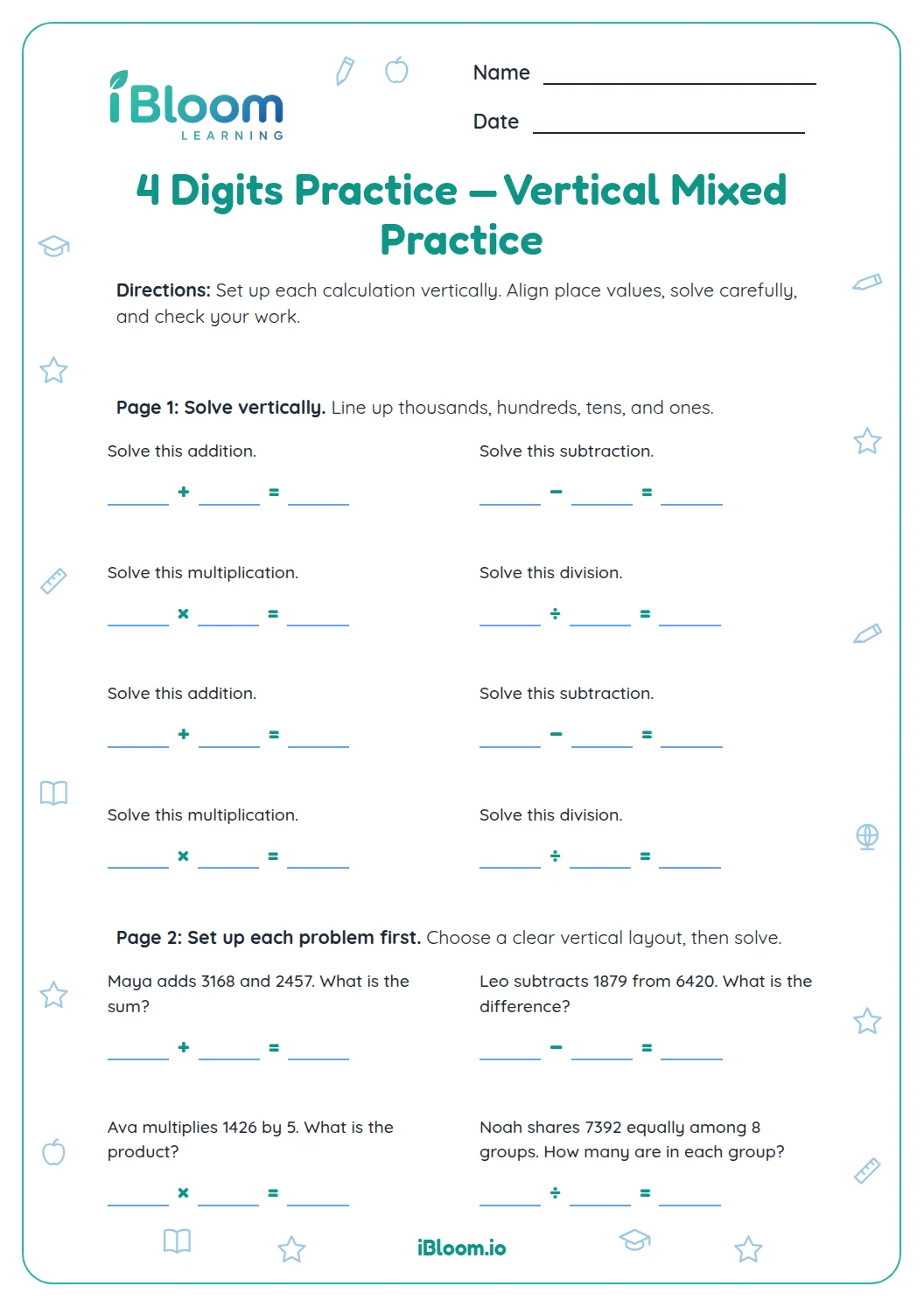
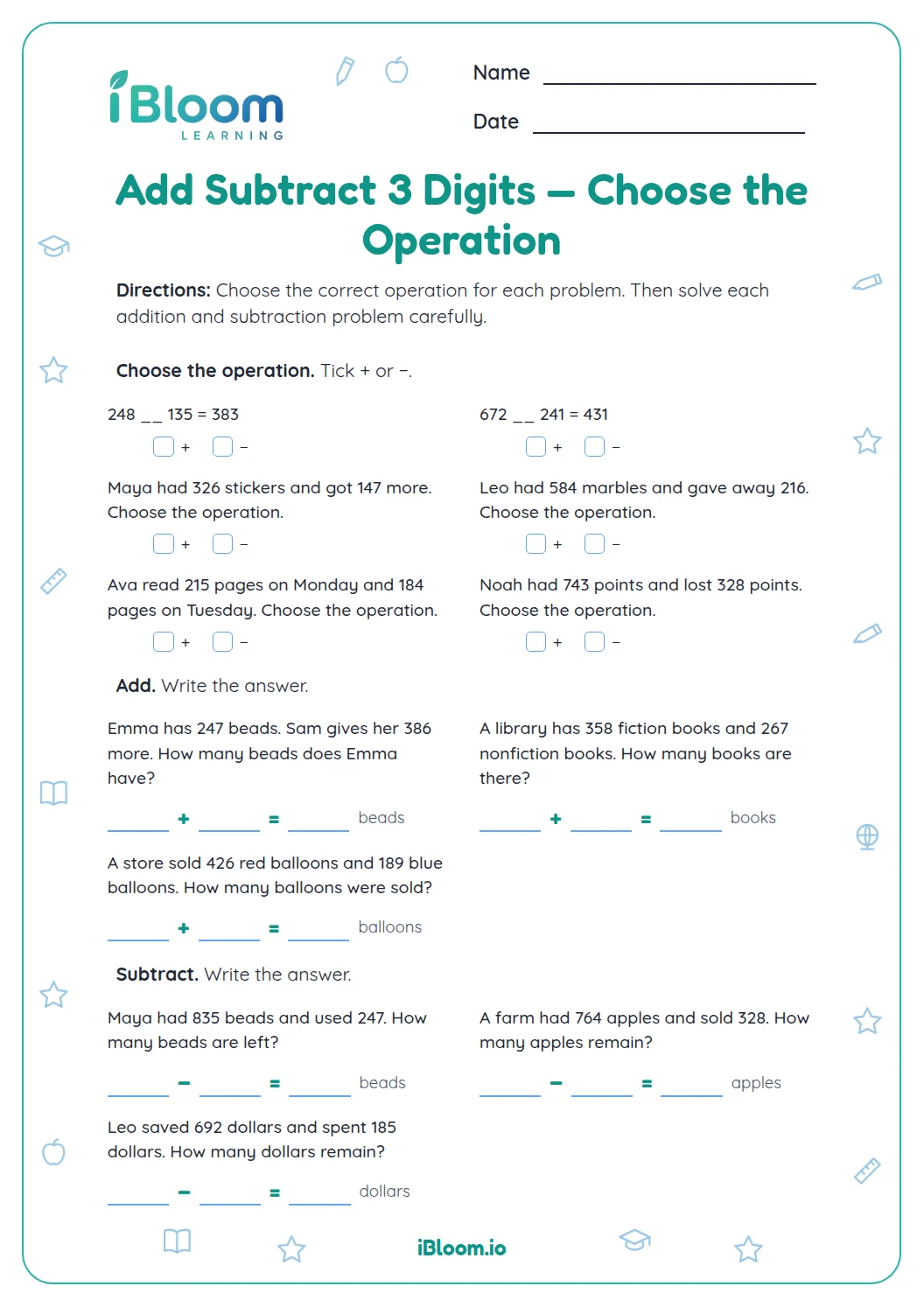
This Grade 4 printable gives learners 16 horizontal equations with one missing number each. The first part uses multiplication facts, the next practices division, and later parts apply multi-digit addition and subtraction before a mixed review. Learners can use inverse operations and substitution to check each answer. The page practices Common Core standards 4.NBT.B.4 and 4.NBT.B.6, with a separate answer key.
Aligned to 4.NBT.B.4 and 4.NBT.B.6
How can you solve a missing-number equation?
Use the inverse operation to undo the known part of the equation. In 935 − ___ = 420, subtract 420 from 935 to find the missing number, 515. Check by putting 515 back: 935 − 515 = 420.
- 1935 − ___ = 420; 935 − 420 = 515; check: 935 − 515 = 420.
How to use this worksheet
- 1Look at the operation sign and locate the blank.
- 2Choose the inverse operation that can undo the known number.
- 3Work with place value for the larger addition and subtraction items.
- 4Put the answer back into the original equation to check it.
- 5Use the key after completing the whole page.
Common mistakes and fixes
The mistake
Adding when the blank is subtracted.
The fix
Use the equation’s relationship: 935 minus the blank equals 420, so find the difference between 935 and 420.
The mistake
Forgetting to regroup in a multi-digit calculation.
The fix
Line up place values mentally or on scrap paper and check each column.
The mistake
Stopping after finding a quotient.
The fix
Multiply the quotient by the divisor to check the dividend.
Curriculum alignment
Add and subtract multi-digit whole numbers with the standard algorithm.
On this sheet: Questions 9–12 and 15–16 use multi-digit addition and subtraction.
Show the official wordingHide the official wording
Fluently add and subtract multi-digit whole numbers using the standard algorithm.
Find whole-number quotients using place value and multiplication relationships.
On this sheet: The division blanks use multiplication relationships and one-digit divisors.
Show the official wordingHide the official wording
Find whole-number quotients and remainders with up to four-digit dividends and one-digit divisors, using strategies based on place value, the properties of operations, and/or the relationship between multiplication and division. Illustrate and explain the calculation by using equations, rectangular arrays, and/or area models.
What to practice next
Make more practice
Further reading
Questions parents and teachers ask
How many equations are included?
The sheet has 16 equations, each with one missing number. The first items use multiplication and division facts, followed by multi-digit addition and subtraction and a short mixed review. Ask the learner to write a quick check on scrap paper, then compare the result with the original equation before using the key.
What is one way to check a missing number?
Substitute it into the original equation and calculate both sides. For 935 − ___ = 420, the missing value is 515, and 935 − 515 equals 420. Ask the learner to write a quick check on scrap paper, then compare the result with the original equation before using the key.
Are the problems arranged by operation?
Yes. The first four use multiplication, the next four use division, and the following four use addition and subtraction. The final four mix operations and larger numbers. Ask the learner to write a quick check on scrap paper, then compare the result with the original equation before using the key.
Is an answer key included?
Yes. A separate answer key lists the value for every blank. Learners can check their work after trying all 16 equations. Ask the learner to write a quick check on scrap paper, then compare the result with the original equation before using the key.
What should a learner do if an answer seems wrong?
Use the inverse operation to solve again, then substitute the result into the original equation. For multiplication and division, check with the related fact; for addition and subtraction, verify the total or difference. Ask the learner to write a quick check on scrap paper, then compare the result with the original equation before using the key.