





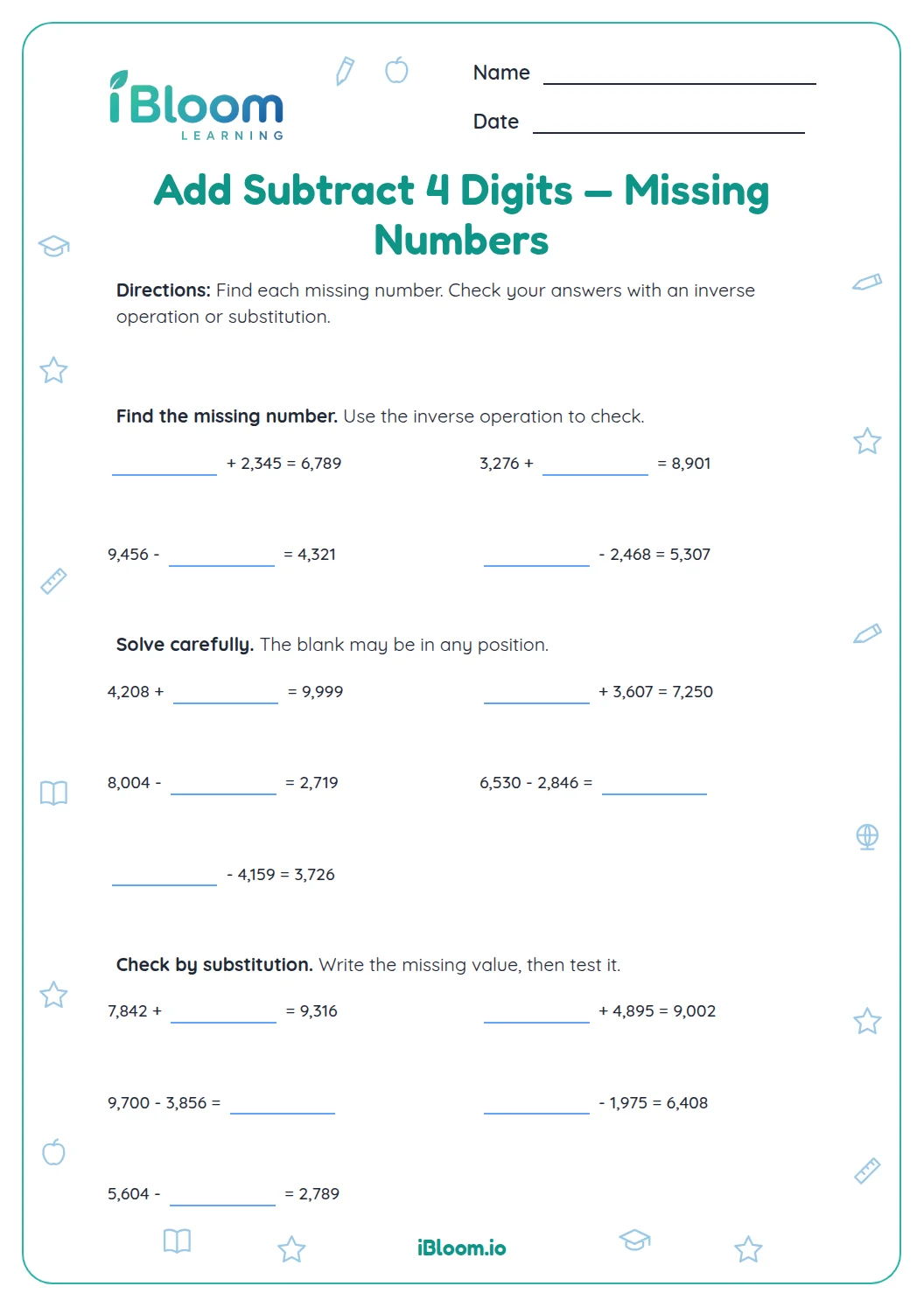
About this worksheet
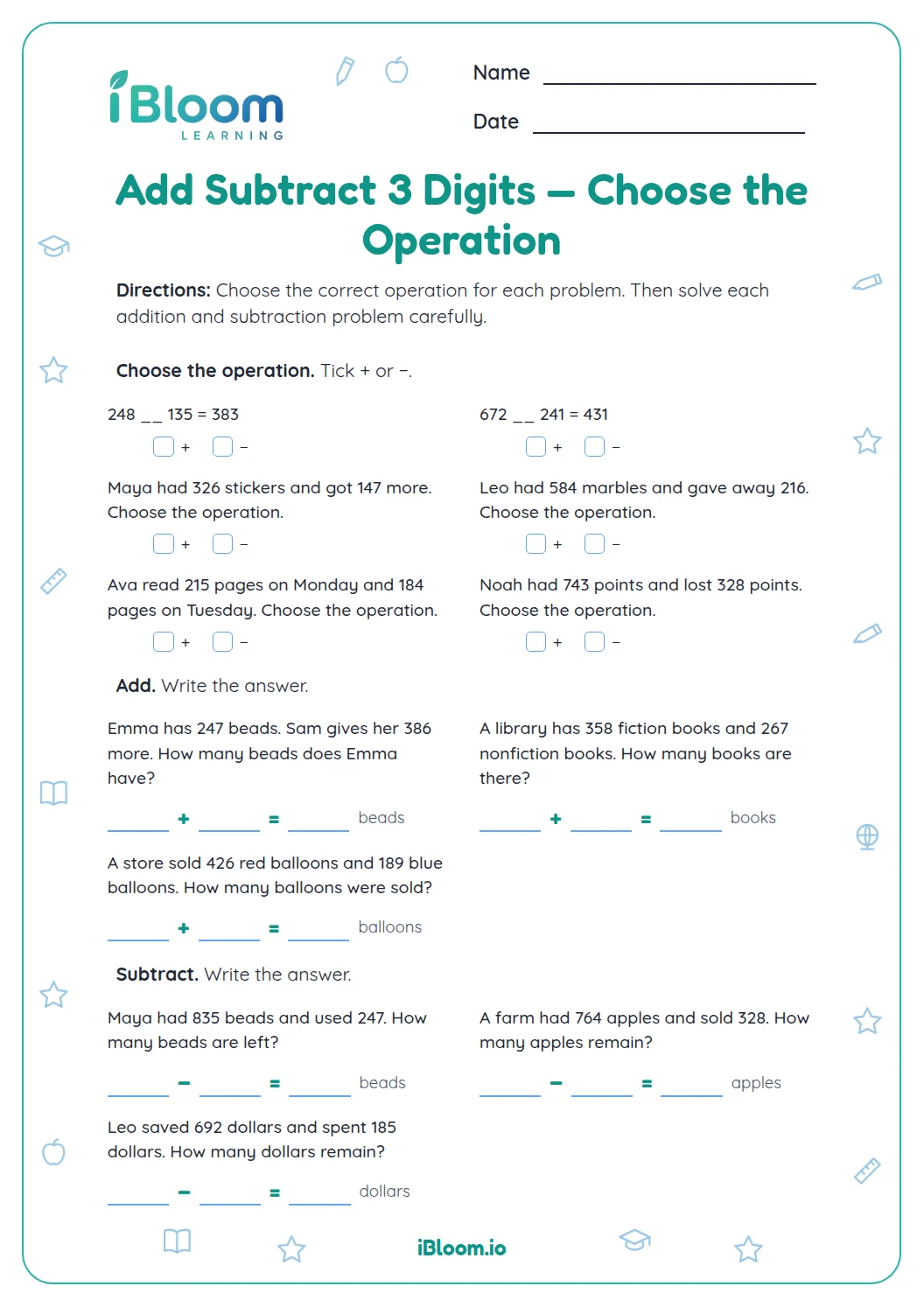
This free printable is for grades 3–6 learners practicing add and subtract three-digit numbers. It provides 16 questions in two parts, moving from a first set into continued independent practice. Students can record their work, check answers with the separate key, and revisit any step that needs attention. The page aligns with 3.NBT.A.2.
Aligned to 3.NBT.A.2
How should students approach add and subtract three-digit numbers?
The first six problems are three-digit addition and the next six are subtraction; the last four mix the operations. Align hundreds, tens, and ones before calculating.
For example, 246 + 132 = 378. Add each place-value column, regrouping when a column reaches 10 or more. In subtraction, regroup when a top digit is too small.
- 1246 + 132 = 378
- 2Ones: 6 + 2 = 8; tens: 4 + 3 = 7; hundreds: 2 + 1 = 3.
- 3Write each result in its matching place.
What will the two parts practice?
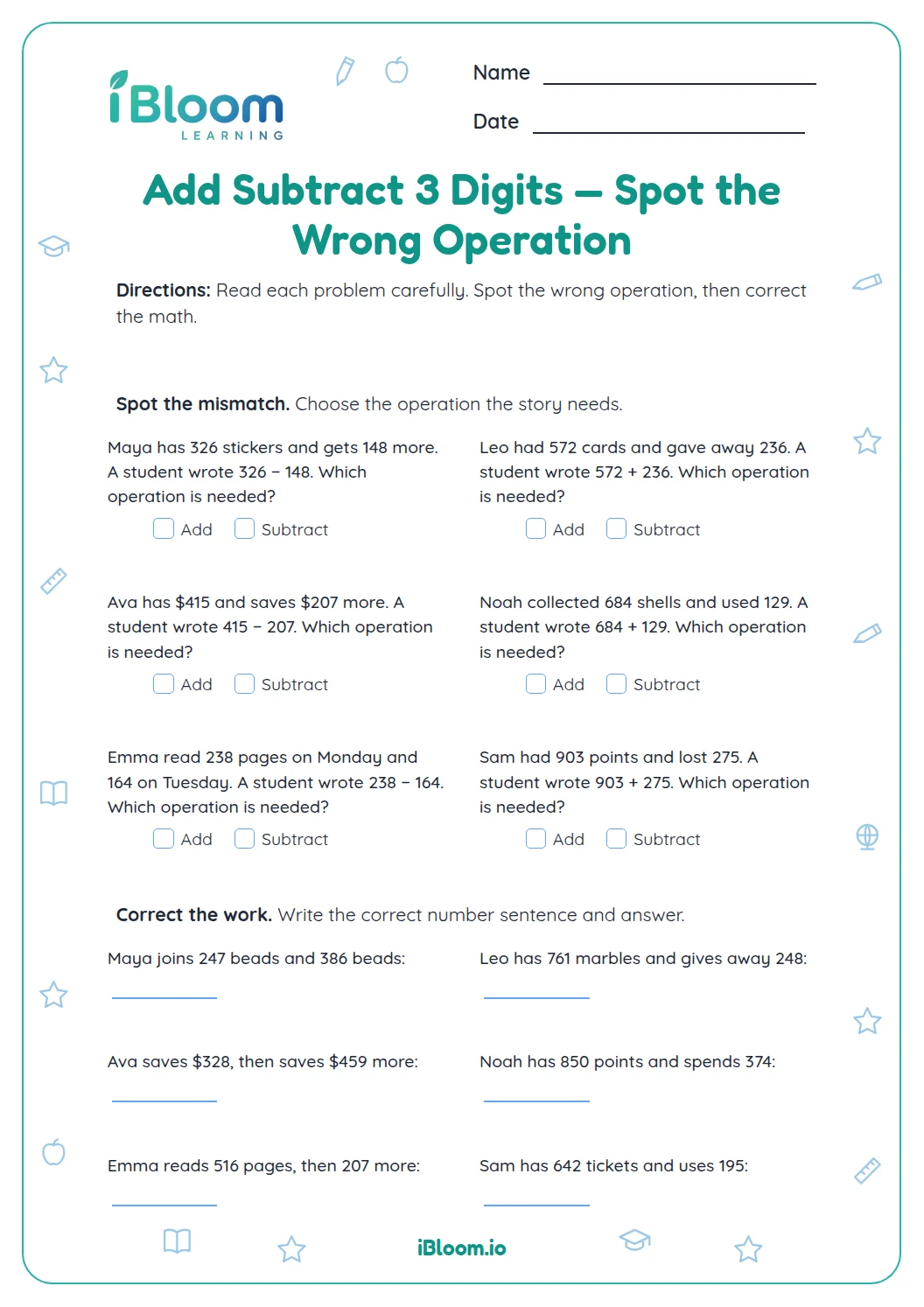
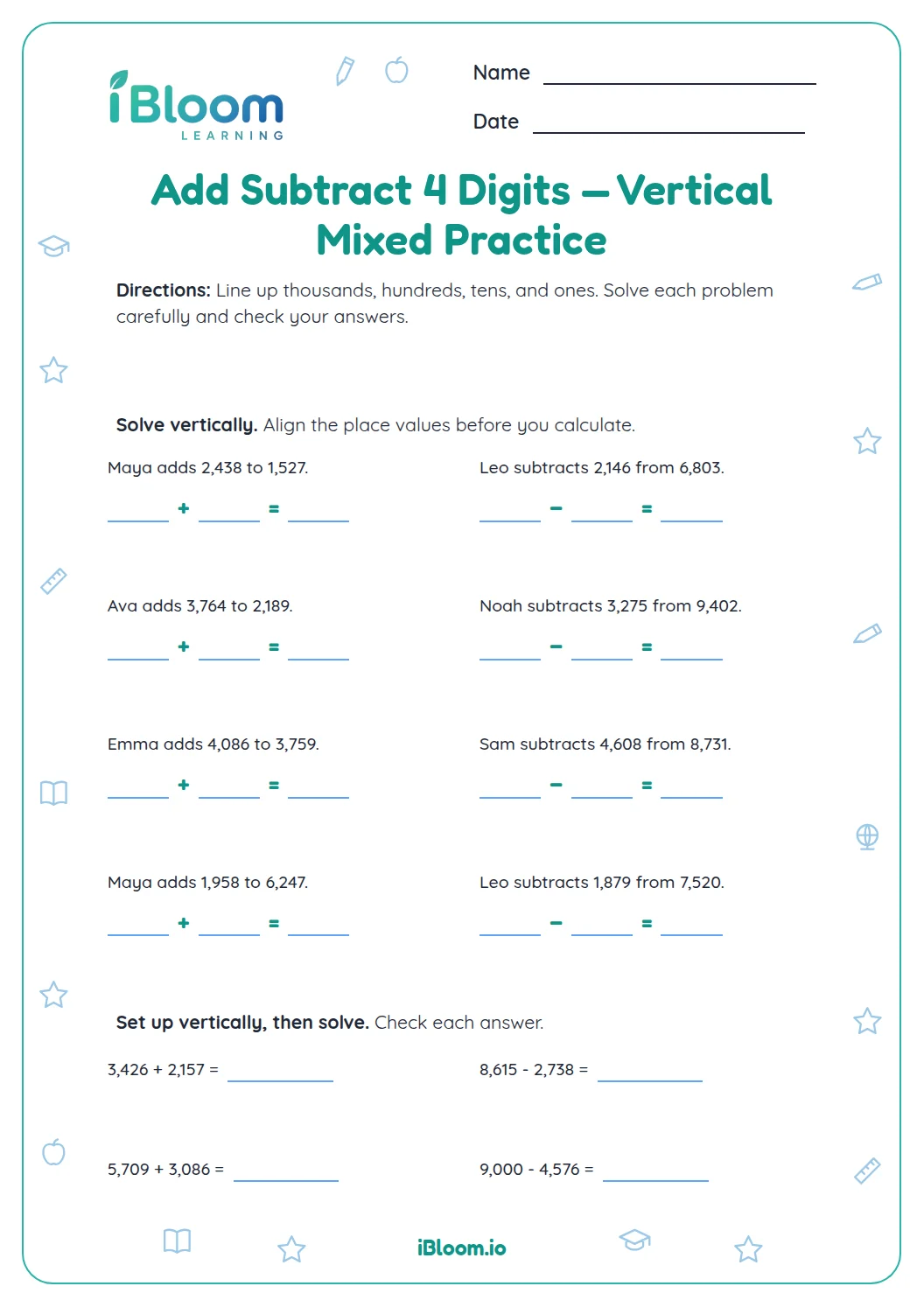
Part A (questions 1–8) starts with addition and subtraction stories. Part B (questions 9–16) continues with stories and direct vertical calculations. The answer key gives each result.
- Part A: establish the method and record each answer.
- Part B: continue the same skill with a fresh set of examples.
- Use the answer key to review a calculation that needs another try.
How can I guide the practice?
- 1Identify whether the problem uses addition or subtraction.
- 2Set up the hundreds, tens, and ones in aligned columns.
- 3Begin with the ones column and regroup when needed.
- 4Continue through tens and hundreds.
- 5Estimate or use the inverse operation to check the result.
Common slips and how to check them
The mistake
Misaligning a digit when setting up a vertical problem.
The fix
Keep hundreds, tens, and ones in straight columns.
The mistake
Forgetting to regroup from a neighboring place.
The fix
Mark the new ten or hundred before continuing.
The mistake
Solving a story with the wrong operation.
The fix
Use the story action and final question to decide whether the amount grows or shrinks.
Common Core alignment
This worksheet practices the Common Core skill listed here.
Fluently add and subtract within 1,000 using place-value strategies.
On this sheet: The questions directly practice add and subtract three-digit numbers.
Show the official wordingHide the official wording
Fluently add and subtract within 1000 using strategies and algorithms based on place value, properties of operations, and/or the relationship between addition and subtraction.
What to practice next
Make more practice
Further reading
Questions parents and teachers ask
How many questions are on the worksheet?
There are 16 questions, divided into two parts of eight. The separate answer key lists one answer for every item, so an adult can check the whole set or review a few questions at a time. Students may complete one part per sitting.
What skill does this page practice?
The page focuses on add and subtract three-digit numbers. Each question uses the same core idea with a new example, giving students repeated practice with the numbers and language used for this skill. Adults can ask learners to explain one answer aloud.
Should students show their work?
Yes. Have students write their steps beside each problem or use scratch paper, especially when aligning digits or reasoning about a missing value. Showing the steps makes it easier to find where a calculation changed. The key supports that review after students finish.
How can I use the answer key?
Let the learner finish a group before checking it. If an answer differs, return to the question and check the operation, place values, and arithmetic. This review helps the student correct the step instead of simply copying the answer.
How long will the worksheet take?
Plan for about 20 minutes, including time to read prompts and check work. The pace will vary with familiarity, so it is fine to pause between the two parts and complete the second set later. A short break can make the practice easier to manage.