




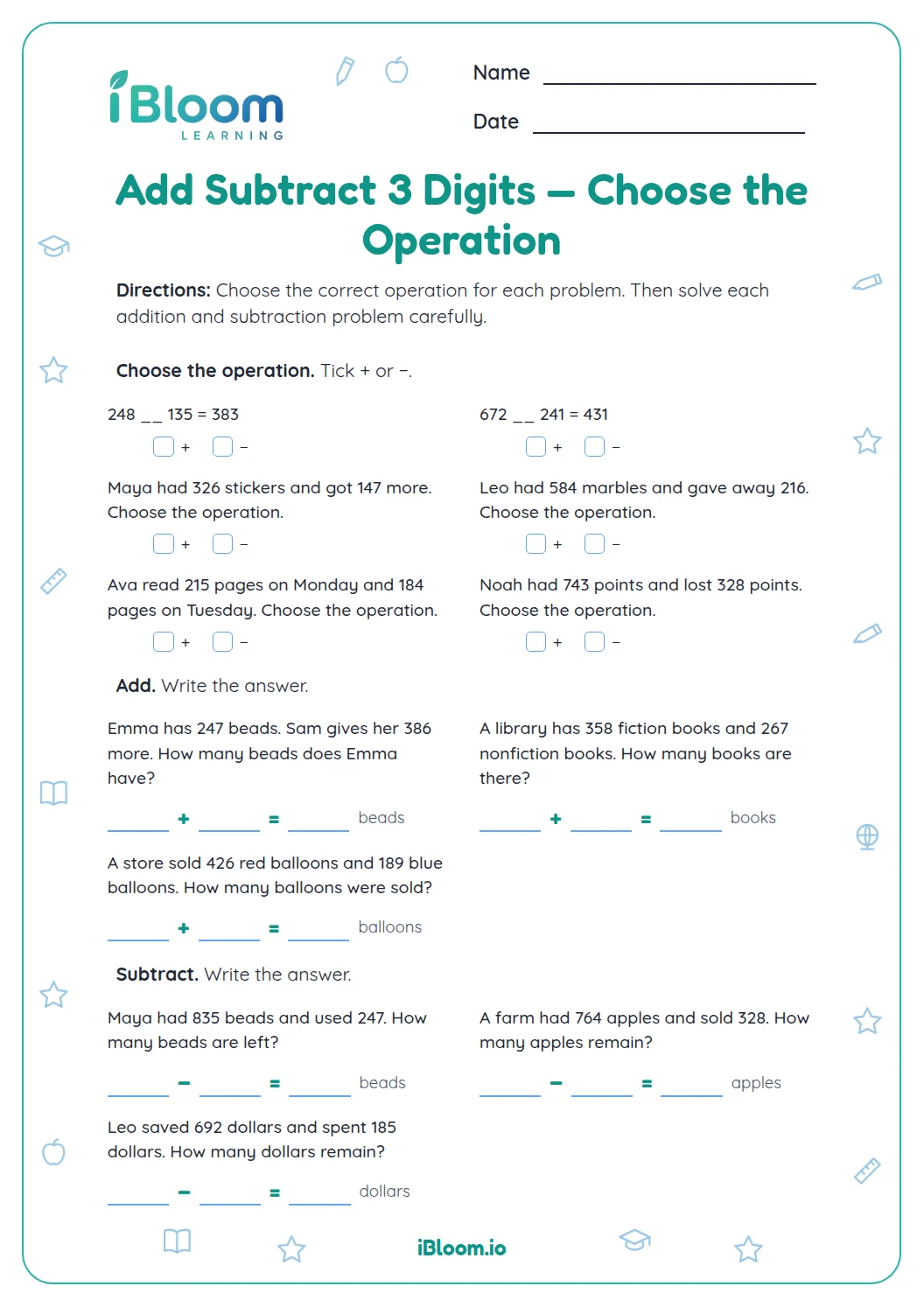


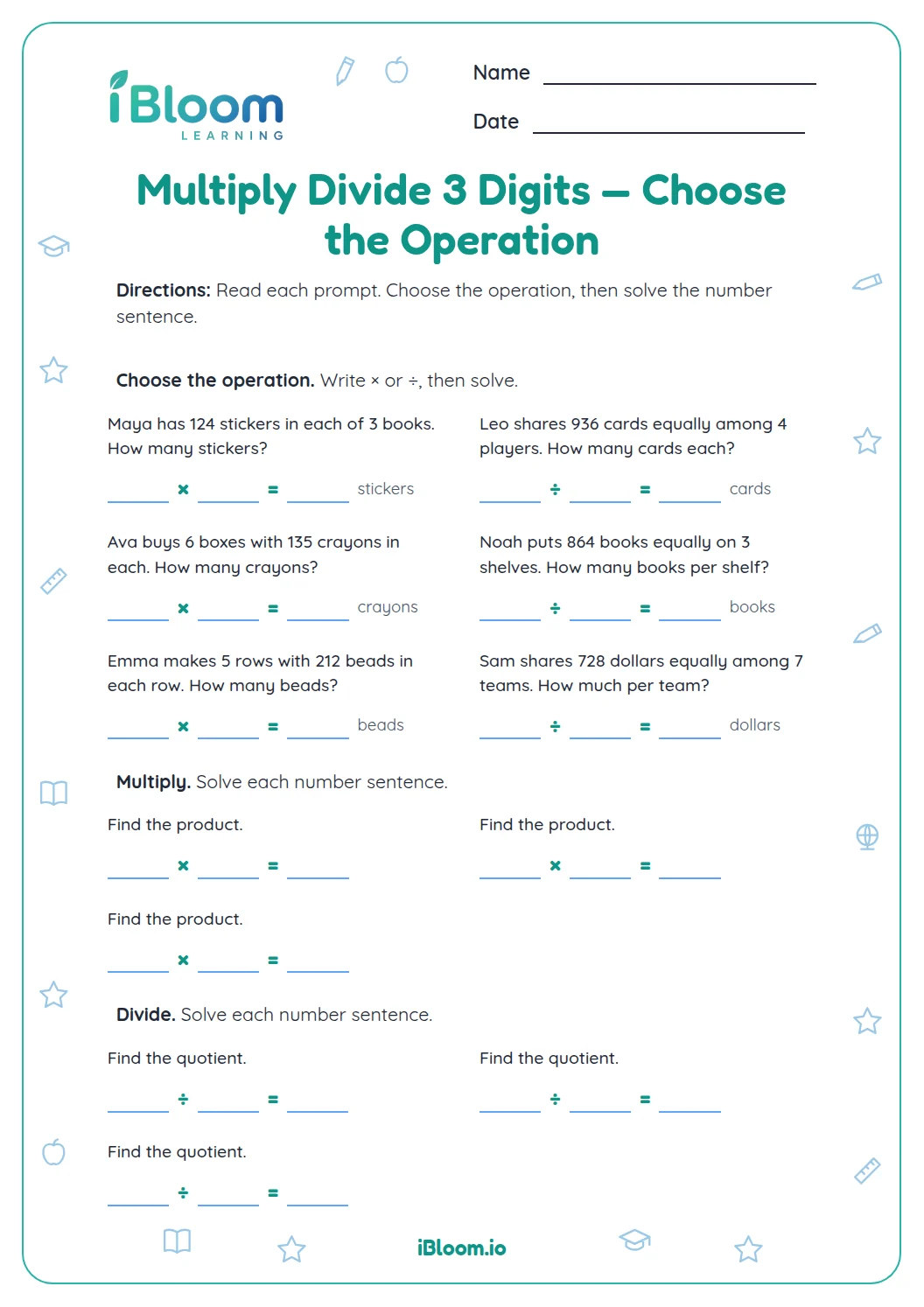


About this worksheet
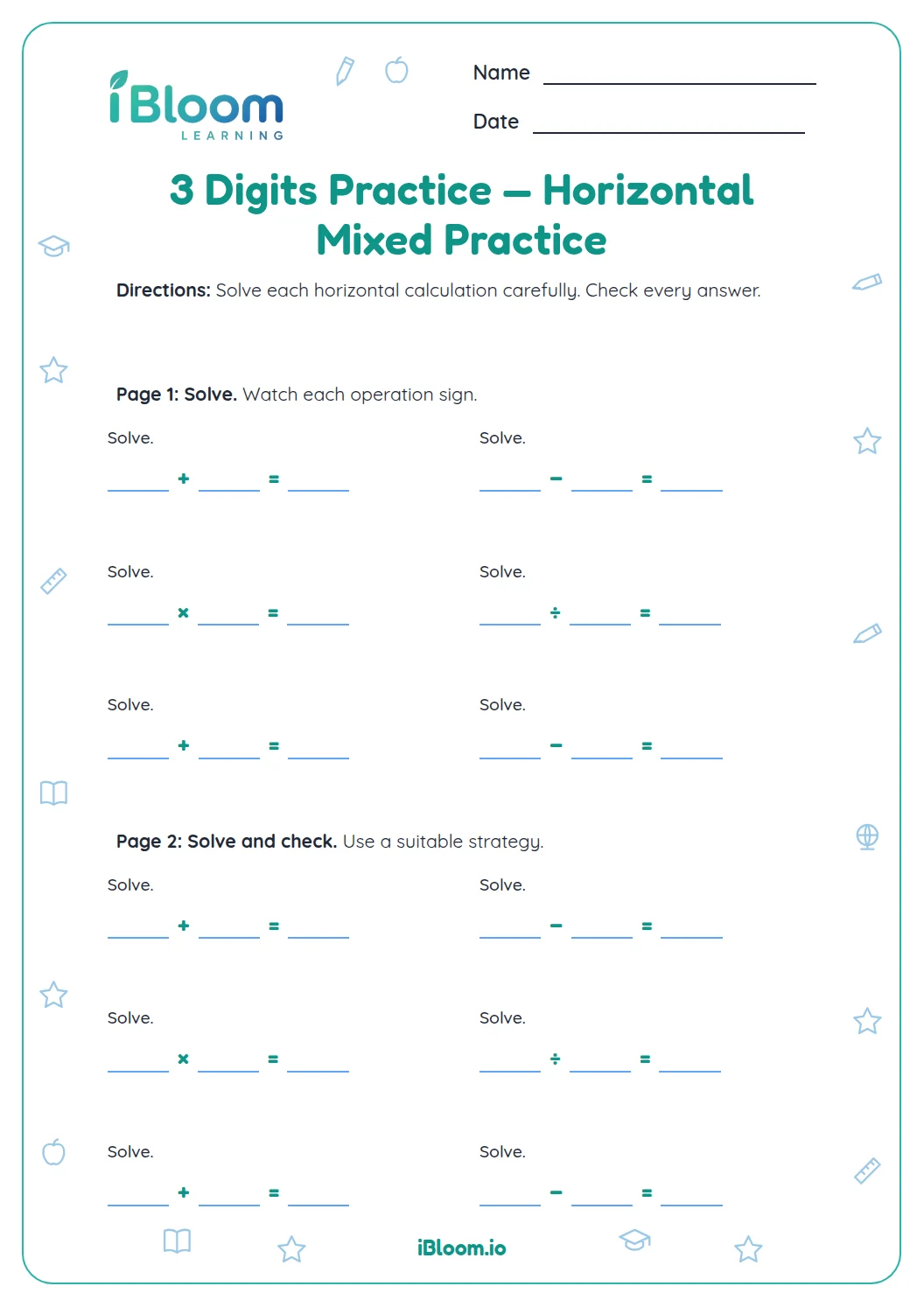
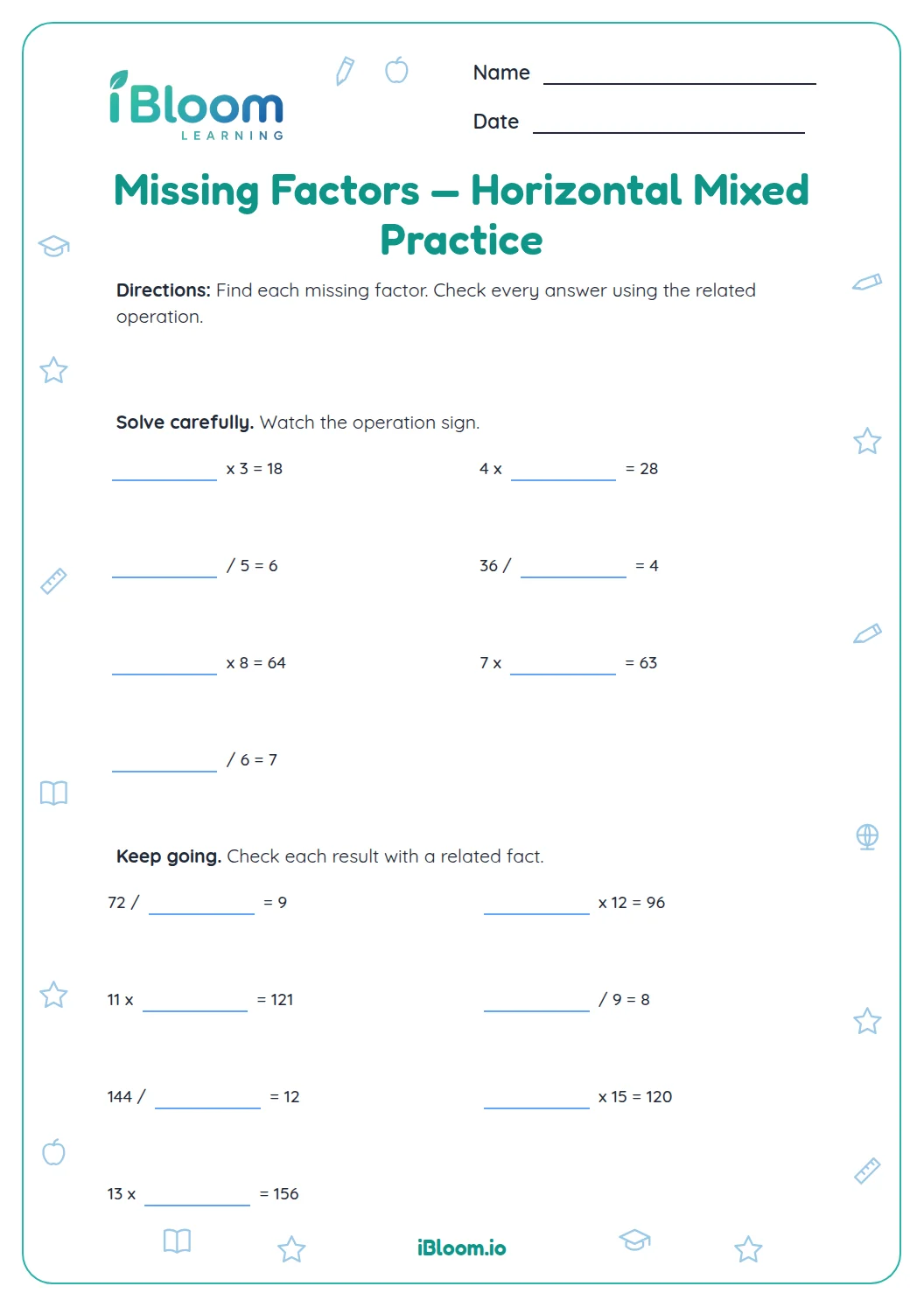
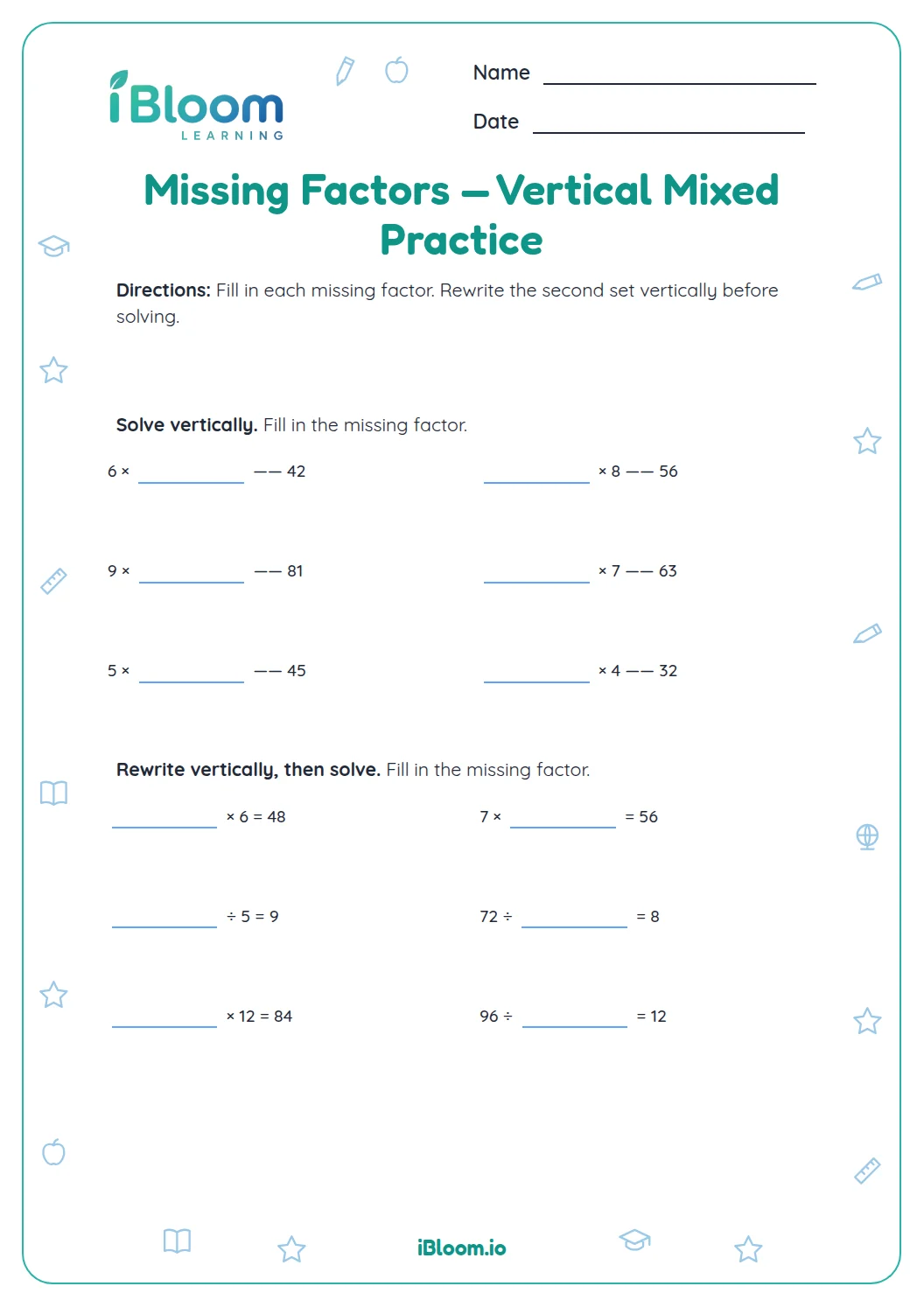
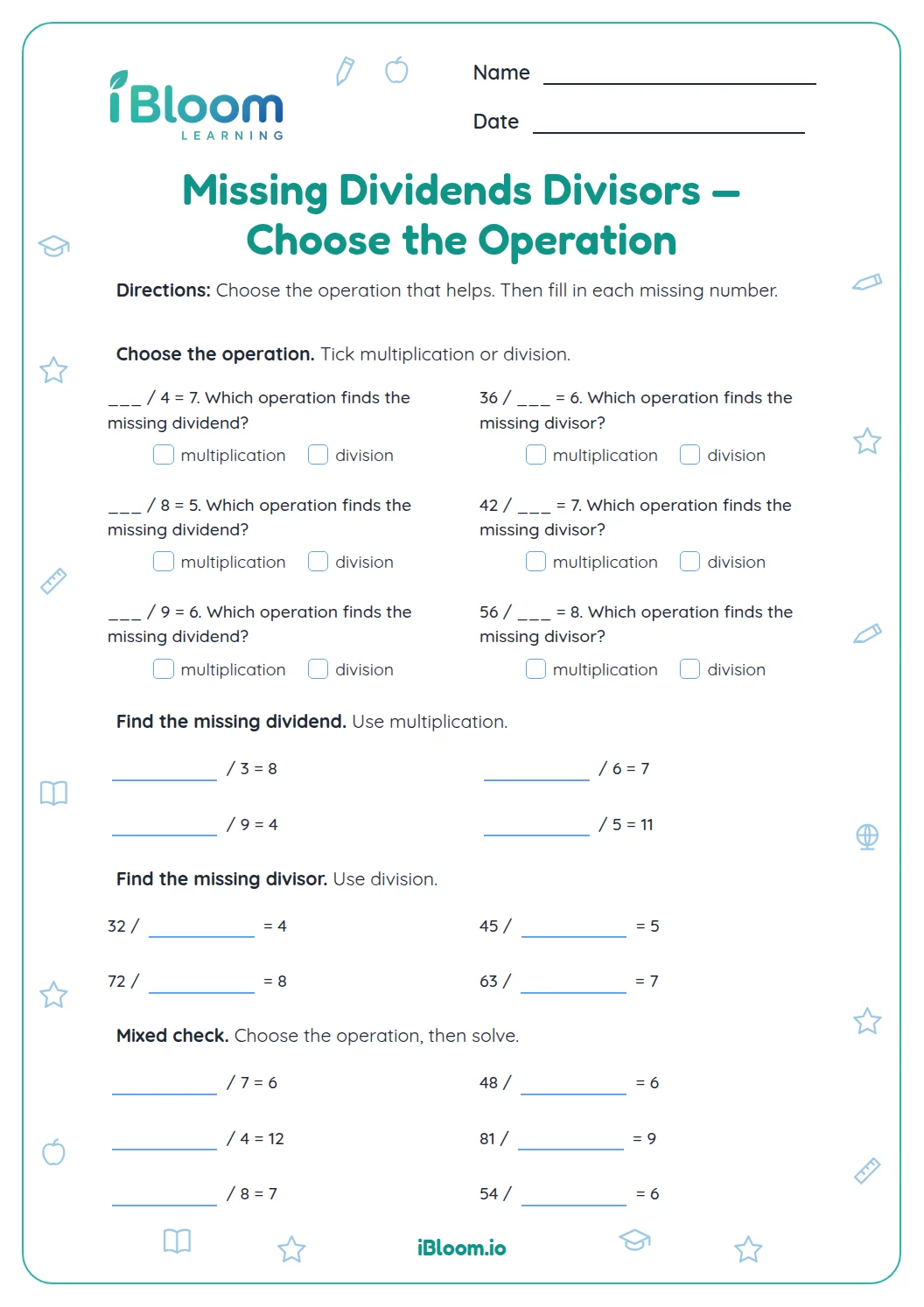
This free Grade 4 worksheet has 20 missing-number problems using addition, subtraction, multiplication, and division with three-digit values. Students first use inverse operations in equations, then apply the same reasoning to four short situations. For example, an unknown addend can be found by subtracting the known addend from the total. A separate answer key gives the missing value for each item. The multiplication and division work practices Common Core standards 4.NBT.B.5 and 4.NBT.B.6.
Aligned to 4.NBT.B.5 and 4.NBT.B.6
How do inverse operations uncover a blank?
Part A uses addition and subtraction. In q1, ___ + 248 = 673, subtract the known addend from the total: 673 − 248 = 425.
How do multiplication and division work in reverse?
Part B asks students to undo a known factor or divisor. For q7, ___ × 3 = 729, divide 729 by 3 to find 243, then multiply to verify.
How can students check an equation?
Part C mixes operation types. Substitute the proposed value for the blank and calculate both sides; the equation is correct only when they match.
How do the final stories use missing values?
Part D turns an unknown addend, subtrahend, factor, or quotient into a short situation. First write the operation the story describes, then use the matching inverse operation to find the unknown.
How to use this worksheet
- 1Identify the operation and the known values.
- 2Choose the inverse operation that will isolate the blank.
- 3Calculate the missing value and write it in the equation.
- 4Substitute it back into the original equation to verify.
- 5For a story problem, name the unknown and include the requested unit or object.
- 6Check the completed set with the separate answer key.
Common mistakes and quick fixes
The mistake
Subtracting the total from the known addend when finding an unknown addend.
The fix
Subtract the known addend from the total, then add back to check.
The mistake
Treating a missing divisor like a missing quotient.
The fix
Use the equation’s position: dividend ÷ divisor = quotient, then test the divisor by multiplying.
The mistake
Calculating with the missing value but not substituting it back.
The fix
Replace the blank with your answer and check that the equation balances.
Curriculum alignment
The multiplication and division questions practice these Common Core computation skills.
Multiply three-digit whole numbers by one-digit factors in the missing-factor equations.
On this sheet: Multiply three-digit whole numbers by one-digit factors in the missing-factor equations.
Show the official wordingHide the official wording
Multiply a whole number of up to four digits by a one-digit whole number, and multiply two two-digit numbers, using strategies based on place value and the properties of operations. Illustrate and explain the calculation by using equations, rectangular arrays, and/or area models.
Divide three- and four-digit dividends by one-digit divisors in the missing-value equations.
On this sheet: Divide three- and four-digit dividends by one-digit divisors in the missing-value equations.
Show the official wordingHide the official wording
Find whole-number quotients and remainders with up to four-digit dividends and one-digit divisors, using strategies based on place value, the properties of operations, and/or the relationship between multiplication and division. Illustrate and explain the calculation by using equations, rectangular arrays, and/or area models.
What to practice next
Make more practice
Further reading
Questions parents and teachers ask
What does this worksheet practice?
It asks students to find missing values in addition, subtraction, multiplication, and division problems with three-digit values. The sheet includes 16 equations and four short word problems. Students use inverse operations to solve, then substitute an answer back to check it.
How many questions and pages are included?
There are 20 questions in four parts: 16 equations followed by 4 word problems. The worksheet uses two pages, and the answer key is printed on two separate pages. The final situations apply the same missing-value reasoning used in the equations.
What is one example from the worksheet?
In q1, ___ + 248 = 673. Subtract the known addend from the total: 673 − 248 = 425. Then check 425 + 248 = 673. The inverse operation both finds the unknown and confirms that the original equation is true.
How should students check a missing divisor?
Substitute the proposed divisor into the equation and use multiplication to check it. For 945 ÷ ___ = 135, the missing divisor is 7 because 135 × 7 = 945. This check helps distinguish a missing divisor from a missing quotient.
Which standards appear on this page?
The multiplication and division equations practice Grade 4 computation standards 4.NBT.B.5 and 4.NBT.B.6. Students multiply a three-digit number by a one-digit factor or divide a dividend by a one-digit divisor. The addition and subtraction equations provide mixed-operation review alongside those skills.
Is an answer key included?
Yes. The separate answer key provides the missing number for all 20 questions, including the four stories. For word problems, check that the number answers the question and names the requested item, such as 171 markers in each carton.