




About this worksheet
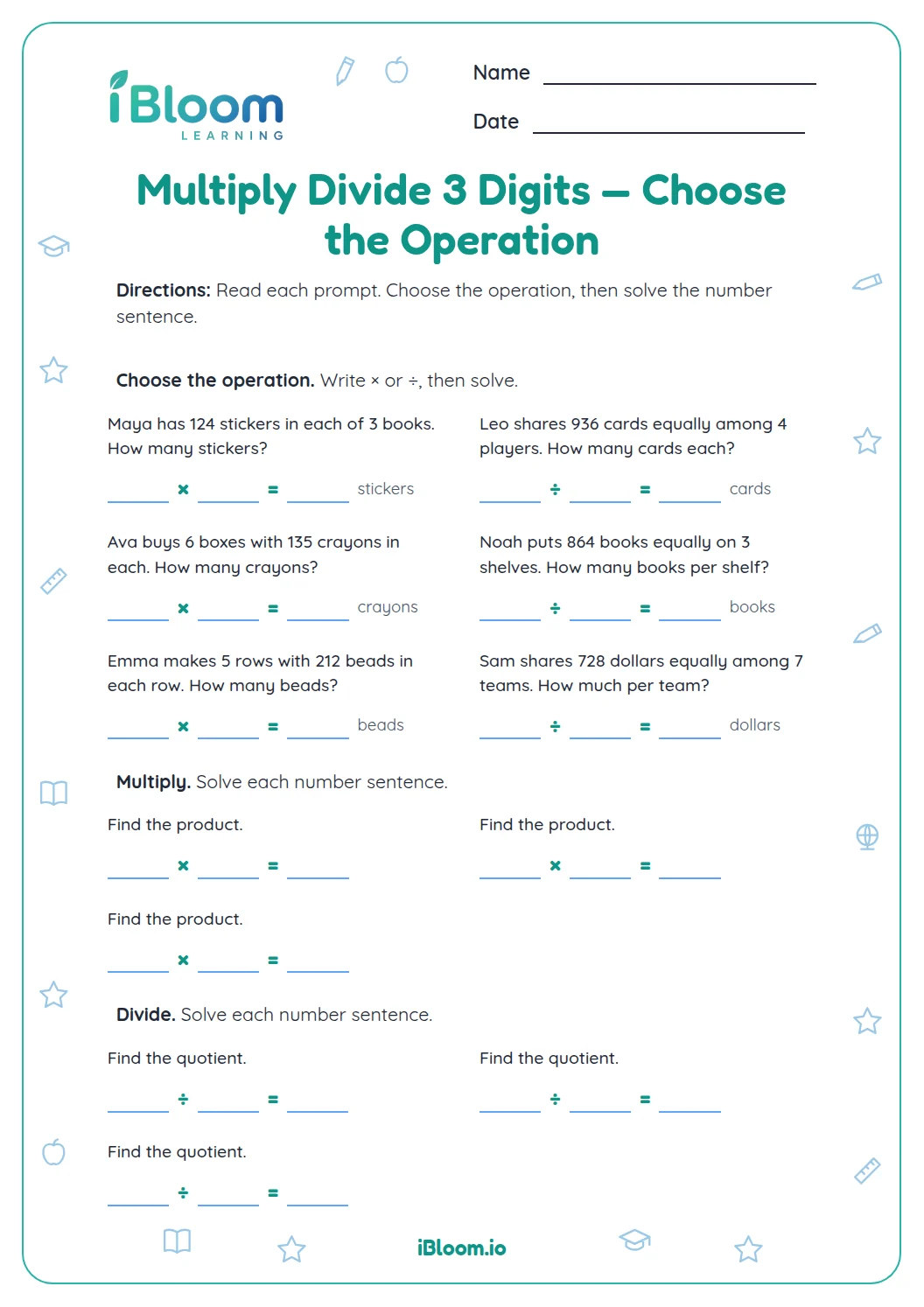
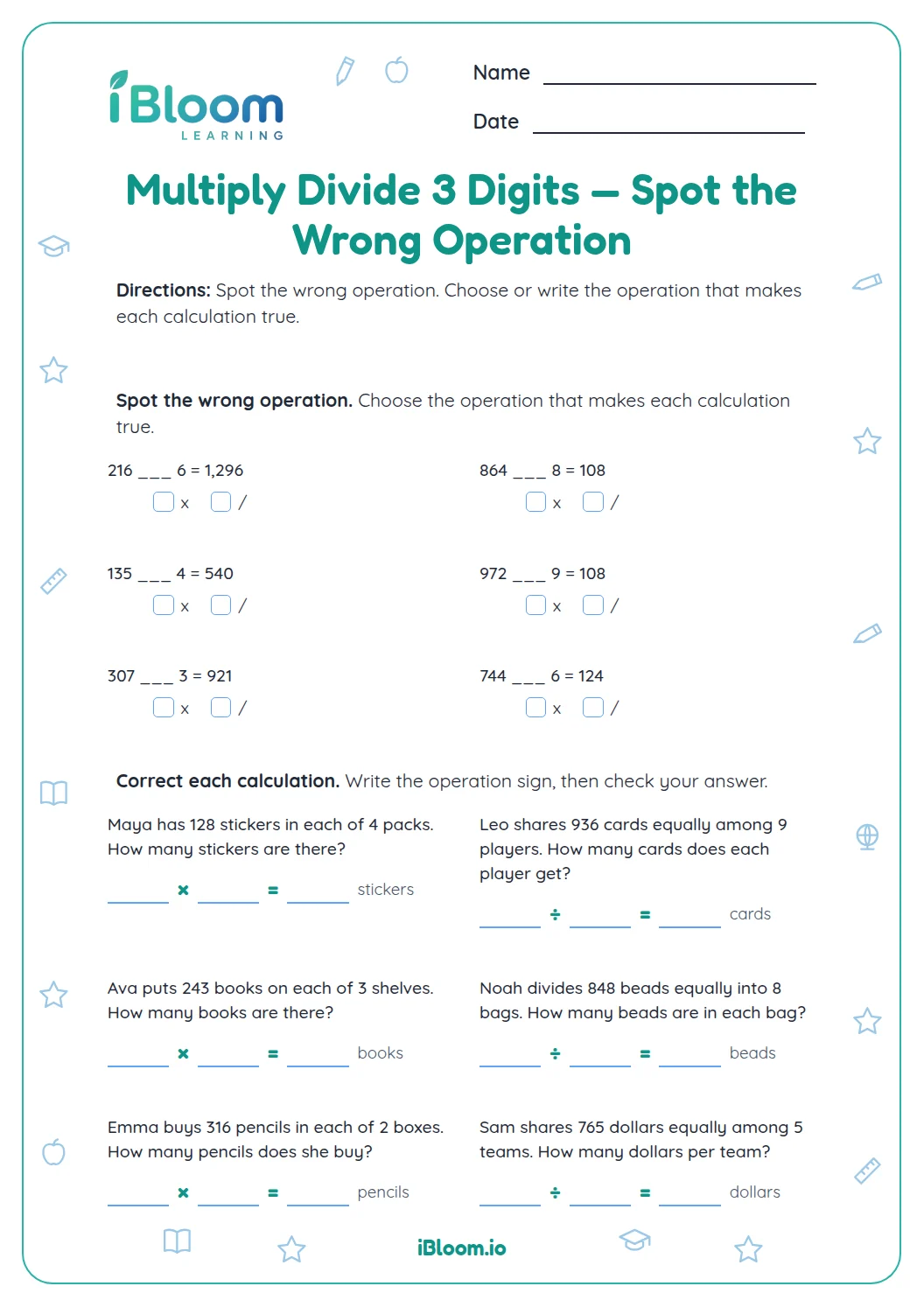
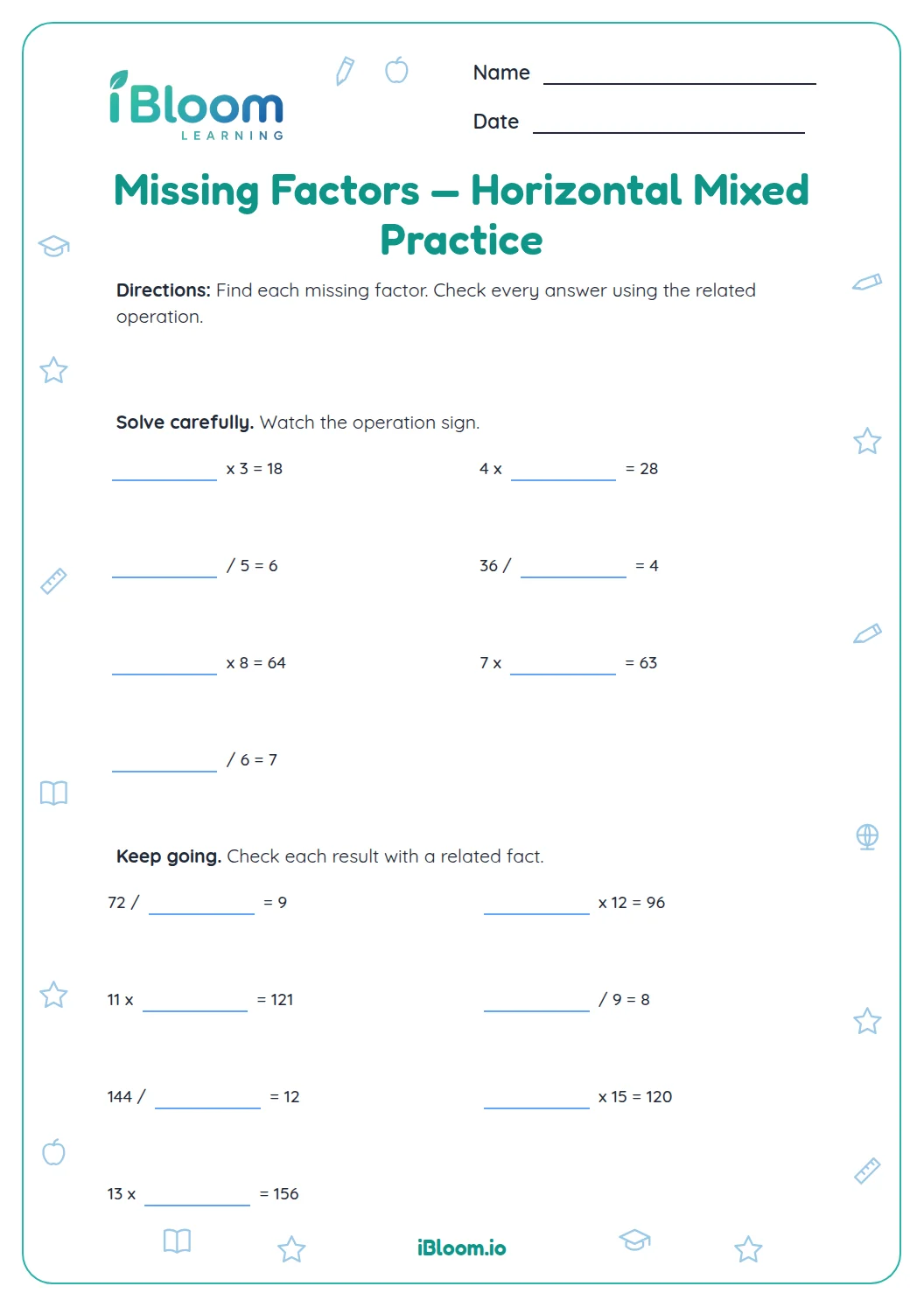
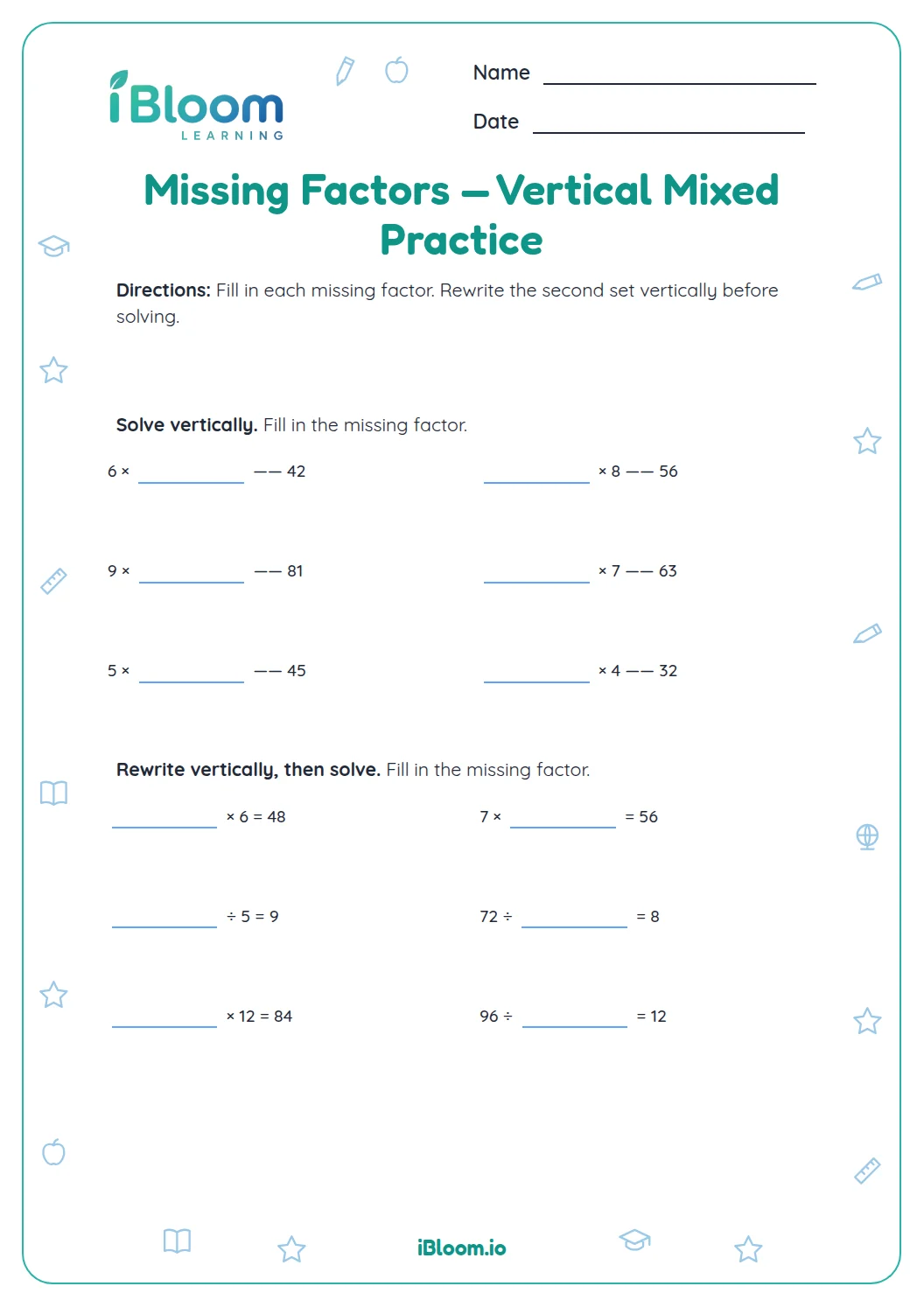
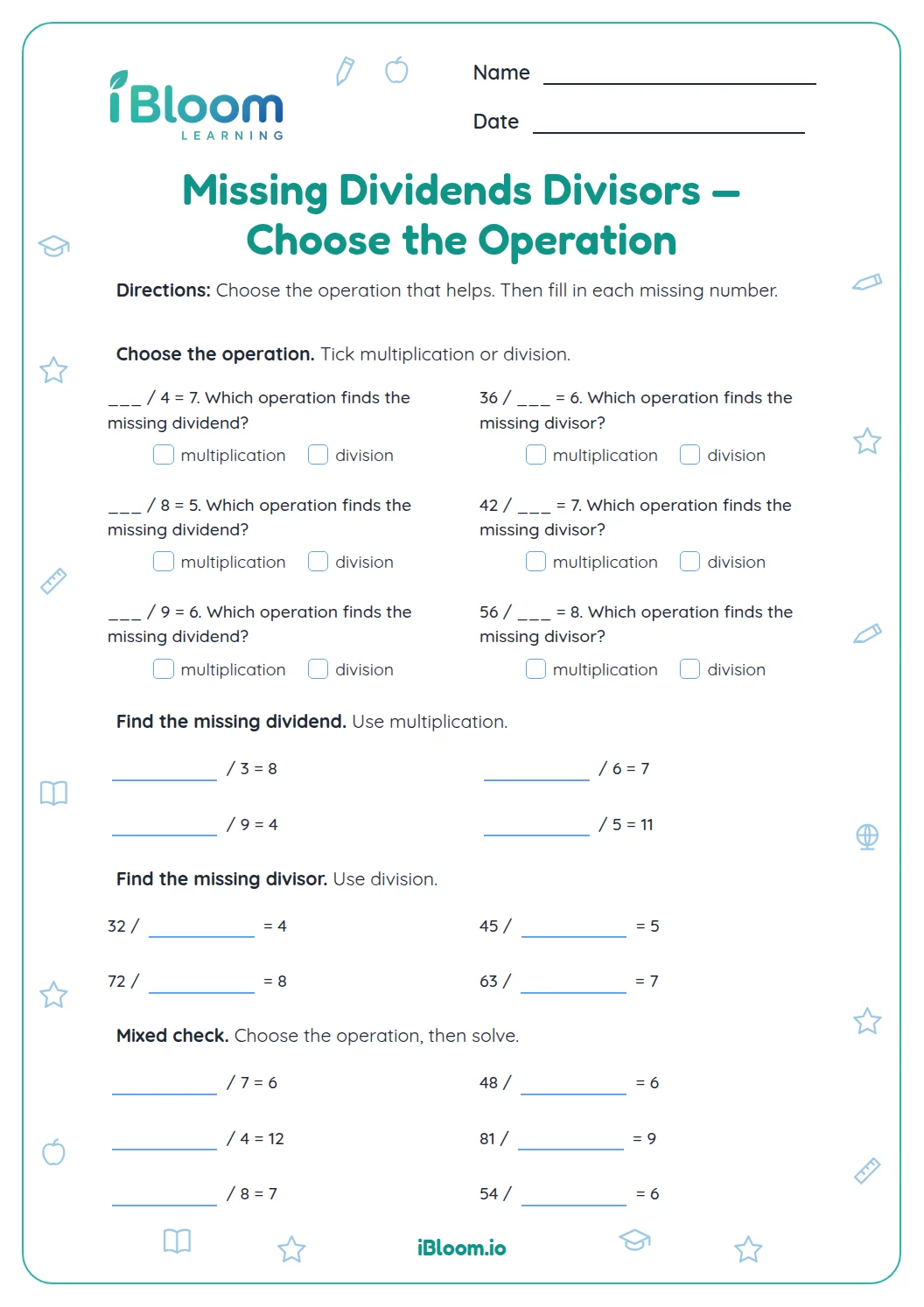
This printable gives Grade 5 students fourteen missing-number multiplication and division problems. Part A asks students to find a factor from a product. Part B uses the inverse relationship between multiplication and division to find a quotient, dividend, or divisor. The answer key shows each completed equation, so learners can check both the arithmetic and the operation used. It practices CCSS 5.NBT.B.5 and 5.NBT.B.6.
Aligned to 5.NBT.B.5 and 5.NBT.B.6
How do you find a missing factor?
Use the product and the known factor to find the blank. Division reverses multiplication: 1,248 ÷ 4 = 312, so 312 × 4 = 1,248. Estimate first to make sure the answer has a sensible size.
- 1___ × 4 = 1,248
- 21,248 ÷ 4 = 312
- 3312 × 4 = 1,248
How can multiplication help with a division blank?
Every exact division equation can be checked as a multiplication equation. For 1,176 ÷ ___ = 294, ask what number times 294 equals 1,176. Since 294 × 4 = 1,176, the missing divisor is 4.
How can you check a three-digit answer?
Put the missing number back into the original equation and calculate again. For division, multiply the quotient by the divisor to recover the dividend. For multiplication, multiply both factors to see whether they make the given product.
How to use this worksheet
- 1Do Part A first and estimate each product before dividing.
- 2For a missing factor, divide the product by the known factor.
- 3For a missing dividend or divisor, write its related multiplication fact.
- 4Recheck the completed equation using the original operation.
- 5Use the key to find any equation that needs another try.
Common mistakes and quick fixes
The mistake
Using the given product as the missing factor.
The fix
Divide the product by the known factor, then multiply to check.
The mistake
Dividing the dividend by the quotient when the dividend is missing.
The fix
Multiply the quotient by the divisor to recover the dividend.
The mistake
Switching dividend and divisor.
The fix
Read the equation left to right: dividend ÷ divisor = quotient.
Common Core alignment
This page gives students focused practice with the skills named in these Common Core standards.
Multiply multi-digit whole numbers with the standard algorithm.
On this sheet: The missing-factor problems use multi-digit whole-number products.
Show the official wordingHide the official wording
Fluently multiply multi-digit whole numbers using the standard algorithm.
Find whole-number quotients using place value and multiplication connections.
On this sheet: The missing-dividend and missing-divisor questions use multiplication to recover exact quotients.
Show the official wordingHide the official wording
Find whole-number quotients of whole numbers with up to four-digit dividends and two-digit divisors, using strategies based on place value, the properties of operations, and/or the relationship between multiplication and division. Illustrate and explain the calculation by using equations, rectangular arrays, and/or area models.
What to practice next
Make more practice
Further reading
Questions parents and teachers ask
How do I solve ___ × 4 = 1,248?
Divide 1,248 by 4 to find the missing factor, 312. Then multiply 312 by 4 to check that the product is 1,248. Part A has six missing-factor equations, and the answer key lists the completed equations for checking. Use this inverse step for each factor blank. Use the same inverse step on every missing-factor equation.
How can I find a missing dividend?
Multiply the divisor by the quotient. In ___ ÷ 4 = 216, calculate 216 × 4 to get 864, the missing dividend. This reverses the division and restores the original number. Multiply back once more to verify the result. Use multiplication for the same check.
How can I find a missing divisor?
Divide the dividend by the quotient. In 1,176 ÷ ___ = 294, calculate 1,176 ÷ 294 to get 4. You can check by multiplying 294 × 4. The product returns 1,176 and confirms the missing divisor. This works because division undoes multiplication.
How many problems are on the worksheet?
There are fourteen problems: six missing-factor equations, four missing-number division equations, and four division situations to solve. Students find a factor, quotient, dividend, or divisor. The separate key lists completed equations and units so each result can be checked. The word problems leave room to show the related division. The word problems also include units in the key.
What should students do if an answer seems too large?
Estimate before calculating, then use the inverse operation to check. A product divided by a factor should give a reasonable other factor; a quotient multiplied by its divisor should return the dividend. The key can help pinpoint an arithmetic slip.