




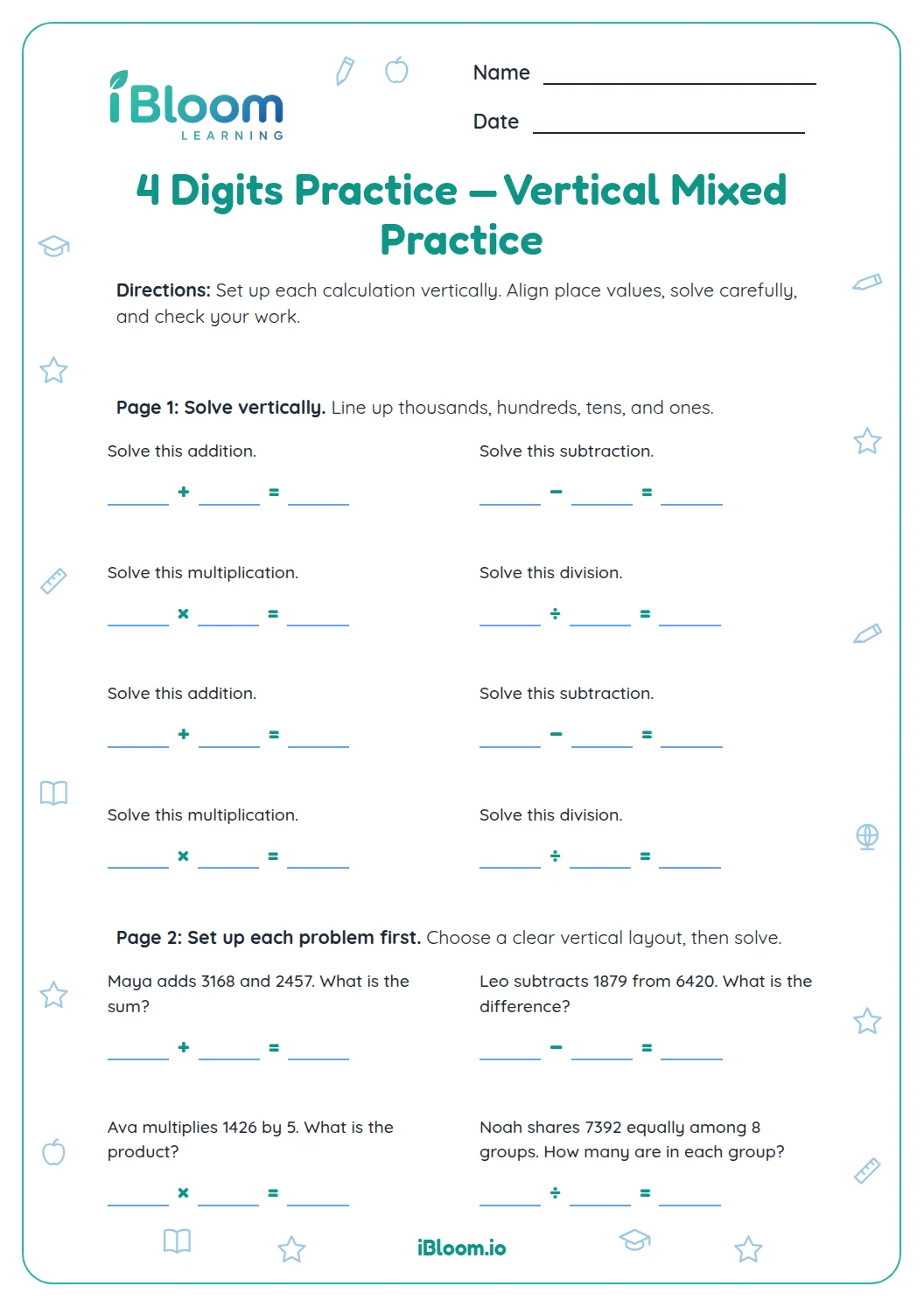

About this worksheet
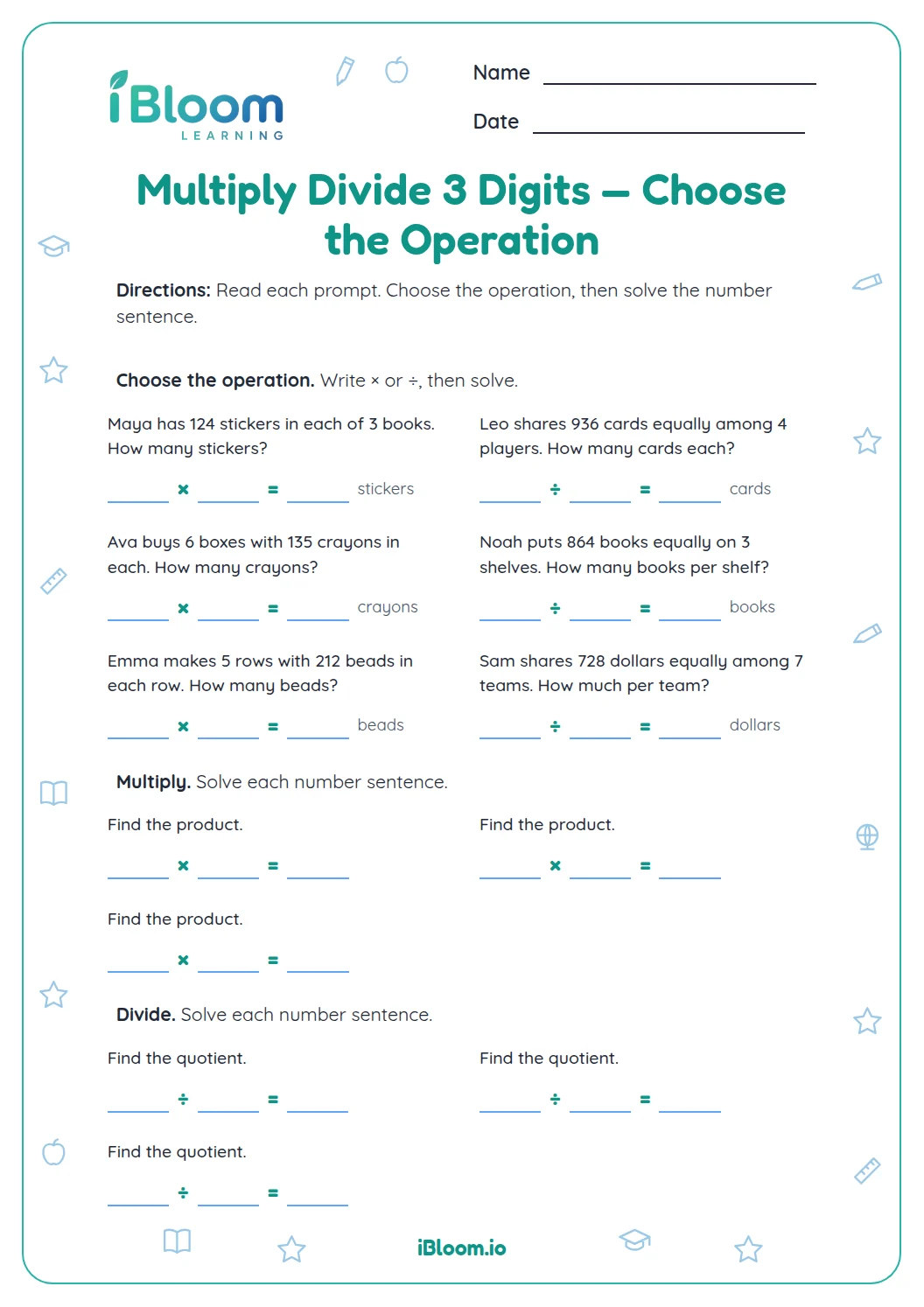
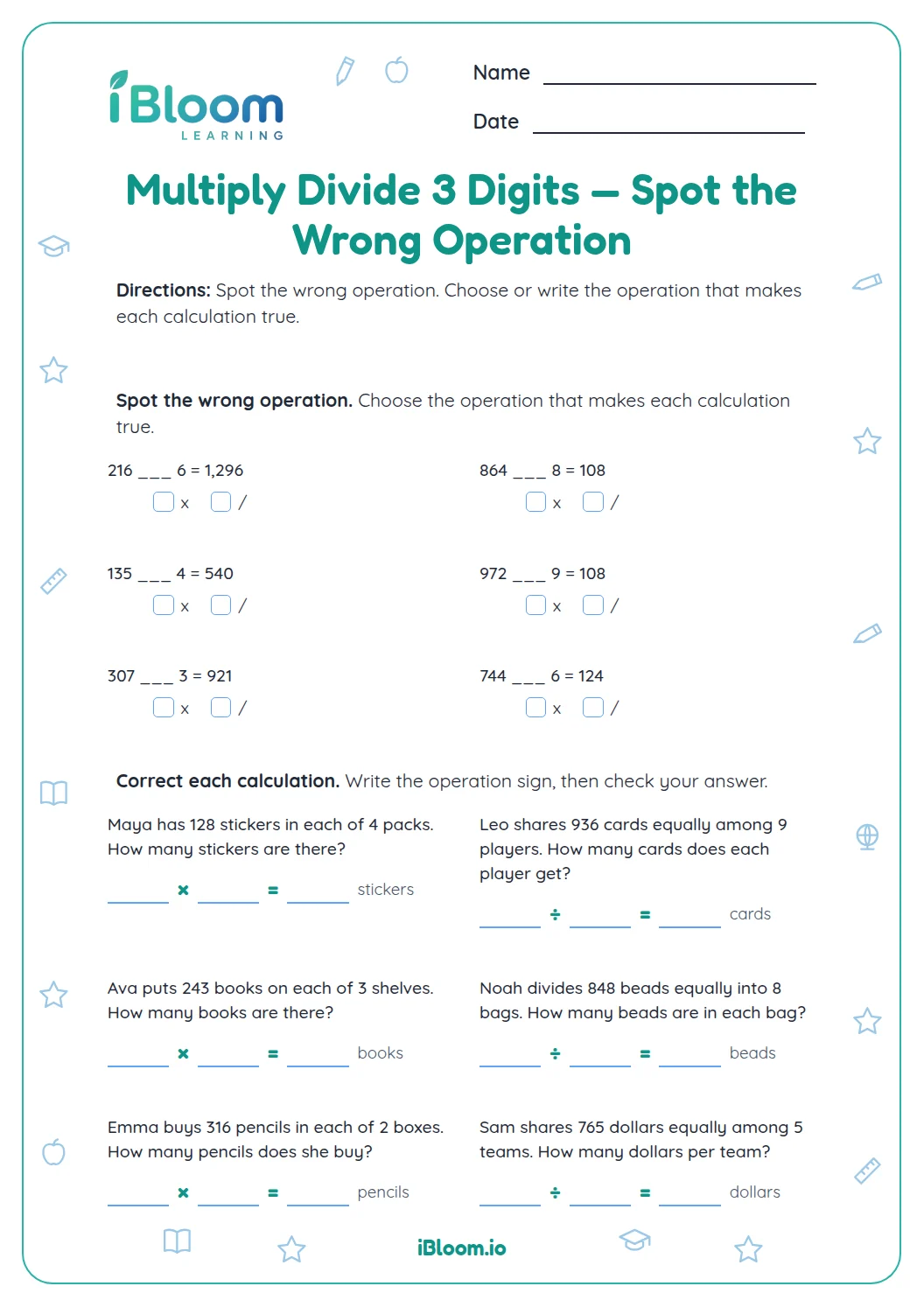
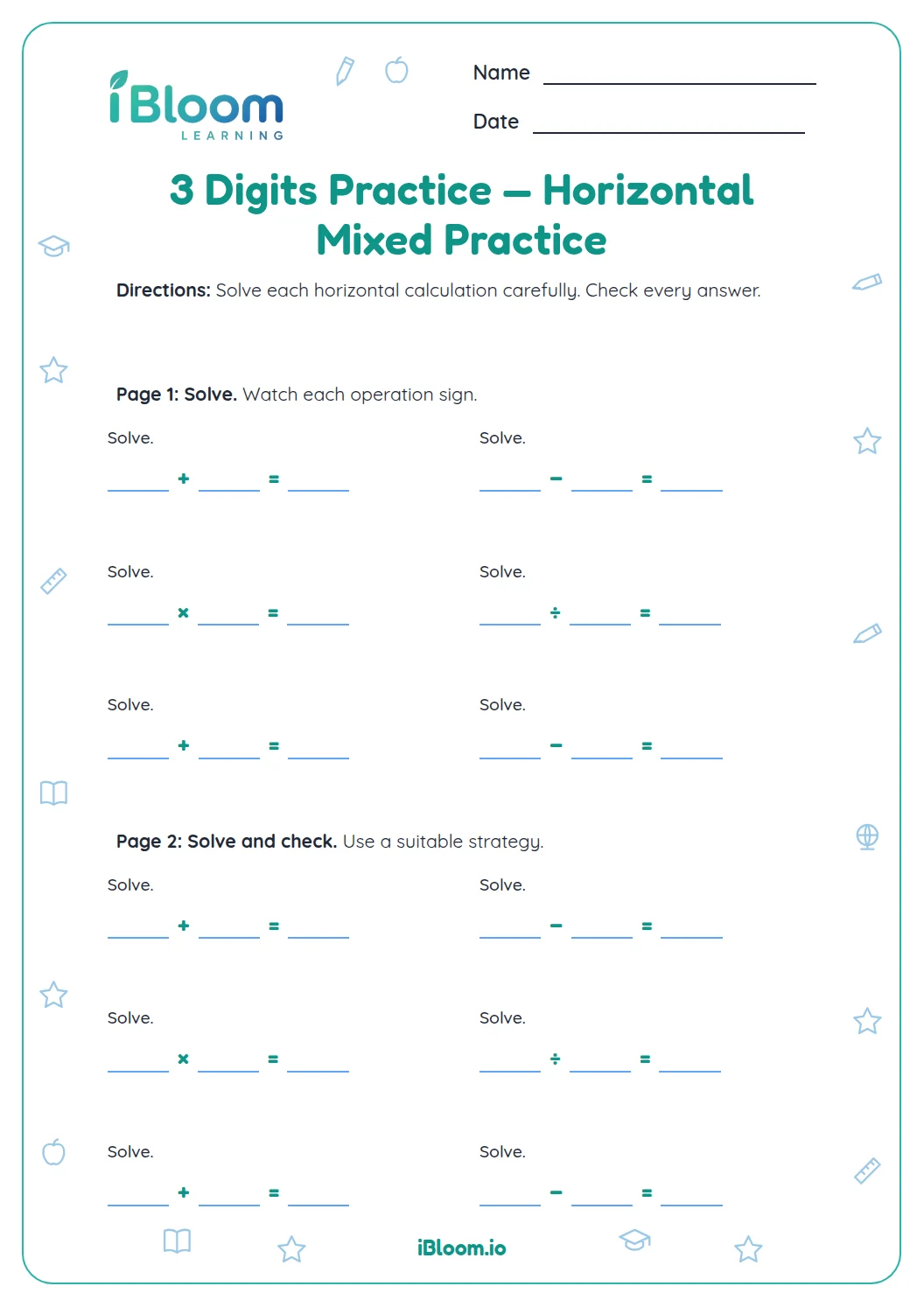
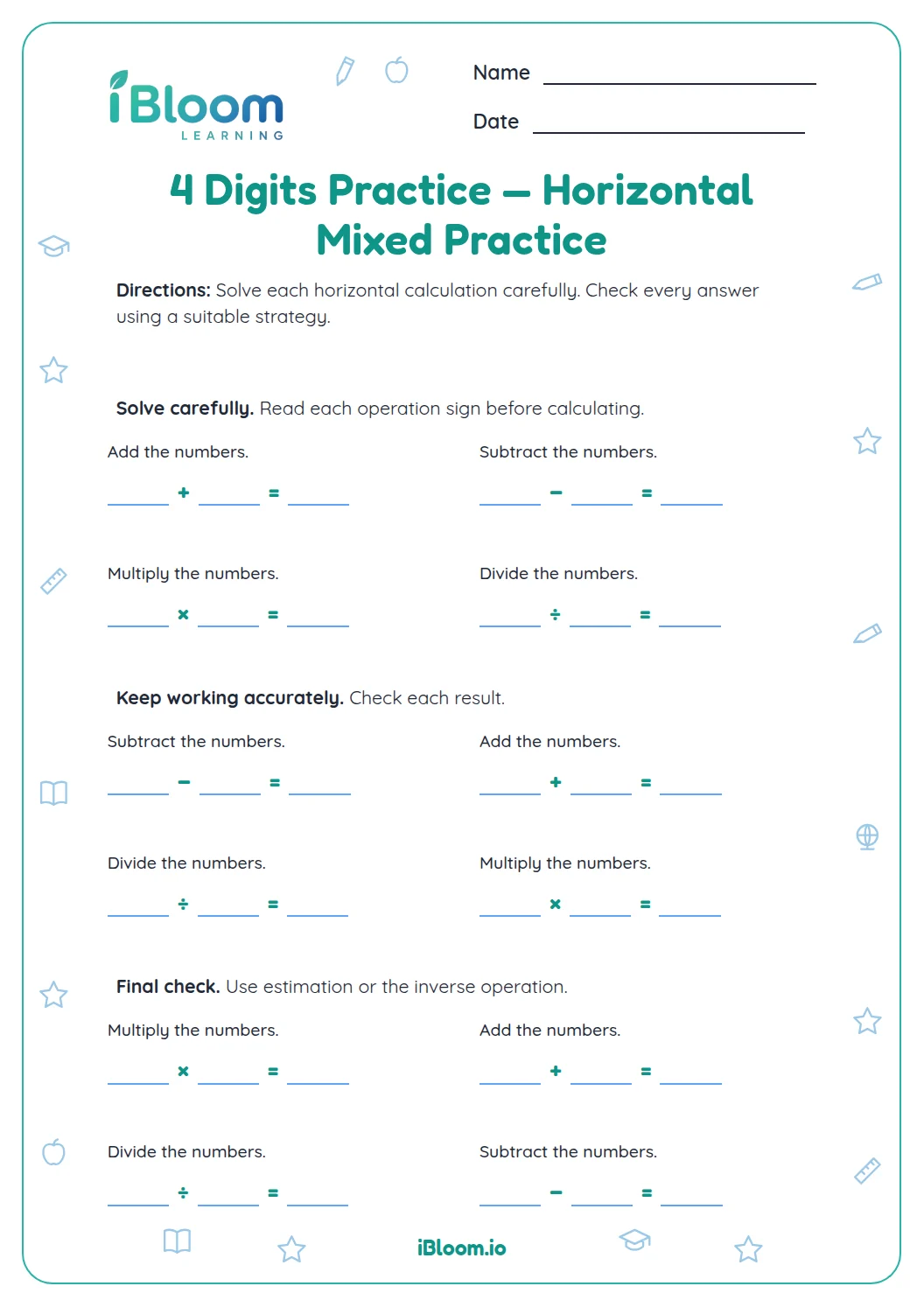
This Grade 4 worksheet mixes three-digit multiplication and division in four parts. Students multiply by one digit, divide three-digit dividends into whole-number quotients, use inverse operations to find missing values, and apply both operations in short stories. The numbers and directions keep the focus on place value and exact answers. A separate answer key lists all 16 results.
Aligned to 4.NBT.B.5 and 4.NBT.B.6
How can place value help with multiplication?
Break a three-digit factor into hundreds, tens, and ones, multiply each part, and combine the partial products. For 236 × 4, compute 200 × 4, 30 × 4, and 6 × 4, then add the results.
- 1236 × 4
- 2200 × 4 = 800; 30 × 4 = 120; 6 × 4 = 24
- 3800 + 120 + 24 = 944
How do you check a division answer?
Multiply the quotient by the divisor. For example, if 864 ÷ 3 = 288, check 288 × 3 = 864. This inverse check works for the exact quotients in Part B.
What is in each part?
Part A multiplies three-digit numbers by one digit. Part B divides three-digit dividends by one digit. Part C uses multiplication and division facts backward, and Part D applies the operations to books, stickers, markers, and tickets.
How to use this worksheet
- 1Read the operation sign before calculating.
- 2For multiplication, split the three-digit number by place value.
- 3For division, use a related multiplication fact or partial quotients.
- 4Use multiplication to check a division answer.
- 5For each story, identify equal groups and label the final quantity.
Mistakes to watch for
The mistake
Forgetting a place value in 307 × 5.
The fix
Multiply the hundreds, tens, and ones separately; keep the zero in the tens place.
The mistake
Stopping after finding a quotient in a story with a second step.
The fix
Reread the final question and do every action the story describes.
The mistake
Using the quotient to check a multiplication problem.
The fix
Check multiplication with division, and check division with multiplication.
Common Core alignment
The questions practice multi-digit multiplication and division with one-digit factors or divisors.
Multiply multi-digit whole numbers by a one-digit number using place value.
On this sheet: Part A and the multiplication stories multiply a three-digit number by one digit.
Show the official wordingHide the official wording
Multiply a whole number of up to four digits by a one-digit whole number, and multiply two two-digit numbers, using strategies based on place value and the properties of operations. Illustrate and explain the calculation by using equations, rectangular arrays, and/or area models.
Find whole-number quotients for dividends up to four digits.
On this sheet: Parts B and C and the division stories use three-digit dividends and one-digit divisors.
Show the official wordingHide the official wording
Find whole-number quotients and remainders with up to four-digit dividends and one-digit divisors, using strategies based on place value, the properties of operations, and/or the relationship between multiplication and division. Illustrate and explain the calculation by using equations, rectangular arrays, and/or area models.
What to practice next
Make more practice
Further reading
Questions parents and teachers ask
How many problems are on the worksheet?
There are 16 questions in four parts. Students multiply, divide, find missing numbers in related facts, and solve four short situations. The separate answer key lists the result for every question, with units on the story answers. Students can also estimate the product or quotient before checking the exact result.
Are the division answers whole numbers?
Yes. Each division problem is chosen for an exact whole-number quotient. Students can check each one by multiplying the quotient by the one-digit divisor and seeing whether the product matches the original dividend. The key also makes it easy to spot a calculation error and try the inverse check.
What multiplication strategy can students use?
Students can break the three-digit number into hundreds, tens, and ones, multiply each part, and add the partial products. For 236 × 4, that means 800 + 120 + 24, which totals 944. This strategy keeps the hundreds, tens, and ones in their correct places.
What does the missing-number part practice?
Part C asks students to use multiplication and division relationships backward. For example, in ___ × 6 = 936, divide 936 by 6 to find the missing factor, then multiply to check it. Students can write the related multiplication fact beside the division equation.
Can students show their work?
Yes. The worksheet directions invite students to show a place-value strategy, and the story questions can be represented with an equation. The answer key gives the expected result so an adult can check both the calculation and the unit. The answer key provides a clear way to check the result after the student finishes.