






About this worksheet
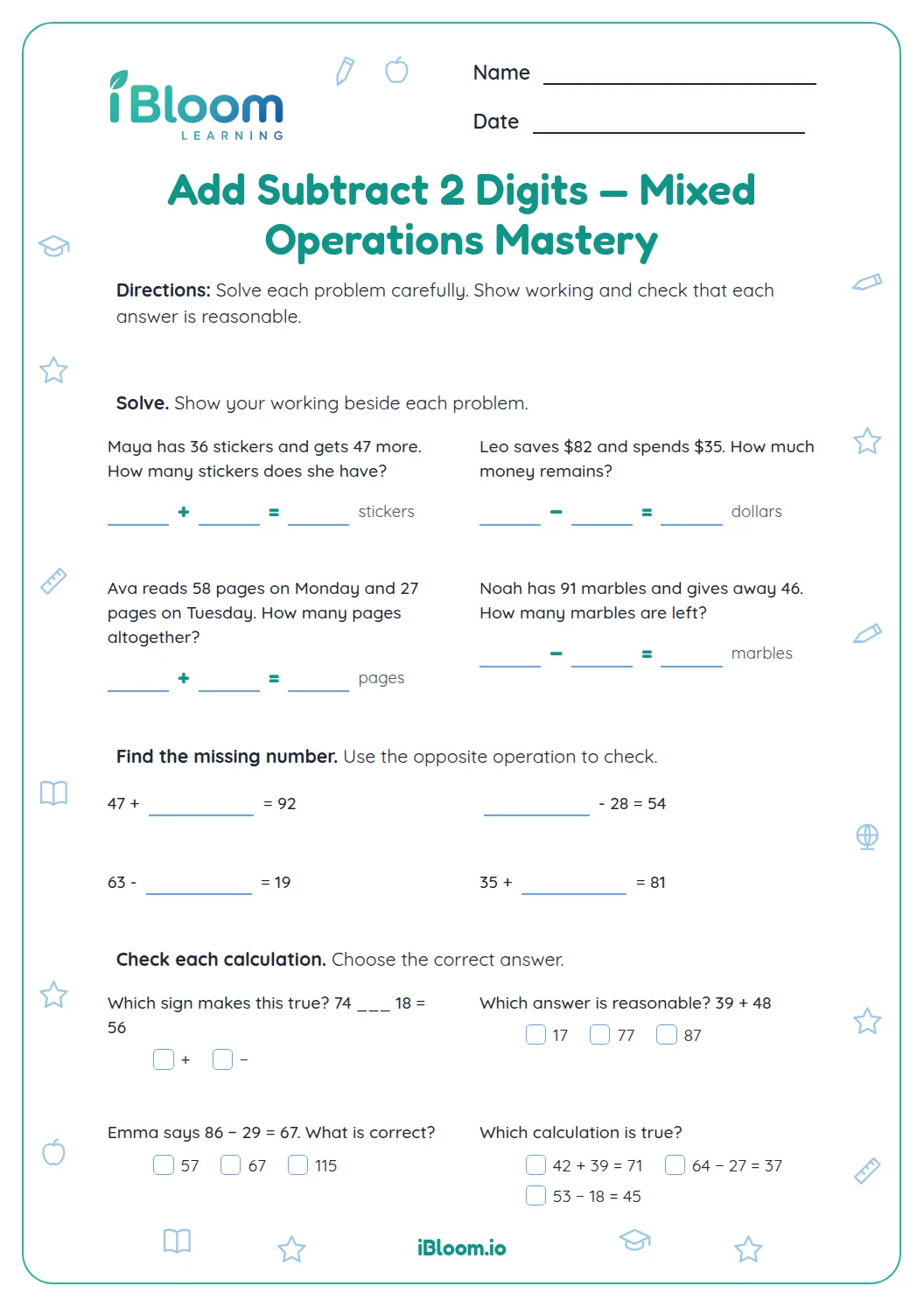
This Grade 3 math worksheet gives 16 addition and subtraction equations with one missing number in each. Part A practices missing addends, minuends, and subtrahends with totals and differences within 100. Part B mixes those unknown positions and includes sums above 100, while keeping each operand to two digits. Learners can substitute a result to check the equation. The practice aligns with Common Core 3.NBT.A.2.
Aligned to NBT.1
How can subtraction find a missing addend?
In Part A, an equation such as 24 + ___ = 57 can be solved by subtracting 24 from 57. The missing number is 33.
How can you check a missing number?
In Part B, put the proposed value back into the original equation. For 46 + ___ = 91, 45 works because 46 + 45 equals 91.
How to use this worksheet
- 1Locate the blank and decide which number it replaces.
- 2Use a related addition or subtraction fact to find the unknown.
- 3Write the value in the blank.
- 4Substitute it in the original equation to verify both sides.
- 5Use the key after completing both parts.
Common mistakes and quick fixes
The mistake
Subtracting the smaller number from the larger one without checking the equation.
The fix
Use the known sum or difference to identify the related fact.
The mistake
Treating the blank as the same position in every equation.
The fix
Check whether the blank is before or after the operation sign.
The mistake
Stopping after finding a possible value.
The fix
Substitute it and verify that both sides are equal.
Common Core alignment
This worksheet gives children focused practice with a named Common Core skill.
Use place value and inverse operations to solve two-digit addition and subtraction equations.
On this sheet: [{'href': '/free-worksheet-generator/missing-numbers', 'label': 'Missing numbers worksheet generator', 'note': 'Make another set of number sentences.'}]
Show the official wordingHide the official wording
Fluently add and subtract within 1000 using strategies and algorithms based on place value, properties of operations, and/or the relationship between addition and subtraction.
What to practice next
Make more practice
Further reading
Questions parents and teachers ask
What kinds of blanks appear in the equations?
The unknown may be an addend, the starting number in a subtraction equation, or the number being subtracted. Each of the 16 problems has one blank. Check its position before deciding which related fact will help. Pause after each part and ask the learner to explain how the clue or operation supports the answer.
How can subtraction help find an addend?
If a known addend and sum are shown, subtract the addend from the sum. For example, 24 + ___ = 57 becomes 57 − 24, so the missing number is 33. Substitute 33 to check that the original equation is true.
How can a child check a missing number?
Put the proposed number back into the original equation and calculate both sides. In 46 + ___ = 91, the answer 45 checks because 46 + 45 equals 91. The second part encourages this substitution check. Pause after each part and ask the learner to explain how the clue or operation supports the answer.
Can this worksheet be used for home practice?
Yes. Children can solve the equations independently or explain their strategy to an adult. Ask them to identify the blank’s role, solve using the related operation, and substitute the result before checking the answer key. Pause after each part and ask the learner to explain how the clue or operation supports the answer.
How long does this worksheet take?
Plan for about 20 minutes to complete 16 equations and check them. Some children may finish sooner, while others may want to write related facts beside the equations. The worksheet and key each have two pages. Pause after each part and ask the learner to explain how the clue or operation supports the answer.