




About this worksheet
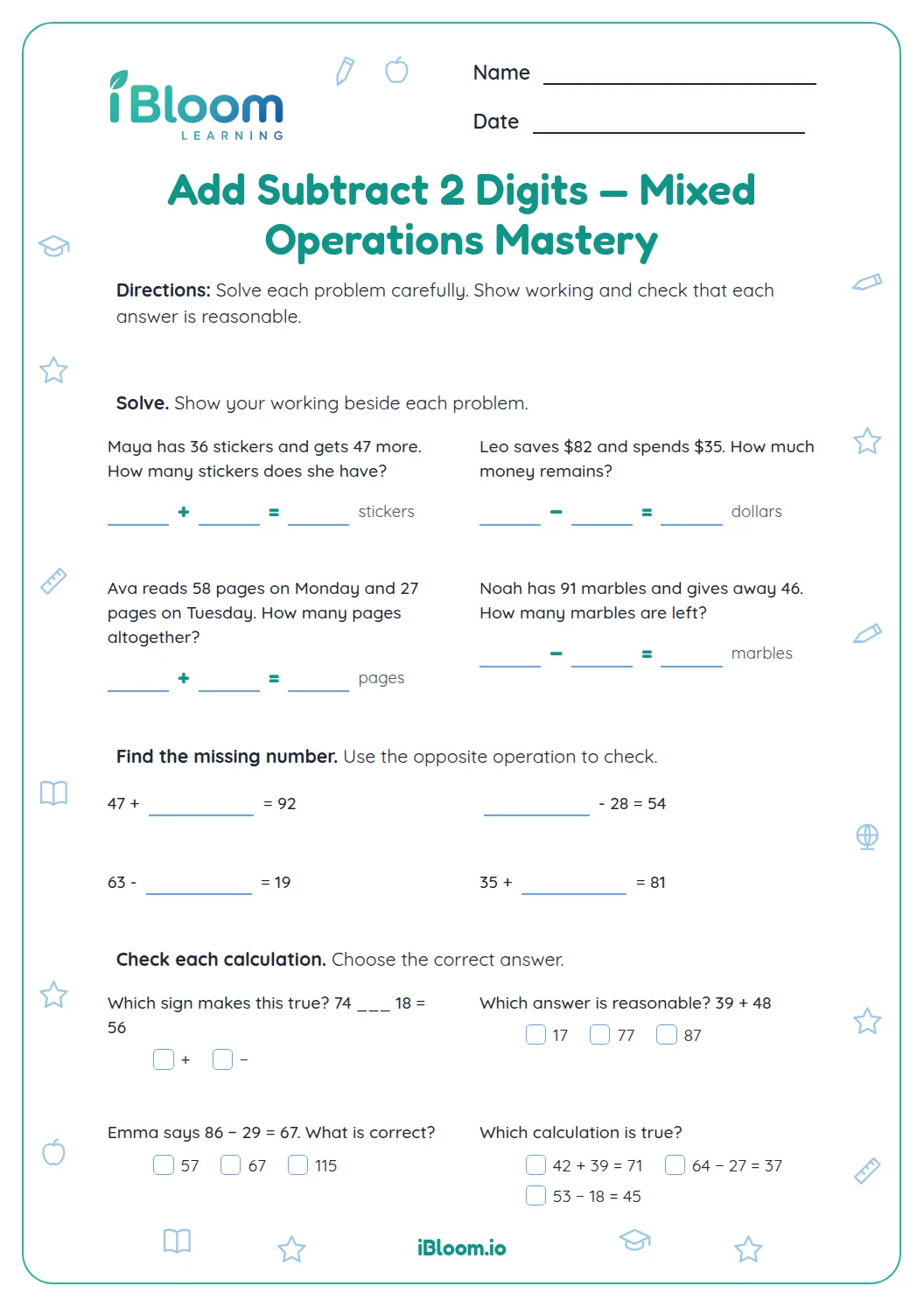
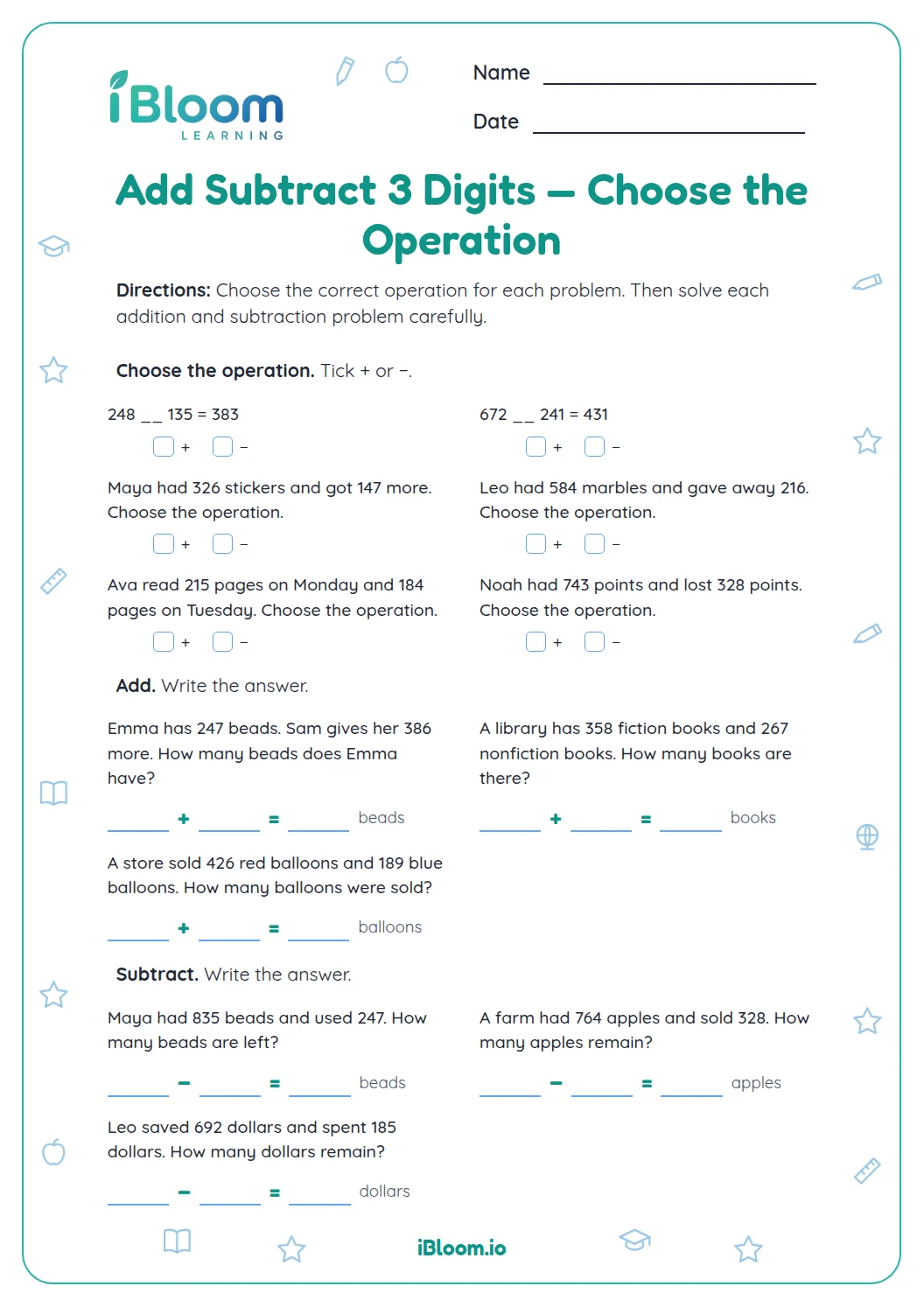
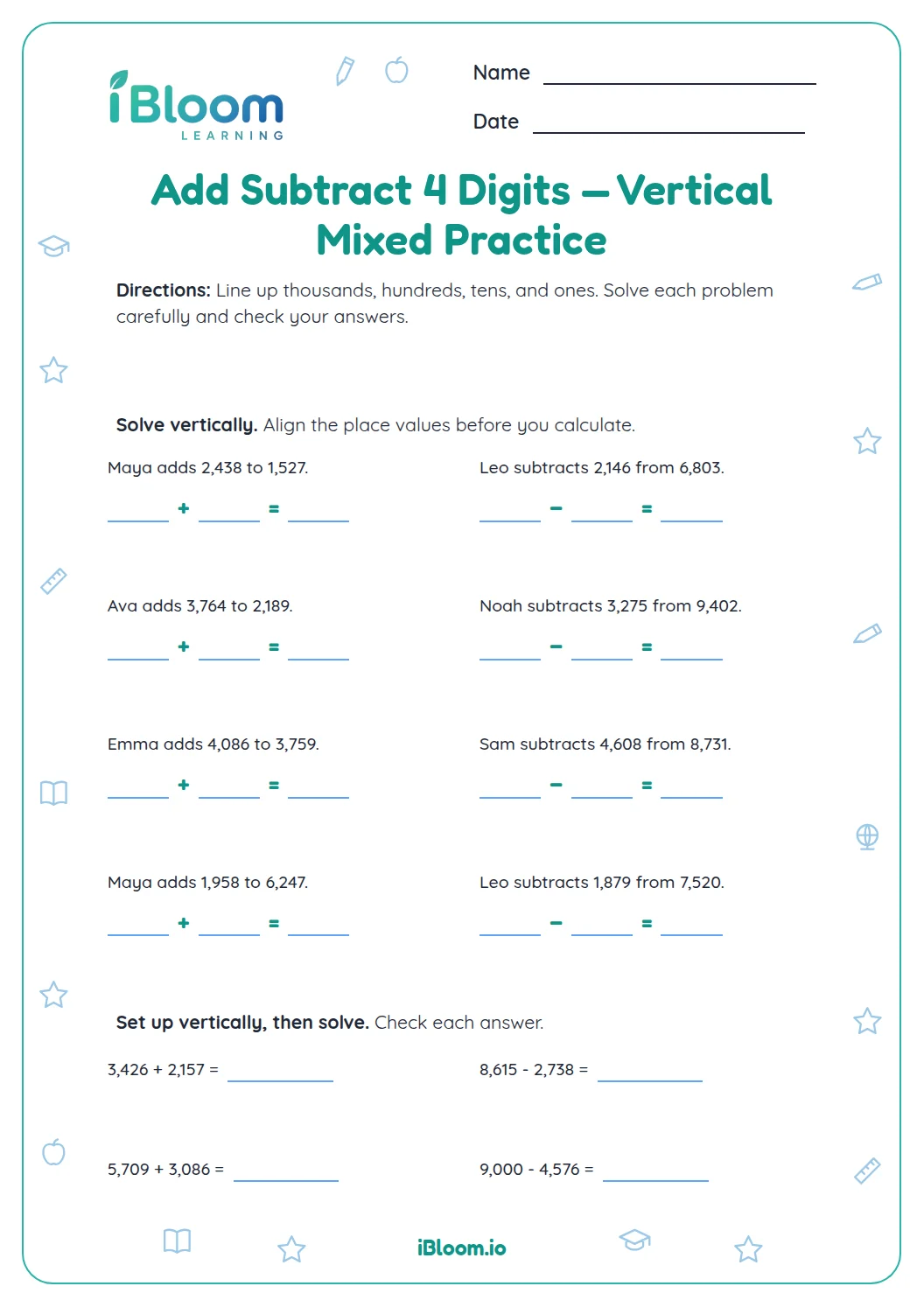
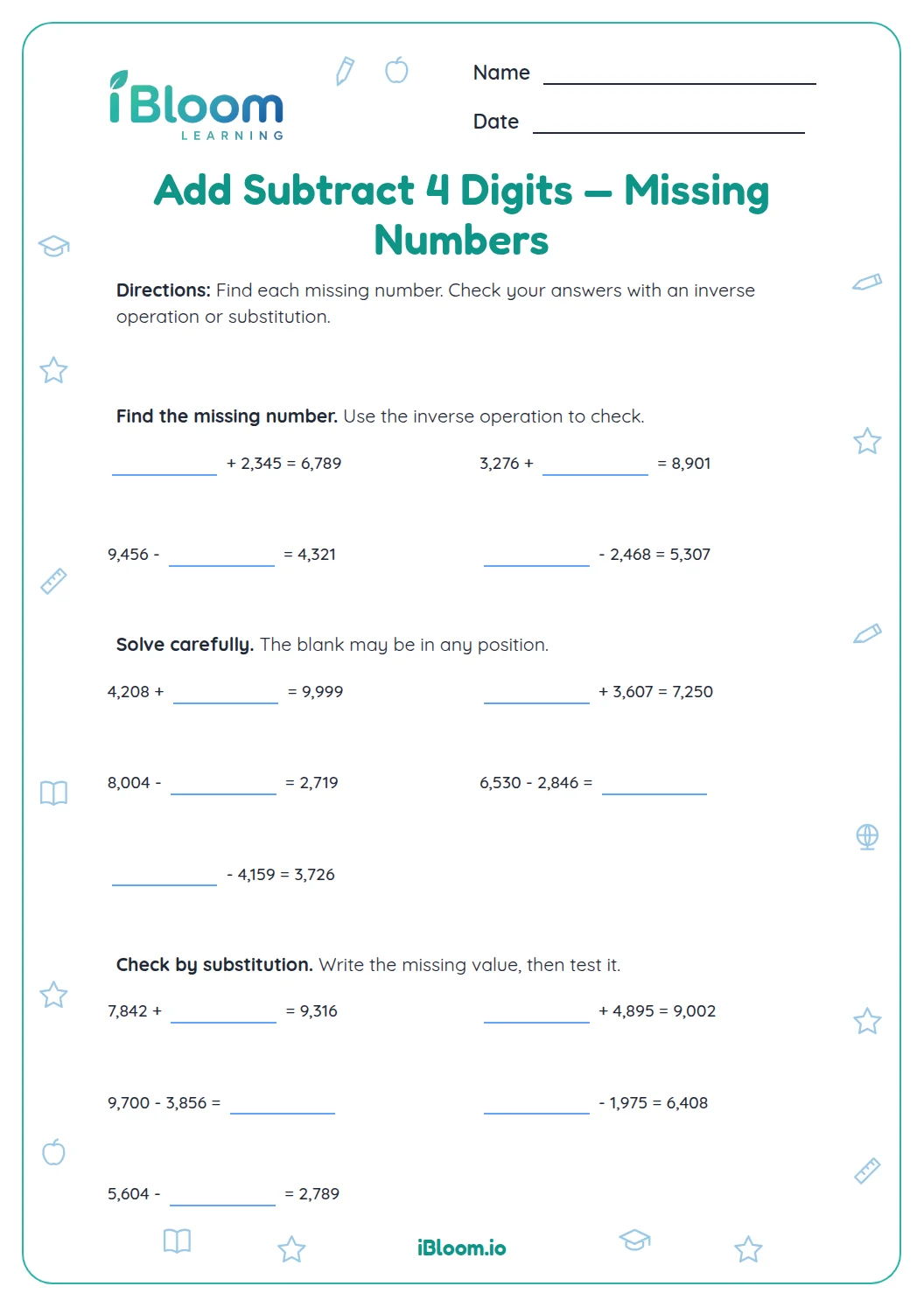
This free printable math drill gives students in Grades 3–6 focused review of two-digit addition and subtraction. Part A has eight story-based sign choices, Part B has six calculations, and Part C has four short word problems. The signs change throughout the practice, so students must decide what each situation or equation requires. All calculations stay within 100 and include regrouping. The sheet practices Common Core 2.NBT.B.5 and 2.OA.A.1 through calculation and story equations. A separate answer key shows the signs, numerical results, and word-problem answers.
Aligned to 2.NBT.B.5 and 2.OA.A.1
How do the stories help children choose an operation?
Part A gives a short situation and two numbers. Children choose + when an amount is joined to the starting group and − when some of that group is removed. Ask the child to describe what happened before writing the sign.
For example, 17 riders board a bus that already has 28 riders. Both groups are now on the bus, so the sign between 28 and 17 is +. Part A asks for the sign only; Parts B and C add calculation.
What should children do when the ones cross a ten?
For addition, combine the ones and trade ten ones for one ten when needed. For subtraction, rename one ten as ten ones when there are too few ones to subtract. Keep the digits aligned so that tens are combined with tens and ones with ones.
- 182 − 47 = ___
- 2Rename 82 as 7 tens and 12 ones.
- 312 − 7 = 5 ones; 7 − 4 = 3 tens.
- 482 − 47 = 35. Check: 35 + 47 = 82.
Why should the word problems be read before choosing a sign?
The four stories ask about a growing bus group, stickers given away, a comparison of collections, and an unknown starting amount. Reading the whole situation helps students decide which quantity they need to find.
In the pencil question, 24 pencils were given out and 39 remain. The starting amount must include both groups, so 24 + 39 = 63. Children can check with 63 − 24 = 39. The word gave describes what happened, but the question asks for the amount before it happened.
How to use this worksheet
- 1Read Part A’s directions and point out that each blank needs a sign.
- 2Describe whether each Part A group grows or shrinks, then write the matching sign.
- 3Solve Part B with mental place-value steps or written work as needed.
- 4For Part C, identify the unknown quantity and write an equation in the working space.
- 5Use the opposite operation to check one regrouping calculation and the missing-start story.
Mistakes to notice and how to help
The mistake
Writing the numerical result in a Part A blank.
The fix
Part A asks which operation matches the story. Write + for joining or − for taking away.
The mistake
Subtracting the smaller ones digit from the larger one in 82 − 47 and getting 45.
The fix
Rename one ten first: 82 is 7 tens and 12 ones, so the ones difference is 5.
The mistake
Subtracting 24 from 39 in the pencil story because it says gave out.
The fix
Find what was there at the start by combining the 24 given out and the 39 still there.
Common Core alignment
Add and subtract within 100 using place value and inverse operations.
On this sheet: Students choose operations from stories and calculate sums and differences within 100, with regrouping.
Show the official wordingHide the official wording
Fluently add and subtract within 100 using strategies based on place value, properties of operations, and/or the relationship between addition and subtraction.
Use equations to solve addition and subtraction stories within 100.
On this sheet: Part C includes joining, taking away, comparing, and finding a missing starting amount.
Show the official wordingHide the official wording
Use addition and subtraction within 100 to solve one- and two-step word problems involving situations of adding to, taking from, putting together, taking apart, and comparing, with unknowns in all positions, e.g., by using drawings and equations with a symbol for the unknown number to represent the problem.
What to practice next
Make more practice
Further reading
Questions parents and teachers ask
Does every question ask for an operation sign?
The first eight questions ask for a missing + or − sign. The next six ask for a numerical result, and the final four ask students to write an equation and solve a story. Read the instruction under each part before beginning because the answer format changes.
Are all the numbers and answers within 100?
Yes, all calculations use two-digit whole numbers and stay within 100. The sheet includes addition that crosses a ten and subtraction that requires renaming a ten. Students can use place-value reasoning, written calculation, or an inverse-operation check to explain how they found an answer.
Why does the pencil story use addition when pencils were given away?
Addition finds the starting amount because both parts are known: 24 pencils were given out and 39 remain. Together they make 63 pencils at the start. Students can then check the story in its original order: begin with 63, take away 24, and finish with 39.
Should this drill be timed?
Timing is optional; use accuracy and clear operation choices as the first goals. Allow about fifteen minutes for the whole sheet, including the four story equations. If you use a timer later, compare a student’s own work across attempts and leave time to discuss any errors.
How can older students use this worksheet?
Students in Grades 3–6 can use it as a focused review of addition and subtraction decisions. Ask them to justify the missing signs and check the final story backward. When their calculations and explanations are secure, the linked three-digit and four-digit practice pages extend the same habits.