




About this worksheet
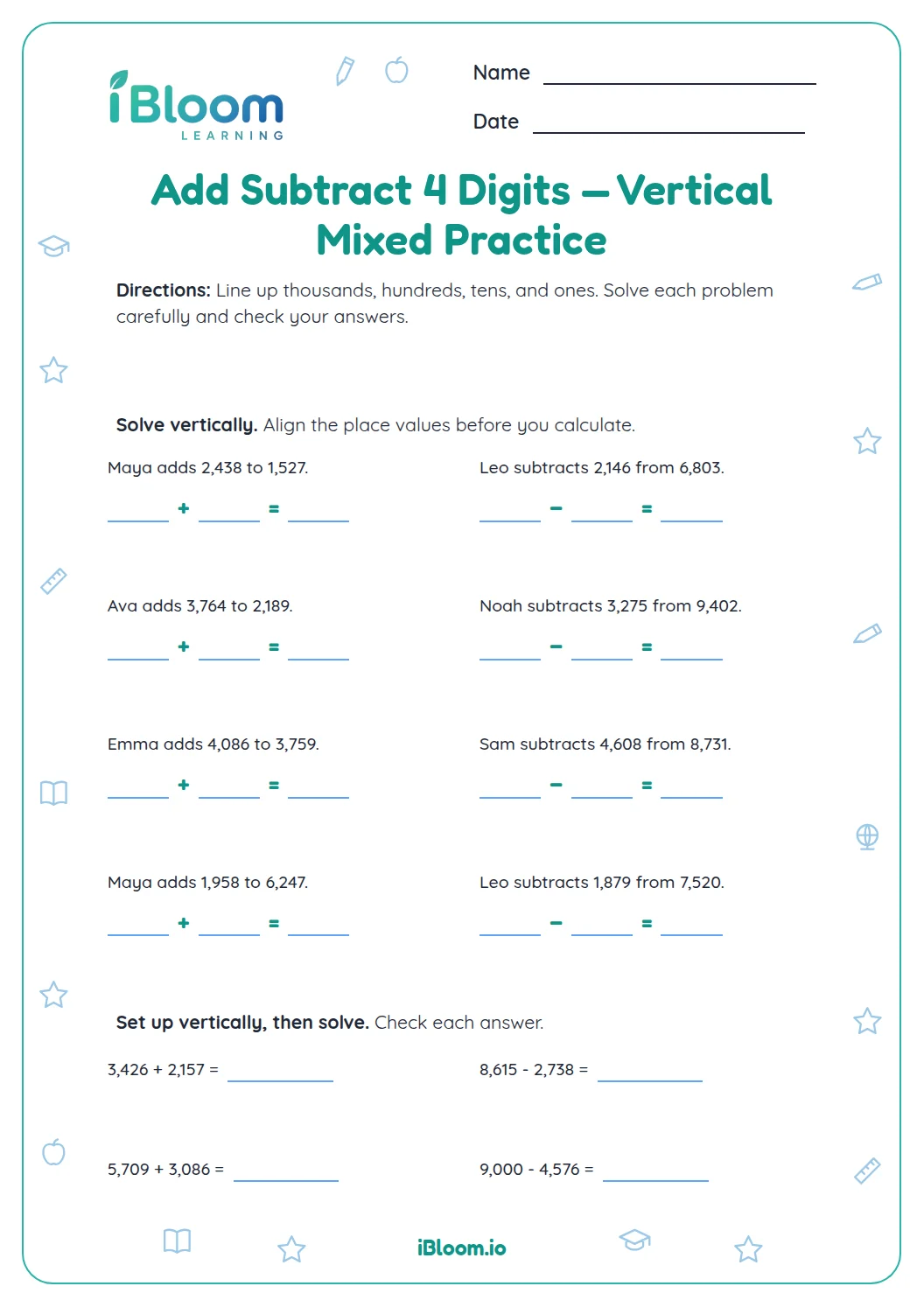
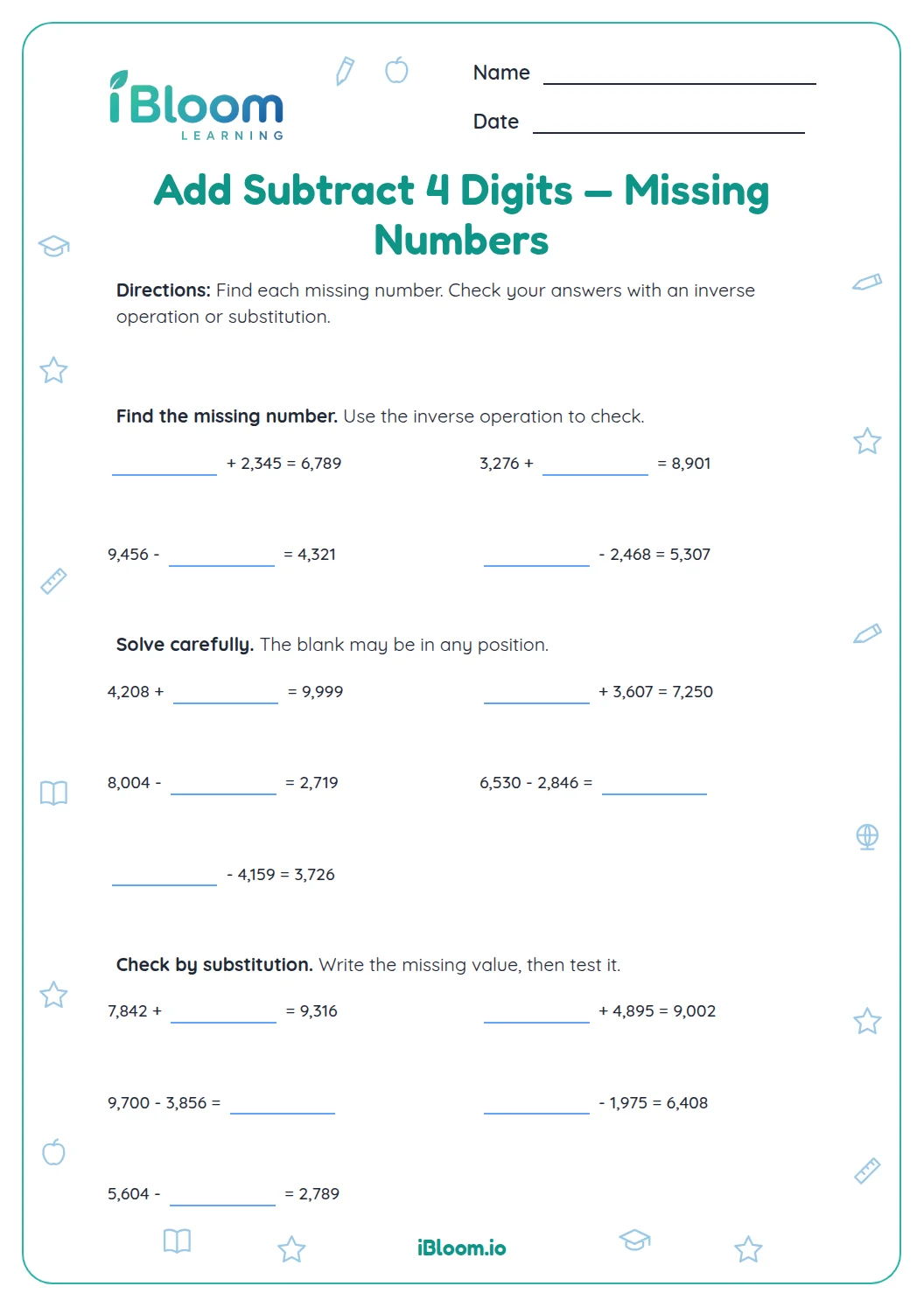
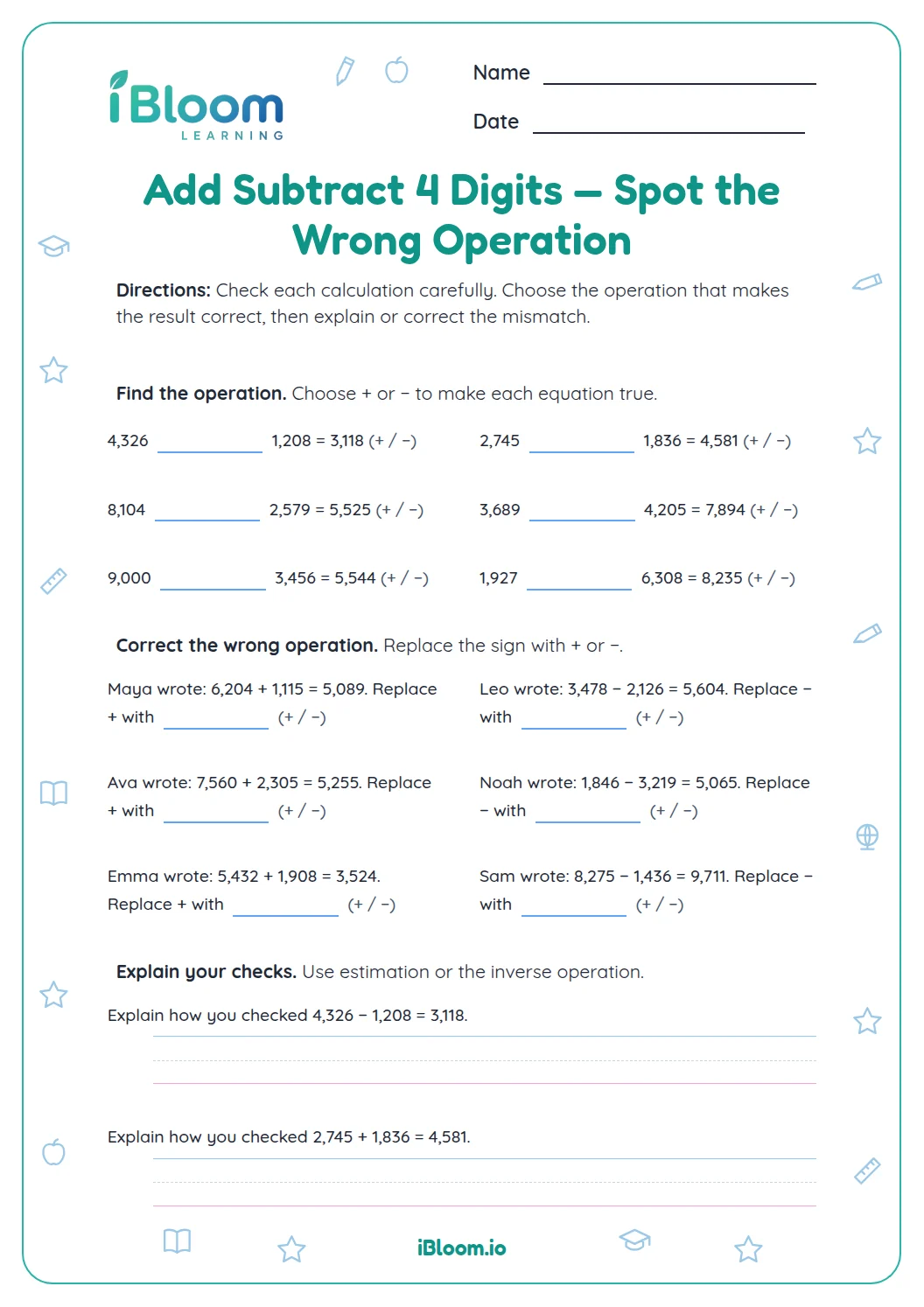
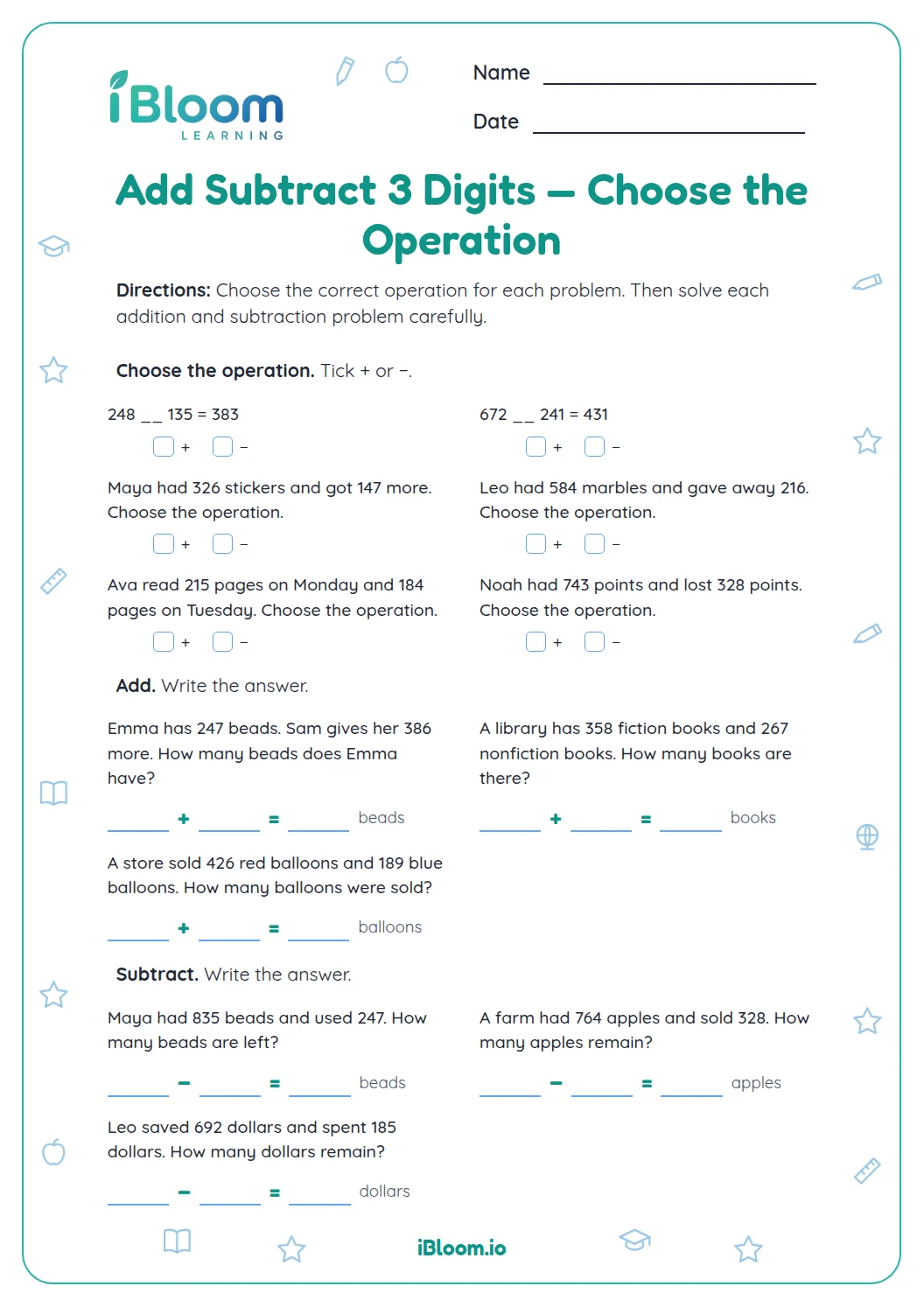
This free printable helps students decide when to add or subtract four-digit whole numbers and check the result with written calculation. It is written for Grade 4 practice and can also serve as review in Grades 5–6. Part A has four missing-sign equations with straightforward place-value patterns. Part B has four more equations that require regrouping to verify. Part C has four short word problems asking for totals, amounts left and differences. Common Core 4.NBT.B.4 guides the calculation work. A separate answer key gives every sign and word-problem result.
Aligned to 4.NBT.B.4
How do students find a missing operation sign?
Compare the result with the first number. Because all second numbers on this sheet are positive, addition increases the first number and subtraction decreases it. Then use a written calculation to confirm that the entire equation is true.
Parts A and B each contain two addition and two subtraction equations. Students write the sign in the blank and use scrap paper to align thousands, hundreds, tens and ones for checking.
How do you check the equation with 6,402?
The result 3,617 is less than 6,402, so try subtraction. Regroup across the zero in the tens place carefully. Use addition as a second check after completing the subtraction.
- 16,402 ___ 2,785 = 3,617
- 2Try − because the result is smaller than 6,402.
- 36,402 − 2,785 = 3,617
- 4Check: 3,617 + 2,785 = 6,402.
How do the word problems change the task?
Part C gives a situation instead of a finished equation. The library and can-collection problems combine amounts, the pencil problem takes away an amount, and the team problem compares two scores.
Students write a complete equation in each work box before reporting an answer with its unit. For the team comparison, subtract the blue team’s points from the red team’s points; the phrase “how many more” asks for the difference.
How to use this worksheet
- 1Read the first equation and compare its result with the first number.
- 2Write + or − in each blank in Parts A and B.
- 3Verify each equation with column addition or subtraction on scrap paper, aligning place values.
- 4Read each Part C story and decide which quantity is being found.
- 5Write and solve an equation in the work box, then check the labeled result with the key.
Mistakes to catch and how to fix them
The mistake
Writing + for the team problem because it says “more.”
The fix
The question compares two scores; subtract 3,786 from 6,104 to find the difference.
The mistake
Lining up the first digits instead of the place-value columns.
The fix
Write ones under ones, tens under tens, hundreds under hundreds and thousands under thousands.
The mistake
Subtracting across the zeros in 8,000 without changing the other columns.
The fix
Regroup 8,000 as 7 thousands, 9 hundreds, 9 tens and 10 ones before subtracting 3,648.
Common Core alignment
Add and subtract four-digit whole numbers, including regrouping.
On this sheet: Students use column addition and subtraction to check eight equations and solve four word problems.
Show the official wordingHide the official wording
Fluently add and subtract multi-digit whole numbers using the standard algorithm.
What to practice next
Make more practice
Further reading
Questions parents and teachers ask
Which operations can go in the blanks?
Each blank takes either + or −. All eight equations use positive four-digit numbers, so the size of the result helps students choose. They should still check by calculating, particularly in Part B where regrouping matters. The separate key lists all eight correct signs.
What grade is this worksheet for?
The calculations are written for Grade 4 practice with Common Core 4.NBT.B.4 and can be used for review in Grades 5–6. Students should understand place-value columns and regrouping. The sheet combines eight quick sign choices with four word problems that require written equations.
Why should students calculate after choosing a sign?
Calculating verifies that every digit in the equation is correct. A smaller result suggests subtraction on this sheet, but the student still needs to check the difference. For example, 6,402 − 2,785 equals 3,617; addition of 3,617 and 2,785 checks that result.
Does “how many more” always mean add?
No, in the team-score problem it asks for a difference. The red team has 6,104 points and the blue team has 3,786, so subtract to find 2,318 more points. Ask your child to explain what the unknown quantity represents before choosing the operation.
Where should students show their calculations?
Use scrap paper for the written checks in Parts A and B, and the printed work boxes for the four Part C equations. Keep each column aligned by place value. After checking the key, redo a missed calculation and identify whether the error involved the sign or regrouping.