



About this worksheet
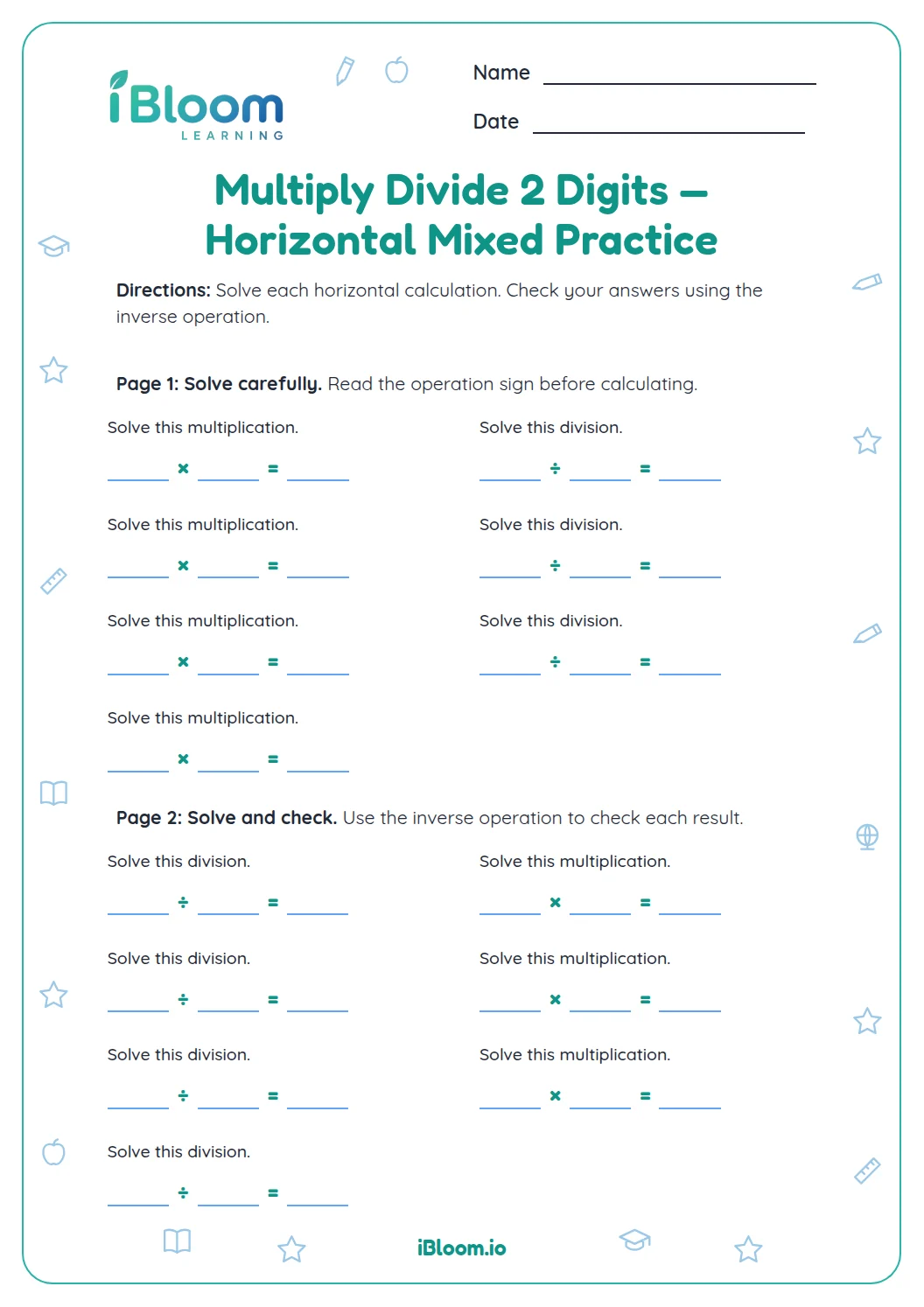
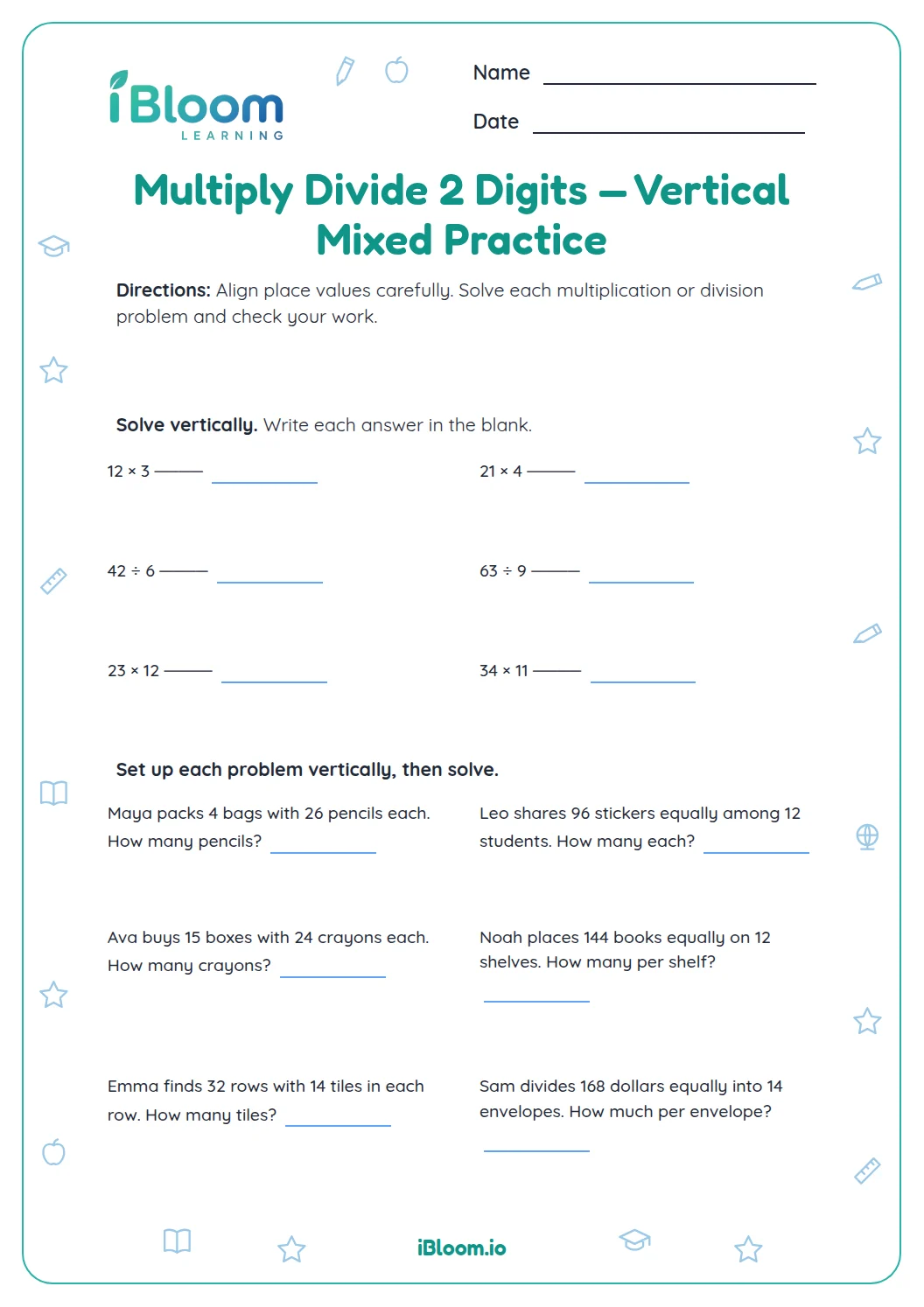
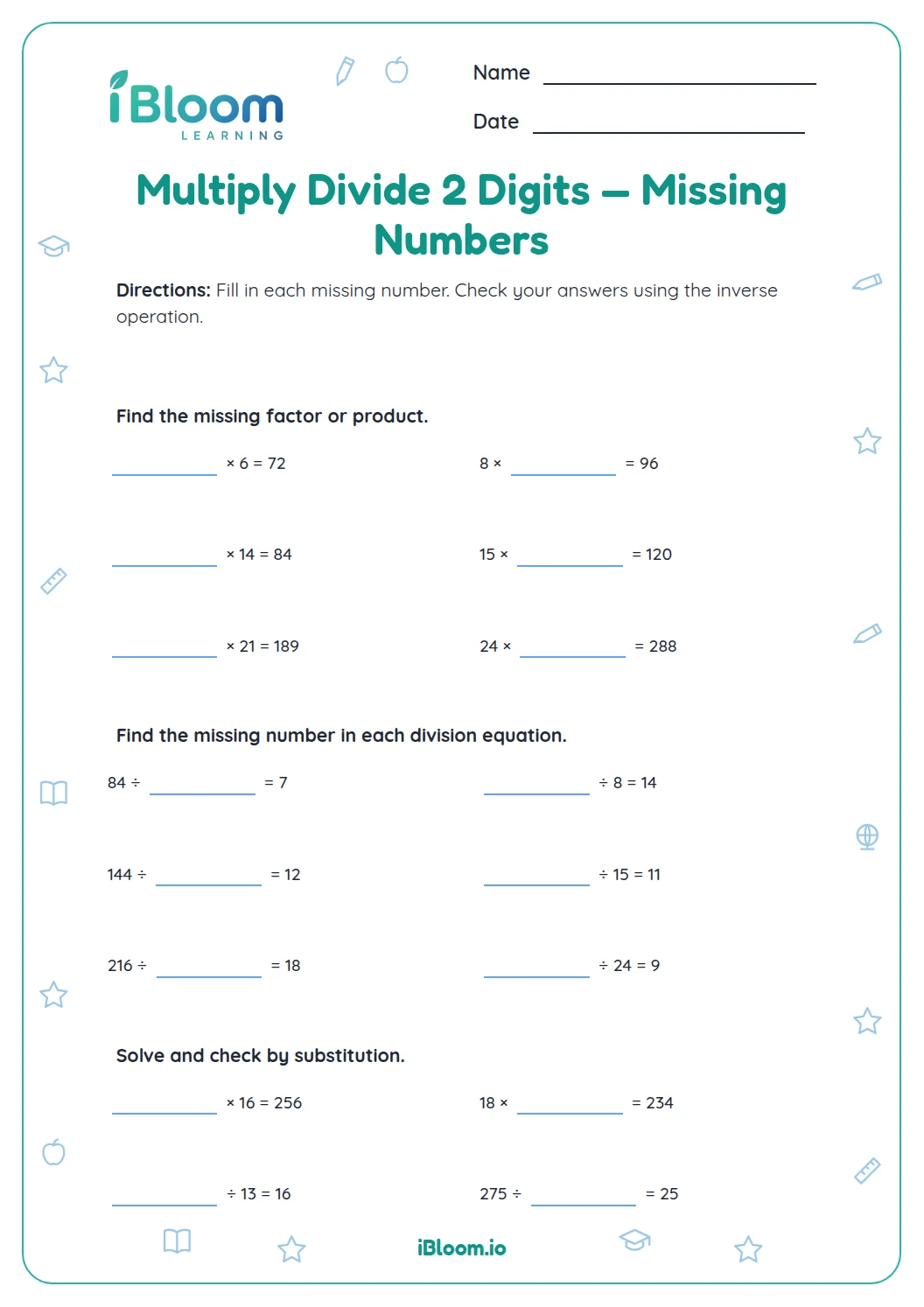
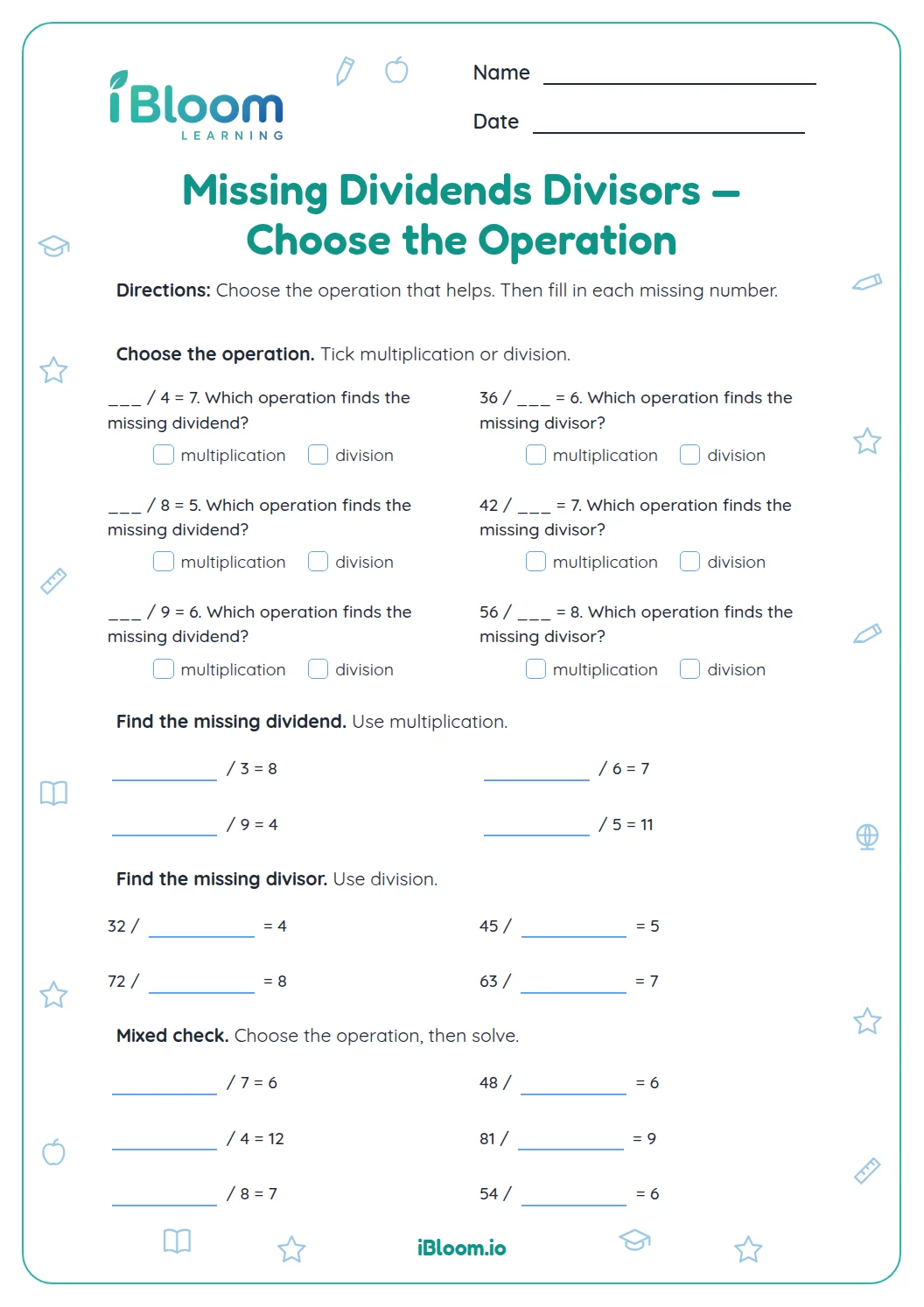
This printable mixed-operations worksheet gives students 8 multiplication and division expressions and 6 short word problems. The expressions include two-digit factors and division facts; the stories ask students to decide whether to multiply or divide, then solve. A separate answer key shows each result. The practice aligns with Common Core 4.NBT.B.5 and 4.NBT.B.6 for multiplying two-digit numbers by one-digit numbers and finding whole-number quotients.
Aligned to 4.NBT.B.5 and 4.NBT.B.6
What should be solved first in an expression?
In 18 ÷ 3 + 4, division comes before addition. First calculate 18 ÷ 3 = 6, then add 4 to get 10.
Work left to right when multiplication and division appear together, and use parentheses before other operations.
- 118 ÷ 3 + 4
- 218 ÷ 3 = 6
- 36 + 4 = 10
How do the word problems connect to multiplication and division?
Equal rows or equal groups point to multiplication when you know the number in each group. Sharing a total equally points to division.
For 8 rows of 12 markers, calculate 8 × 12 = 96 markers. For 84 cards shared among 7 teams, calculate 84 ÷ 7 = 12 cards per team.
How can you check an answer?
For division, multiply the quotient by the divisor. For multiplication, use the inverse division fact or estimate the size of the product.
How to use this worksheet
- 1Read the expression or story twice.
- 2Circle parentheses and operation signs.
- 3For multiplication and division, identify the two quantities and what is unknown.
- 4Write one operation before calculating each story problem.
- 5Check products with division and quotients with multiplication.
- 6Use the answer key after trying every item.
Mistakes to watch for
The mistake
Adding before multiplying in 50 − 6 × 5.
The fix
Multiply 6 × 5 first, then subtract from 50.
The mistake
Using the wrong sign after reading quickly.
The fix
Mark each operation symbol before starting.
The mistake
Giving a quotient without its story unit.
The fix
Reread the question and label what each share or group counts.
Common Core alignment
This worksheet connects the skill to the following Common Core standard.
Multiply a two-digit whole number by a one-digit whole number.
On this sheet: The word problems include multiplying a two-digit number by a one-digit number.
Show the official wordingHide the official wording
Multiply a whole number of up to four digits by a one-digit whole number, and multiply two two-digit numbers, using strategies based on place value and the properties of operations. Illustrate and explain the calculation by using equations, rectangular arrays, and/or area models.
Find whole-number quotients using one-digit divisors.
On this sheet: The division stories ask students to divide two-digit totals by one-digit group counts.
Show the official wordingHide the official wording
Find whole-number quotients and remainders with up to four-digit dividends and one-digit divisors, using strategies based on place value, the properties of operations, and/or the relationship between multiplication and division. Illustrate and explain the calculation by using equations, rectangular arrays, and/or area models.
What to practice next
Make more practice
Further reading
Questions parents and teachers ask
What does this mixed multiplication and division worksheet include?
It includes expression practice and equal-group word problems. The answer key lists each result, including units for story problems, so students can check both the operation and what the answer counts. Expressions also include addition or subtraction with multiplication and division.
How do I know whether to multiply or divide in a story problem?
Multiply when you know how many equal groups there are and how many are in each group. Divide when you know the total and need the size of each share or the number of groups. Draw or name the groups before choosing.
Does the sheet include an answer key?
Yes. The separate answer key includes expression values and labeled word-problem answers. Use it after completing the problems, then revisit any item where the operation or computation needs another look. Check a quotient by multiplying it by the divisor.
How much time should I plan?
Plan for about 20 minutes for the expressions and word problems. Leave time to show an operation for each story and check multiplication with division or division with multiplication. Students can work at a steady pace without timing themselves.