




About this worksheet
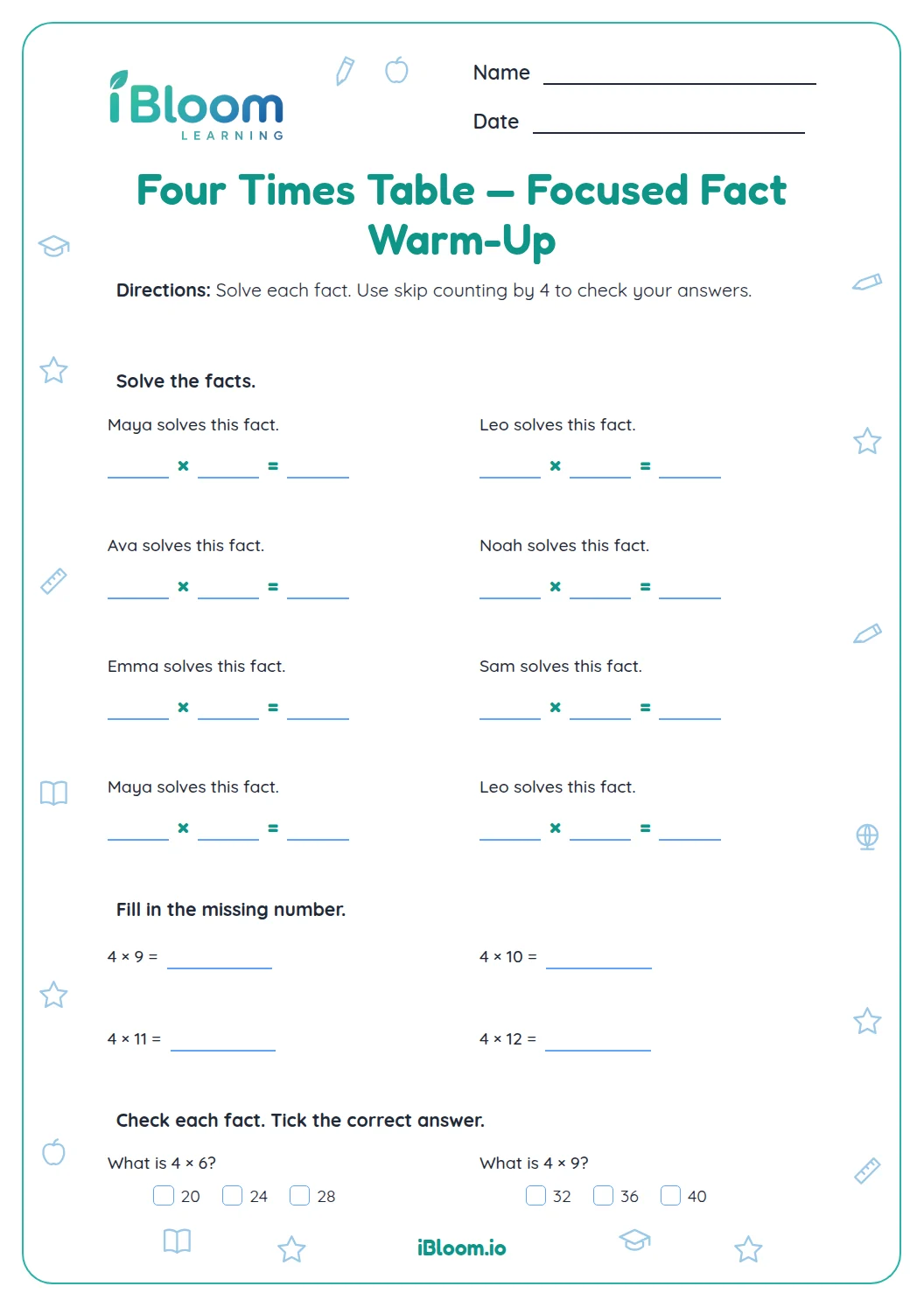
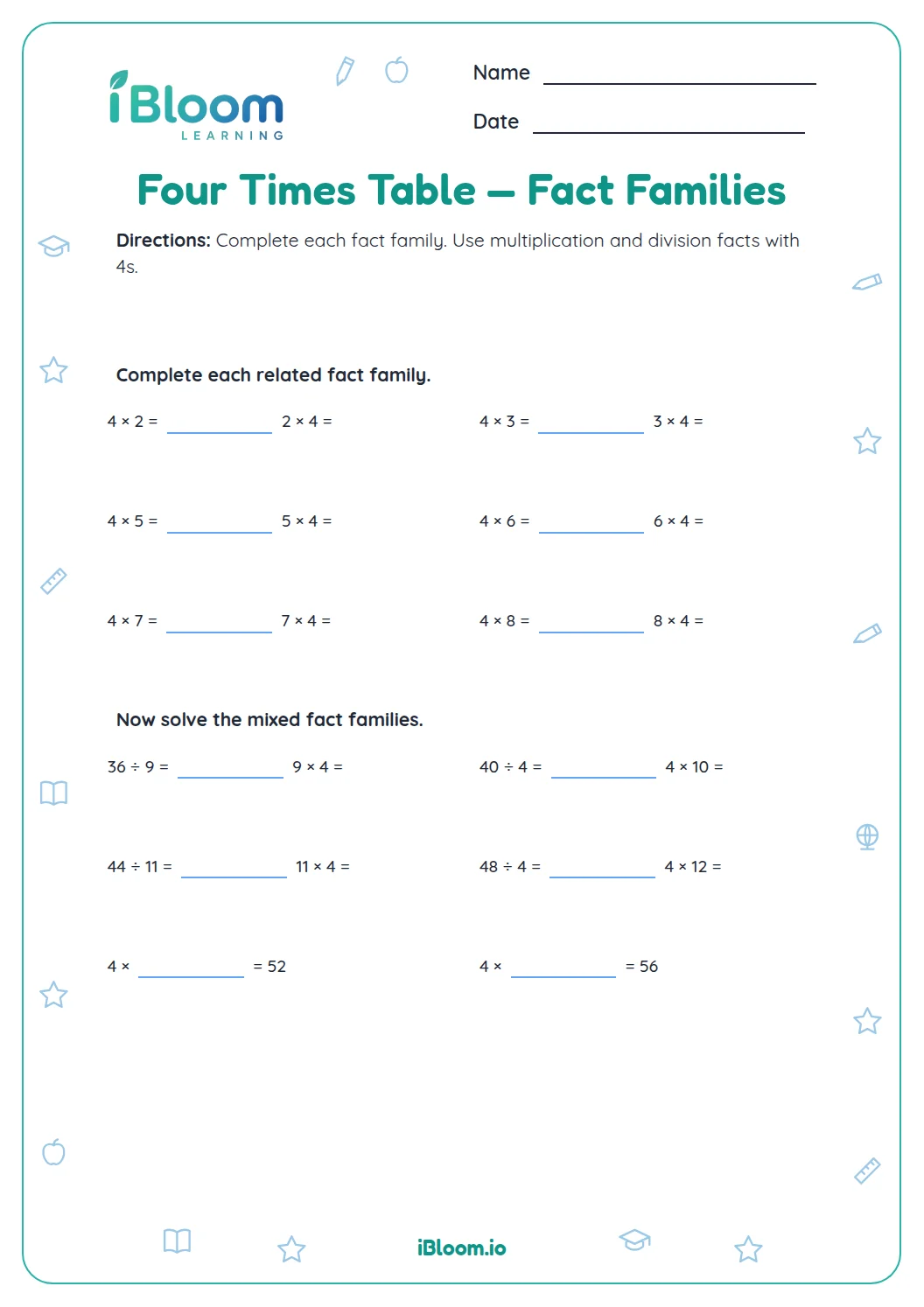
This Grade 3 multiplication worksheet focuses on the four times table. Students solve direct facts, find missing factors, and apply the same facts to equal-group stories. Story problems provide room to write a number sentence, and the separate answer key lists products, factors, and totals. The practice supports CCSS 3.OA.C.7.
Aligned to CCSS.MATH.CONTENT.3.OA.C.7
How can children build four-fact fluency?
Start with the factor pairs and products. For example, 4 × 7 = 28, so seven groups of four make 28.
How do you find a missing factor?
Use the known product and divide by four. In 4 × ___ = 36, 36 divided into groups of four gives 9.
How do four facts describe equal groups?
Identify the number of groups and the amount in each group, then multiply. Four trays with six muffins each make 24 muffins: 4 × 6 = 24.
A four-fact strategy
- 1Read the factors or story details.
- 2For a missing factor, divide the product by four.
- 3For a story, identify the number of groups and items per group.
- 4Write a multiplication sentence in the story work space.
- 5Label the total with the object named in the question.
Multiplication checks
The mistake
Adding the two numbers in an equal-groups story.
The fix
Multiply the number of groups by the amount in each group.
The mistake
Using the product as the missing factor.
The fix
Divide the product by four to find the factor.
The mistake
Leaving off the object label in a story answer.
The fix
Include muffins, players, pages, or the other counted item.
Common Core alignment
The facts, missing factors, and equal-group problems practice multiplication fluency.
Recall one-digit products and use multiplication or division strategies within 100.
On this sheet: The questions ask learners to practice this standard.
Show the official wordingHide the official wording
Fluently multiply and divide within 100, using strategies such as the relationship between multiplication and division (e.g., knowing that 8 × 5 = 40, one knows 40 ÷ 5 = 8) or properties of operations. By the end of Grade 3, know from memory all products of two one-digit numbers.
What to practice next
Make more practice
Further reading
Questions parents and teachers ask
Which multiplication facts are included?
Every direct fact and missing-factor item uses the four times table. The word problems also describe groups of four, including trays, teams, pages, wheels, and bags. Products stay within 40, so students can focus on fluent recall and applying multiplication to equal groups.
How do you find a missing factor?
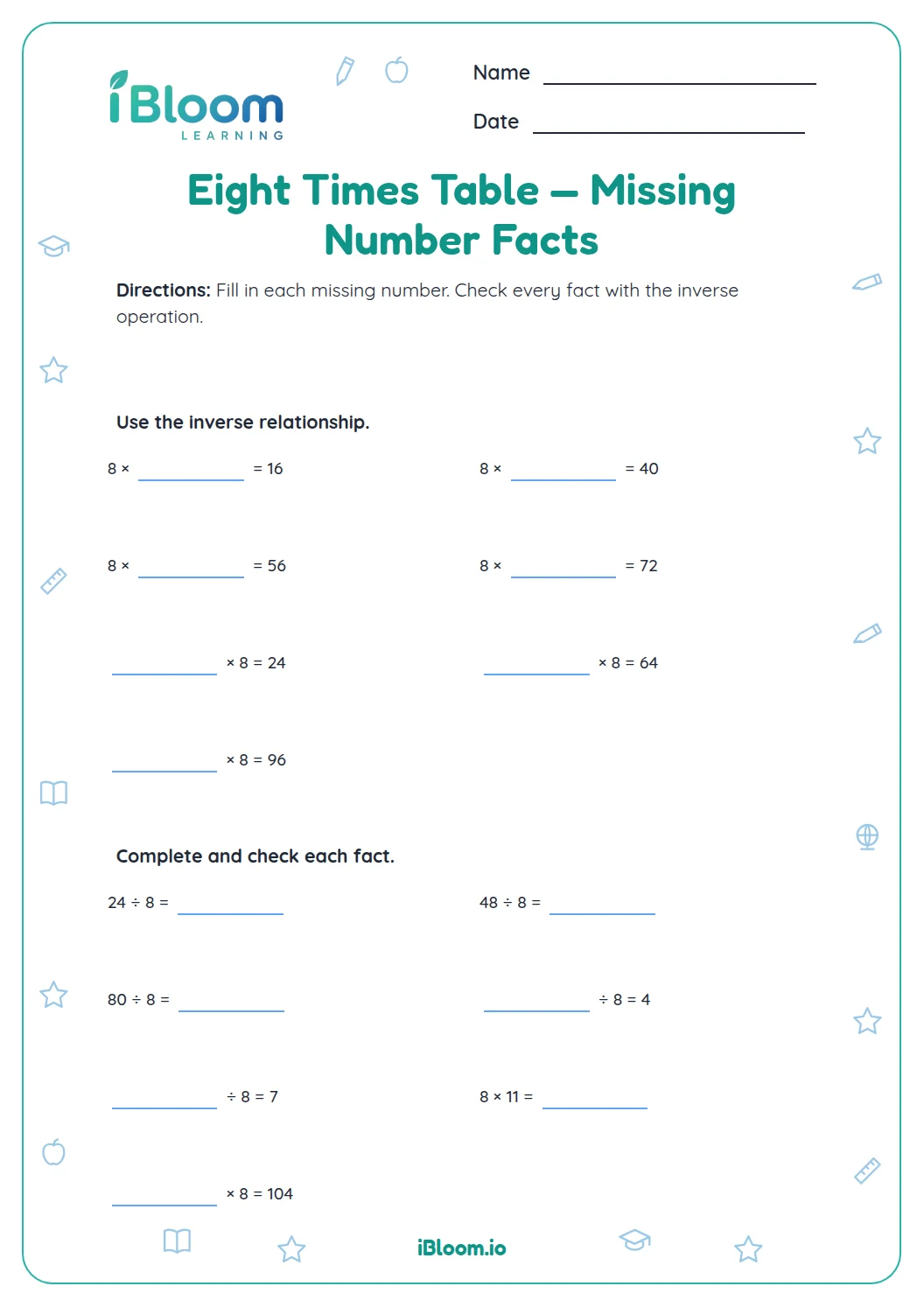
Use the known product to work backward. In 4 × ___ = 36, divide 36 by 4 to find the missing factor, 9. Check by multiplying 4 × 9 and confirming that the product is 36. This inverse relationship can also help check a direct fact.
Do the word problems have room for work?
Yes. The story problems use equation work space, so students can write a multiplication or division sentence before giving the answer. Identify the number of groups and the amount in each group, then label the total with the objects named in the prompt.
Is the worksheet timed?
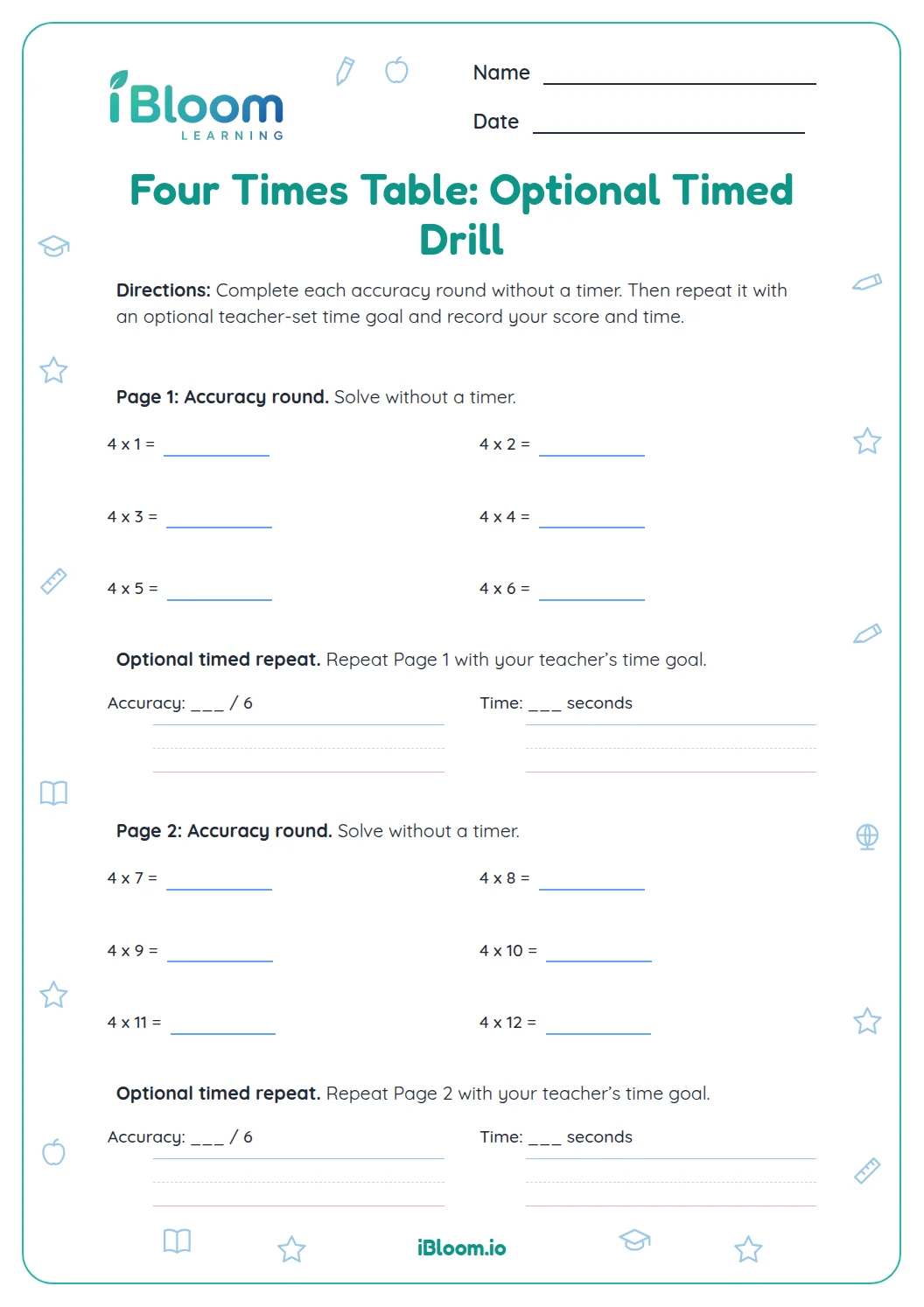
No timer is required. The page is designed as a practice check with direct facts, missing factors, and equal-group stories. Students can work carefully, show a number sentence for each story, and use the separate key to review their calculations after finishing.
Is an answer key included?
Yes. The separate key gives the products, missing factors, and story totals. For a word problem, check both the number sentence and the labeled answer. For example, 4 trays with 6 muffins each gives 24 muffins, or 4 × 6 = 24.