

About this worksheet
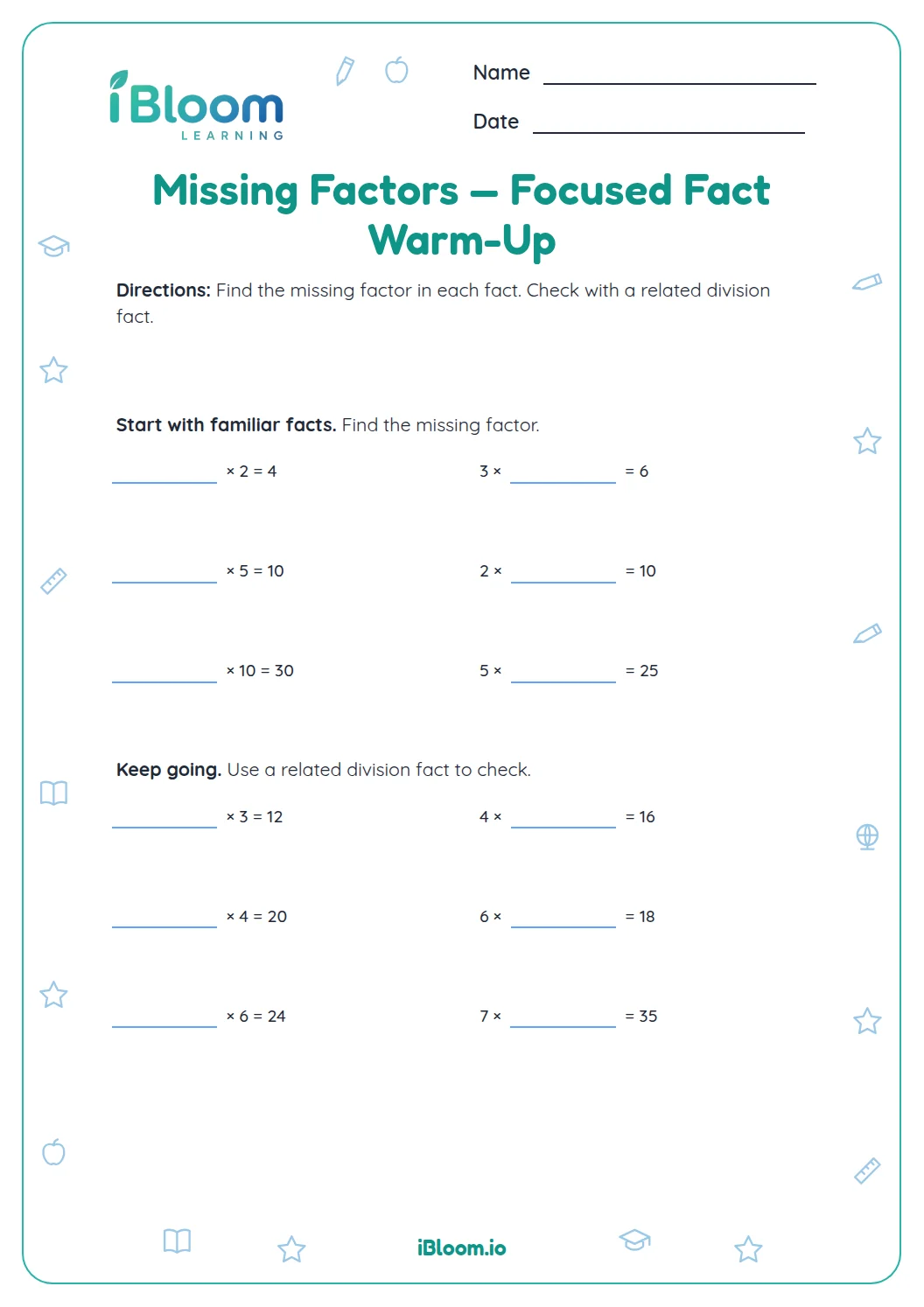
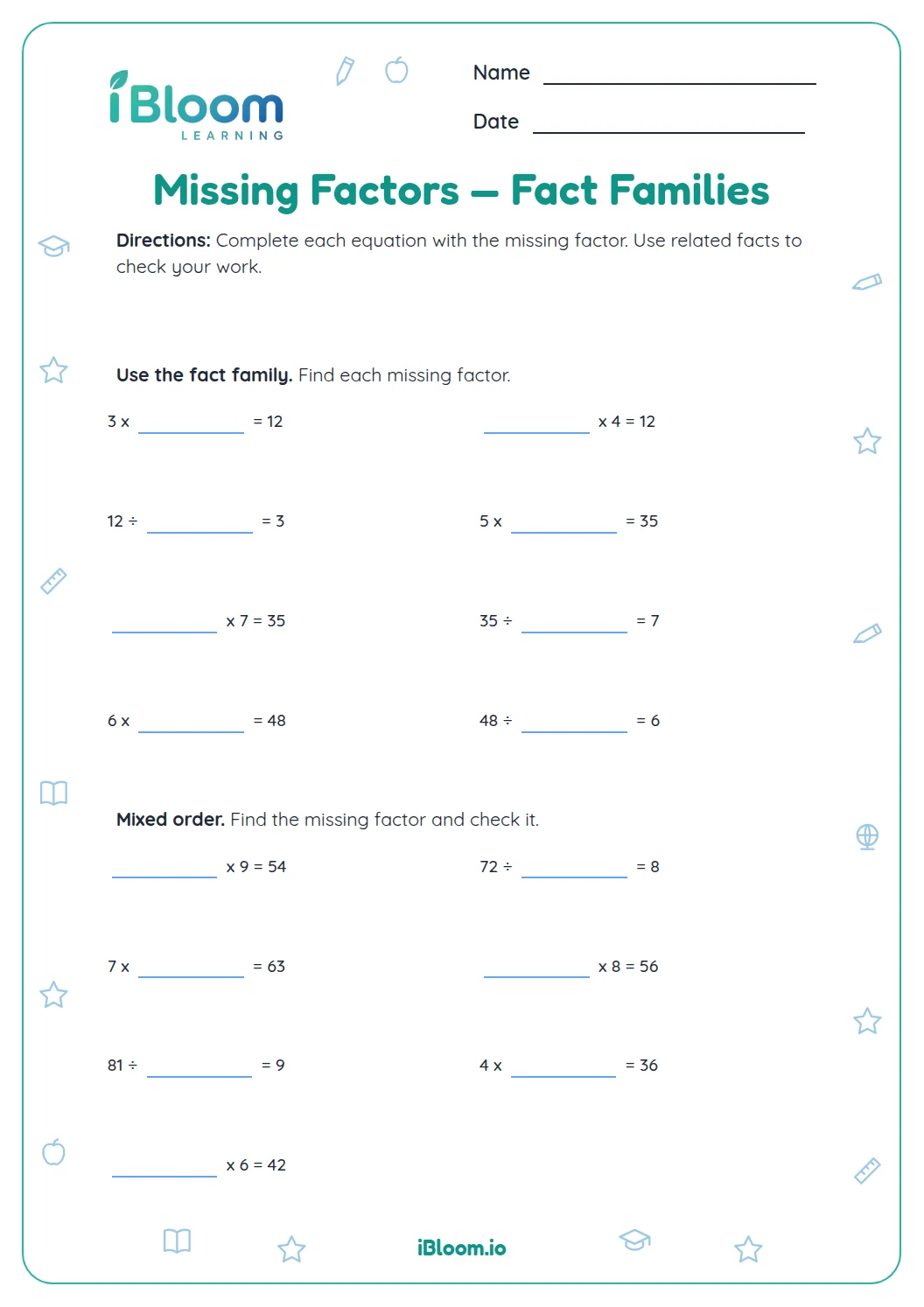
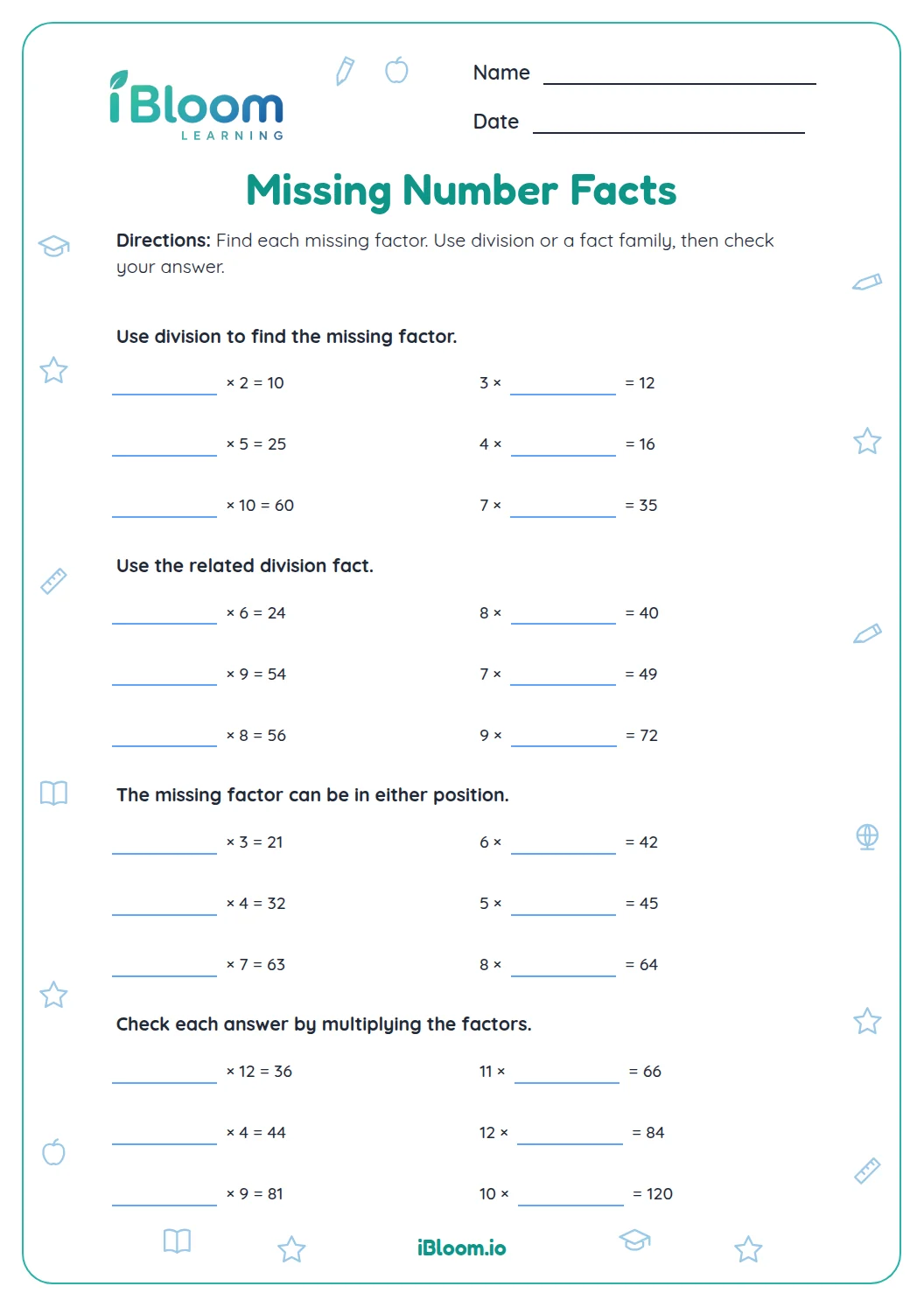
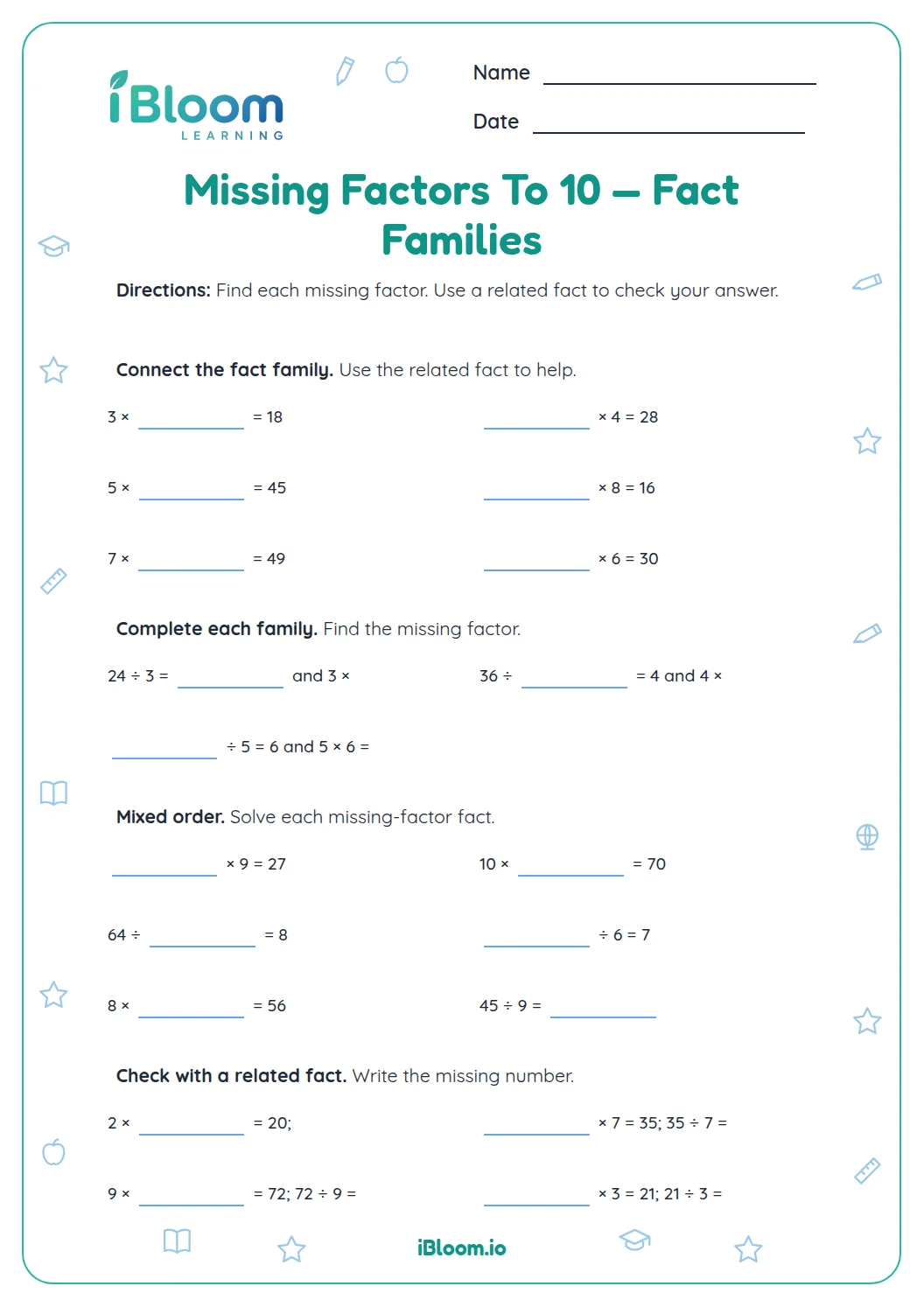
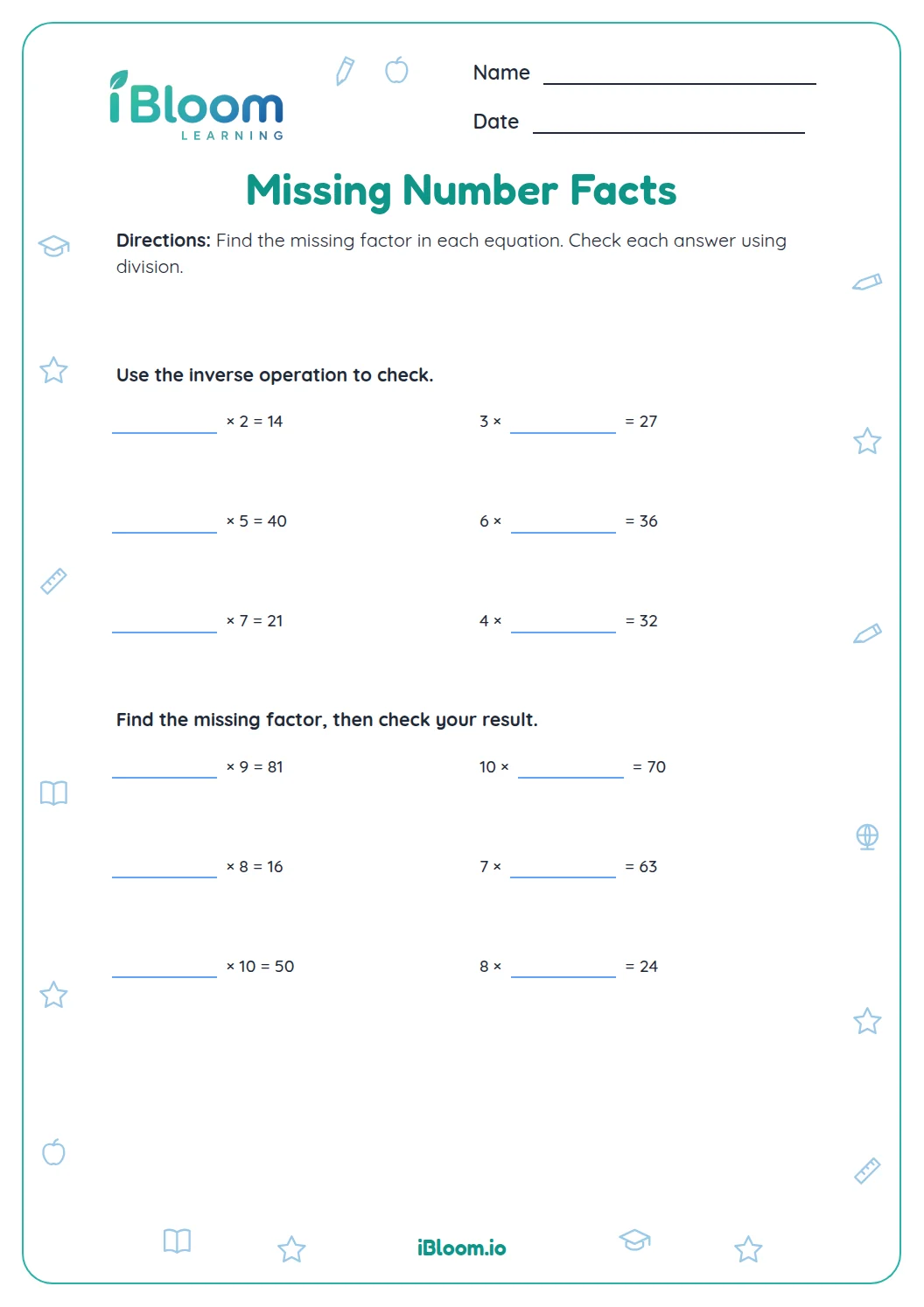
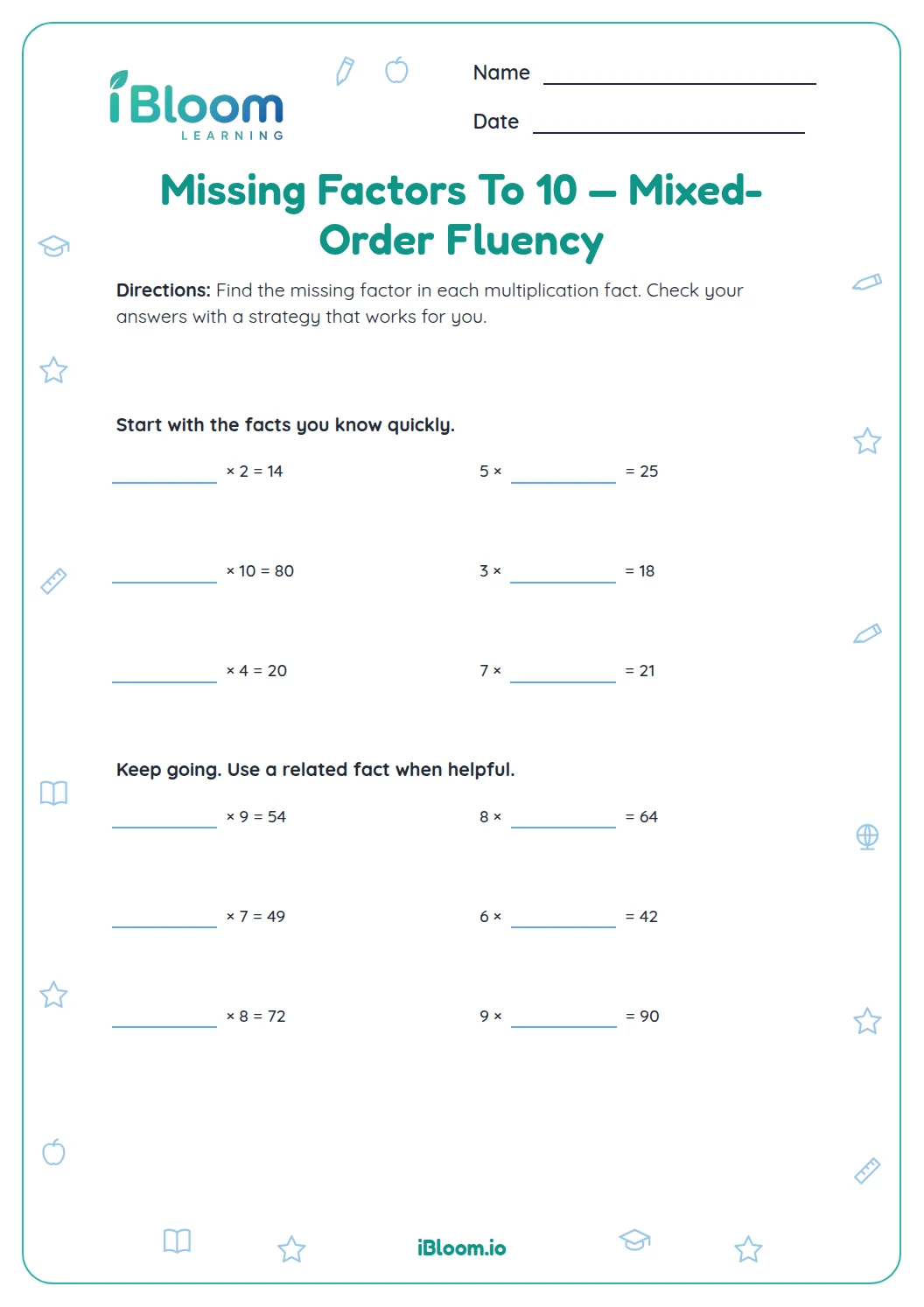
This free missing-factor worksheet gives Grade 3 and Grade 4 students two rounds of 16 multiplication equations. Children find a factor in either position, using known products or related division facts. Part A includes facts with 1, 2, 5, and 10, plus a zero product. After recording that score in Part B, children try a mixed round in Part C. Timing is optional, with separate spaces for a time goal, elapsed time, and accuracy. The work practices Common Core 3.OA.A.4 and 3.OA.C.7. A separate answer key lists all 32 factors.
Aligned to 3.OA.A.4 and 3.OA.C.7
What belongs in the blank?
The blank is one of the two numbers being multiplied. The number after the equals sign is already the product. In 4 × ___ = 24, children need the factor 6; writing 24 in the blank repeats the product and makes a false equation.
The missing factor moves between the left and right positions. That change helps children attend to the entire equation. Multiplication can be checked in either order, so 6 × 4 and 4 × 6 both make 24.
- 1___ × 7 = 56
- 2Think: 7 times what number is 56?
- 356 ÷ 7 = 8, so the missing factor is 8.
- 4Check: 8 × 7 = 56.
How are the two rounds organized?
Part A has 16 equations, including 2 × ___ = 14, ___ × 10 = 90, and 8 × ___ = 0. Children use familiar patterns and check each missing factor. Part B provides spaces for the score out of 16 and an optional time goal for the second round.
Part C has 16 more equations, with products such as 56, 54, 64, 72, and 81. Part D records the second score and elapsed time. The rounds have equal numbers of equations, but the facts differ in difficulty; use each score to identify facts that need more practice.
How can families use the optional timer?
First finish and check Part A without a timer. In Part B, write the number correct and either a time goal in seconds or “untimed.” If the child chooses timing, start a stopwatch at question 19 and stop it when question 34 is finished.
Record the Part C score out of 16 and elapsed time separately in Part D. Write “untimed” in the time space if no stopwatch was used. Review errors and check corrected equations by multiplication before trying another set.
How to use this worksheet
- 1Explain that the blank holds a factor, while the product is already given.
- 2Work through 2 × ___ = 14 together and substitute 7 to check the equation.
- 3Complete all 16 Part A equations, check them, and record the score in Part B.
- 4Write an optional time goal or “untimed,” then begin Part C at question 19.
- 5Record the second score out of 16 and elapsed seconds or “untimed” in Part D.
- 6Revisit missed facts using related division, then read the corrected multiplication equations aloud.
Mistakes to watch for
The mistake
Multiplying the two visible numbers, such as 7 × 56 in question 19.
The fix
Treat 56 as the completed product. Ask “What times 7 makes 56?” or use 56 ÷ 7.
The mistake
Writing 8 in 8 × ___ = 0 because it is the visible factor.
The fix
Eight equal groups of zero contain nothing. Substitute 0 and confirm that 8 × 0 = 0.
The mistake
Writing 7 in 6 × ___ = 54 after recalling the nearby fact 6 × 7 = 42.
The fix
Check the whole equation. Count on by six from 42 to 48 to 54, giving two more groups and a factor of 9.
Common Core alignment
Find the unknown factor that makes each multiplication equation true.
On this sheet: Every equation gives one factor and a product, with the other factor missing.
Show the official wordingHide the official wording
Determine the unknown whole number in a multiplication or division equation relating three whole numbers. For example, determine the unknown number that makes the equation true in each of the equations 8 × ? = 48, 5 = _ ÷ 3, 6 × 6 = ?
Use multiplication recall or related division facts to find factors within 100.
On this sheet: The two rounds combine familiar and harder products, followed by multiplication checks.
Show the official wordingHide the official wording
Fluently multiply and divide within 100, using strategies such as the relationship between multiplication and division (e.g., knowing that 8 × 5 = 40, one knows 40 ÷ 5 = 8) or properties of operations. By the end of Grade 3, know from memory all products of two one-digit numbers.
What to practice next
Make more practice
Further reading
Questions parents and teachers ask
Is timing required for this worksheet?
No; both rounds can be completed without a timer. After checking Part A, children record their score in Part B and write either a time goal or “untimed.” Part C is the second round. Part D keeps its score separate from elapsed seconds, so accuracy remains visible.
What multiplication facts appear in the two rounds?
The sheet uses factors from zero through ten and products no greater than 90. Part A includes patterns involving one, two, five, and ten. Part C mixes products such as 54, 56, 64, 72, and 81, with the blank alternating between the first and second factor positions.
Can children use division to find an answer?
Yes; division is a useful way to find the missing factor. In 6 × ___ = 54, calculate 54 ÷ 6 = 9, then check 6 × 9 = 54. Children may also recall the multiplication fact directly; both methods identify the number that makes the equation true.
Why is there a question with a zero product?
It checks whether children can use the meaning of multiplying by zero. Question 5 is 8 × ___ = 0, so the missing factor is zero. The known factor is eight, which makes the answer definite. Read the completed equation aloud as eight groups of zero making zero.
How should I score the drill?
Check each round out of 16 using the answer key, or combine the two scores for a total out of 32. The four score and timing records are not extra math problems. After scoring, correct missed factors and multiply to check them before choosing the next facts to practice.