





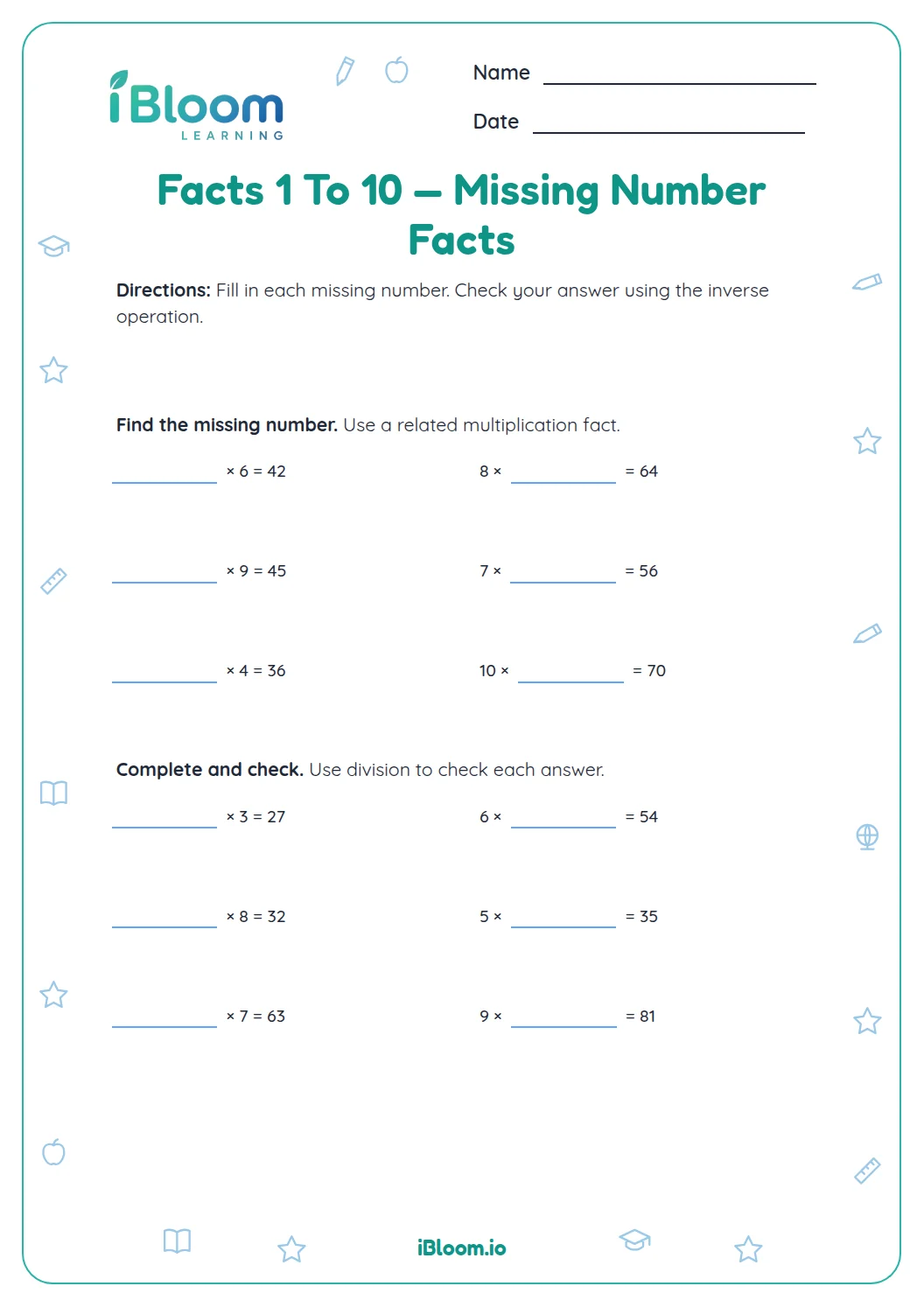
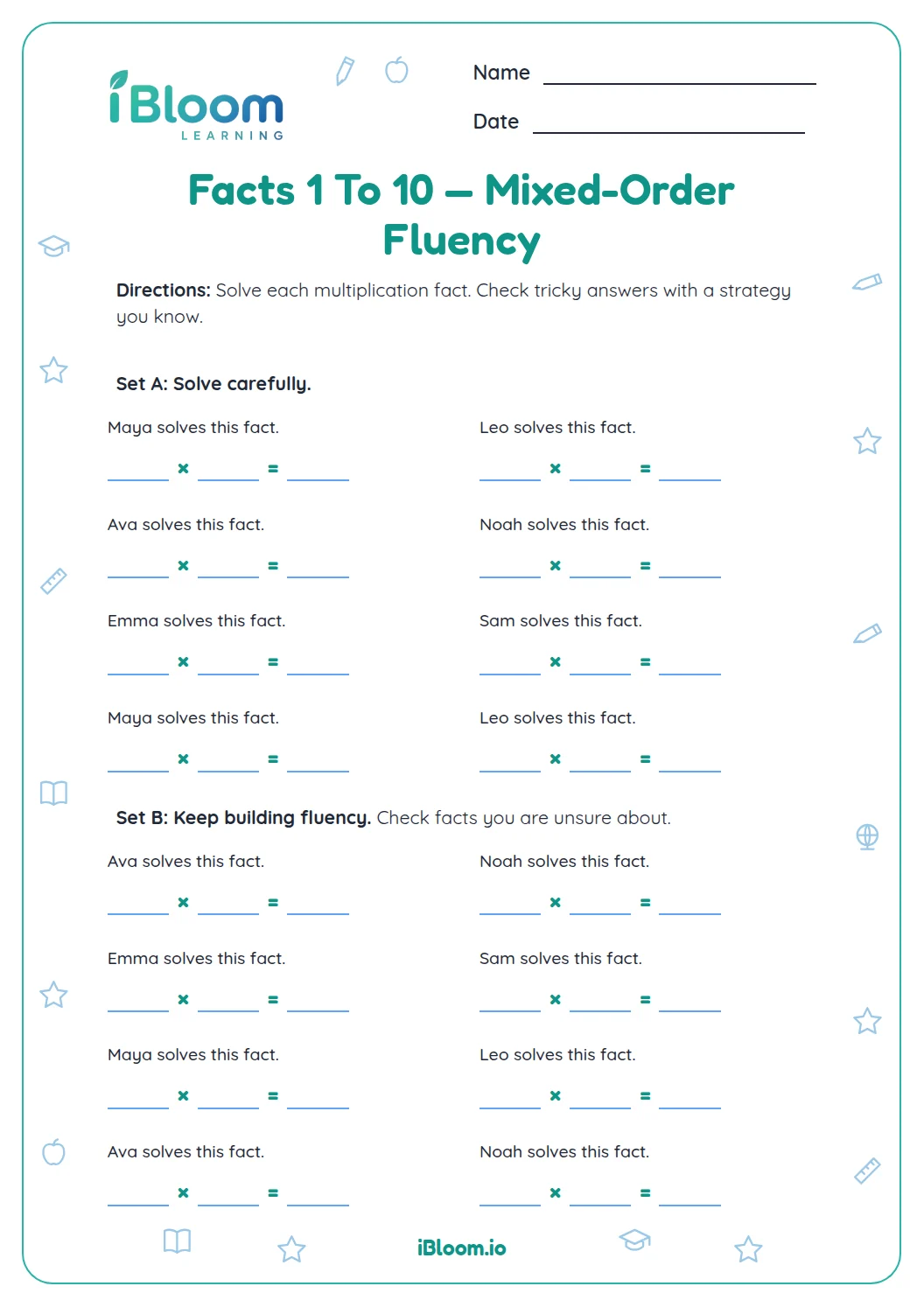
About this worksheet
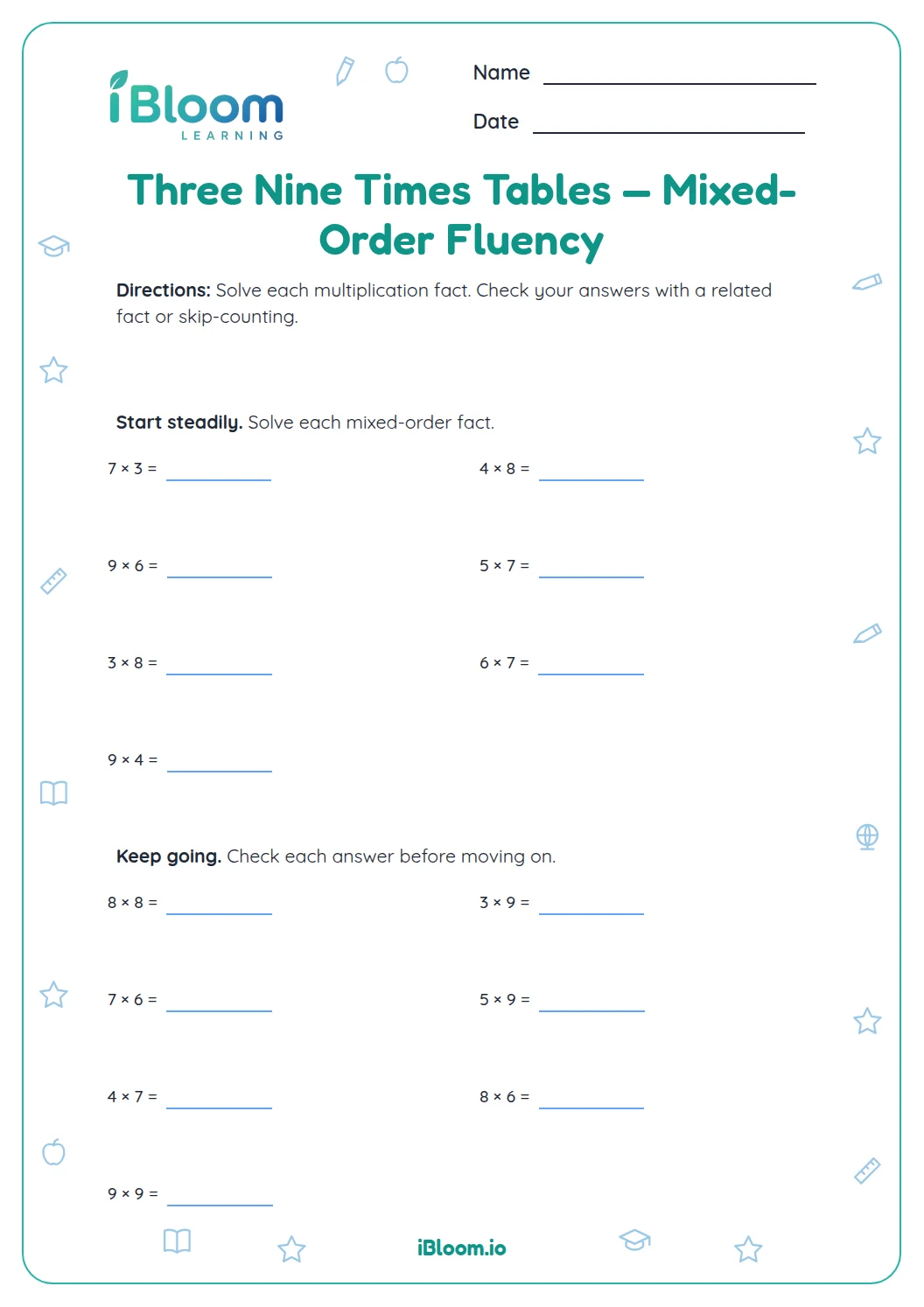
This free printable multiplication warm-up gives students in Grades 3–4 fourteen facts from the 3 through 9 times tables. Each table appears twice as the first factor, once in each part. Part A starts with products such as 3 × 4 and 4 × 5; Part B includes 6 × 7, 7 × 8 and the square facts 8 × 8 and 9 × 9. Students write products in large number sentences and check uncertain answers with a known fact. The sheet supports Common Core 3.OA.C.7, multiplication fluency within 100, and includes a separate answer key.
Aligned to 3.OA.C.7
Which times tables are on the sheet?
The sheet covers every table from 3 through 9. In each part, the first factors run from 3 to 9, giving one short round of all seven tables. The second factors change between rounds.
All products are within 100. The second round includes larger products while keeping the response format the same: write one number in the blank.
How can a known fact help with a harder one?
Students can build a product instead of guessing. For 7 × 8, begin with 5 × 8 and add two more groups of 8. If a student knows 6 × 8, adding one group of 8 works too.
After checking, ask the student to say the entire fact aloud. This connects the calculation back to the product they want to remember.
- 1Question 12: 7 × 8 = ___.
- 25 × 8 = 40 and 2 × 8 = 16.
- 340 + 16 = 56, so 7 × 8 = 56.
How can this stay a short warm-up?
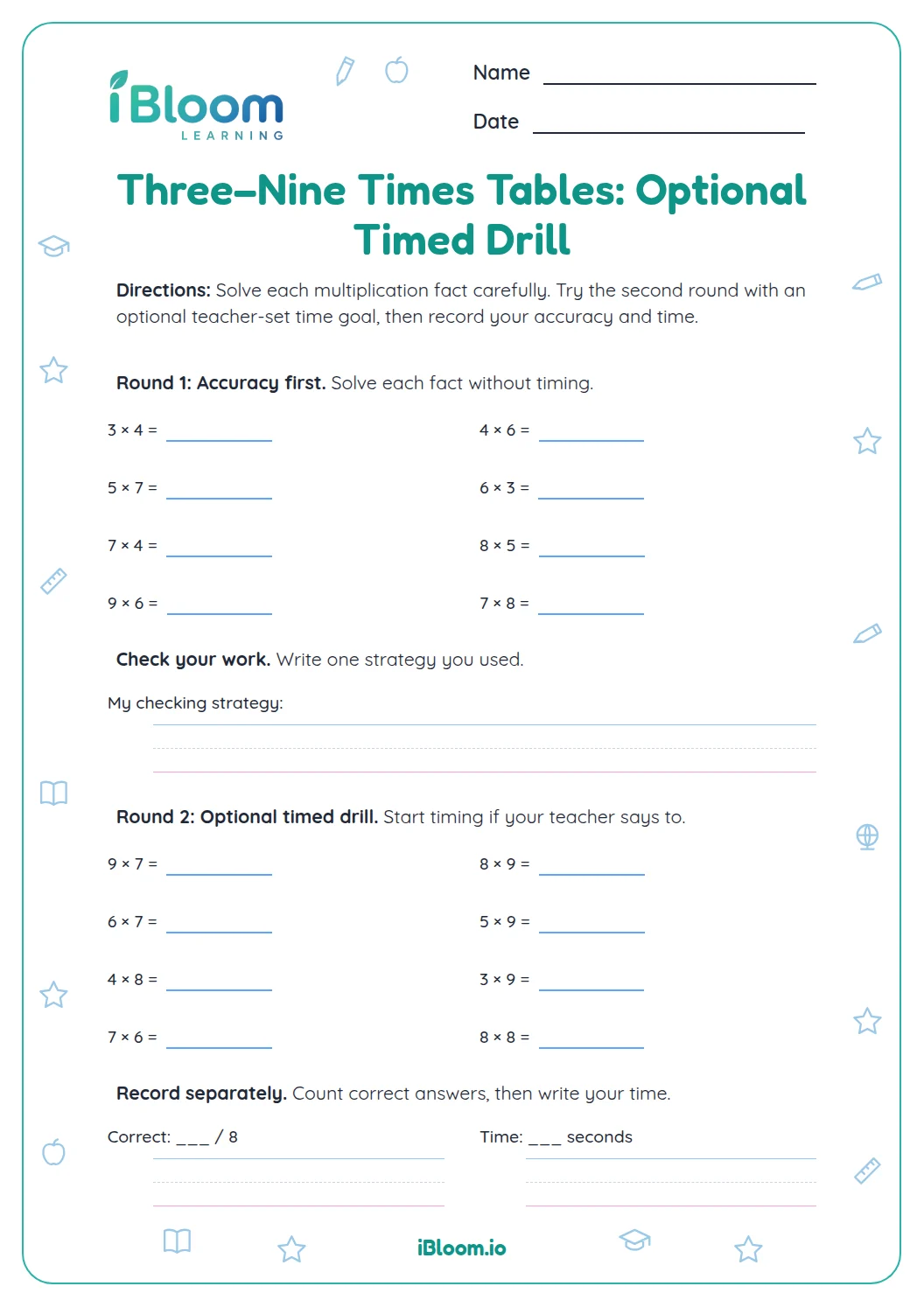
Let students complete Part A, pause to check any uncertain facts, then try Part B. There is no required timer. A five- to eight-minute session leaves room to discuss one useful strategy.
Afterward, choose one or two missed facts for an oral review. A full repeat of the sheet is useful when the student can explain the corrected products without copying from the key.
How to use this worksheet
- 1Read the multiplication sign as “groups of” for the first fact.
- 2Complete the seven facts in Part A at a comfortable pace.
- 3Check a product that caused a pause using skip-counting or a nearby fact.
- 4Complete the seven facts in Part B.
- 5Use the key, then say any corrected fact and explain how you checked it.
Mistakes to notice and how to fix them
The mistake
Adding the factors and answering 3 × 4 with 7.
The fix
Think of three groups of four: 4 + 4 + 4 = 12.
The mistake
Stopping at 6 × 8 = 48 when the question asks for 7 × 8.
The fix
Add the missing group of 8: 48 + 8 = 56.
The mistake
Using 9 × 10 = 90 for 9 × 9 without adjusting it.
The fix
Subtract one group of 9: 90 − 9 = 81.
Common Core alignment
Recall and check multiplication products from the 3 through 9 times tables.
On this sheet: Fourteen products provide focused practice with one-digit multiplication facts within 100.
Show the official wordingHide the official wording
Fluently multiply and divide within 100, using strategies such as the relationship between multiplication and division (e.g., knowing that 8 × 5 = 40, one knows 40 ÷ 5 = 8) or properties of operations. By the end of Grade 3, know from memory all products of two one-digit numbers.
What to practice next
Make more practice
Further reading
Questions parents and teachers ask
Does this sheet cover only the 3 and 9 tables?
It covers all seven tables from 3 through 9. Each appears once in Part A and once in Part B as the first factor. That gives students fourteen products and lets an adult compare performance across the range without a long drill.
Should I time this warm-up?
Timing is optional; the sheet works well without a timer. Give students enough time to use a known fact or skip-count if needed. After checking the fourteen answers, choose one or two facts for a brief explanation so the session ends with a useful strategy.
How can my child check 9 × 9?
Use ten groups of nine, then take away one group. Ten times nine is 90, and 90 minus 9 is 81. This checks the last question in Part B and connects a less familiar square fact to an easy multiplication-by-ten fact.
Can a fourth grader use this sheet?
Yes, a fourth grader can use it to review multiplication facts before work with larger numbers. The two short rounds cover products such as 6 × 7 and 8 × 8. Ask the student to explain any corrected product before starting the next math task.
What should we do with a wrong product?
Rebuild the fact using equal groups or a product the student already knows. For 7 × 8, combine 5 × 8 and 2 × 8 to make 56. Then cover the key and ask for the product again, along with the strategy used to find it.