



About this worksheet
This printable drill uses fact families to connect multiplication with division. Students work with factors from the 3 and 9 tables, then apply those facts to equal groups. The same three numbers make a related set: two multiplication facts and two division facts.
Aligned to 3.OA.B.5 and 3.OA.C.7
How do multiplication and division facts connect?
A fact family uses two factors and their product. Switching the factors gives another multiplication fact, while dividing the product by either factor gives a division fact.
- 13 × 9 = 27
- 29 × 3 = 27
- 327 ÷ 3 = 9
- 427 ÷ 9 = 3
When can students use a fact family?
Equal groups are a useful check. If 6 trays hold 9 muffins each, 6 × 9 finds the total. If 54 muffins are shared among 9 trays, 54 ÷ 9 finds the number on each tray.
How to practice
- 1Name the two factors and the product.
- 2Write the related multiplication fact.
- 3Use the product to check each division fact.
- 4For a story problem, decide whether the groups or the group size is unknown.
Common fact family slips
The mistake
Dividing a product by the same number that is already missing.
The fix
Use the other known factor to find the unknown factor.
The mistake
Changing the product when the factors switch places.
The fix
Multiplication order can switch, but the product stays the same.
Common Core alignment
The practice connects multiplication and division and uses equal groups.
Apply properties of operations as strategies to multiply and divide.
On this sheet: Students use the relationship and order of factors in multiplication facts.
Show the official wordingHide the official wording
Apply properties of operations as strategies to multiply and divide.
Fluently multiply and divide within 100.
On this sheet: All products and quotients stay within 100.
Show the official wordingHide the official wording
Fluently multiply and divide within 100, using strategies such as the relationship between multiplication and division.
What to practice next
Make more practice
Further reading
Questions parents and teachers ask
How does a fact family connect multiplication and division?
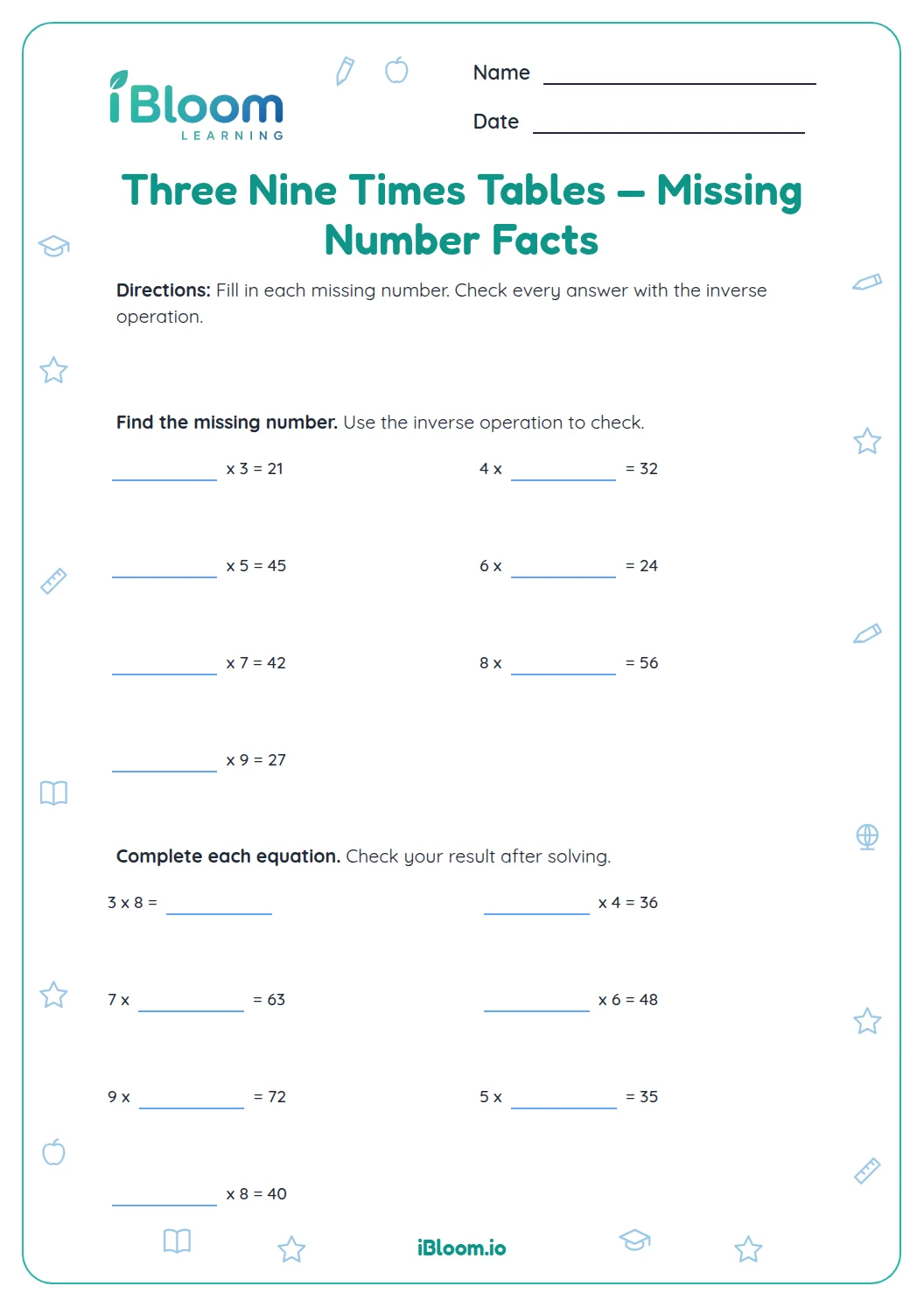
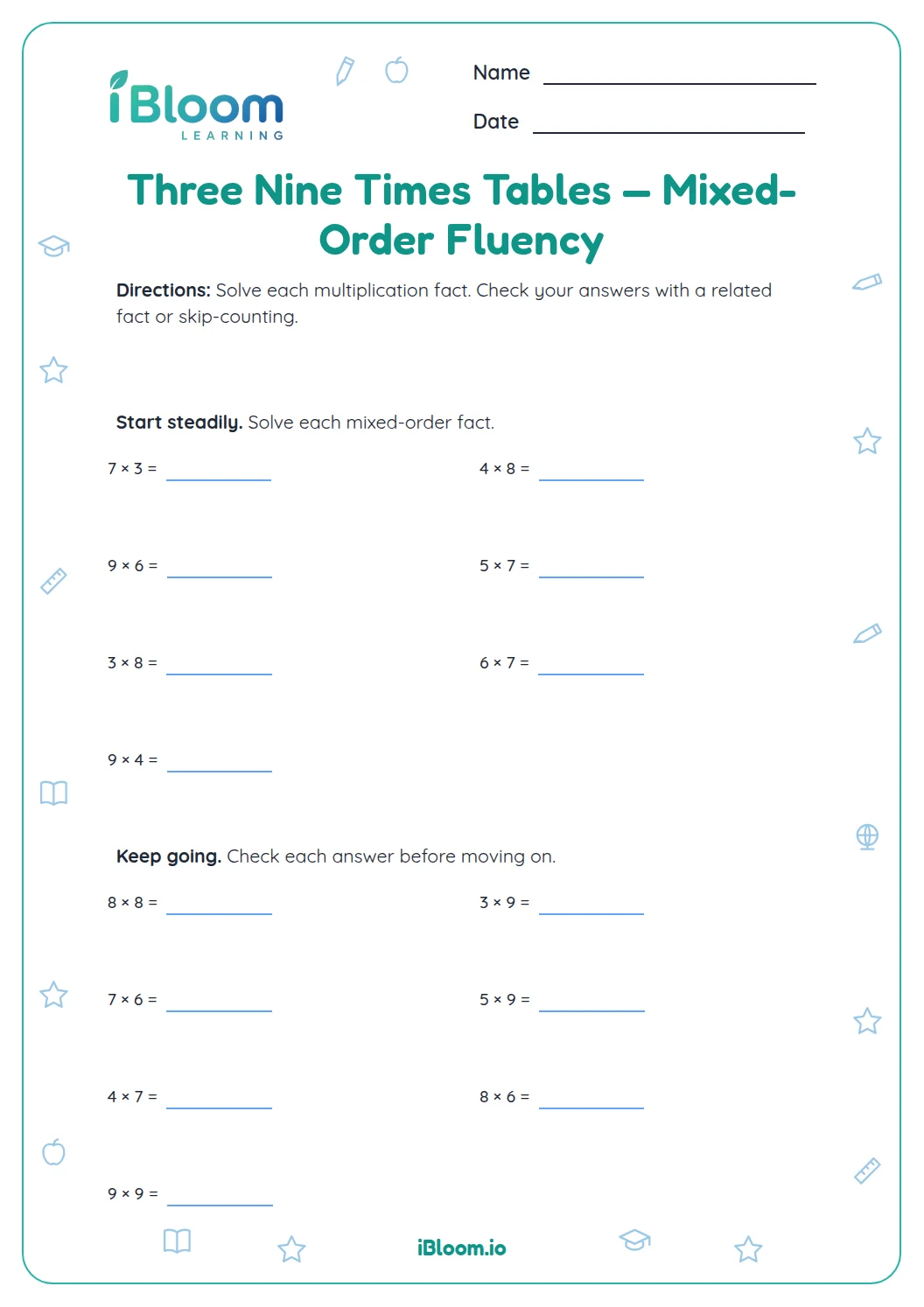
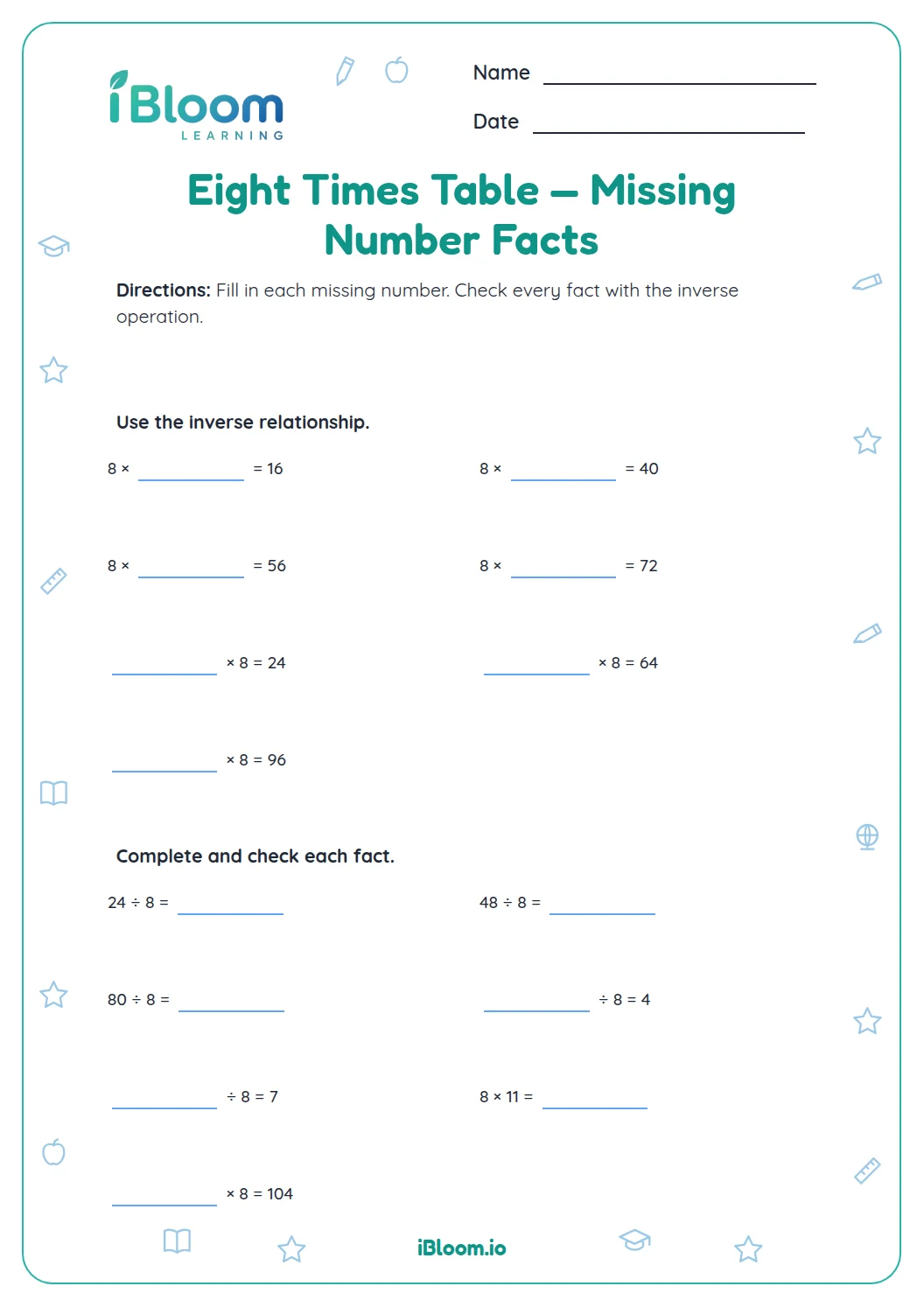
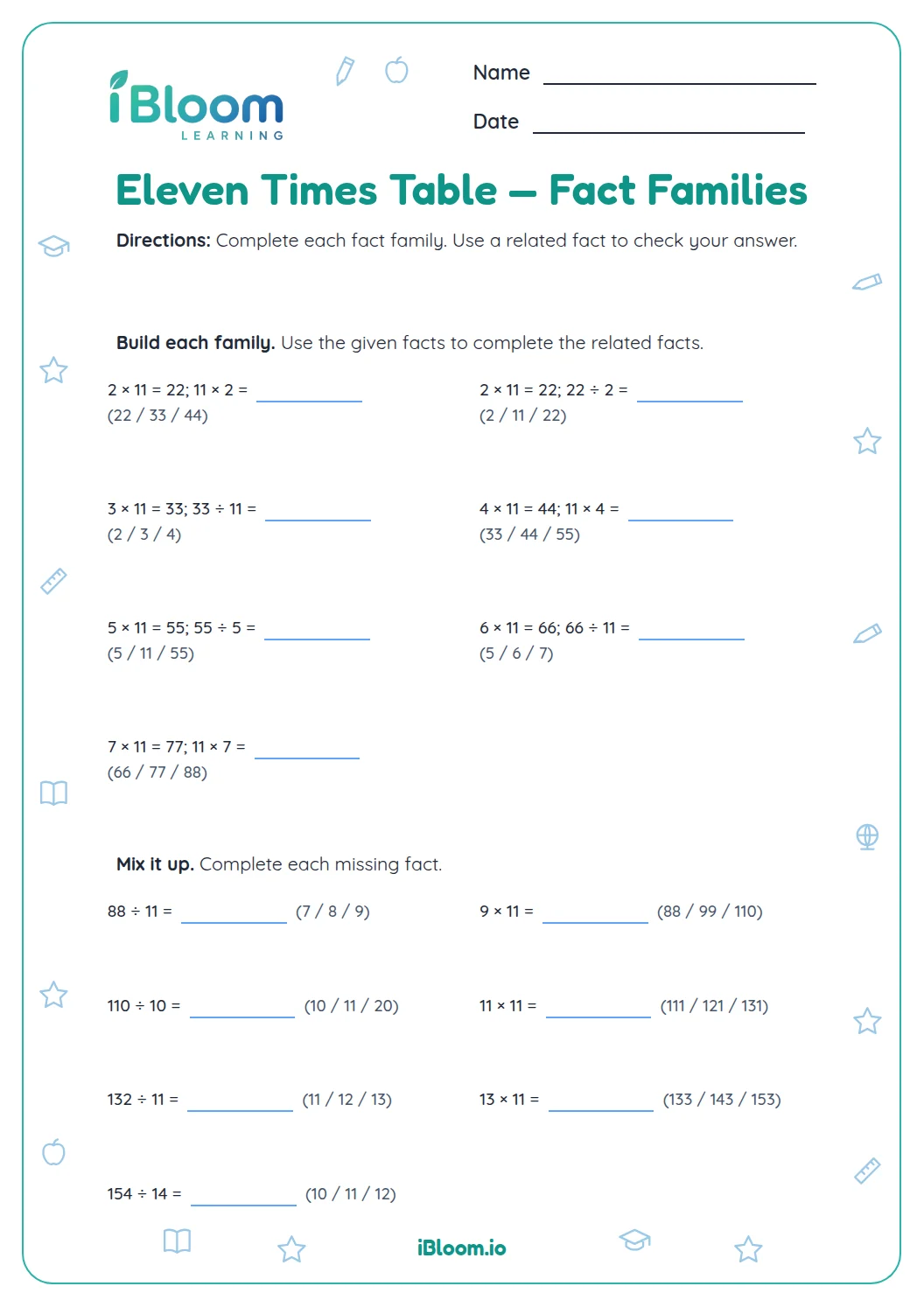
The 14 questions include multiplication and division with factors from the 3 and 9 tables. Several items name a fact family and ask for a related equation, while others practice a single fact or missing factor. Ask the student to name the clue or operation that supports the choice, then check the completed sentence or equation against the key..
Why can multiplication factors switch places?
The product stays the same when the factors switch places. For instance, 3 groups of 9 and 9 groups of 3 both make 27. This fact can help students check a multiplication answer and remember its related family. Ask the student to name the clue or operation that supports the choice, then check the completed sentence or equation against.
Can repeated addition help with these facts?
Yes. Adding equal groups can help a learner find a product, especially while a fact is still new. Then the product can be used to check the related division equations. With practice, students can recall the facts more quickly. Ask the student to name the clue or operation that supports the choice, then check the completed sentence or equation.
What should students do when a division fact feels hard?
Think of the related multiplication fact. For 72 ÷ 9, ask what number multiplied by 9 makes 72. Since 9 × 8 = 72, the quotient is 8. Checking by multiplying confirms the answer. A quick multiplication check often makes the division step easier to trust.
How many facts are included?
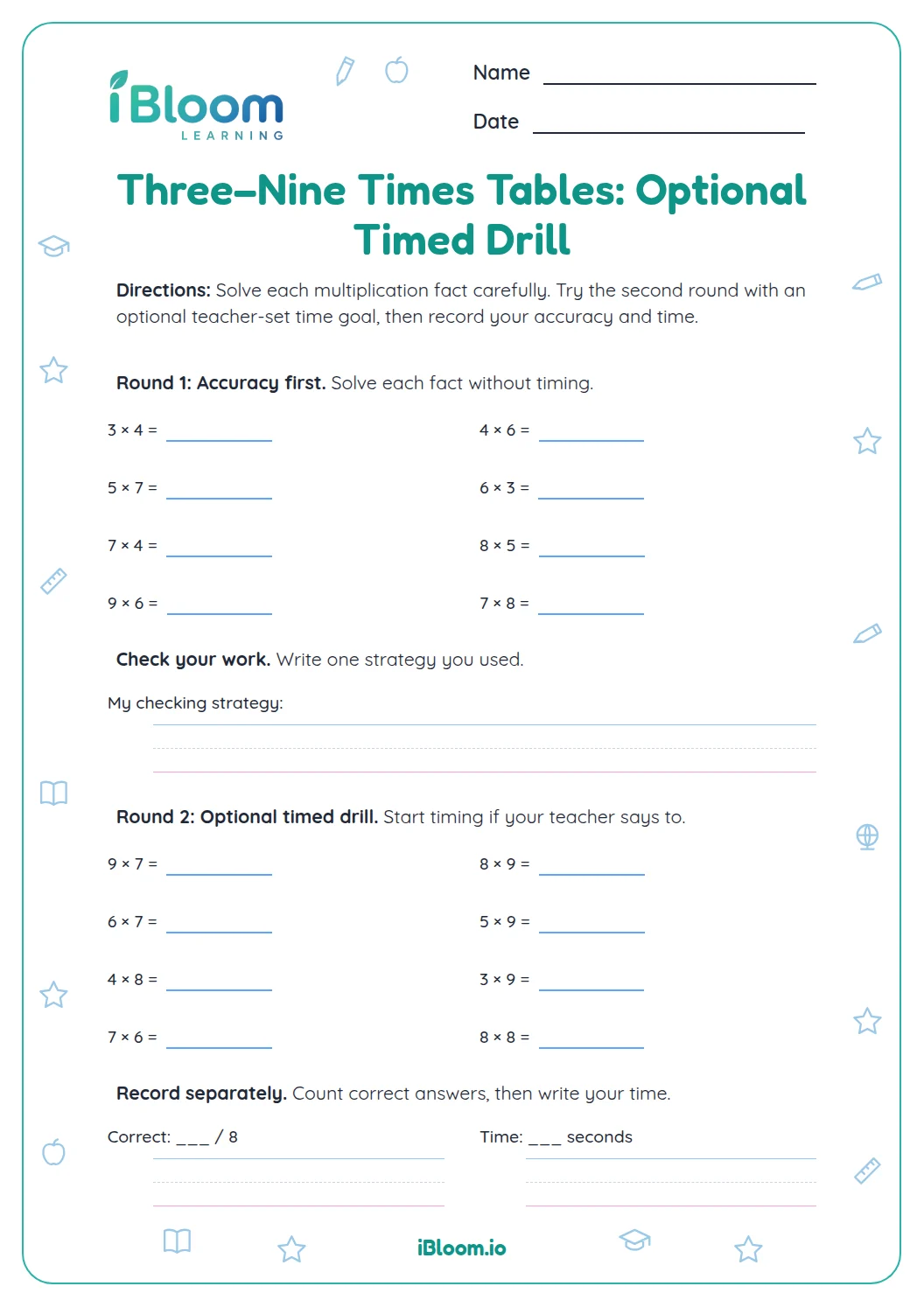
The sheet has 14 questions in four parts. Students complete multiplication and division facts from the 3 and 9 tables, including related equations that show how one multiplication fact connects to division. Ask the student to name the clue or operation that supports the choice, then check the completed sentence or equation against the key. This quick check connects.