







About this worksheet
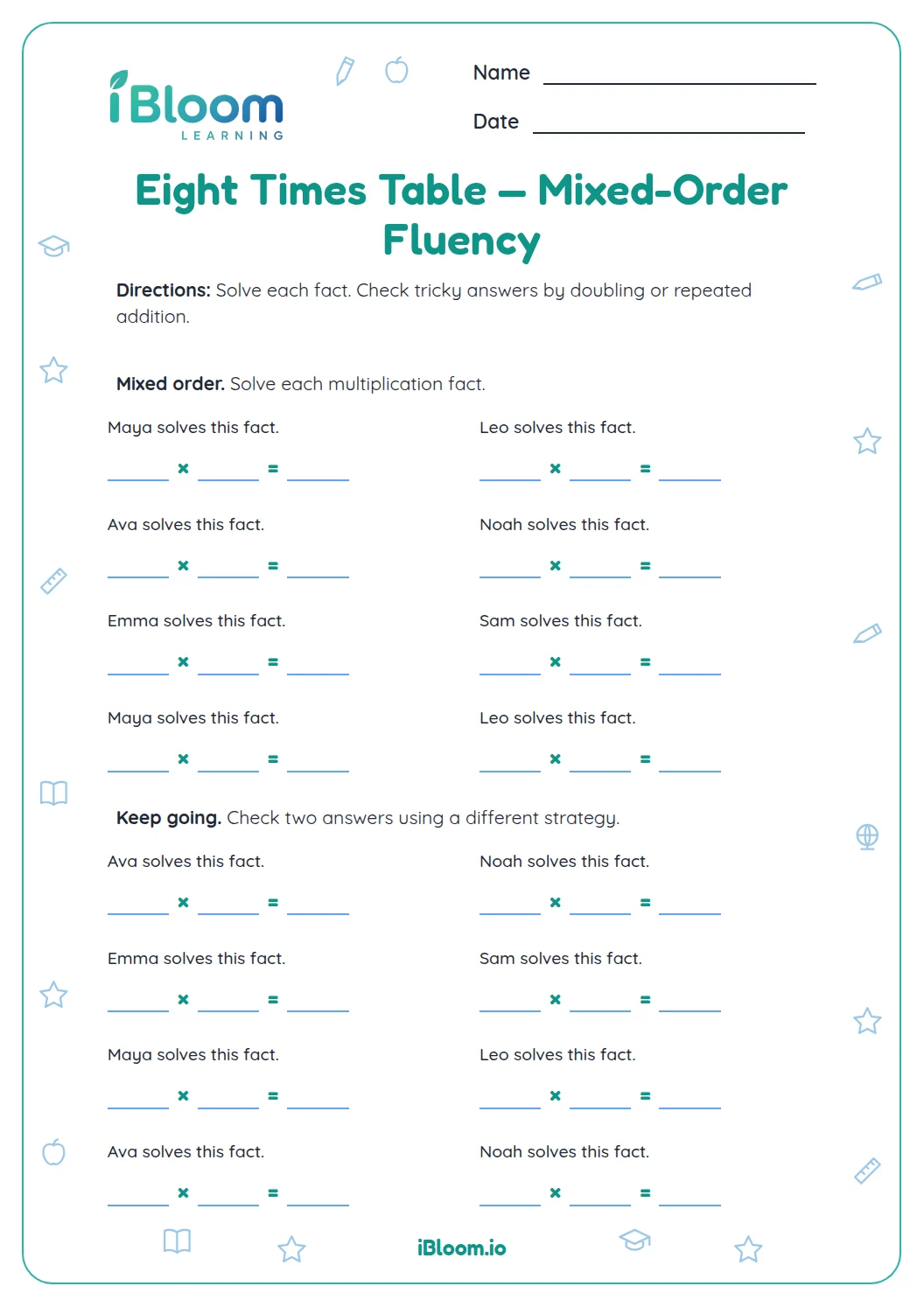
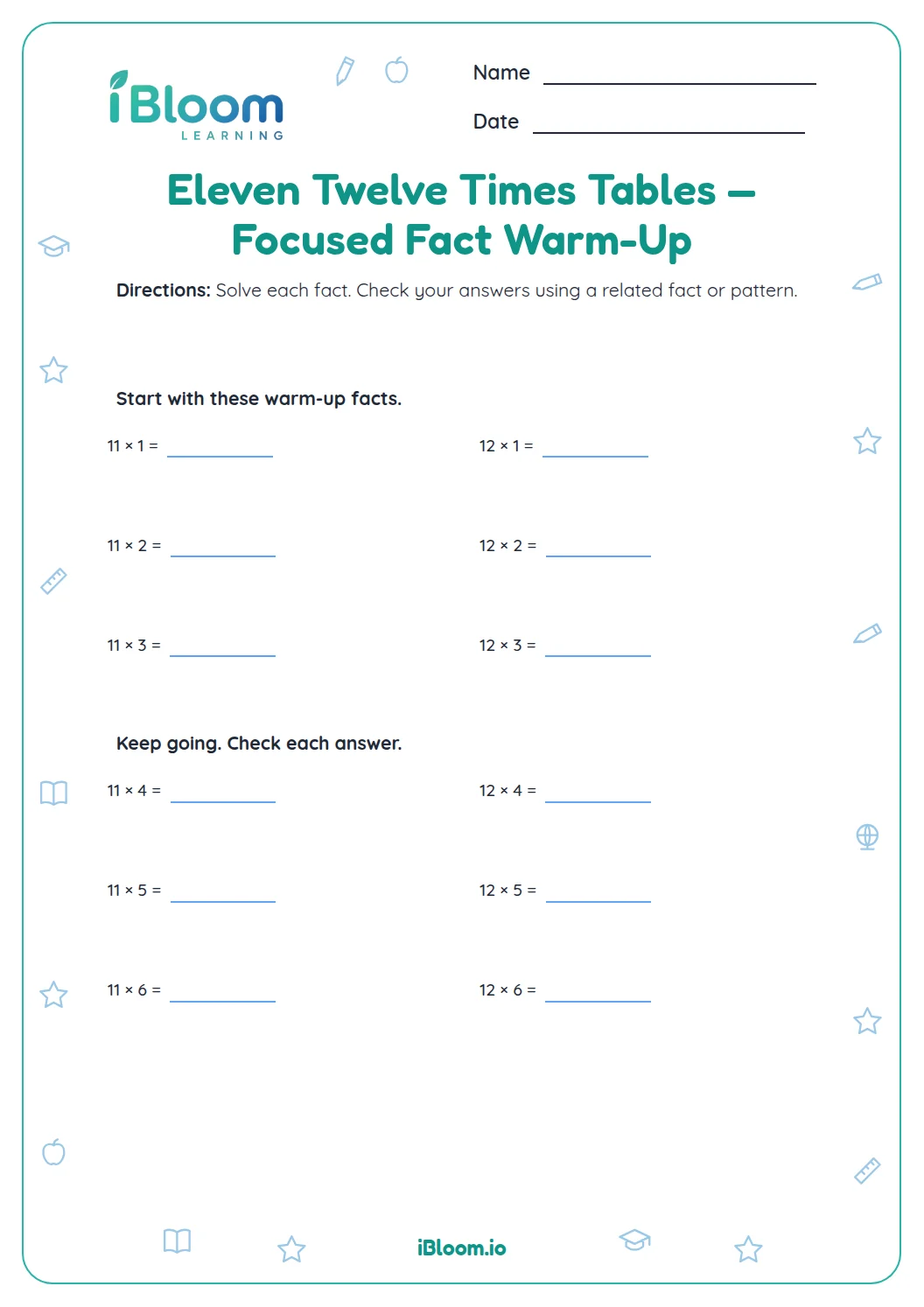
This Grade 3–4 printable gives students 18 mixed-order multiplication facts from the 2s and 3s tables. The factors appear in a shuffled sequence, so students recall each product instead of reciting one table from start to finish. A separate key lists the products in worksheet order.
Aligned to 3.OA.A.1 and 3.OA.C.7
What does mixed-order practice mean?
The worksheet has 18 multiplication sentences: nine facts from the 2s table and nine from the 3s table. The factors appear in mixed order, with each table represented throughout the drill.
For 3 × 7, think of three groups of seven or recall the product 21.
- Nine 2s facts
- Nine 3s facts
- No timed score is required
How can equal groups help with a fact?
For 3 × 7, picture three groups with seven objects in each group. Counting by sevens gives 7, 14, 21, so the product is 21. A student may also use a known fact such as 2 × 7 and add one more group of 7.
- 13 × 7 = ___
- 2Three groups of seven total 21.
How can students check a recalled product?
Use repeated addition or switch the order of the factors. For 2 × 8, eight groups of two total 16; the related fact 8 × 2 also equals 16. If the result seems too small, count the groups again.
How to use this worksheet
- 1Read both factors before saying the product.
- 2Complete the mixed set without skipping unfamiliar facts.
- 3Use equal groups, skip counting or a known fact when needed.
- 4Check a few answers by reversing the factors or using repeated addition.
Common mistakes and quick fixes
The mistake
Reading 3 × 7 as 3 + 7.
The fix
Multiplication means equal groups: 3 groups of 7, or 21 altogether.
The mistake
Reciting a table but losing track in mixed order.
The fix
Read the factors in each individual equation before recalling.
The mistake
Swapping a factor and product.
The fix
The factors are the numbers being multiplied; the product is the answer.
Common Core alignment
The facts use equal groups and multiplication within 100.
Interpret each product as equal groups of 2 or 3.
On this sheet: Each multiplication fact can be understood as equal groups.
Show the official wordingHide the official wording
Interpret products of whole numbers, e.g., interpret 5 × 7 as the total number of objects in 5 groups of 7 objects each. For example, describe a context in which a total number of objects can be expressed as 5 × 7.
Build fluency with the 2 and 3 multiplication facts.
On this sheet: The drill practices selected products of two one-digit numbers.
Show the official wordingHide the official wording
Fluently multiply and divide within 100, using strategies such as the relationship between multiplication and division (e.g., knowing that 8 × 5 = 40, one knows 40 ÷ 5 = 8) or properties of operations. By the end of Grade 3, know from memory all products of two one-digit numbers.
What to practice next
Make more practice
Further reading
Questions parents and teachers ask
Are the facts in table order?
There are 18 multiplication facts: nine from the 2s table and nine from the 3s table. The questions mix the factors rather than listing one table in order. The answer key gives each product beside its matching question.
How many 2s and 3s facts are there?
The worksheet has nine facts with a factor of 2 and nine with a factor of 3. Some products repeat across the tables, such as 6, because both 2 × 3 and 3 × 2 equal 6. Each equation still practices its own factor pair.
Should students use skip counting?
Yes. Skip counting is a helpful way to build or check a multiplication fact. For 3 × 7, counting three groups of seven gives 7, 14, 21. As recall improves, students may answer more facts directly without counting each group.
Is this a timed test?
No timed goal is required. A student can work at a comfortable pace and focus on correct answers. The page can also be repeated later to see whether fact recall feels smoother, while still checking each product for accuracy.
What does the answer key include?
The separate answer key lists the products for all 18 equations. It can be used for self-checking or for an adult to review the page. Students can correct a missed product by drawing equal groups or writing repeated addition.