





About this worksheet
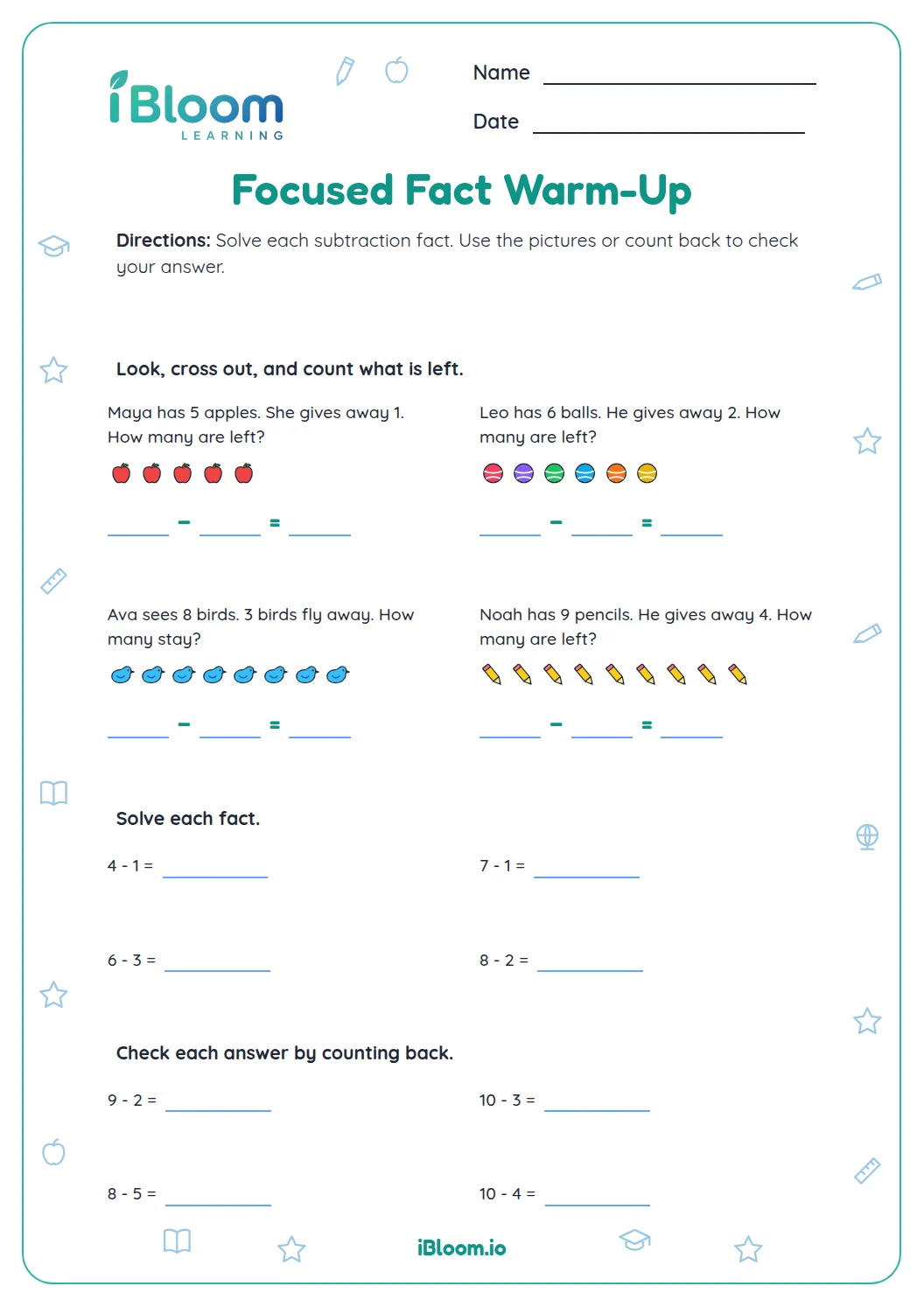
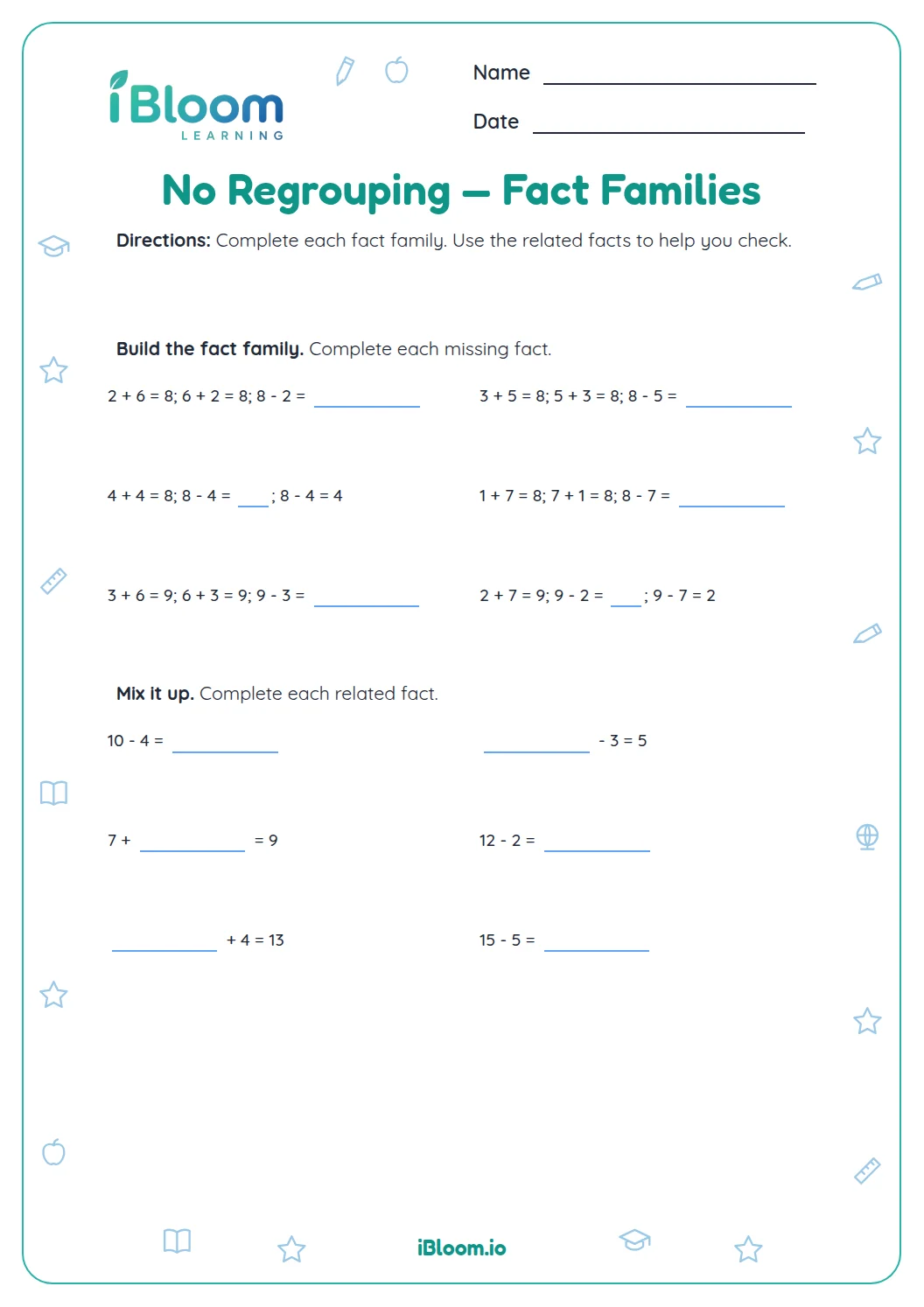
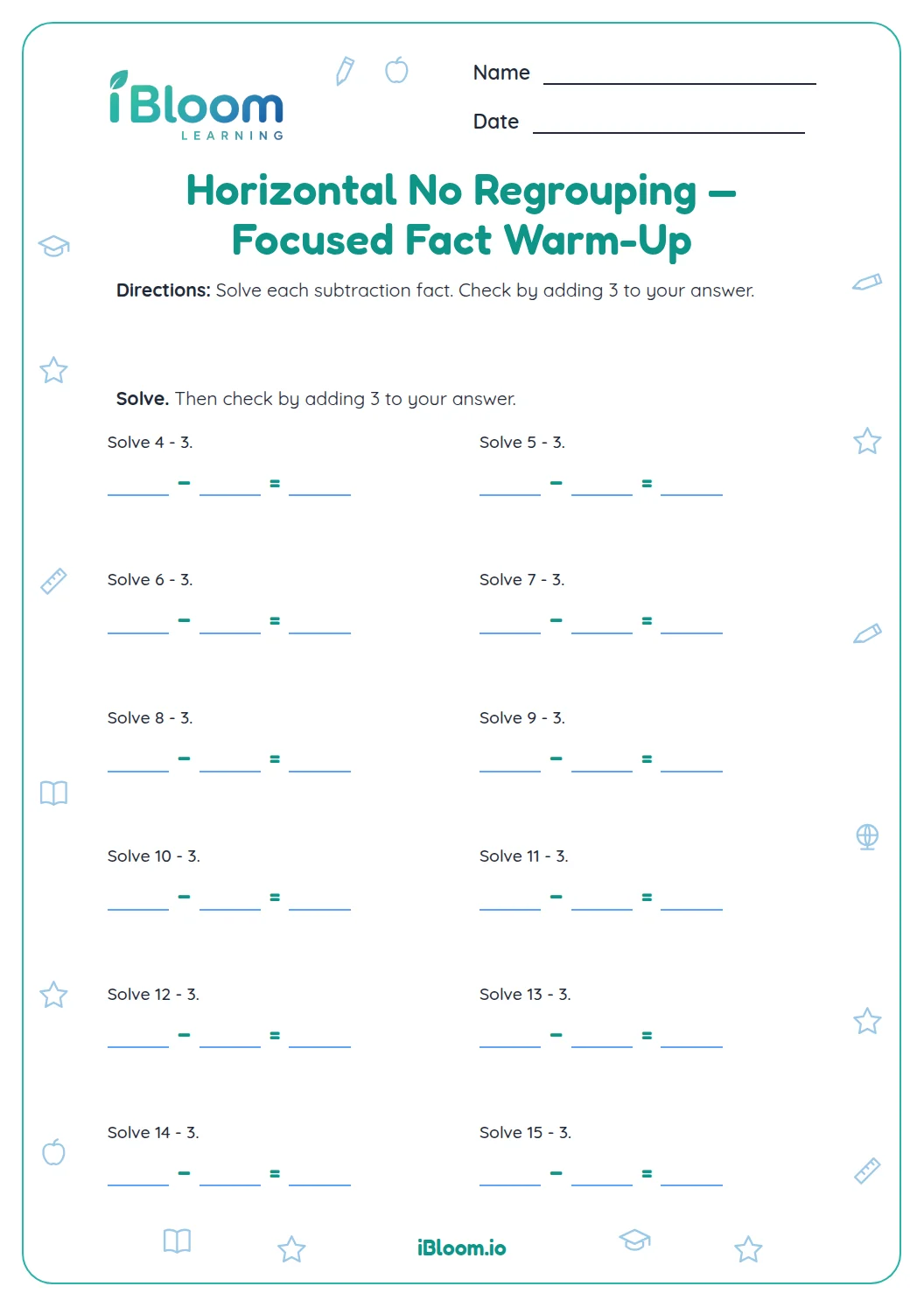
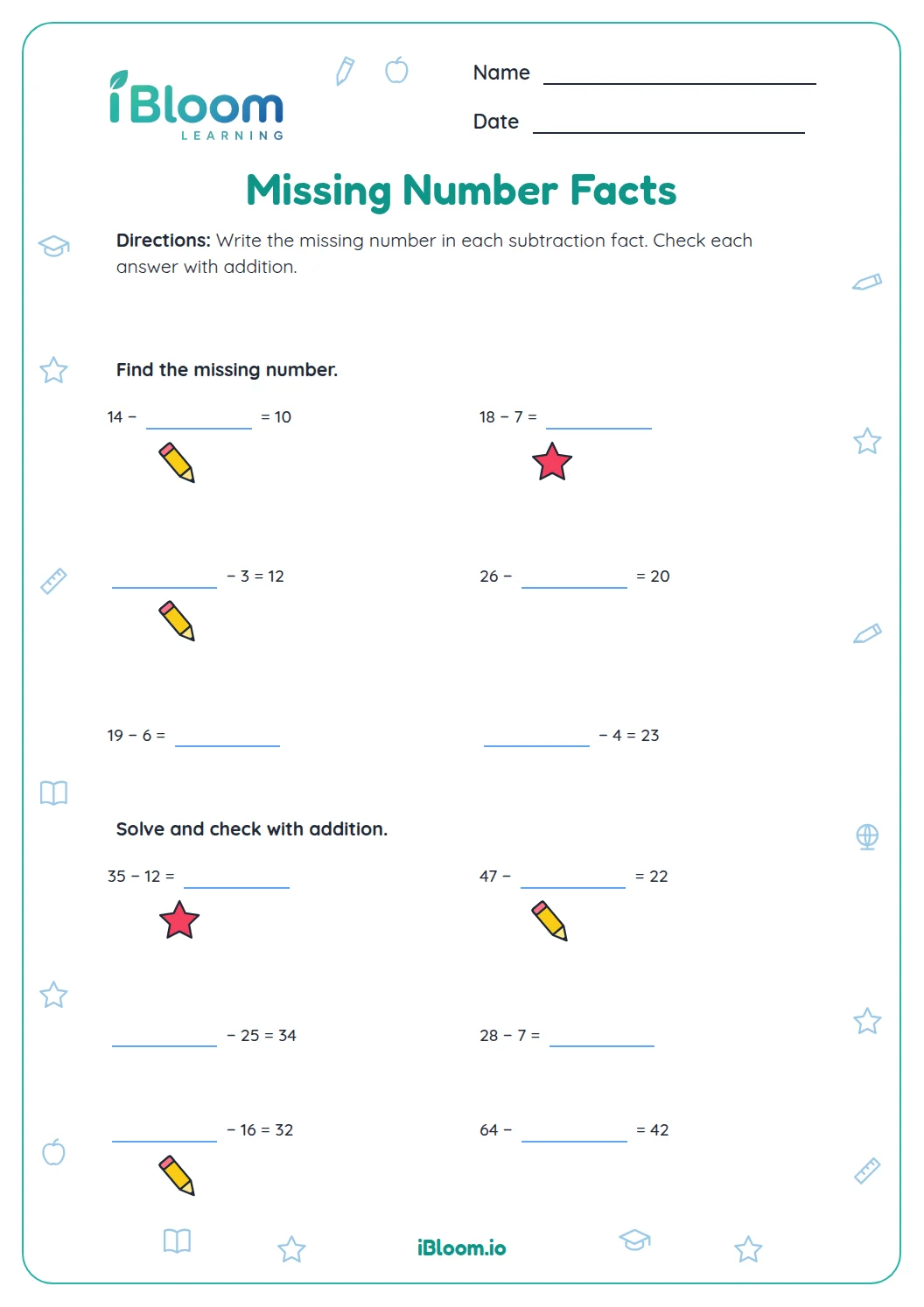
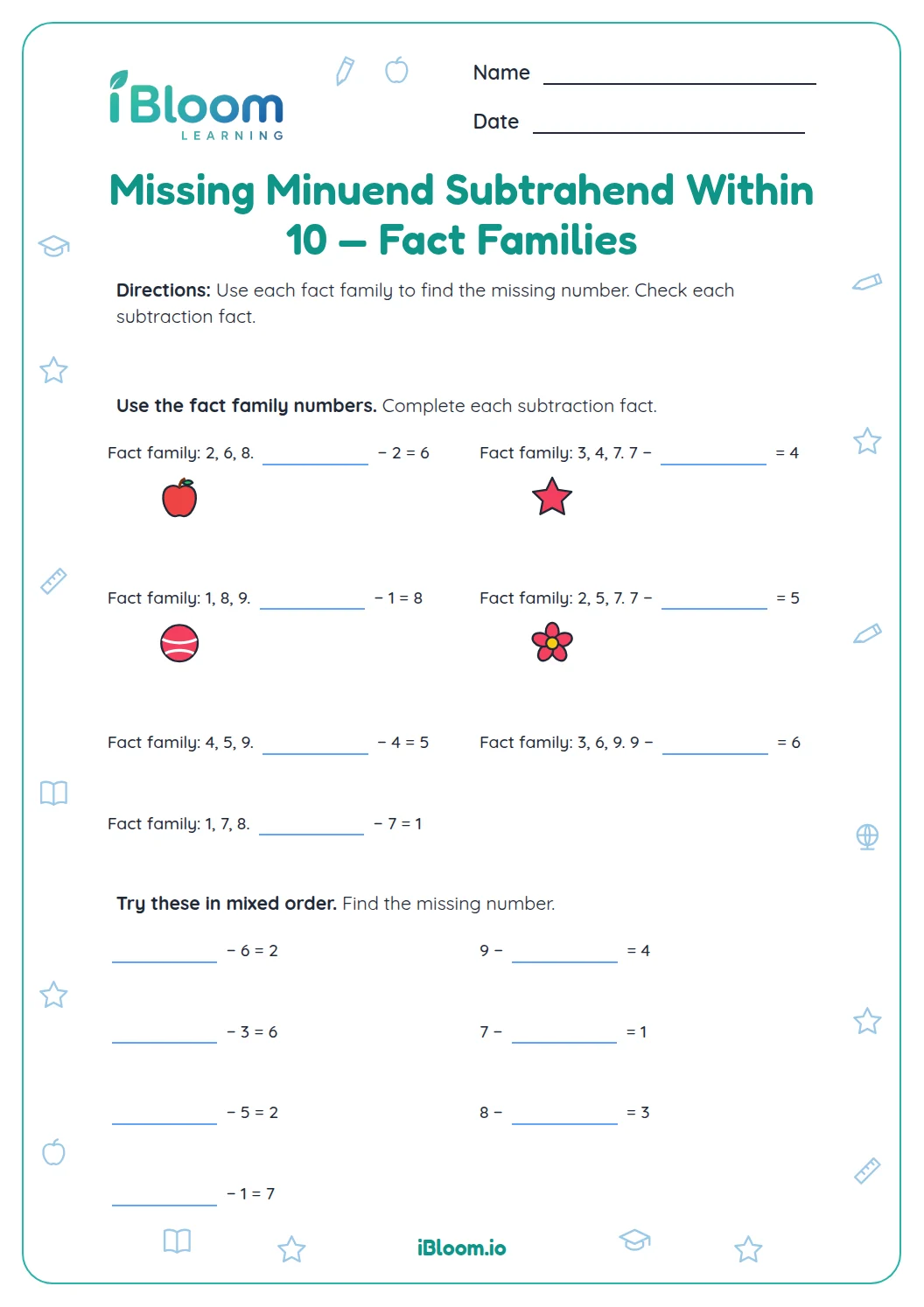
This free printable subtraction worksheet gives Grades 1–2 learners 20 mixed-order problems: ten subtraction facts within 20 and ten two-digit problems without regrouping. Students solve each sentence and use addition to check selected differences. The page practices Common Core 1.OA.C.6 and 2.NBT.B.5 and includes a separate answer key. The two-part mix keeps basic facts alongside the two-digit method from the earlier sheet.
Aligned to 1.OA.C.6 and 2.NBT.B.5
How can you solve each fact accurately?
Read the subtraction sign, name the starting number, and take away the second number. Use a known fact or count back carefully.
How can addition check subtraction?
Add the difference and the subtrahend. The sum should match the starting number, as in 14 − 6 = 8 and 8 + 6 = 14.
What helps build fluency?
Practice a varied set, notice facts you know quickly, and revisit any that need a strategy. Accuracy comes first; timing is optional.
How to use this worksheet
- 1Read the whole number sentence.
- 2Solve by a known fact or careful counting.
- 3Write one difference in the blank.
- 4Add the difference and subtrahend to check.
- 5Retry any missed facts after checking the key.
Mistakes to catch and correct
The mistake
Subtracting in the wrong direction
The fix
Start with the first number and take away the second.
The mistake
Losing count while counting back
The fix
Move one number at a time and say the count aloud.
The mistake
Writing the subtrahend as the answer
The fix
Use addition to check that the difference plus subtrahend returns the starting number.
Common Core alignment
This worksheet gives focused practice with the skill named in each standard.
Solve within-20 subtraction facts using strategies such as related addition.
On this sheet: The first part gives within-20 subtraction practice and prompts learners to check with addition.
Show the official wordingHide the official wording
Add and subtract within 20, demonstrating fluency for addition and subtraction within 10. Use strategies such as counting on; making ten (e.g., 8 + 6 = 8 + 2 + 4 = 10 + 4 = 14); decomposing a number leading to a ten (e.g., 13 - 4 = 13 - 3 - 1 = 10 - 1 = 9); using the relationship between addition and subtraction (e.g., knowing that 8 + 4 = 12, one knows 12 - 8 = 4); and creating equivalent but easier or known sums (e.g., adding 6 + 7 by creating the known equivalent 6 + 6 + 1 = 12 + 1 = 13).
Subtract two-digit numbers within 100 by using place value and related addition.
On this sheet: The second part practices two-digit subtraction within 100 without regrouping.
Show the official wordingHide the official wording
Fluently add and subtract within 100 using strategies based on place value, properties of operations, and/or the relationship between addition and subtraction.
What to practice next
Make more practice
Further reading
Questions parents and teachers ask
What does mixed-order subtraction practice mean?
The first ten questions use subtraction facts within 20. The next ten use two-digit numbers without regrouping, in a varied sequence rather than one number family at a time. Students solve independently and use addition to check selected differences.
What does no regrouping mean for these facts?
For two-digit problems, the ones digit in the first number is at least as large as the ones digit being subtracted, so the child can subtract without regrouping. The first part also includes within-20 facts that need no renaming of a ten.
How can a child check a difference?
Add the difference to the number being subtracted. If 14 − 6 = 8, then 8 + 6 should equal 14. This inverse-operation check helps students catch calculation slips while building connections between addition and subtraction. Use the key after the learner tries each item independently.
How many facts are on the page?
There are 20 subtraction problems in two parts. The first ten are mixed-order facts within 20; the next ten are two-digit problems without regrouping, with space to show addition checks. A separate key gives the answer to each item.
Is this timed practice?
No timing is required. A child can work at a comfortable pace, say a known fact aloud, and use a strategy such as counting back or thinking of a related addition fact. If a teacher uses a timer, it can be an optional fluency check.
Does the worksheet include an answer key?
Yes. The separate key lists all 20 differences. After checking, have the student retry missed facts and use addition to verify selected answers. The second part includes space for that check, while the first part keeps the within-20 fluency work quick.