


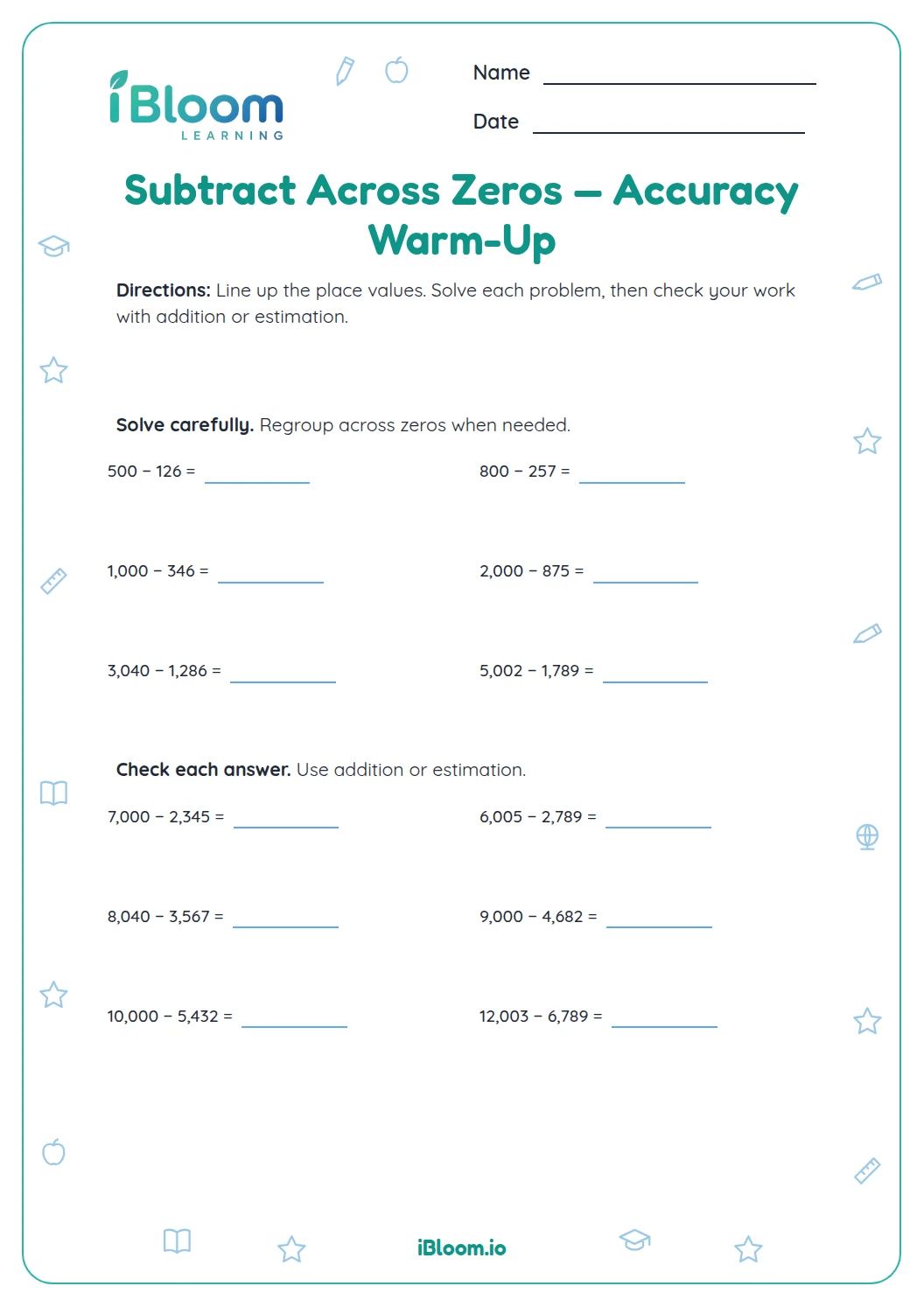
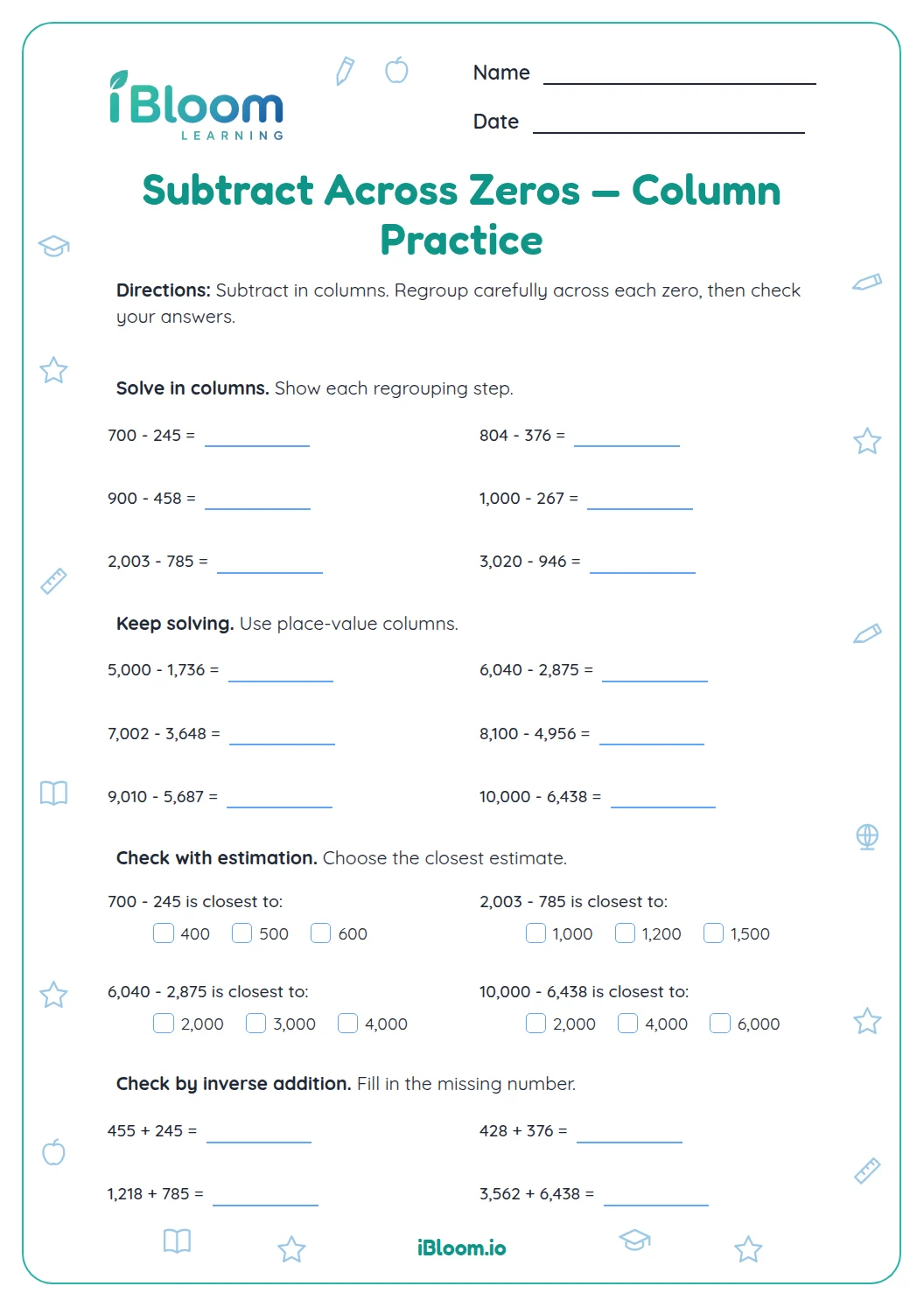
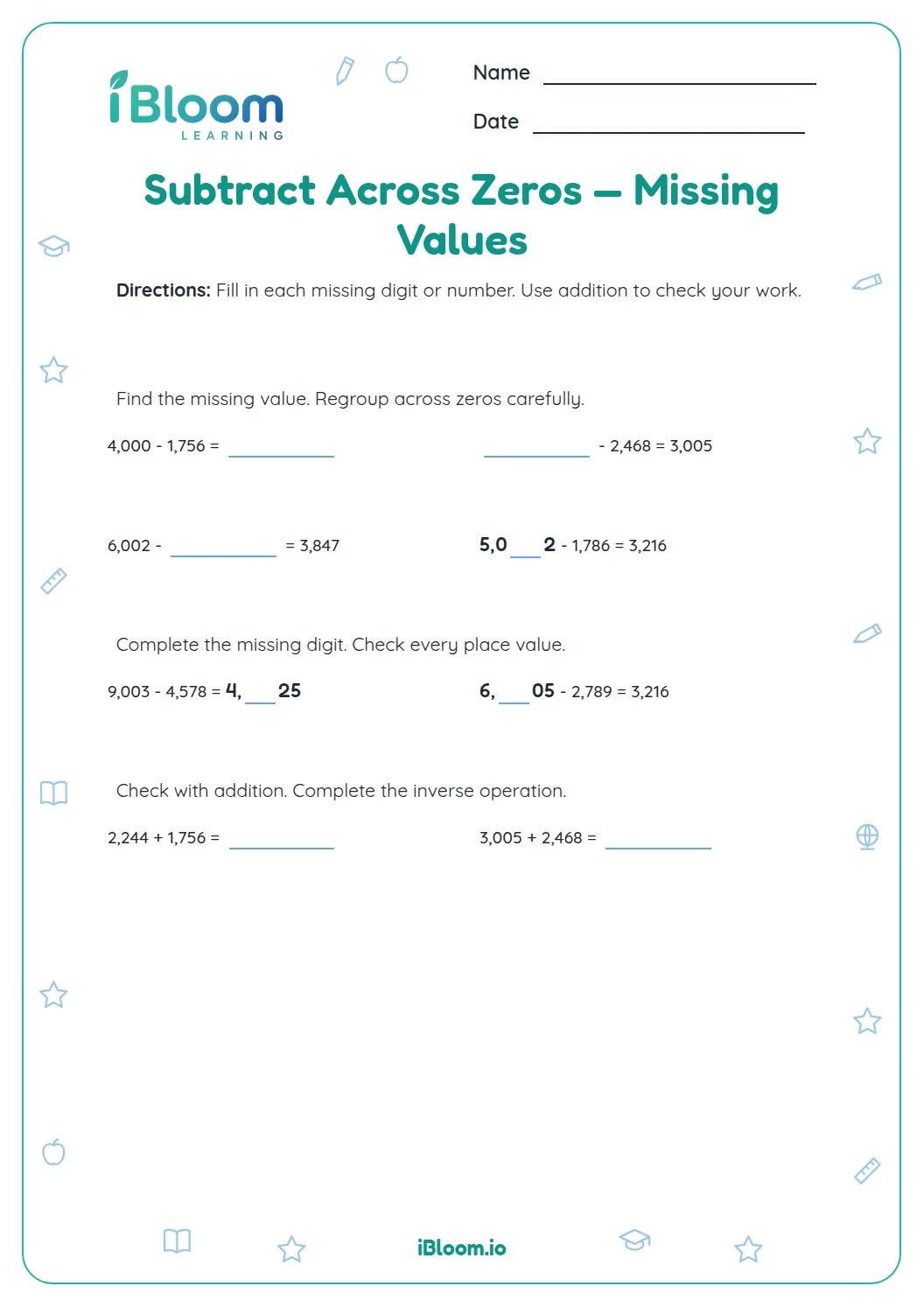
About this worksheet
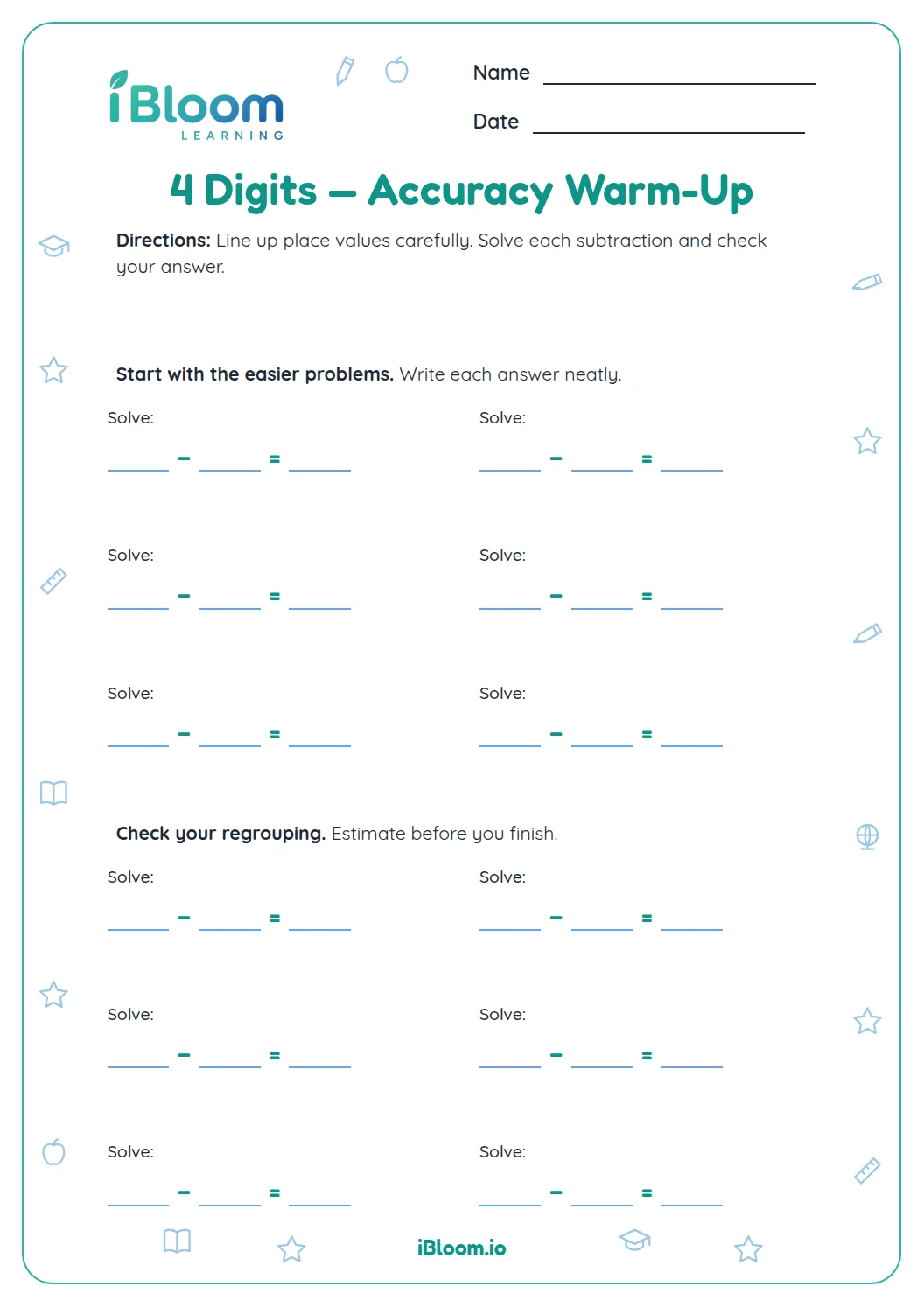
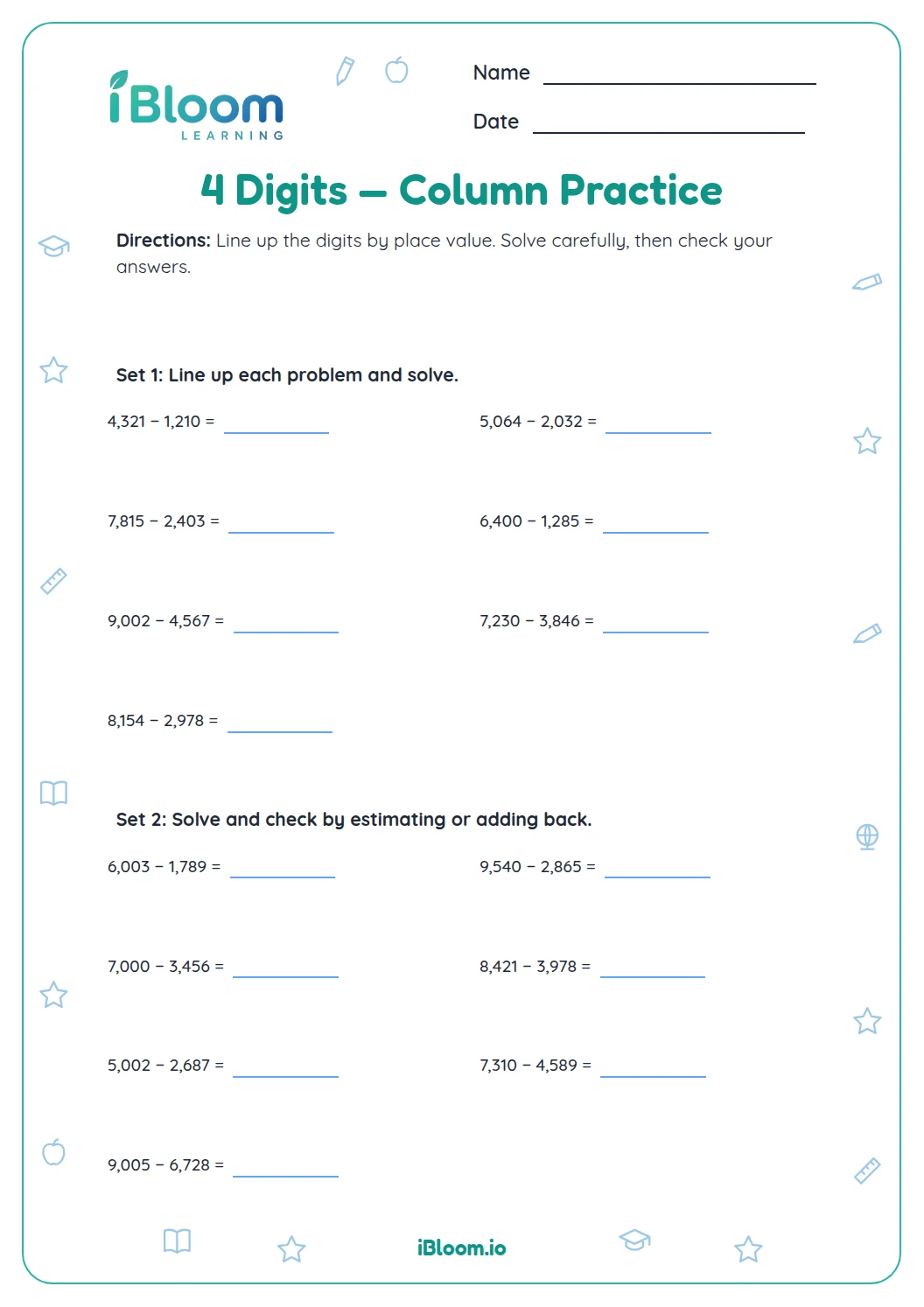
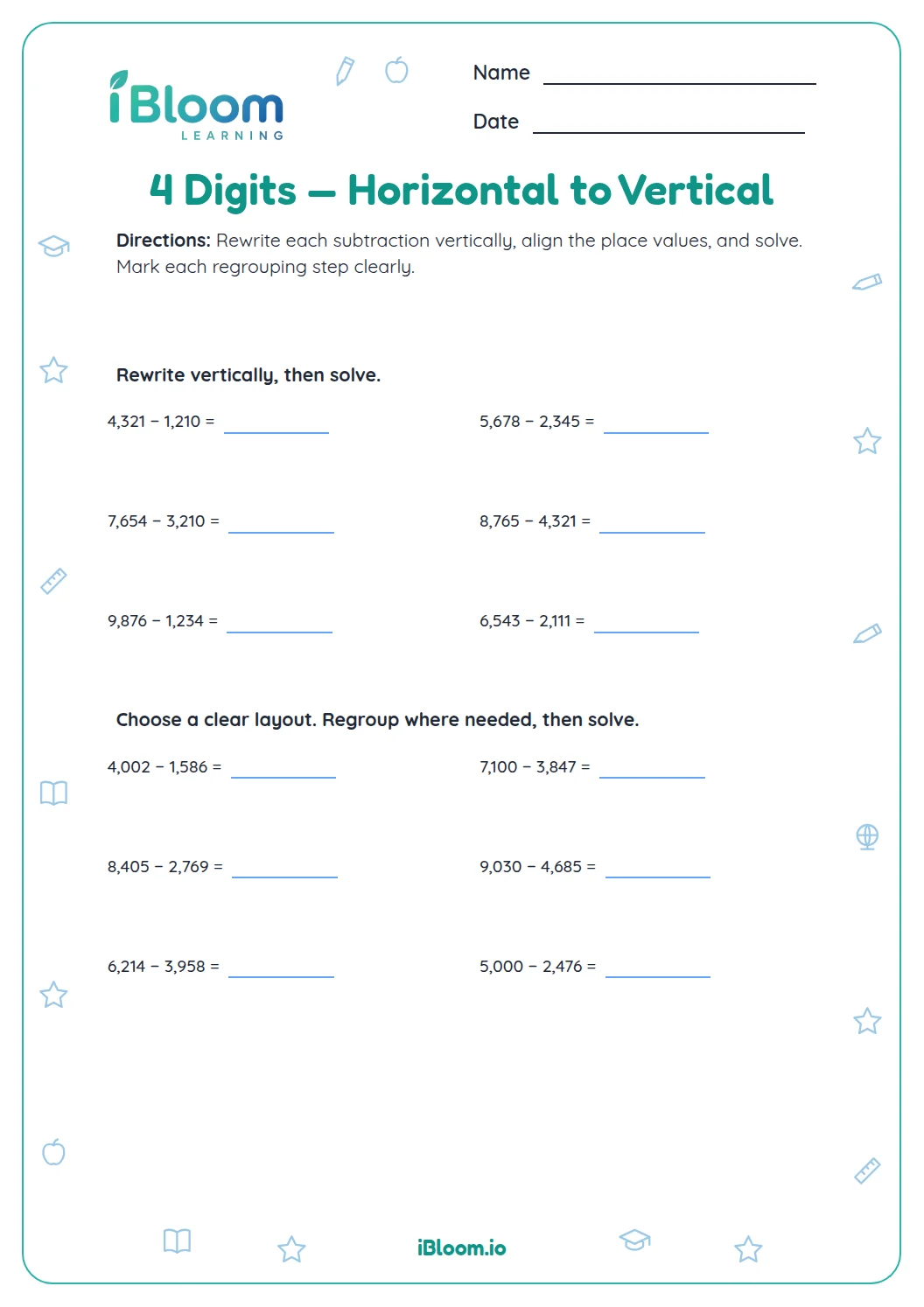
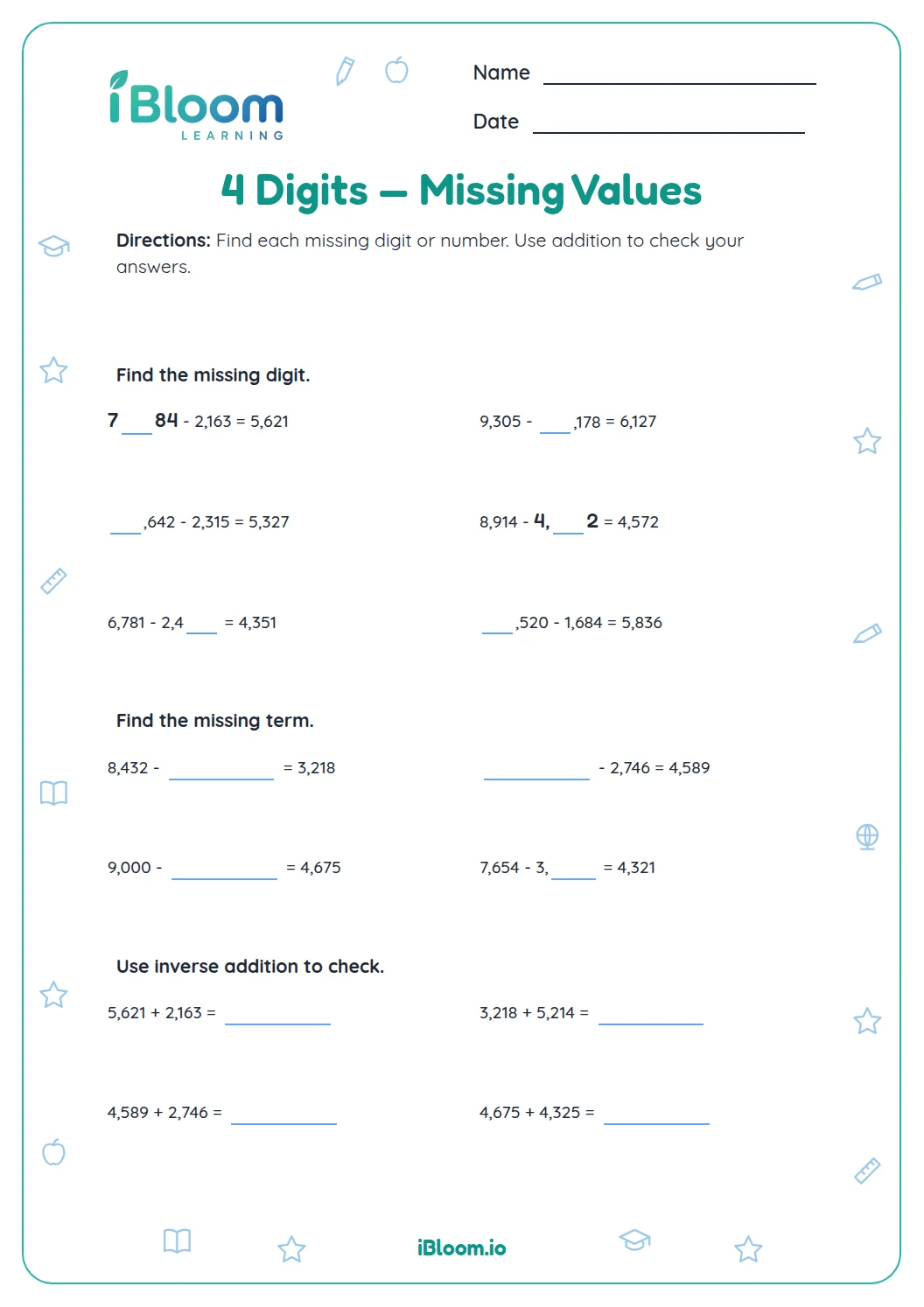
This four-digit subtraction worksheet asks students to do more than calculate: they choose correct differences, repair errors, and solve equations independently. Across 16 problems, children check regrouping across zeros and verify with addition. It aligns with CCSS 4.NBT.B.4 and includes a separate answer key.
Aligned to 4.NBT.B.4
How can place-value columns reveal a slip?
Line up ones, tens, hundreds, and thousands. When a place does not have enough to subtract, regroup from the next place and update both digits.
What makes an error example useful?
Question 1 offers a tempting answer that is 100 too large. Students compare choices against the subtraction and identify which difference fits.
How does regrouping work across zeros?
A regroup may travel across more than one place. In 7,004 − 2,857, exchange one thousand for ten hundreds, then regroup through the tens place to subtract the ones.
How can addition verify the answer?
Add the subtrahend to the difference. The sum should match the minuend, giving students a second way to test the computation.
How to use this worksheet
- 1Align all four digits before subtracting.
- 2Start in the ones place and regroup when needed.
- 3Update each place after exchanging a ten, hundred, or thousand.
- 4For each error, calculate the difference and compare it with the claim.
- 5Add the subtrahend to your result to verify.
Common mistakes and quick fixes
The mistake
Regrouping in one column but not changing the next column.
The fix
Record the reduced digit above the column you borrowed from.
The mistake
Treating a zero as if it can lend one directly.
The fix
Move left to the first nonzero place, then show each exchange.
The mistake
Trusting a plausible-looking difference without checking.
The fix
Add the subtrahend back and compare the sum with the minuend.
Common Core alignment
This worksheet gives focused practice with the reading and math skills described below.
Use place value and the standard algorithm to subtract multi-digit whole numbers.
On this sheet: Use place value and the standard algorithm to subtract multi-digit whole numbers.
Show the official wordingHide the official wording
Fluently add and subtract multi-digit whole numbers using the standard algorithm.
What to practice next
Make more practice
Further reading
Questions parents and teachers ask
What kinds of questions are on this sheet?
The 16 questions include five multiple-choice difference checks, five written error fixes, and six independent subtraction problems. Students work with four-digit numbers, including regrouping across zeros, and can verify each difference by adding the subtrahend back. The key separates each step.
What errors do the examples contain?
In questions 1–5, the stated result is 100 too large. In questions 6–10, the stated result is 100 too small. Students calculate each subtraction to identify the correct difference, then repair the written examples. Addition can confirm the computed difference.
How does regrouping across zeros work?
Start at the first place where the top digit is too small, then move left to find a nonzero place to exchange. For 7,004 − 2,857, regroup one thousand into hundreds and continue across the zeros so each column has enough to subtract.
How can addition check a subtraction answer?
Add the subtrahend to the difference. For example, 5,156 + 2,947 = 8,103, so 8,103 − 2,947 = 5,156 checks out. If the sum does not match the minuend, review the columns where regrouping occurred. This catches column-borrowing mistakes easily.
What should students write for an error fix?
Write the correct difference for the subtraction shown. The key also notes whether the given result was too large or too small, which helps students describe the direction of the mistake. A written explanation should name a place-value step that needs correction.