

About this worksheet
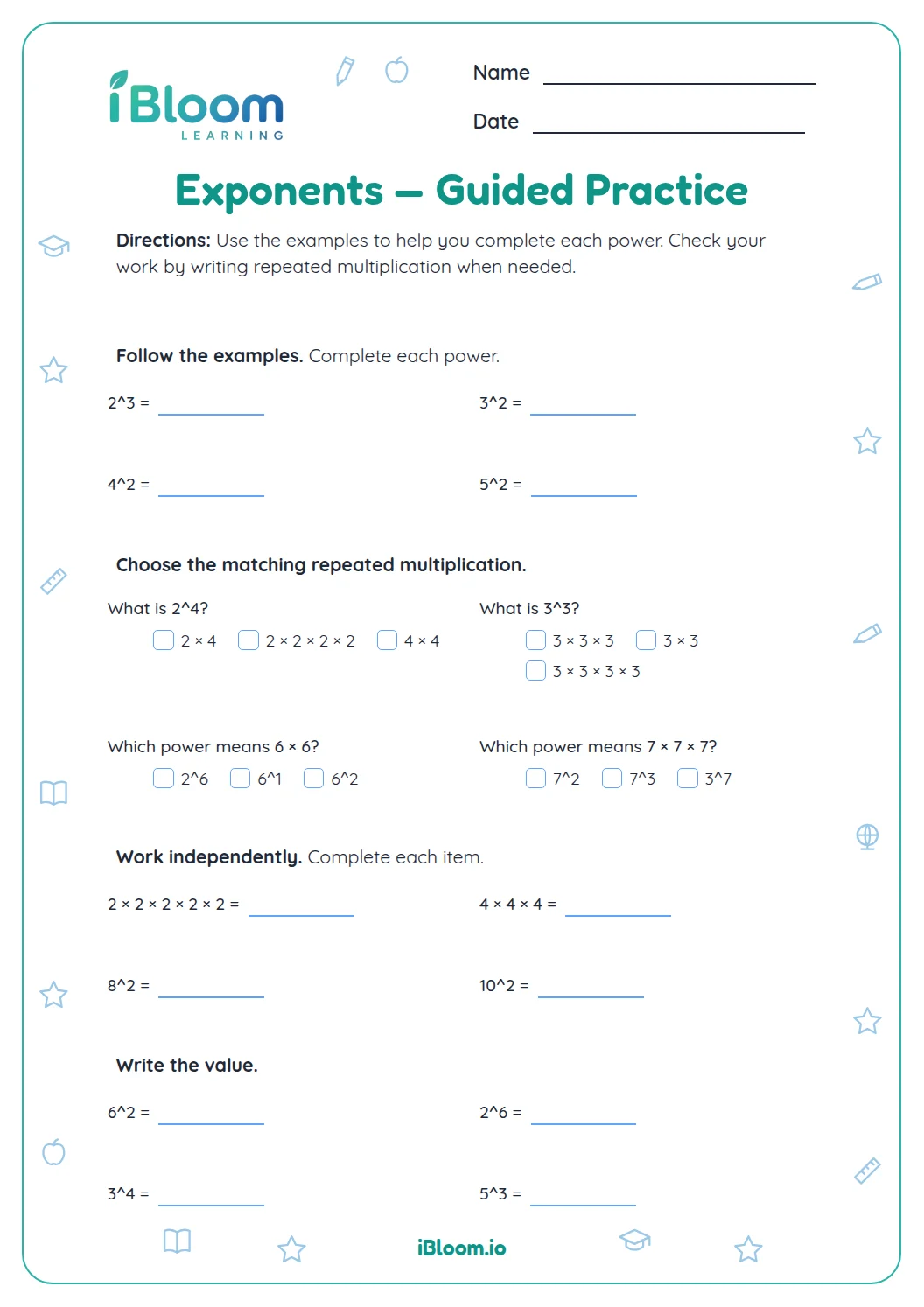
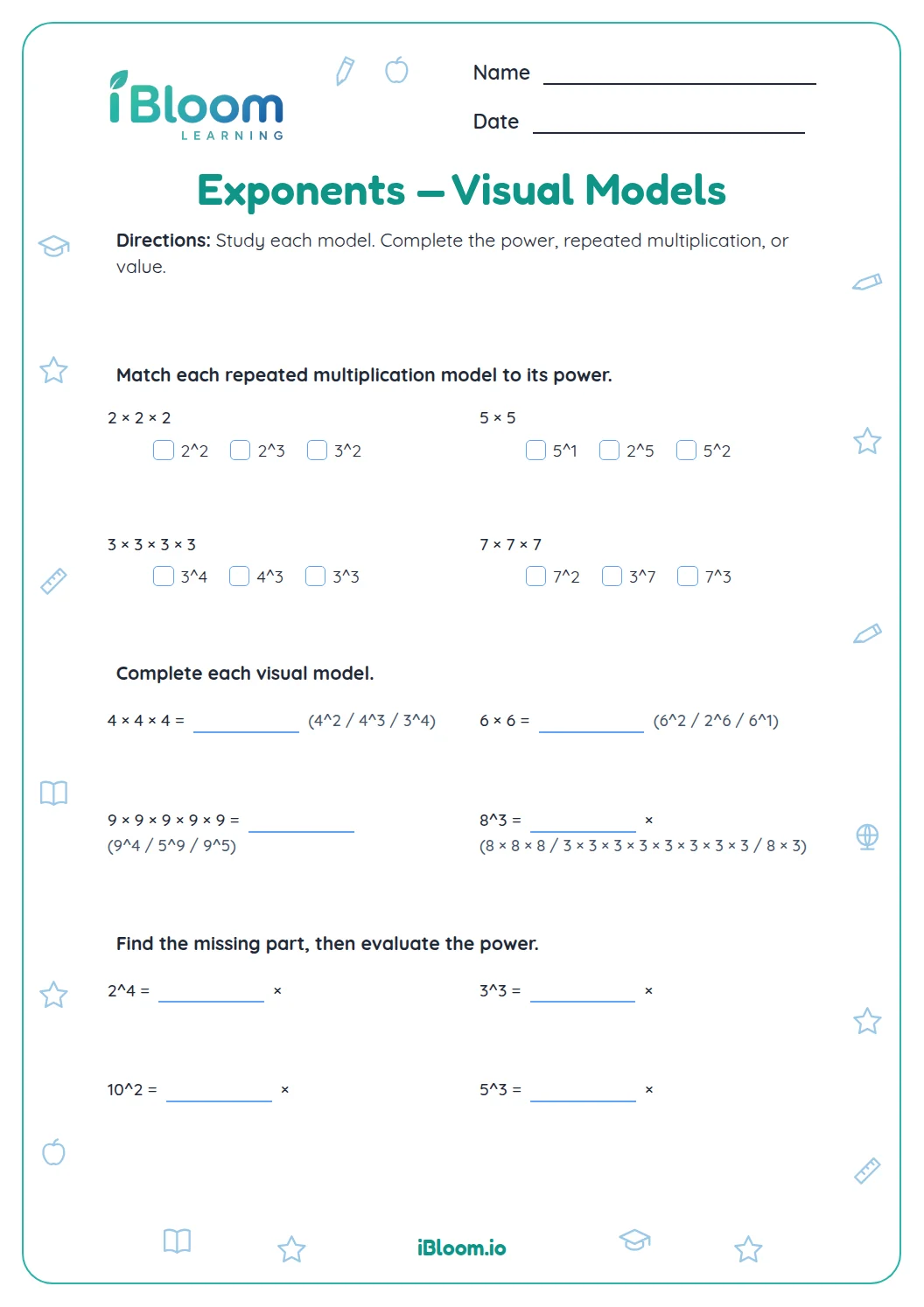
This printable connects whole-number exponents with familiar quantities. Students write powers for repeated equal factors, evaluate powers in equations and real situations, and choose a power or equation that models an area or cube context. The practice begins with notation and moves toward interpreting what a power represents. An answer key is included. The practice supports CCSS 6.EE.A.1 through writing and evaluating whole-number powers.
Aligned to 6.EE.A.1
What does an exponent tell you?
An exponent tells how many times the base is used as a factor. For example, 4² means 4 × 4, while 4³ means 4 × 4 × 4. The exponent counts factors; it does not multiply the base by the exponent.
How do powers model square and cube situations?
A square with side length 9 has area 9² square units. A cube with 6 unit cubes along each edge has 6³ unit cubes. The number of equal dimensions determines the exponent.
- 1Four rows of four plants mean 4 × 4.
- 2There are two equal factors of 4.
- 3Write the power 4².
Why do units matter in an application?
Units show what a computed value counts. A square’s area uses square units, while an arrangement of small cubes is counted in cubes. Keep the unit attached to the answer.
How to use this worksheet
- 1Count the repeated equal factors before writing the exponent.
- 2For a square, use the side length as the base and 2 as the exponent.
- 3For a cube, use the edge count as the base and 3 as the exponent.
- 4Evaluate by multiplying the base by itself the number of times shown.
- 5In an application, match the unit to what is counted: square units for area and cubes or cubic units for volume.
Common mistakes and quick fixes
The mistake
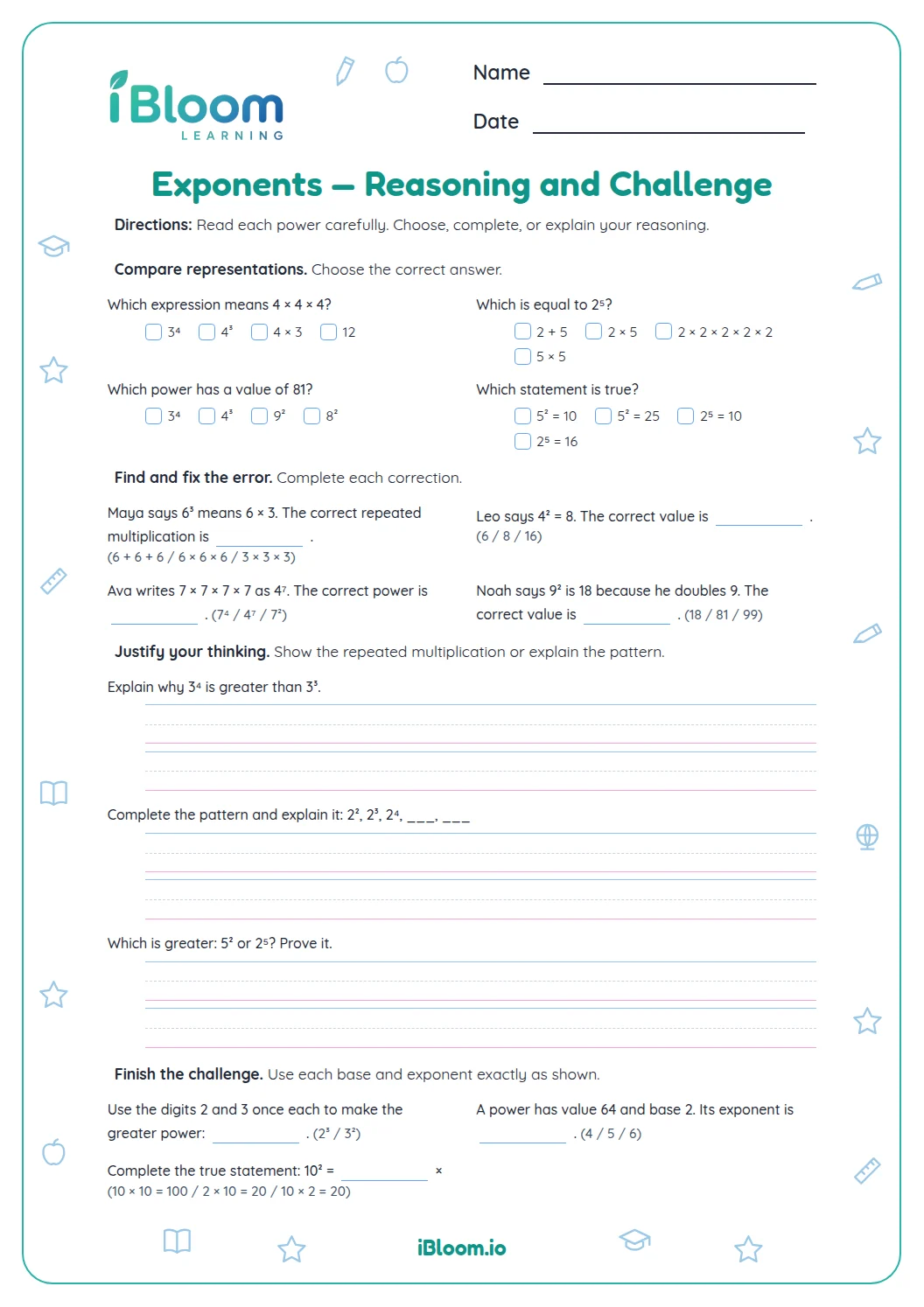
Treating 4³ as 4 × 3.
The fix
Write three factors of 4: 4 × 4 × 4.
The mistake
Using 2 as the exponent for a cube.
The fix
A cube has three equal edge dimensions, so the factor appears three times.
The mistake
Leaving out the quantity unit.
The fix
State whether the answer counts flowers, cubes, dollars, or square feet.
Curriculum alignment
This worksheet gives learners practice with the listed standard.
Write and evaluate powers that represent repeated equal factors in real situations.
On this sheet: Students represent repeated factors with powers and evaluate them in contexts involving area, volume, growth, and choices.
Show the official wordingHide the official wording
Write and evaluate numerical expressions involving whole-number exponents.
What to practice next
Make more practice
Further reading
Questions parents and teachers ask
What does an exponent mean?
An exponent shows how many times a base is used as a factor. For example, 3⁴ means 3 × 3 × 3 × 3. Students first write repeated factors as powers, then evaluate powers and use them to model familiar quantities.
How are exponents used for square area?
For a square with side length s, the area is s × s, or s². The sheet uses square situations to connect the repeated factor with the area and its square-unit measurement. For example, a square with side length 5 has area 5² square units.
How does a cube connect to a power?
A cube with n unit cubes along each edge contains n × n × n small cubes, written n³. Students write and select powers that represent equal layers and rows in cube arrangements. For edge length 4, that is 4 × 4 × 4 small cubes.
What kinds of problems are included?
There are six items for writing a power, six for evaluating powers in equations or situations, and four for choosing an exponent model. Contexts include plants, stacked cubes, stars, and square area. The sequence moves from notation to calculations and then models.
Is an answer key included?
Yes. The key gives the powers, evaluated values, and selected models. In context problems, check that the number and the unit both match what is counted, such as flowers, dollars, cubes, or square feet. The number alone may be correct but can leave its meaning unclear.