
About this worksheet
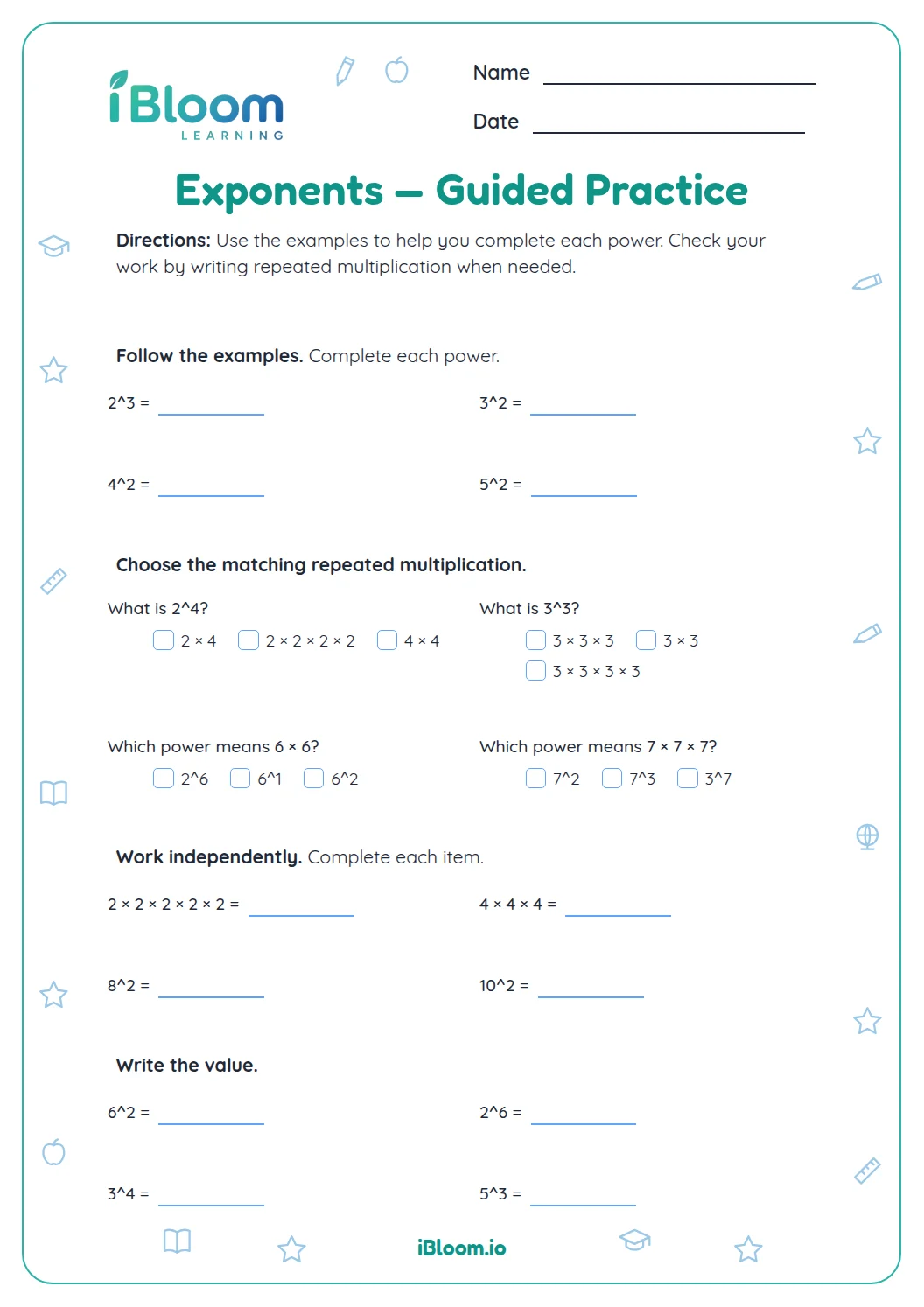
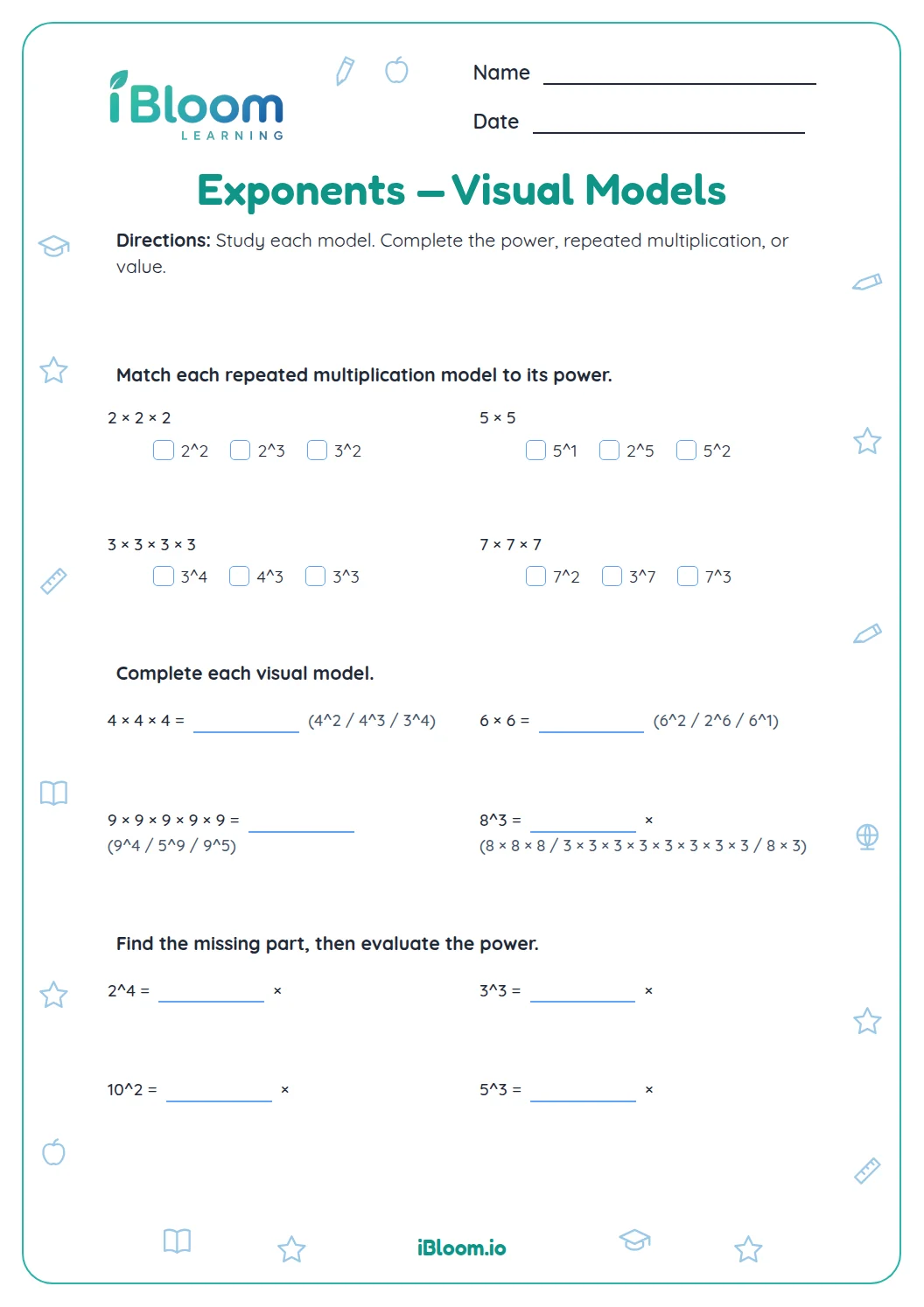
This free printable exponents worksheet helps students in Grades 5–6 connect three forms of a number: a power, repeated multiplication, and its value. The four parts provide four questions each: expand powers, write repeated factors as powers, evaluate, and choose correct statements. Students work with bases 2, 3, 4, 5, 6, 7, and 10 and positive whole-number exponents from 2 through 5. The practice supports Common Core 6.EE.A.1, writing and evaluating expressions with whole-number exponents. A separate answer key shows the expanded forms, powers, values, and correct choices.
Aligned to 6.EE.A.1
How do you read a base and an exponent?
The base is the number used as a factor; the exponent counts those factors. In 4⁴, the base and exponent happen to match, but they still have different jobs: use the factor 4 four times.
Part A asks only for repeated multiplication. Leaving the expression expanded makes it possible to check whether the student understands the notation before evaluating anything.
- 14⁴ = 4 × 4 × 4 × 4
- 2Base: 4
- 3Exponent: 4, so there are four factors.
How are powers, factors, and values connected?
Parts B and C reverse and extend the first task. Five factors of 2 become 2⁵, and multiplying those factors produces 32. Children can count the factors in question 8 and use that expansion to verify question 9.
The powers of 10 offer another check: four factors of 10 make 10,000. Students write 10⁴ in question 7 and evaluate it in question 12, so the symbolic and numerical forms reinforce each other.
How do the last questions uncover mistakes?
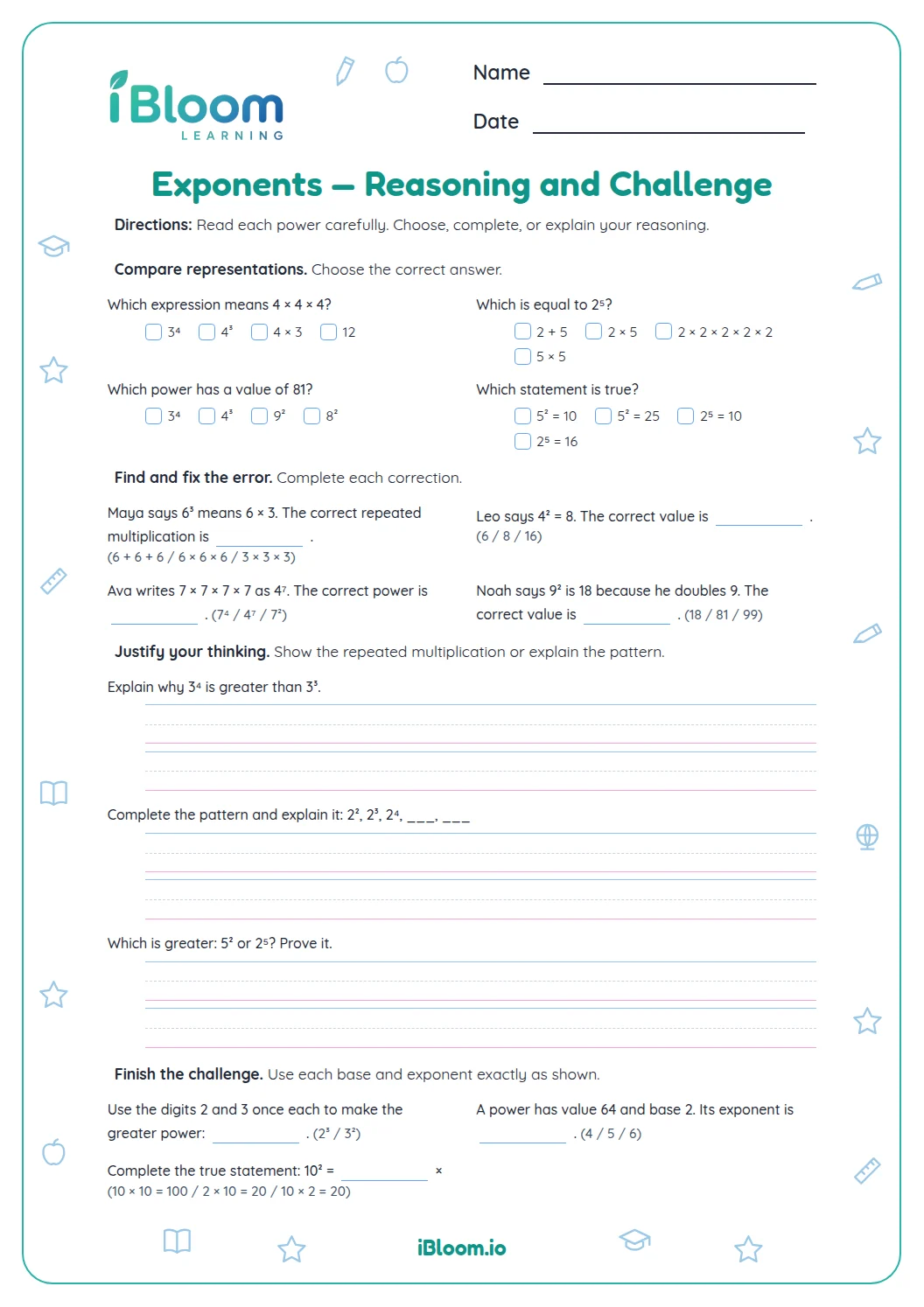
Part D includes choices that multiply the base by the exponent or add equal terms instead of multiplying them. For 4³, the expression 4 × 3 uses only two factors; 4 + 4 + 4 describes addition. The matching expression is 4 × 4 × 4.
Ask students to expand any power they are unsure about. Question 16 focuses directly on what the exponent counts, helping them explain the mistake in 2⁴ = 2 × 4.
How to use this worksheet
- 1Point to the base and exponent in question 1 and say their jobs aloud.
- 2Write all repeated factors in Part A, counting before moving on.
- 3In Part B, count equal factors and use that count as the exponent.
- 4Multiply step by step in Part C, recording intermediate values on scratch paper if needed.
- 5Check each Part D choice by expanding its power or expression.
Mistakes to discuss and fix
The mistake
Calculating 2⁵ as 2 × 5 = 10.
The fix
Write 2 × 2 × 2 × 2 × 2. Multiply from left to right: the running products are 2, 4, 8, 16, 32.
The mistake
Counting multiplication signs to choose the exponent.
The fix
Count the factors themselves; 3 × 3 × 3 has three factors and two signs.
The mistake
Switching the base and exponent when writing a power.
The fix
Name the repeated number first: five factors of 2 give 2⁵, not 5².
Common Core alignment
Write powers from equal factors and evaluate expressions with whole-number exponents.
On this sheet: Parts A and B connect power notation to factors; Parts C and D evaluate and interpret those expressions.
Show the official wordingHide the official wording
Write and evaluate numerical expressions involving whole-number exponents.
What to practice next
Make more practice
Further reading
Questions parents and teachers ask
What do students write in the first two parts?
Part A asks for repeated multiplication, such as 5 × 5 for 5². Part B asks for a single power, such as 3³ for 3 × 3 × 3. The different directions help students connect the notation in both directions before calculating numerical values.
Which bases and exponents appear?
The sheet uses bases 2, 3, 4, 5, 6, 7, and 10, with positive whole-number exponents from 2 through 5. Students expand or write powers in the first eight questions, then evaluate four powers and answer four questions about equivalent expressions and exponent meanings.
Why is 2 to the fifth power equal to 32?
It means multiplying five factors of 2: 2 × 2 × 2 × 2 × 2. The running products are 2, 4, 8, 16, and 32. Questions 8 and 9 connect that repeated multiplication to power notation and its value, so students can check the relationship.
Can students use a calculator?
Have students expand the powers and multiply on paper first, then use a calculator to check if you wish. The goal is to understand what the notation represents. A correct calculator result is more useful when the student can also explain the base and count the factors.
What does the answer key show?
The answer key gives repeated factors for Part A, powers for Part B, numerical values for Part C, and the selected choices for Part D. When checking, distinguish an expanded expression from a final value: the response should match the form requested by that part.