


About this worksheet
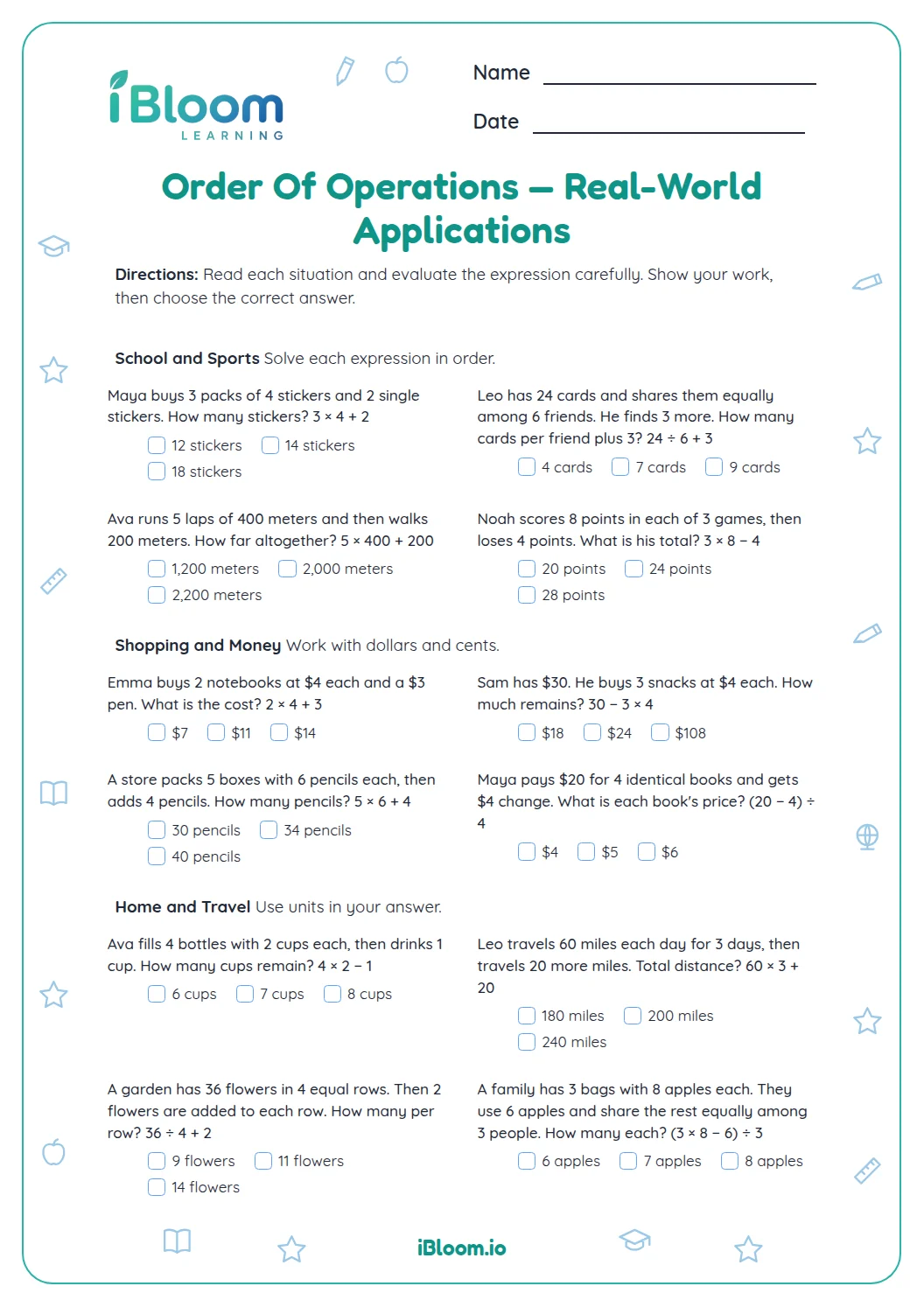
This free printable worksheet helps students follow the order of operations by making each step visible. Across 15 questions, learners choose the first operation, complete the next line of a model, identify a correctly worked expression, and solve expressions independently. It follows the method of the earlier sheet while adding parentheses and an exponent example. A separate key shows the correct choices and values.
Aligned to 5.OA.A.1 and 6.EE.A.1
How do you choose the first operation?
Do what is inside parentheses first. Without parentheses, multiplication and division come before addition and subtraction. In question 1, 3 × 4 comes before 6 + 3, so the first operation is 3 × 4.
- 16 + 3 × 4
- 2Multiply before adding.
- 3First operation: 3 × 4
How does one step change the expression?
Replace only the part you evaluated and keep the rest in place. In question 5, 3 × 4 becomes 12, so 6 + 3 × 4 becomes 6 + 12.
How can you check a completed model?
Follow each line in order and see whether it honors the parentheses and operation priority. Question 9 is correct because it changes 6 + 3 × 4 to 6 + 12 and then gives 18.
What changes when you solve on your own?
The last part removes the choices, so students show the same reasoning themselves. Question 15 includes an exponent: evaluate 2³ first, then multiply 5 × 2, and finally add the results.
How to use the models
- 1Read the whole expression before choosing a step.
- 2Do parentheses first when they appear.
- 3Otherwise find multiplication or division before addition or subtraction.
- 4Replace the completed operation with its value and copy the rest of the expression accurately.
- 5Check each model line before choosing an answer.
- 6Use the answer key to review any step where the expression changed incorrectly.
Common order-of-operations slips
The mistake
Adding 6 + 3 before multiplying in 6 + 3 × 4.
The fix
Find multiplication first; 3 × 4 is 12, then add 6.
The mistake
Multiplying before finishing (8 + 2) in (8 + 2) × 5.
The fix
Evaluate inside parentheses first, giving 10 × 5.
The mistake
Doing addition before multiplication after the parentheses are gone.
The fix
After grouping, complete × and ÷ before + and −.
Common Core alignment
The worksheet builds order-of-operations reasoning from a first step to a complete value.
Use grouping symbols in numerical expressions and evaluate them in the correct order.
On this sheet: Questions model the first operation, show intermediate steps, and ask students to evaluate expressions.
Show the official wordingHide the official wording
Use parentheses, brackets, or braces in numerical expressions, and evaluate expressions with these symbols.
Evaluate expressions with whole-number exponents before completing the remaining operations.
On this sheet: The final part includes evaluating an expression with the whole-number exponent 3.
Show the official wordingHide the official wording
Write and evaluate numerical expressions involving whole-number exponents.
What to practice next
Make more practice
Further reading
Questions parents and teachers ask
What should students do first in an expression?
Evaluate anything inside parentheses first. If there are no grouping symbols, multiplication and division come before addition and subtraction. The worksheet asks students to choose that first operation, complete a next step, and then check a fully worked model. The separate answer key gives a place to check this example.
Does multiplication always come before division?
Multiplication and division have equal priority, so work from left to right when both appear. This sheet includes a first-step question with division and addition, then asks learners to follow through on the division before adding. The separate answer key gives a place to check this example.
How do the visual models work?
Each model makes one stage visible: choose the first operation, replace it with its value, or select the line that correctly follows. For example, 6 + 3 × 4 becomes 6 + 12, then 18. The last part asks students to solve without choices.
Are parentheses included?
Yes. One example asks students to evaluate (8 + 2) × 5. The parentheses tell them to add 8 and 2 first, then multiply 10 by 5. Other questions compare grouping with expressions that have no parentheses. The separate answer key gives a place to check this example.
Does the worksheet include exponents?
The final part includes 2³ + 5 × 2. Evaluate the exponent to get 8, multiply 5 × 2 to get 10, and then add for 18. Earlier parts focus on grouping, multiplication, division, addition, and subtraction. The separate answer key gives a place to check this example.
How long will the worksheet take?
Plan for about 20 minutes. The first three parts provide choices and worked-model reasoning; the last part asks learners to solve expressions independently. The separate answer key can be used after each part or at the end. The separate answer key gives a place to check this example.