

About this worksheet
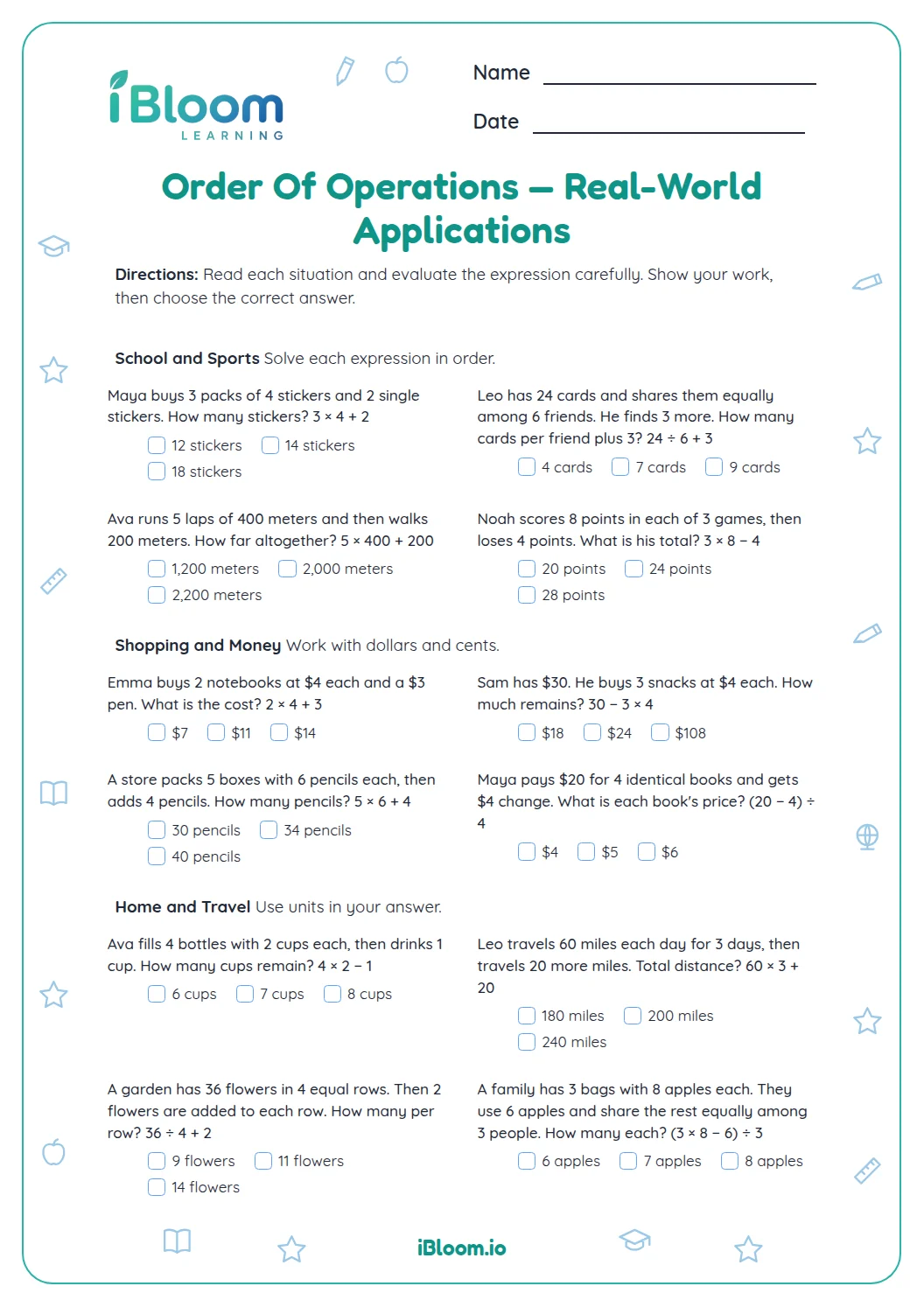
This Grade 5 guided-practice sheet has three parts. Students first evaluate expressions without grouping symbols, then evaluate expressions with parentheses, brackets, or braces, and finally write and solve expressions for four short situations. Worked examples and an answer key support checking the order of steps as well as the final value. The grouped-expression work aligns with CCSS 5.OA.A.1.
Aligned to 5.OA.A.1
Which operations come first without grouping symbols?
Multiply and divide before addition and subtraction. When multiplication and division appear together, work from left to right. The same left-to-right rule applies to addition and subtraction.
- 18 + 3 × 4
- 2Multiply first: 3 × 4 = 12
- 3Then add: 8 + 12 = 20
How do grouping symbols change the steps?
Evaluate the operations inside parentheses, brackets, or braces first. Then use the usual priority rules on what remains. In (8 + 3) × 4, add inside the parentheses before multiplying: 11 × 4 = 44.
How can a story become an expression?
Choose operations to match the actions and keep groups together when needed. For 4 bags with 6 beads each and 5 loose beads, write 4 × 6 + 5. Calculate the grouped sets first, then add the loose beads.
How to use this worksheet
- 1For Part A, mark multiplication or division before addition or subtraction.
- 2For Part B, calculate inside the innermost grouping marks first.
- 3When operations share priority, work from left to right.
- 4For each story, write an expression before calculating.
- 5Check your steps and compare the final results with the key.
Common mistakes and quick fixes
The mistake
Adding before multiplying in 8 + 3 × 4.
The fix
Calculate 3 × 4 first, then add 8.
The mistake
Ignoring parentheses because multiplication is usually first.
The fix
Always finish the grouped operation before applying outside operations.
The mistake
Working right to left when multiplication and division are together.
The fix
Move from left to right when the operations have the same priority.
Common Core alignment
This page gives students focused practice with the skills named in these Common Core standards.
Evaluate numerical expressions with parentheses, brackets, or braces.
On this sheet: Parts A and B evaluate expressions with and without grouping symbols; Part C translates short situations to expressions.
Show the official wordingHide the official wording
Use parentheses, brackets, or braces in numerical expressions, and evaluate expressions with these symbols.
What to practice next
Make more practice
Further reading
Questions parents and teachers ask
What is the order of operations?
Evaluate grouping symbols first, then multiplication and division from left to right, then addition and subtraction from left to right. The worksheet begins with expressions without grouping symbols, adds grouped expressions, and finishes with four short situations. The key shows the steps and final results.
What is the answer to 8 + 3 × 4?
Multiply 3 by 4 before adding 8. The product is 12, and 8 + 12 = 20. This is the worked example for Part A and shows why operation priority matters. The worksheet key confirms the result. Write the product before adding the first number.
Do parentheses always come first?
Yes. Evaluate what is inside parentheses before the operations outside them. Brackets and braces also group work; if one grouping mark contains another, evaluate the innermost group first. Then follow multiplication, division, addition, and subtraction rules. Finish each group before handling operations outside it.
How many problems are included?
There are sixteen problems: six expressions without grouping symbols, six with grouping symbols, and four word situations. Students write answers or an expression with its result. A separate key gives completed values and sample expressions for checking the work. Check that the answer matches the story.
How can a student check a word problem expression?
Read each phrase and match it to an operation: equal groups suggest multiplication, sharing suggests division, and “plus” or “remain” may indicate addition or subtraction. Then calculate using the order of operations and check that the answer fits the story.