

About this worksheet
This free printable order-of-operations worksheet gives Grade 5 and Grade 6 students 16 expressions to evaluate. Part A combines addition, subtraction, multiplication, and division, including equal-priority operations that must be handled from left to right. Part B adds parentheses, including expressions to compare with Part A. Part C includes whole-number powers. Part A uses answer blanks; Parts B and C provide working lines for intermediate steps. The sheet supports Common Core 5.OA.A.1 and 6.EE.A.1, and its separate answer key gives all 16 values.
Aligned to 5.OA.A.1 and 6.EE.A.1
Which operation comes first?
Check for parentheses before choosing an operation. Inside each group, use the same order: powers, multiplication or division from left to right, then addition or subtraction from left to right. Copy any parts you have not used into the next line.
Multiplication and division share a level of priority. So do addition and subtraction. An acronym is useful only if students remember those two ties; it does not mean that every multiplication must happen before any division.
- 124 ÷ 6 × 2
- 2Division and multiplication share a priority level.
- 3Work left to right: 24 ÷ 6 = 4.
- 4Then 4 × 2 = 8.
How do parentheses change the answer?
Compare question 3 with question 9. Without grouping, 24 ÷ 6 × 2 equals 8. With parentheses, 24 ÷ (6 × 2) means divide 24 by the entire product, 12, giving 2.
Questions 1 and 7 make another useful pair: 3 + 4 × 2 is 11, while (3 + 4) × 2 is 14. Ask students to mark the first calculation in each expression before evaluating either one.
How should students handle squares and cubes?
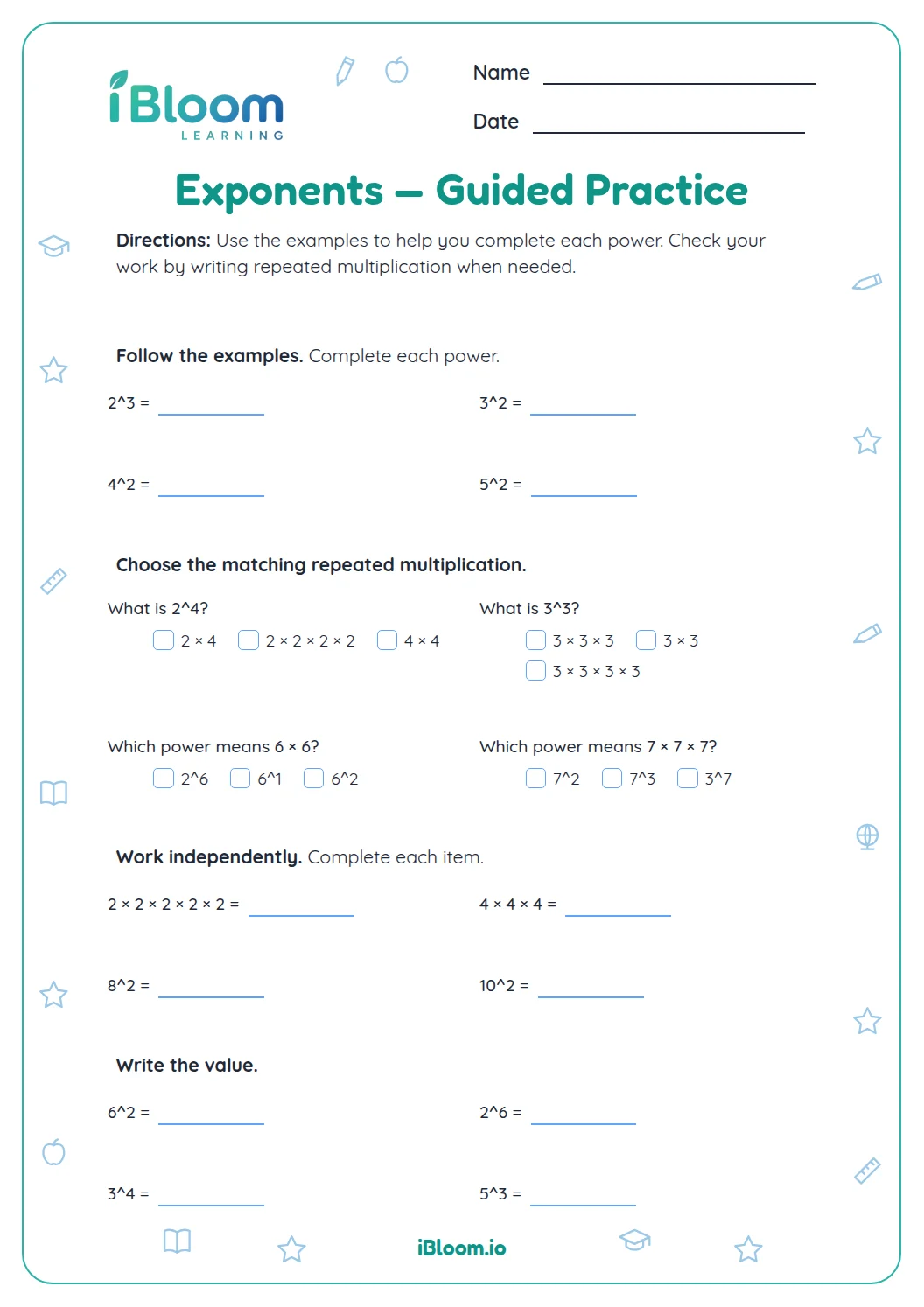
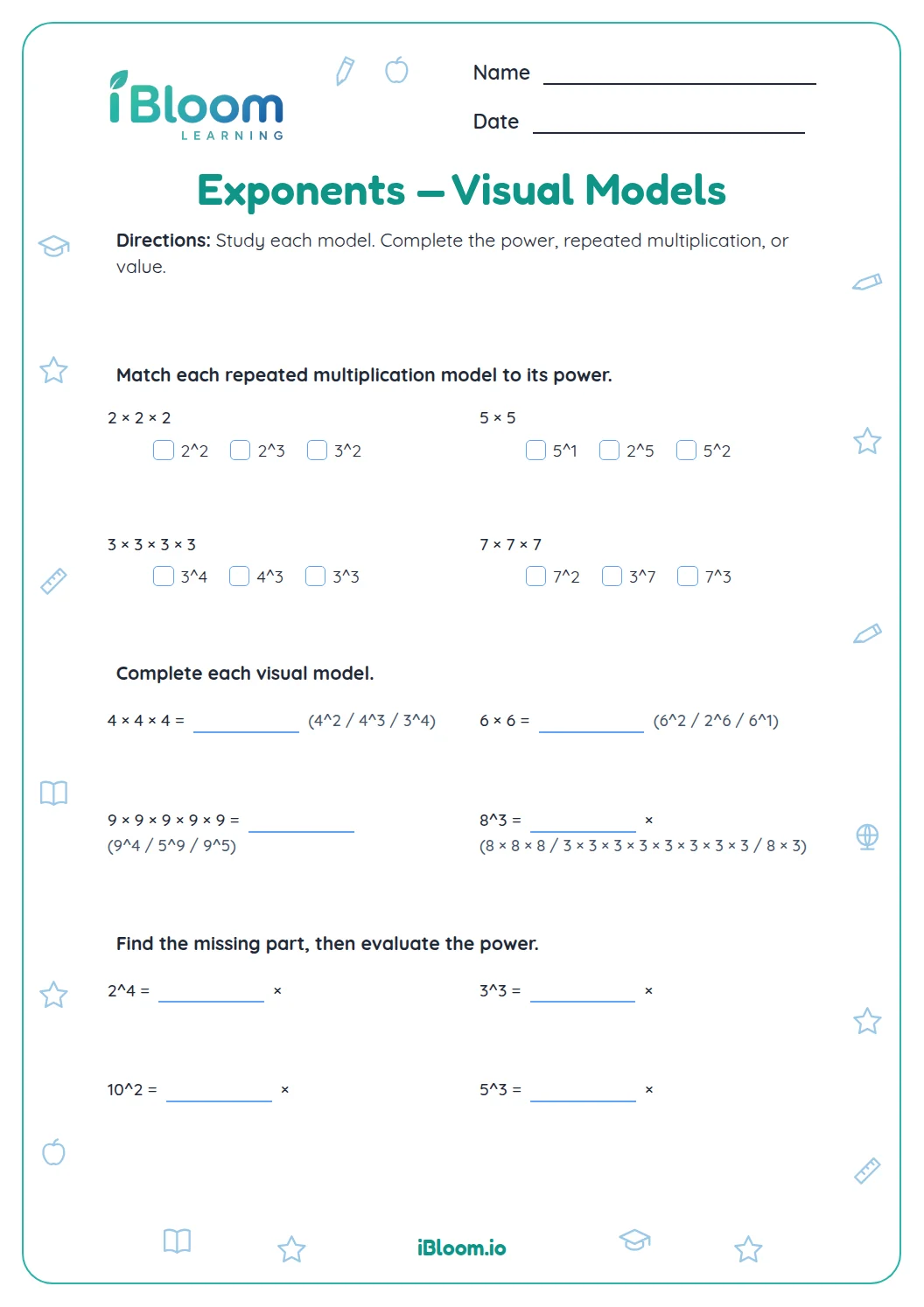
An exponent tells how many times to use the base as a factor. In question 13, 2³ means 2 × 2 × 2, which equals 8. After replacing the power, the expression is 8 + 5 × 2, and the answer is 18.
Question 16 begins with a grouped base: (5 − 2)². Subtract inside the parentheses first, then square 3 to get 9. Complete 12 ÷ 4 before adding, so the final value is 12.
How to use this worksheet
- 1Read the Part A reminder about equal-priority operations.
- 2For each expression, identify the next calculation before writing anything.
- 3In Parts B and C, write a shorter expression on each working line, preserving unused numbers and signs.
- 4Compare questions 1 and 7, then questions 3 and 9, across Parts A and B.
- 5In Part C, expand a power into repeated multiplication if needed.
- 6Check the final values with the key and revisit the first step of any missed item.
Mistakes to notice and fix
The mistake
Multiplying 6 × 2 first in 24 ÷ 6 × 2 and getting 2.
The fix
Division and multiplication have equal priority, so start with the leftmost operation: 24 ÷ 6.
The mistake
Adding 7 + 4 first in 15 − 7 + 4 and getting 4.
The fix
Without parentheses, subtract and add from left to right; 8 + 4 = 12.
The mistake
Treating 2³ as 2 × 3 and getting 6.
The fix
Write three factors of 2: 2 × 2 × 2 = 8, then return that value to the expression.
Common Core alignment
Evaluate expressions with parentheses before completing the remaining operations.
On this sheet: Part B uses parentheses to change or clarify the order of calculations.
Show the official wordingHide the official wording
Use parentheses, brackets, or braces in numerical expressions, and evaluate expressions with these symbols.
Evaluate powers and combine them with grouping and the four operations.
On this sheet: Part C includes squares and cubes in numerical expressions.
Show the official wordingHide the official wording
Write and evaluate numerical expressions involving whole-number exponents.
What to practice next
Make more practice
Further reading
Questions parents and teachers ask
Do students always multiply before dividing?
No, multiplication and division have equal priority and are completed from left to right. Question 3 is 24 ÷ 6 × 2, so division comes first and the answer is 8. Question 9 adds parentheses around 6 × 2, changing that expression’s answer to 2.
What is the difference between questions 1 and 7?
Question 1 gives 11, while question 7 gives 14 because parentheses change the first calculation. In 3 + 4 × 2, multiply 4 by 2 before adding 3. In (3 + 4) × 2, add inside the parentheses before multiplying the result by 2.
How much working should a student show?
In Parts B and C, show one simpler expression after each step, carrying down the numbers and operations that remain. The working lines are there to make the order visible. A final correct value is useful, but the intermediate steps help an adult identify whether a mistake involved arithmetic, grouping, or operation priority.
What should my child know about exponents first?
Your child should understand a whole-number exponent as repeated multiplication of the base. For example, 2³ uses three factors of 2 and equals 8. Part C combines that idea with parentheses and other operations, so have the child evaluate each power before continuing the ungrouped multiplication or division.
Can this worksheet be completed across two sessions?
Yes, use Parts A and B in one session and return to Part C for powers. Before the second session, revisit one pair whose parentheses change the answer. Keep the answer key aside until the work is finished, then compare the final values and discuss any different first steps.