







About this worksheet
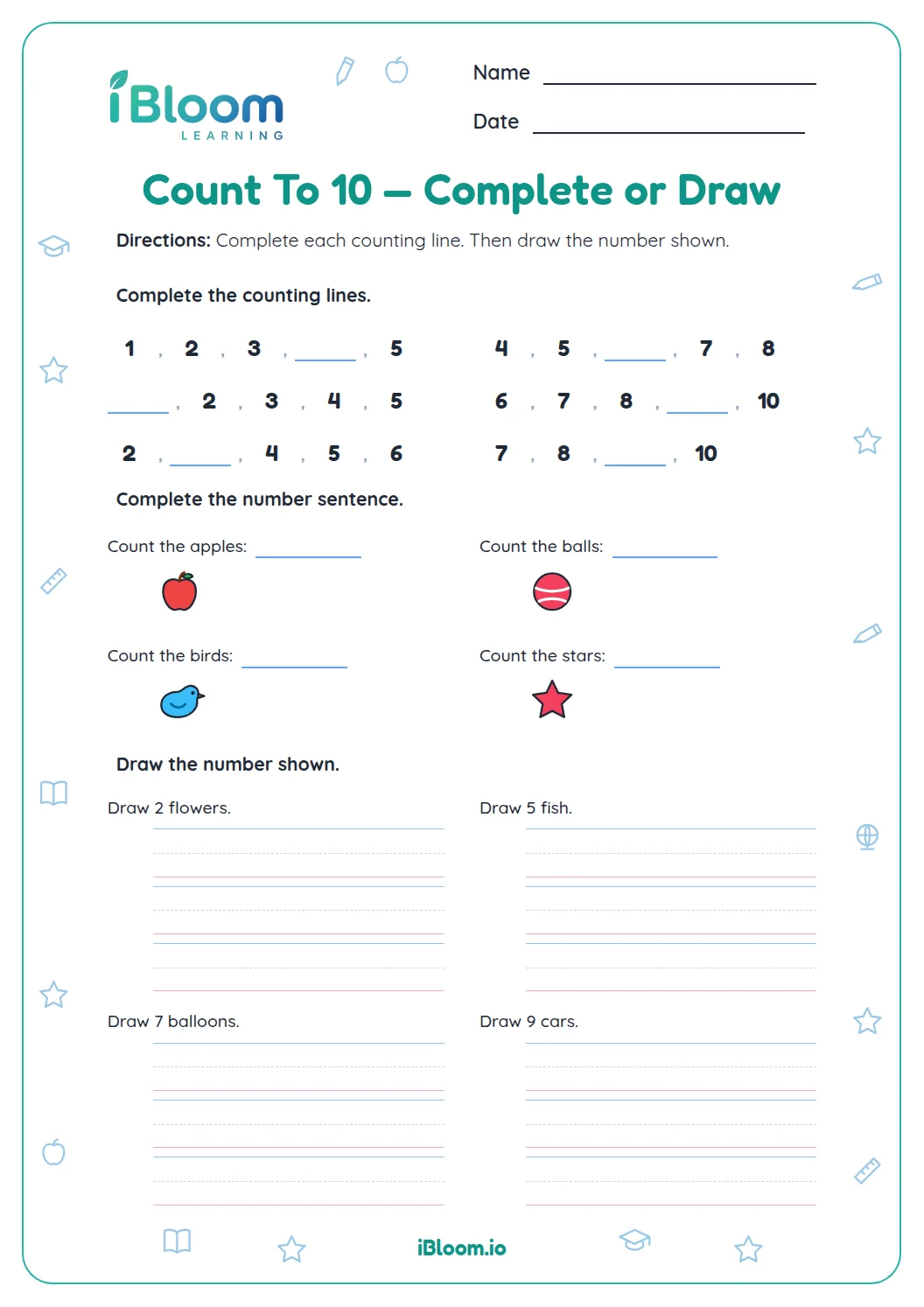
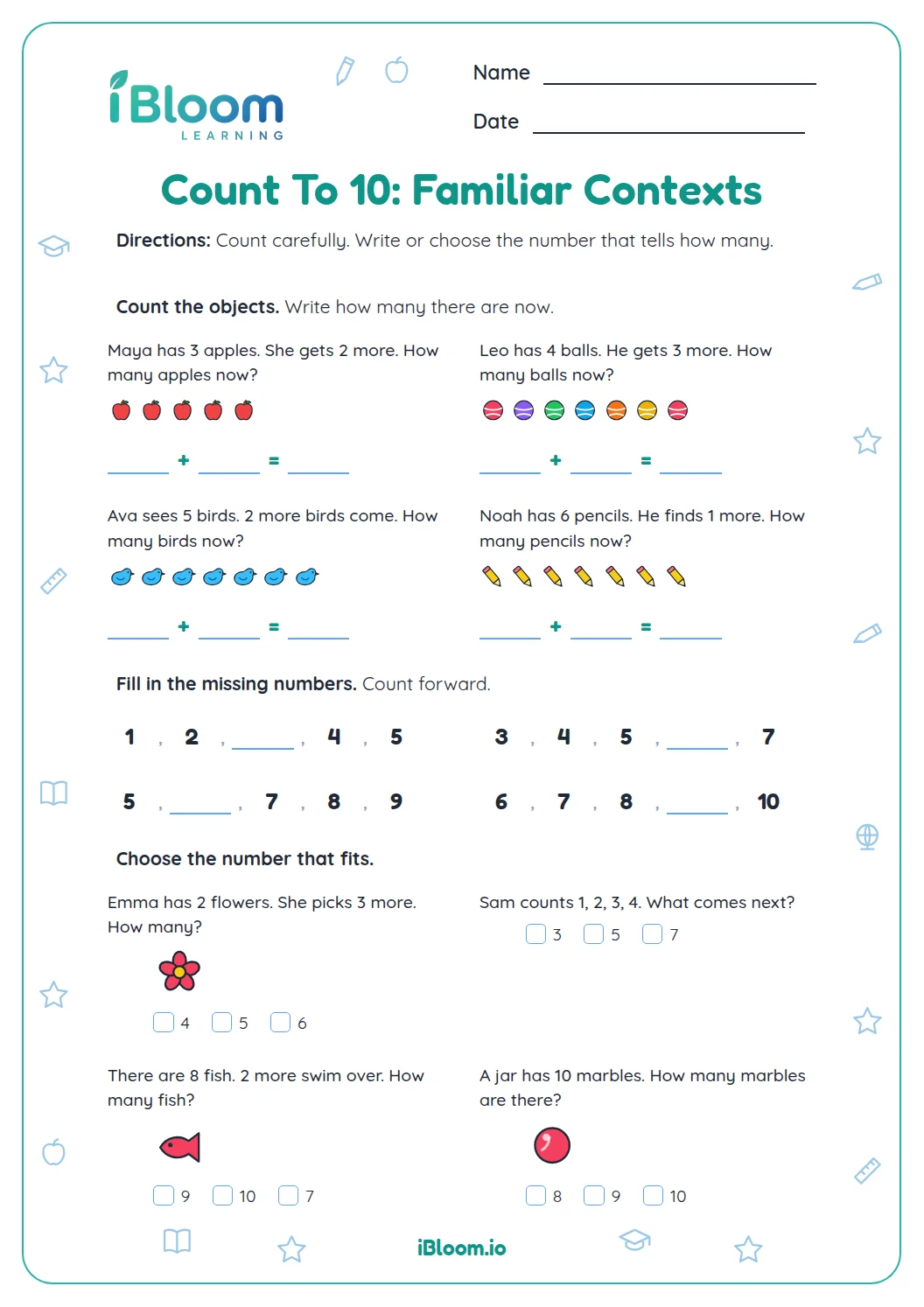
This printable counting worksheet is for preschool and kindergarten learners finding one more or one less than a stated amount. Ten picture-cued number sentences name apples, fish, bears, or stars and give the starting count; four more prompts ask children to draw the changed group. Children move forward or back one number, then use the separate key to check each count and drawing target. The one-more questions connect a quantity with the next number.
Aligned to K.CC.B.4.c
How do children find one more?
Read the starting amount in the prompt, then say the next number. For example, one more than 3 apples is 4 apples.
- 1One more than 3 apples is ___.
- 2The next number after 3 is 4.
- 3Write 4.
How do children find one less?
Count the group, then say the number just before it. For a group of six bears, one less is five. Counting backward one step helps keep the change to exactly one.
What should the drawings show?
The four drawing prompts ask for the new group after adding or taking away one. Reread “one more” or “one less,” then draw the target number of objects. The key gives a sample count for each box.
How to use this worksheet
- 1Count every pictured object once.
- 2Say the group’s starting number.
- 3For one more, name the next number.
- 4For one less, name the number just before it.
- 5Reread the prompt on the mixed questions and check the key.
Common mistakes and quick fixes
The mistake
Counting the new group without counting the starting group carefully.
The fix
Touch or point to each object once before changing the count.
The mistake
Moving backward for one more.
The fix
Say the count sequence aloud and move forward one number for more.
The mistake
Answering the starting amount instead of the changed amount.
The fix
Repeat the prompt’s last words, “one more” or “one less,” before writing.
Common Core alignment
Connect each next number name with a quantity one larger.
On this sheet: The one-more items connect counting a pictured group to the next quantity; the one-less items use the adjacent count.
Show the official wordingHide the official wording
Understand that each successive number name refers to a quantity that is one larger.
What to practice next
Make more practice
Further reading
Questions parents and teachers ask
How does “one more” work?
Count the objects first, then say the next number in the count sequence. For example, if there are three apples, the next number after three is four, so one more than three is four. Touching each pictured object once helps keep the starting count accurate.
How does “one less” work?
Count the objects first, then move back one number. If there are six bears, one less is five. The worksheet uses pictured groups so children can count the starting amount before naming the nearby number. Saying the number sequence backward by one makes the change easier to hear.
What kinds of pictures are on the page?
The ten number sentences use apple, fish, bear, and star pictures as clues for the object named in each prompt. Each sentence states the starting count, so children can focus on moving one number forward or back. Four additional prompts ask them to draw the changed group.
Should my child draw another object or cross one out?
The ten pictured questions ask for a number on the line, so children can count the group and write the new amount. The last four prompts provide drawing boxes and ask them to show the changed group. Pointing to an imagined object can also help explain one more or one less before writing.
How many practice questions are included?
There are 14 questions: five number sentences ask for one more, five ask for one less, and four ask children to draw the changed group. The answer key gives each number answer and a sample count for the drawings. Each of the first ten prompts states its starting amount.
What can my child practice next?
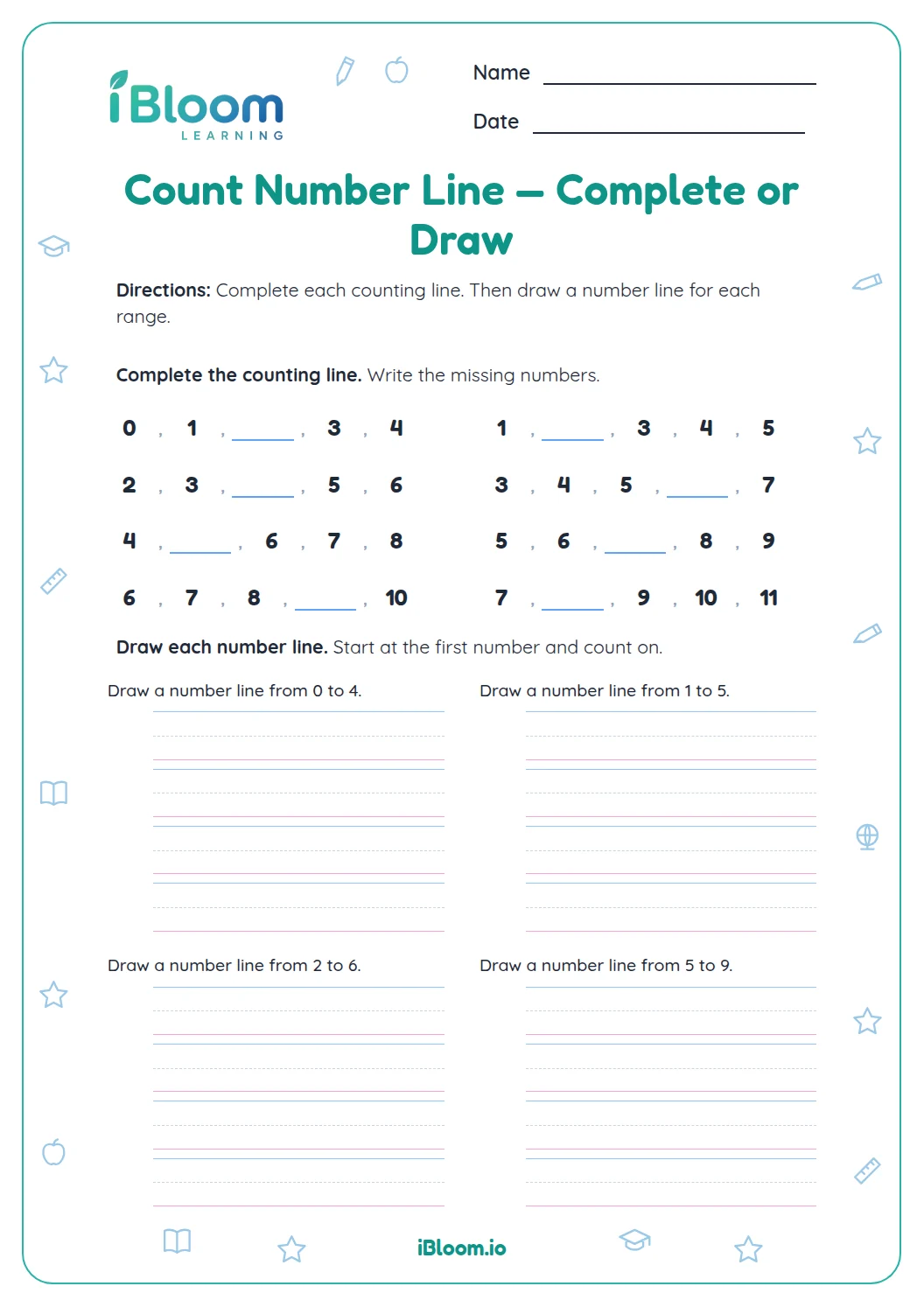
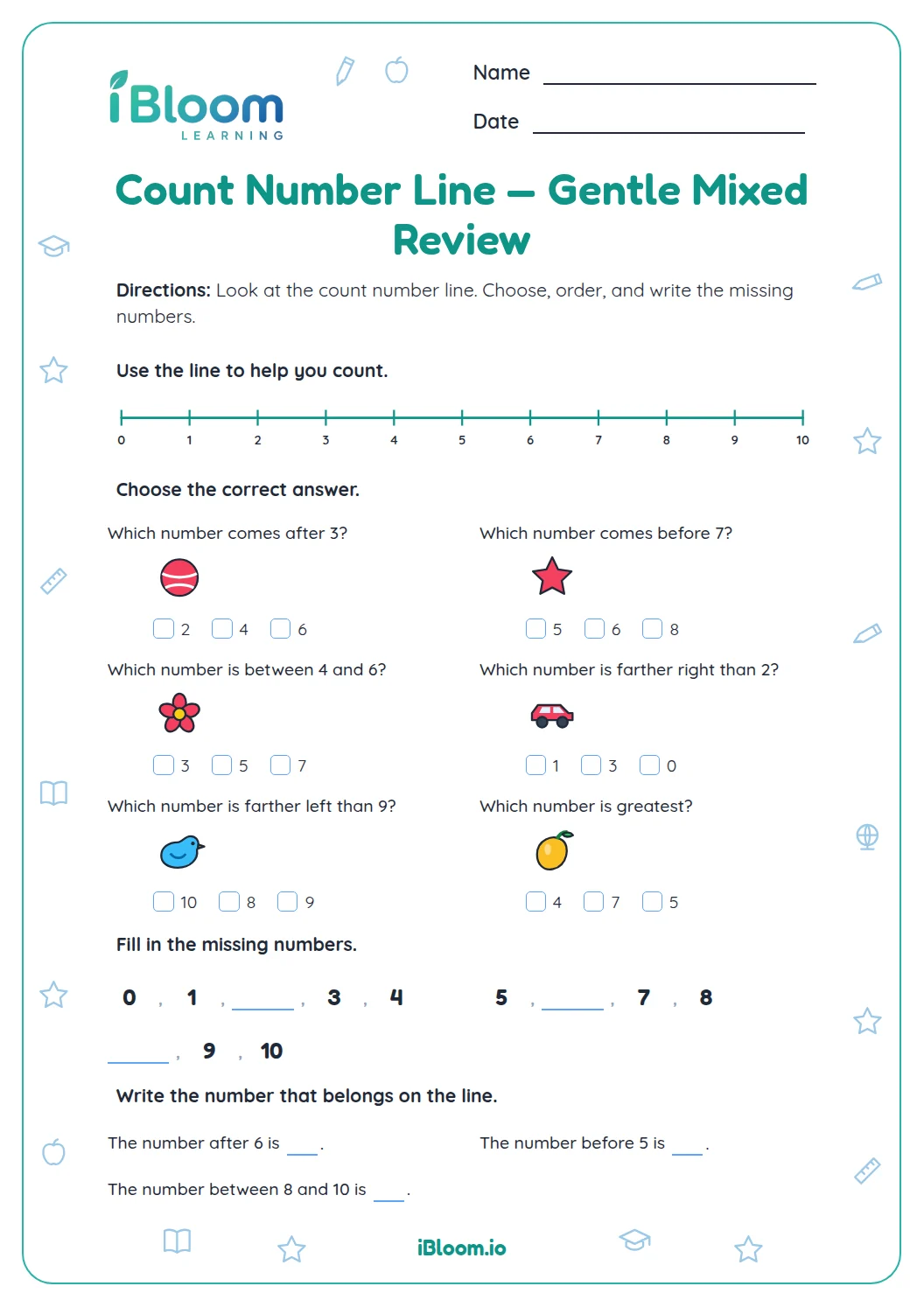
Count-to-10 activities strengthen accurate group counting. A number-line page shows how numbers follow one another, while a cross-out activity gives a concrete way to model taking one away. The related pages keep the focus on ownership while adding fresh sentences.