


About this worksheet
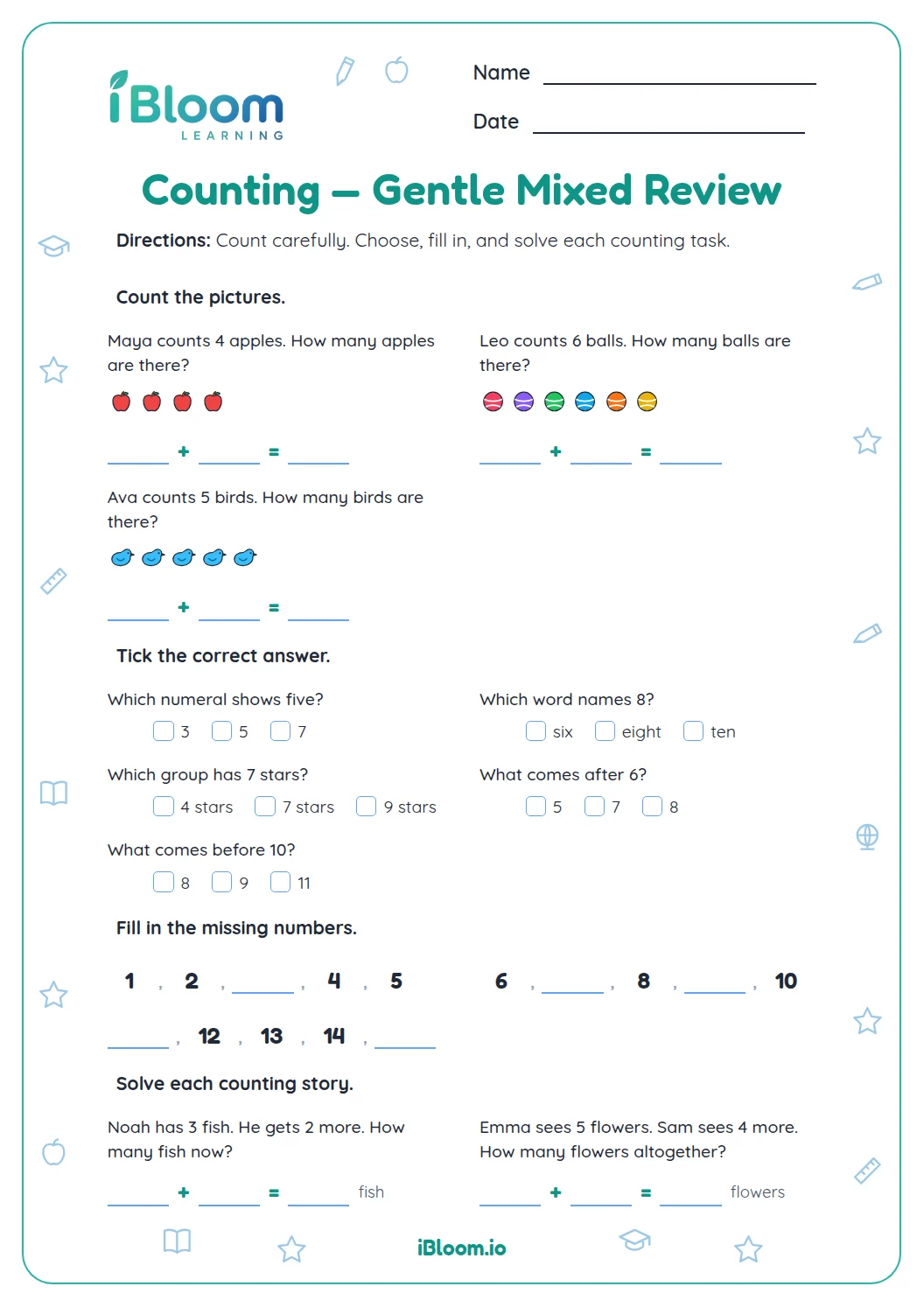
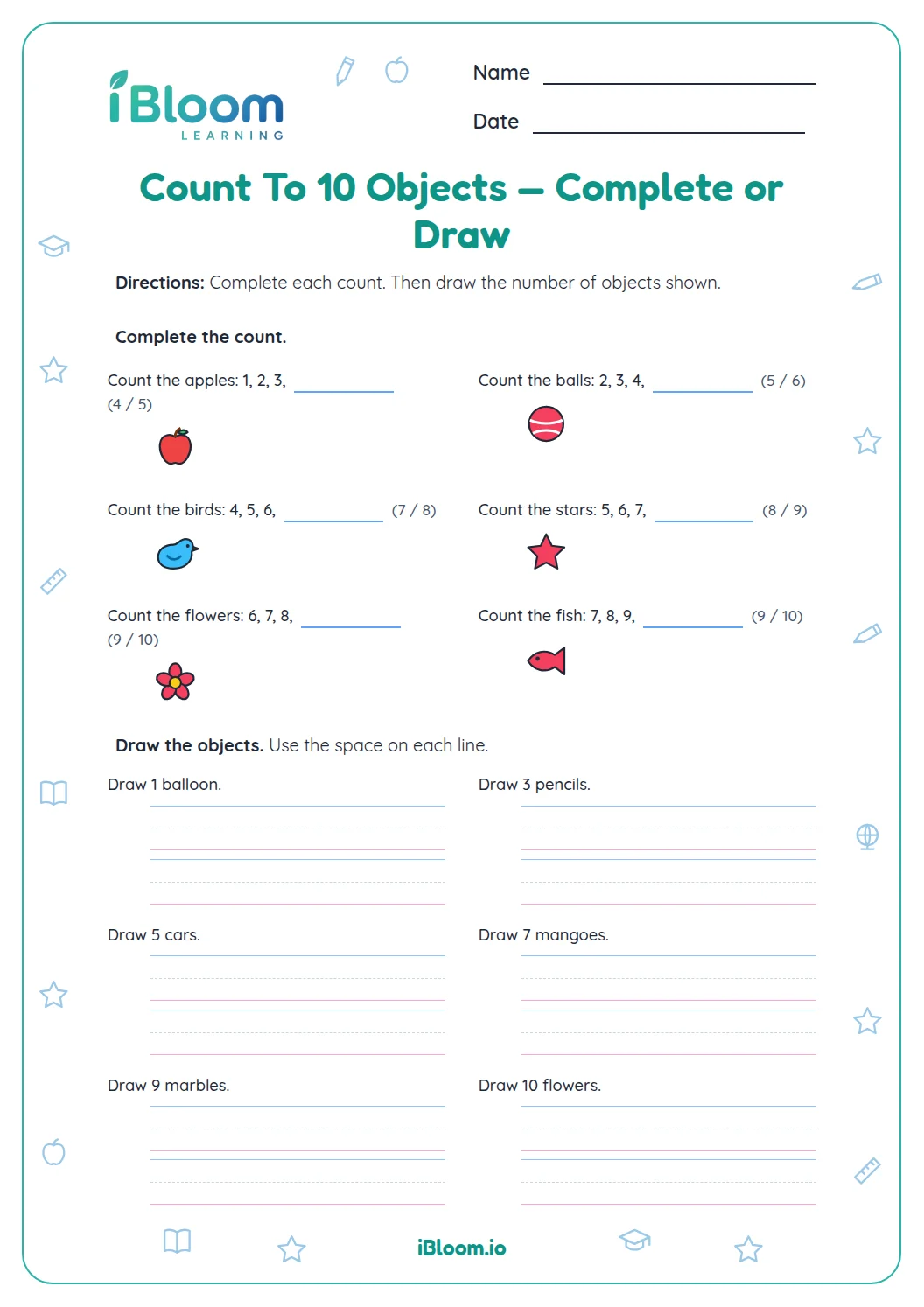
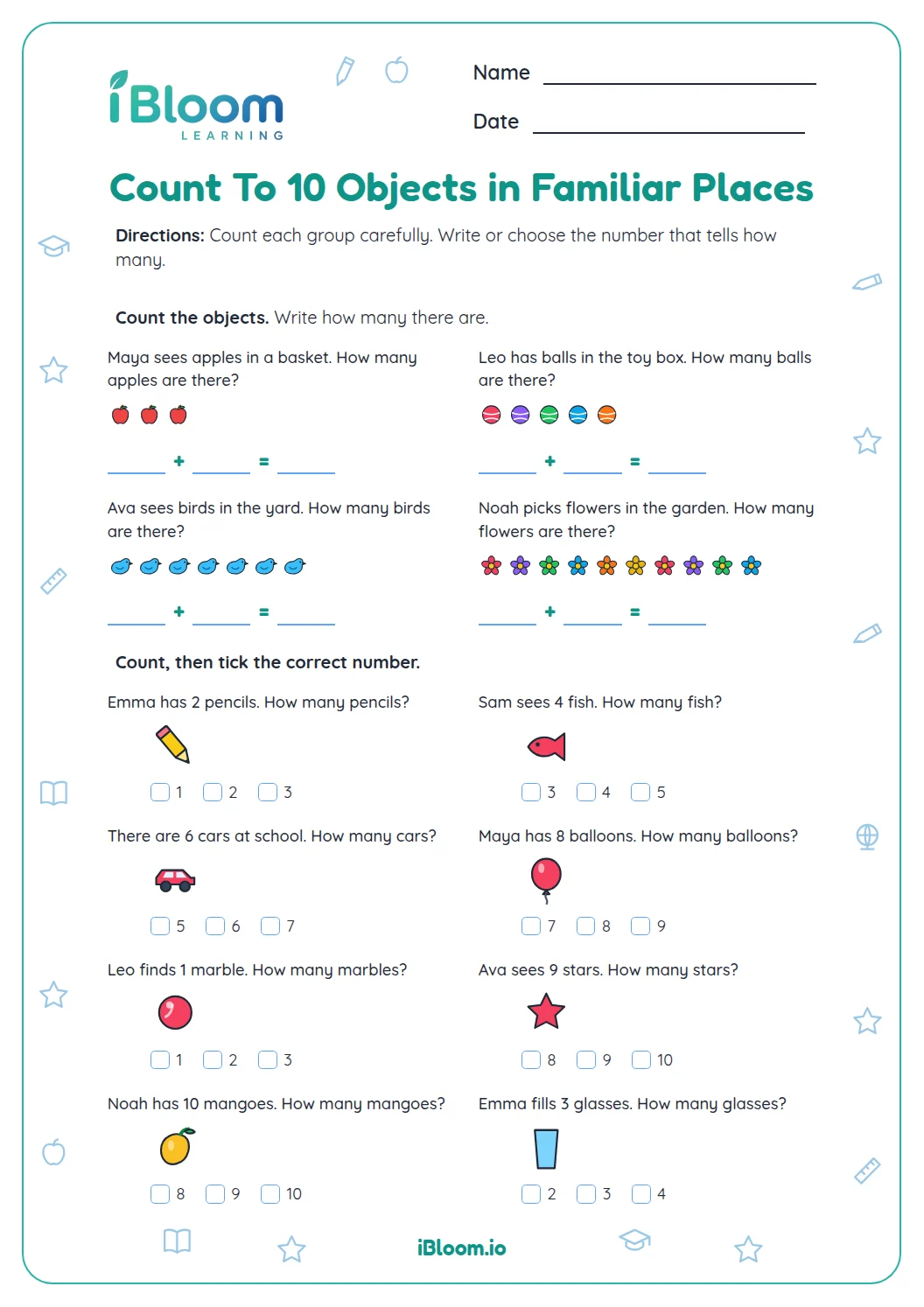
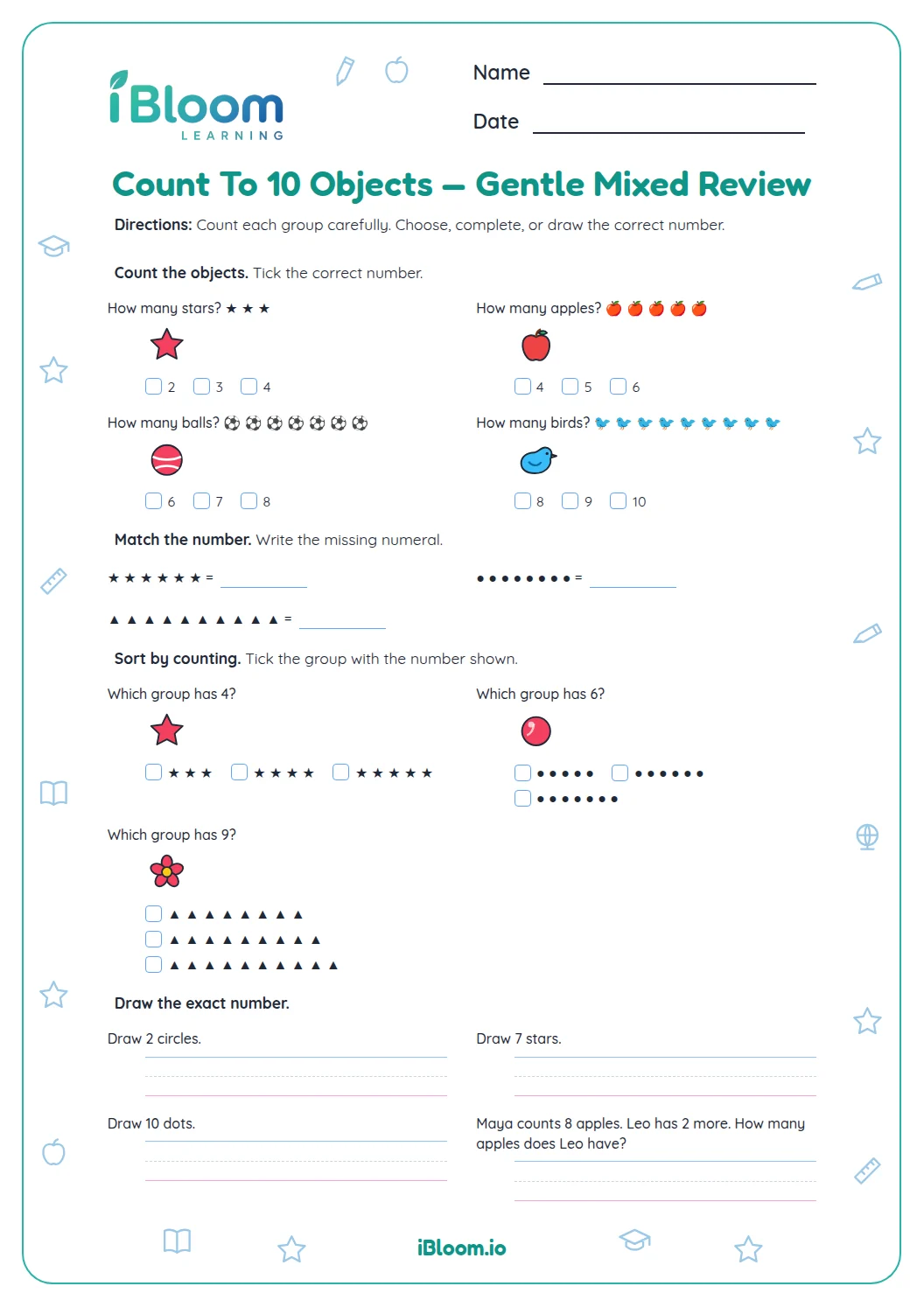
Children count familiar picture groups and choose the number that matches, comes just after, or comes just before. The 15 questions move from picture counting to one-more and one-less practice, then use short number sentences and counting paths for review. Picture groups support the visual activities, and a separate answer key is included.
Aligned to K.CC.A.2
How do children find one more or one less?
Count each object once to find the starting number. For one more, say the next number; for one less, say the number just before it. The picture groups on Part A make the starting amount visible.
In Part B, children use the same idea in number sentences. Part C asks them to keep counting in order, including a short count backward.
- 1Count 4 apples: 1, 2, 3, 4
- 2One more is 5.
- 3One less is 3.
What is on the worksheet?
The first part checks counting. Parts B and C focus on one more and one less. Part D mixes the two so children must notice which direction to move.
- Part A: find one more in three picture groups
- Part B: find one less in four picture groups
- Part C: complete four one-more or one-less number sentences
- Part D: finish four counting paths, forward and backward
How can an adult check the counting?
Ask the child to point to each picture once, then say the starting number and the new number aloud. For number paths, have the child read the whole sequence from left to right.
The separate key lists the answer for all 15 items across four parts.
How to use this worksheet
- 1Point to each picture as your child counts it once.
- 2Ask which number comes next before answering a one-more question.
- 3For one less, count back one step from the group total.
- 4Finish the mixed part without naming the operation for your child.
- 5Use the key to check and revisit any missed count.
Common counting slips
The mistake
Skipping a picture or counting one picture twice.
The fix
Touch each picture once while saying one number.
The mistake
Repeating the group total for a one-more answer.
The fix
Say the next counting number after the total.
The mistake
Counting forward for one less.
The fix
Start at the group total and take one counting step back.
Common Core alignment
The one-more questions practice counting forward from a pictured quantity.
Count forward beginning from a given number.
On this sheet: The picture groups give a starting quantity, and children name the next number.
Show the official wordingHide the official wording
Count forward beginning from a given number within the known sequence (instead of having to begin at 1).
What to practice next
Make more practice
Further reading
Questions parents and teachers ask
How do children find one more?
Count the pictures to find the group total, then say the next number in order. For 6 stars, count on one step: 7. Children can check by touching the original six pictures and adding one more count. Say both the starting number and the new total aloud.
How do children find one less?
Count the pictures to find the group total, then say the number just before it. One less than 6 is 5. Pointing to the counted set and counting back one step helps make the change clear. Practice the count in a calm voice before choosing a number.
Should my child count the pictures first?
Yes. Counting each picture once gives the starting number for the one-more or one-less step. If counting is still new, touch each picture while saying one number, then talk through the next or previous number together. Keeping the starting quantity visible helps children see what changes by one.
Is an answer key included?
Yes. The printable has a separate answer key with the correct number for every picture group, number sentence and counting path. Children can try the page first, then use the key with an adult to review any number they want to check.
What is on each part of the page?
Part A uses picture groups for one-more and one-less questions. Part B has four number sentences, and Part C has four counting paths with one missing number each. The questions move from visible groups to number-only practice, and the separate key gives all 15 answers.
Can preschoolers use this page too?
Yes, an adult can read the directions and point to the picture groups with a child. The first seven questions use familiar pictures, while the later number sentences and paths may be easier after counting practice. Work through one part at a time and pause when needed.