





About this worksheet
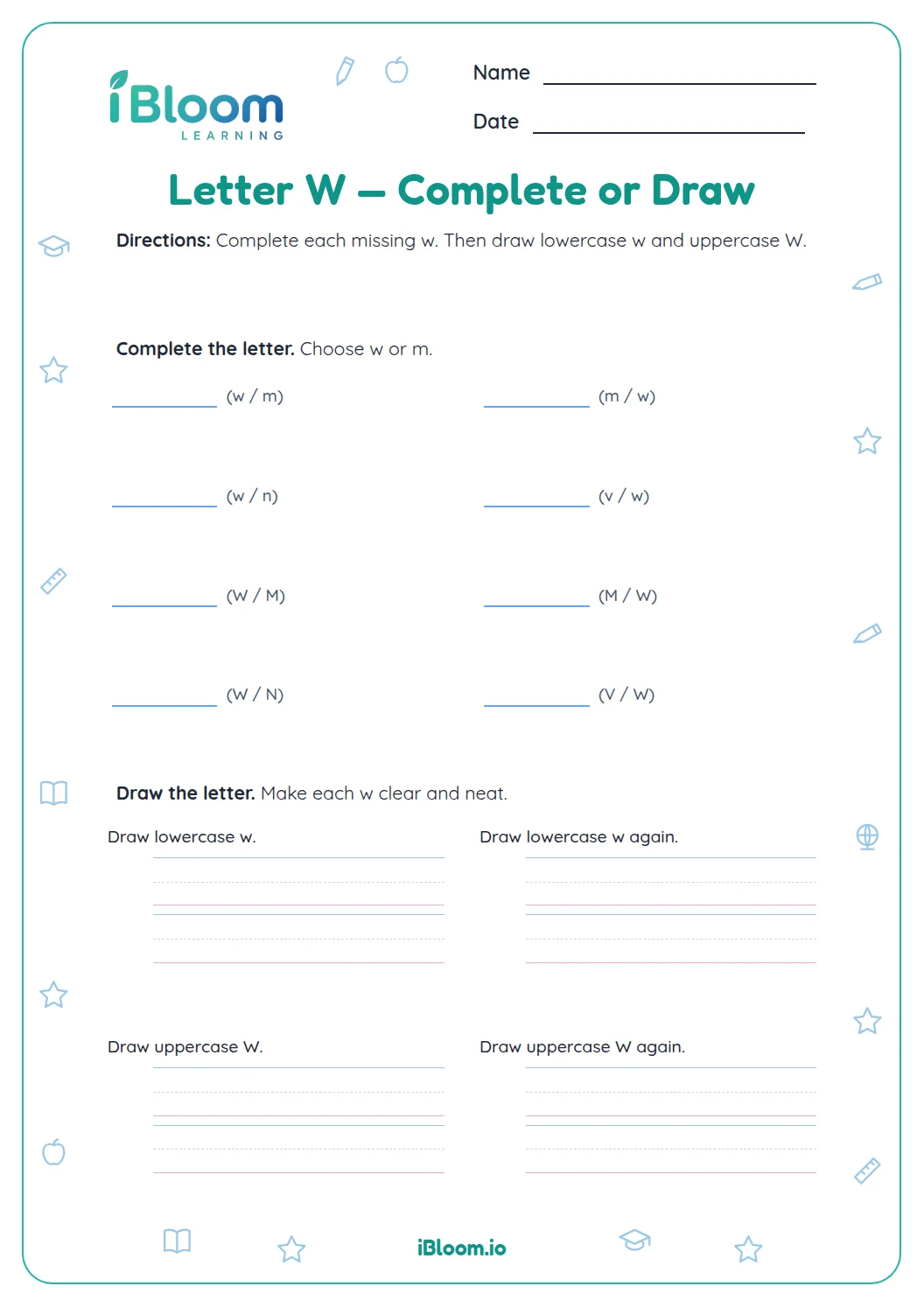
This preschool and kindergarten worksheet gives children 15 chances to name and trace uppercase W and lowercase w, then connect W to familiar words with picture clues. The practice moves from tracing letter forms to spotting W at the start of words such as watermelon, window, whale, and worm. The answer key identifies the letter and word choices.
Aligned to CCSS.ELA-Literacy.RF.K.1.d
How does tracing help children notice W?
Tracing gives children repeated practice following the two slanted strokes that meet in uppercase W and the rounded dips in lowercase w. Saying the letter name while tracing connects its shape with its name.
- 1Trace uppercase W, then lowercase w.
- 2Say the letter name as each form is traced.
How do picture clues connect W to words?
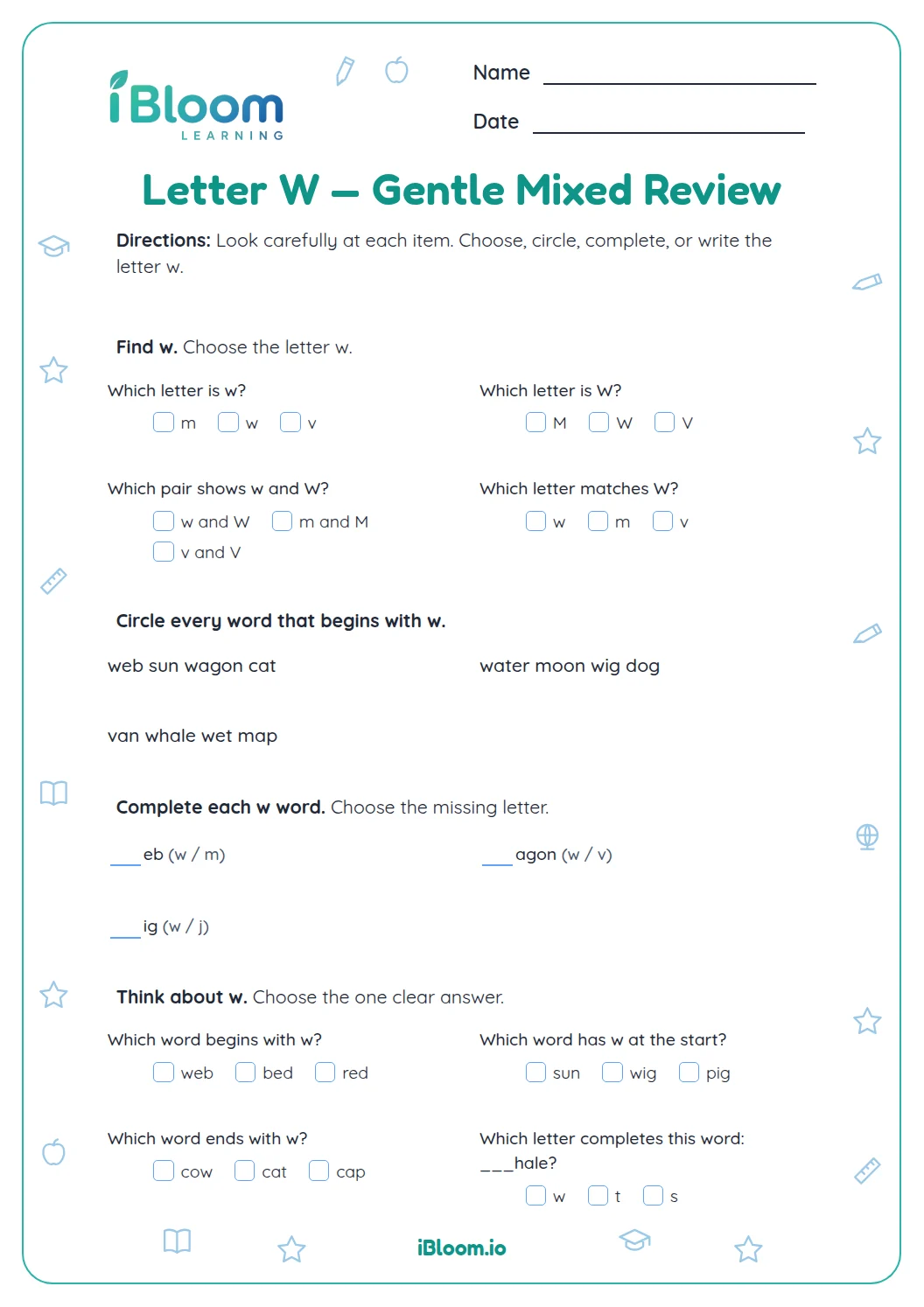
Each picture gives a word to say aloud. Children can listen to its first sound and identify W in words such as whale, window, worm, and watermelon.
- Part B uses familiar picture clues and letter choices.
- Part C listens for W at the beginning of a spoken word.
When do we use uppercase and lowercase W?
A name at the beginning of a sentence uses uppercase W. Most other words use lowercase w. Both shapes represent the same letter and beginning sound in these examples.
How to use this worksheet
- 1Name the uppercase W and lowercase w before tracing.
- 2Trace each letter slowly from its starting point.
- 3Point to each picture and say its name aloud.
- 4Stretch the first sound in the word and listen for W.
- 5Praise careful looking and let the child try missed items again.
Common mistakes and quick fixes
The mistake
Confusing W with M because both have pointed strokes.
The fix
Compare their starting strokes: W begins at the top and zigzags down, while M begins with a downstroke.
The mistake
Choosing a picture because it contains W later in its name.
The fix
Say the word slowly and listen only to its first sound.
The mistake
Thinking uppercase W and lowercase w are different letters.
The fix
Place W beside w and say that both are forms of the same letter.
Common Core alignment
The letter tracing and recognition activities support early print concepts.
Children recognize and name uppercase and lowercase W.
On this sheet: Children recognize and name uppercase and lowercase W.
Show the official wordingHide the official wording
Recognize and name all upper- and lowercase letters of the alphabet.
What to practice next
Make more practice
Further reading
Questions parents and teachers ask
Which letter forms does the page practice?
The page practices uppercase W and lowercase w. Children trace each form, say its name, and then identify W at the beginning of familiar words using picture clues. An adult can model the letter name and sound, then invite the child to repeat both during practice.
Which W words appear?
The picture clues include watermelon, window, worm, whale, watch, web, and wig. Ask the child to name each picture, then listen for the /w/ sound at the beginning. The key shows the correct letter or word choice for the recognition questions.
Is this suitable for preschool?
Yes. An adult can name each picture and model how to trace the letter. Children who are ready can complete the picture choices independently and say the word that helped them choose. An adult can model the letter name and sound, then invite the child to repeat both during practice.
Does it include an answer key?
Yes. The answer key identifies the letters and picture choices. Tracing answers show the target letter or word so an adult can check that the child practiced the intended form. An adult can model the letter name and sound, then invite the child to repeat both during practice.
Why are there pictures on the worksheet?
The picture clues let young learners connect a spoken word to its first letter without needing to decode a printed word. This keeps the practice focused on recognizing W in a familiar context. An adult can model the letter name and sound, then invite the child to repeat both during practice.