
About this worksheet
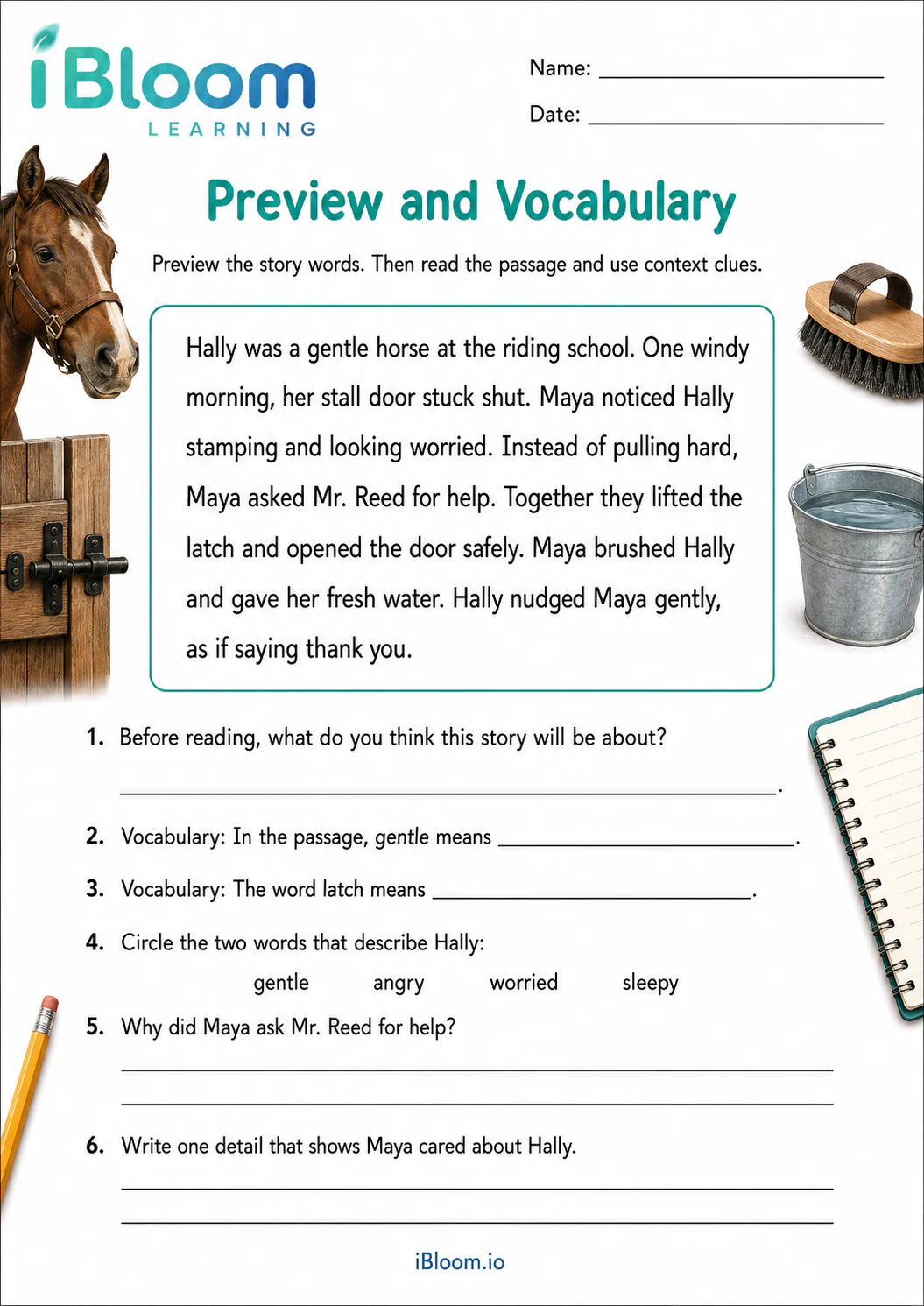
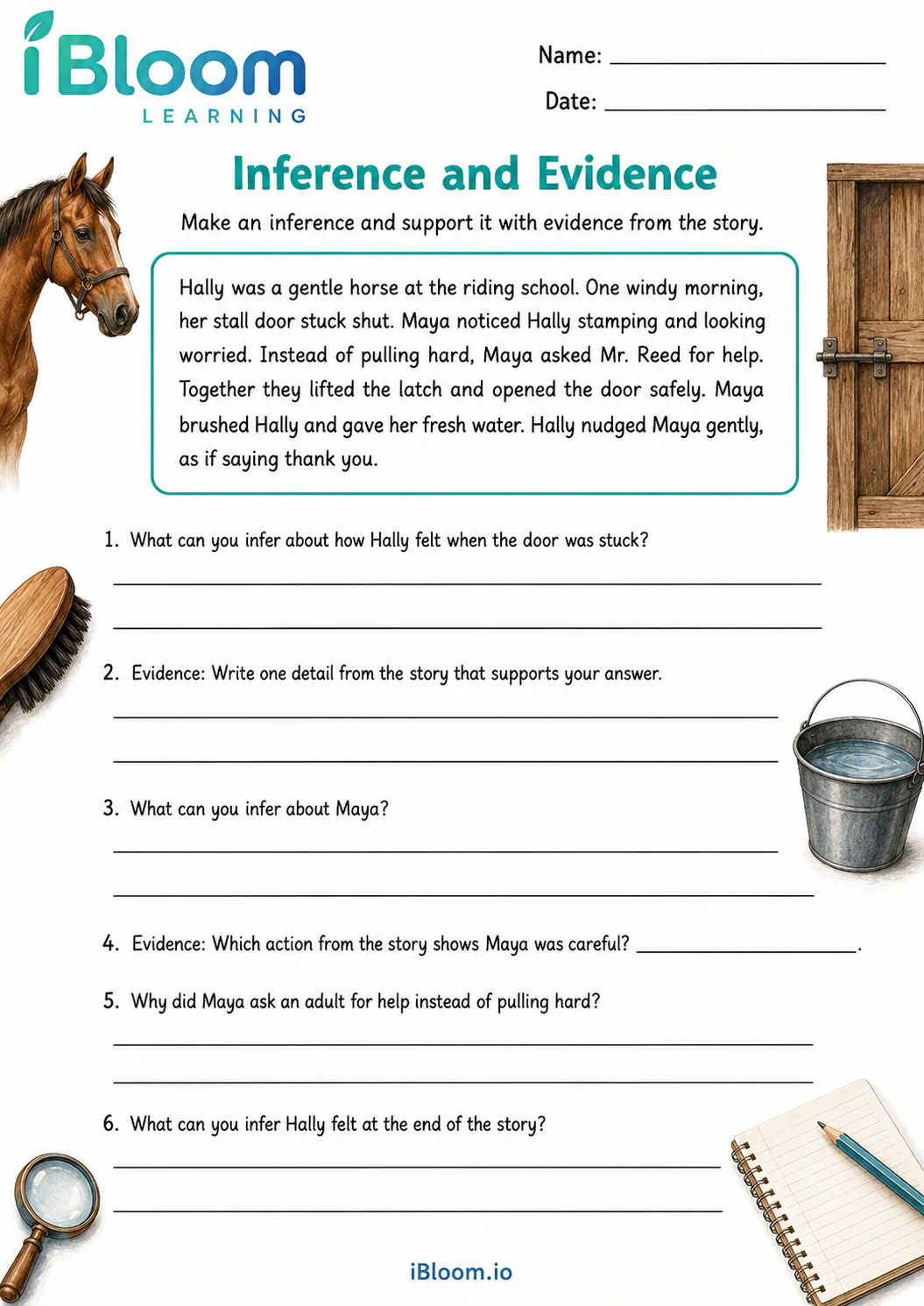
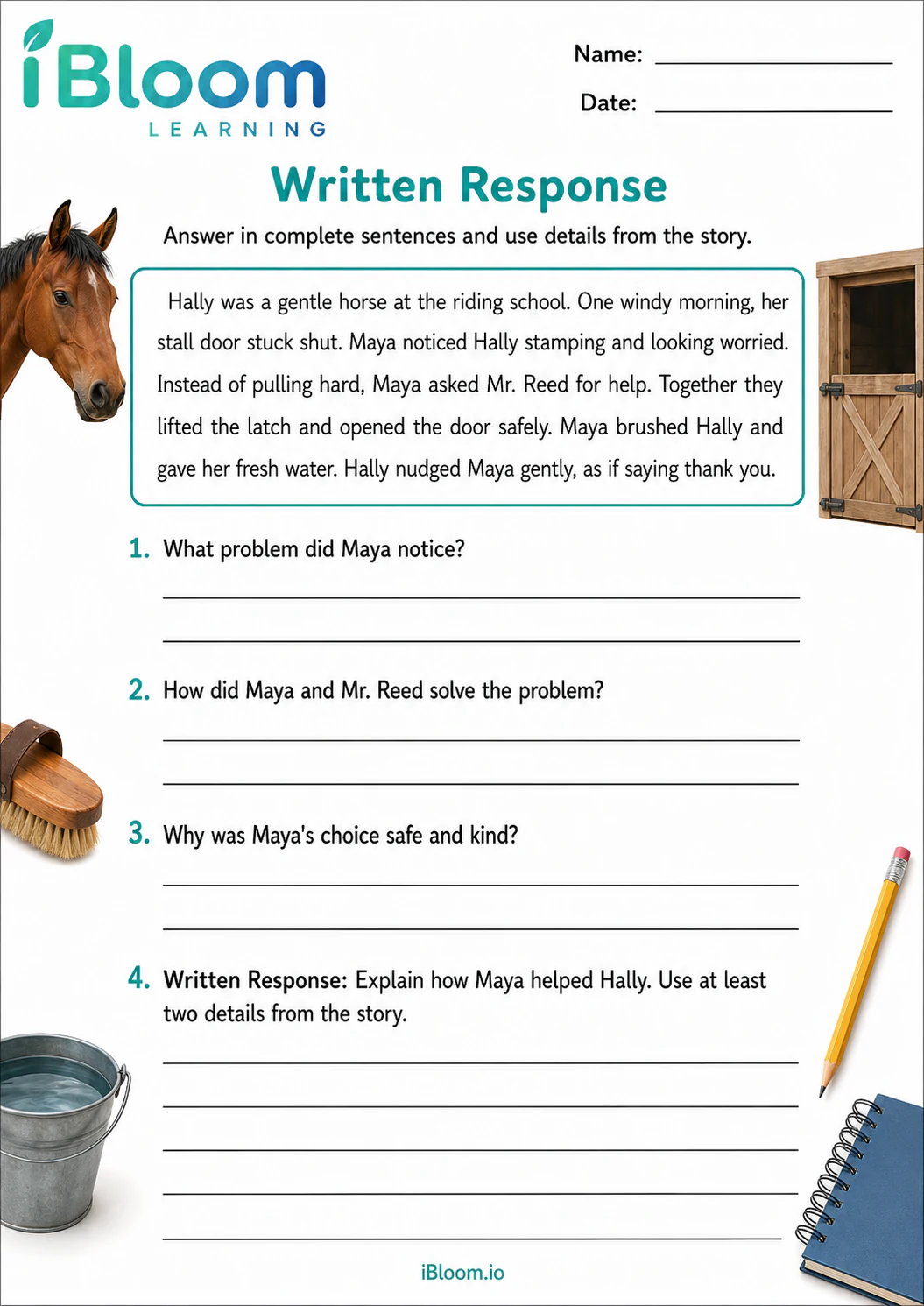
This free Grade 3 reading worksheet uses the “Helping Hally” story about Maya and Mr. Reed safely opening a stuck stall door for a worried horse. Sixteen questions ask readers to explain a vocabulary word, recall details and sequence, identify the main idea, make an inference, and support answers with evidence. The passage stays with the established story, while the practice adds careful checks of its events and clues. A separate answer key includes sample responses.
Aligned to RL.3.1
How can context explain a word like “latch”?
Look at the word in its sentence and the events around it. The stuck stall door opens after Maya and Mr. Reed lift the latch, so the word refers to a fastener that holds a door closed.
Part B asks children to answer in their own words, then check that their explanation fits the event.
- 1The latch is lifted.
- 2Then the door opens.
- 3A latch is a fastener that keeps a door closed.
How do details and sequence build understanding?
A detail answers a who, what, or where question. Sequence questions ask readers to put those details in the order the story gives them. Notice Maya asks Mr. Reed before they open the door; she brushes Hally and gives water afterward.
- 1First, Maya asks Mr. Reed for help.
- 2Afterward, Maya brushes Hally.
- 3So asking for help happened first.
What can we infer from Hally’s actions?
An inference combines a clue in the passage with a reasonable idea. Hally is stamping and looks worried before the door opens. Later she nudges Maya gently. Those actions suggest how Hally may feel, though the story does not state her thoughts directly.
- 1Clue: Hally nudges Maya gently.
- 2Inference: Hally may feel affection or gratitude.
How can a reader support an answer with evidence?
A strong response names the idea and points to a detail that supports it. For example, the story is mostly about Maya getting help with Hally’s stuck stall and caring for the horse. The steps of opening the door and giving Hally water support that summary.
- 1Claim: Maya cares for Hally.
- 2Evidence: She brushes her and gives her fresh water.
How to use this worksheet
- 1Read the passage once to follow the whole event.
- 2Reread the sentence around an unfamiliar word.
- 3For sequence, note what Maya does before and after the door opens.
- 4For an inference, name the clue and then explain what it suggests.
- 5Answer in a complete thought when the question asks why or how.
- 6Check each response against a specific detail in the passage.
Common slips and ways to check
The mistake
Giving a meaning for “latch” that does not fit a door.
The fix
Reread what happens when Maya and Mr. Reed lift it; the door then opens.
The mistake
Mixing up the order of helping Hally and caring for her.
The fix
Track the passage: ask Mr. Reed, open the door, then brush and give water.
The mistake
Treating an inference as a fact stated word-for-word.
The fix
Name the action as evidence and use “may” or “suggests” for the idea it supports.
Common Core alignment
Readers answer questions about a literary passage and support their thinking with details from the text.
Answer questions about a text and refer to details as evidence.
On this sheet: Questions ask children to answer from the passage and cite events or character actions.
Show the official wordingHide the official wording
Ask and answer questions to demonstrate understanding of a text, referring explicitly to the text as the basis for the answers.
What to practice next
Make more practice
Further reading
Questions parents and teachers ask
Who is Hally in the passage?
Hally is a gentle horse at the riding school. Her stall door sticks on a windy morning, and Maya notices her stamping and looking worried. Maya asks Mr. Reed for help, and the two of them open the door safely before Maya brushes Hally and brings fresh water.
What does “latch” mean in this story?
A latch is a fastener that keeps a door closed. Maya and Mr. Reed lift the latch, and then the stall door opens. That event helps readers infer the word’s meaning from context. Question 1 asks children to explain that meaning in their own words.
What happens first when Maya helps Hally?
Maya first notices Hally stamping and looking worried. She asks Mr. Reed for help before they lift the latch and open the stall. Afterward, she brushes Hally and gives her fresh water. Questions 6 and 7 ask readers to track that order.
What can readers infer from Hally’s gentle nudge?
The passage says Hally nudges Maya gently after Maya cares for her. A reader may infer that Hally feels affection or gratitude, but the passage does not state Hally’s thoughts. A strong response names the nudge as a clue and marks the idea as an inference.
How many questions are on the worksheet?
There are 16 written-response questions after the passage. They cover a word in context, story details, event order, main idea, inference, and evidence. The answer key gives direct responses for details and sample answers when more than one explanation can fit.
What should I look for in the answer key?
The key lists an answer for each of the 16 questions and uses “Sample” where children may respond in different words. Compare the idea and supporting detail with the passage instead of requiring the exact wording shown in the key.