




About this worksheet
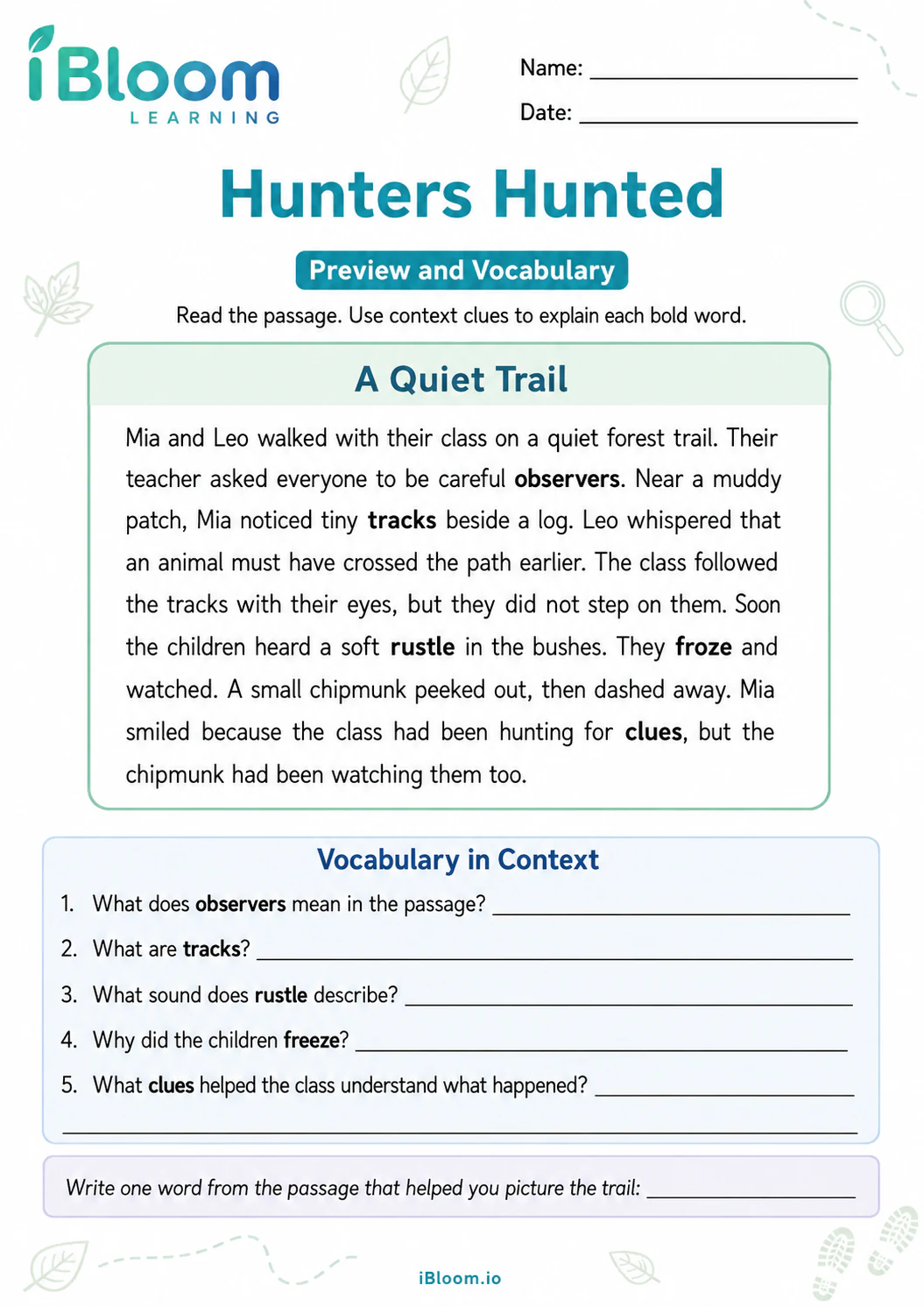
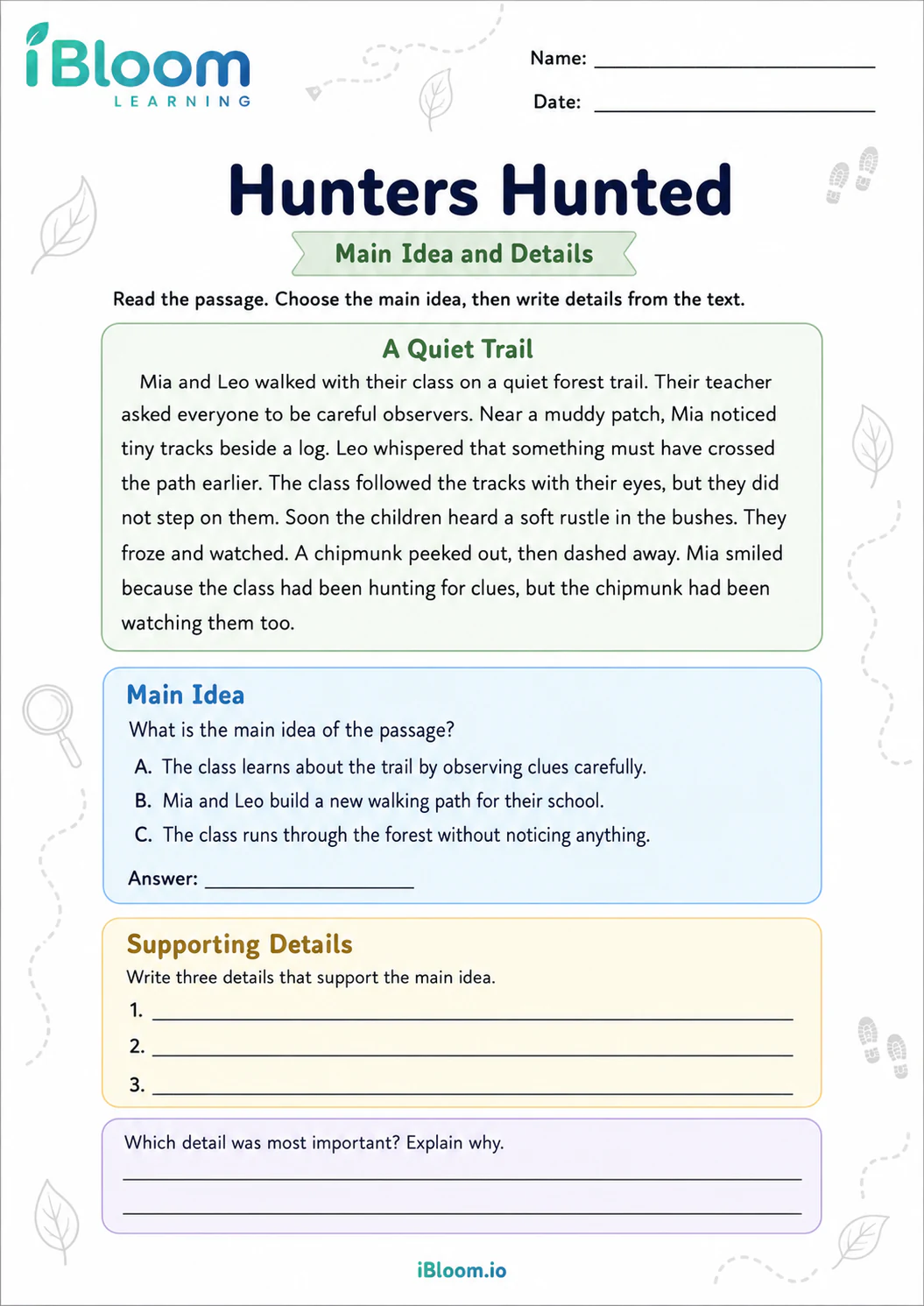
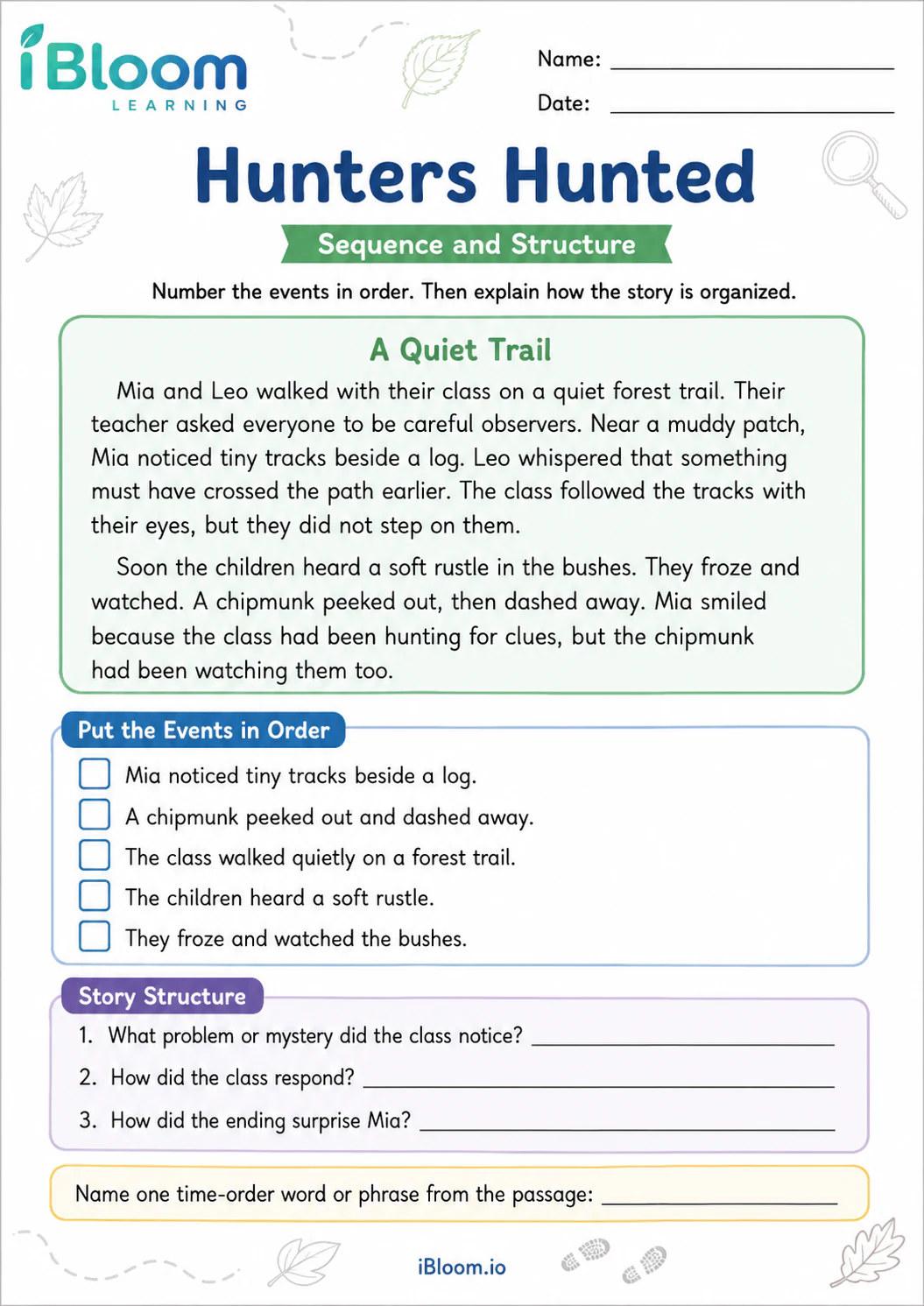
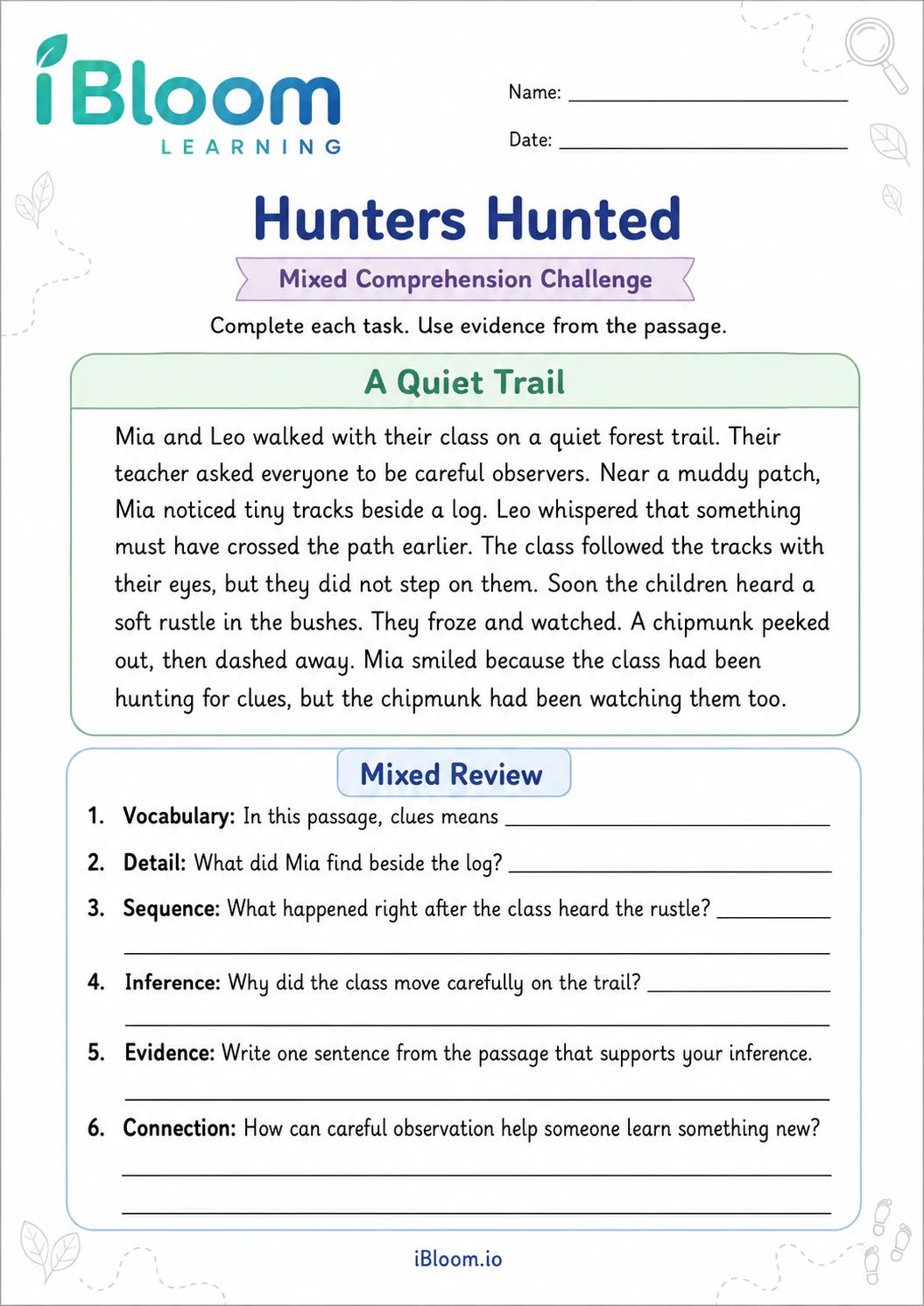
This Grade 3 reading worksheet uses an original forest story about a class following animal clues. Children answer questions about details, cause and effect, and the title’s meaning, supporting responses with evidence from the story. The passage shows how Mia and Leo observe tracks without disturbing them, while a chipmunk watches the class. The questions practice asking and answering questions with explicit story details, as described in RL.3.1. The answer key offers sample responses.
Aligned to RL.3.1
What skill does this page practice?
A strong reading response answers the question and names a detail that supports it. In this story, tracks, a rustle, and the chipmunk’s actions give readers clues to explain.
How can a reader build a strong answer?
Read the whole prompt, find the detail or clue that answers it, and check that your response fits the question.
- 1Mia and Leo searched for animal clues.
- 2The chipmunk watched the class before it peeked out.
- 3Those details explain the title “Hunters Hunted.”
What will children do on the worksheet?
The worksheet has 14 questions. The answer key follows the same order and gives sample wording for open responses.
How to use this worksheet
- 1Read the story once to follow the class along the trail.
- 2Reread the sentence that contains the detail each question asks about.
- 3For cause questions, connect the action to the reason in the story.
- 4Use a story detail in each complete response.
- 5Compare your ideas with the sample answers in the key.
Common mistakes and quick fixes
The mistake
Retelling the whole story instead of answering the question.
The fix
Reread the prompt, find the relevant detail, and revise the response so it answers the question clearly.
The mistake
Making an inference that has no story detail behind it.
The fix
Reread the prompt, find the relevant detail, and revise the response so it answers the question clearly.
The mistake
Confusing what Nico did with what Mara did.
The fix
Reread the prompt, find the relevant detail, and revise the response so it answers the question clearly.
Common Core alignment
This activity connects close reading and written responses to a specific English language arts standard.
Answer questions using explicit story details and inferences.
On this sheet: Each written response asks readers to point to story details as evidence.
Show the official wordingHide the official wording
Ask and answer questions to demonstrate understanding of a text, referring explicitly to the text as the basis for the answers.
What to practice next
Make more practice
Further reading
Questions parents and teachers ask
What is the story about?
Mia and Leo’s class searches for clues on a forest trail. They find tracks, hear a rustle, and see a chipmunk dash away. The title fits because the children hunt for clues while the chipmunk watches them first. Question 4 asks children to name both sides of that reversal.
What does “hunters” mean in this story?
They hunt for signs of animals, such as the tracks beside a log. The story makes clear they are observing clues, not chasing or disturbing the animals, and they keep their feet off the tracks. Questions 2 and 10 also ask about careful, nondisruptive observing.
What does the answer key include?
It includes sample responses for 14 written questions. Children can use different wording when they answer accurately and point to a detail from the passage. A sample is a guide, not the only correct sentence. Several questions accept different complete sentences supported by story facts.
How can children find evidence for an inference?
Readers can connect Mia’s tracks, the class’s careful watching, and the chipmunk’s appearance. Those details support the idea that the class noticed the animal’s clues while the animal noticed the class. Question 14 uses two actions from the story as supporting evidence.
Why did the class stay still when they heard a rustle?
The class stayed still to watch for the source of the rustle, and a chipmunk peeked out and dashed away. The question connects their response to an event stated directly in the passage. Children can point to both the rustle and the animal’s appearance.
How long does the sheet take?
Plan about 25 minutes to read the passage and answer 14 questions. Children may need more time to find details, compare observations, and write full responses in their own words. Fourteen written items give children practice citing details and explaining ideas.