
About this worksheet
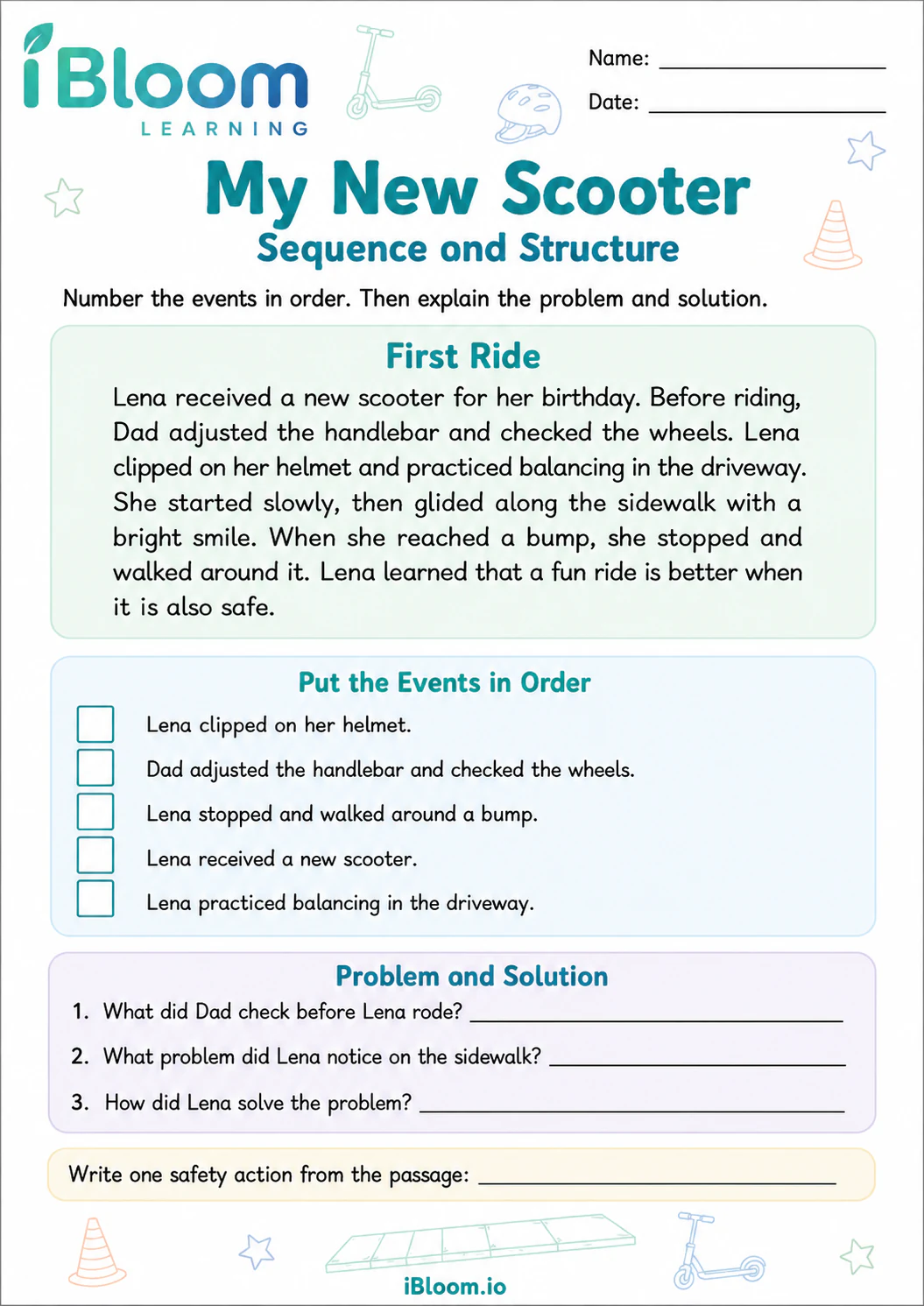
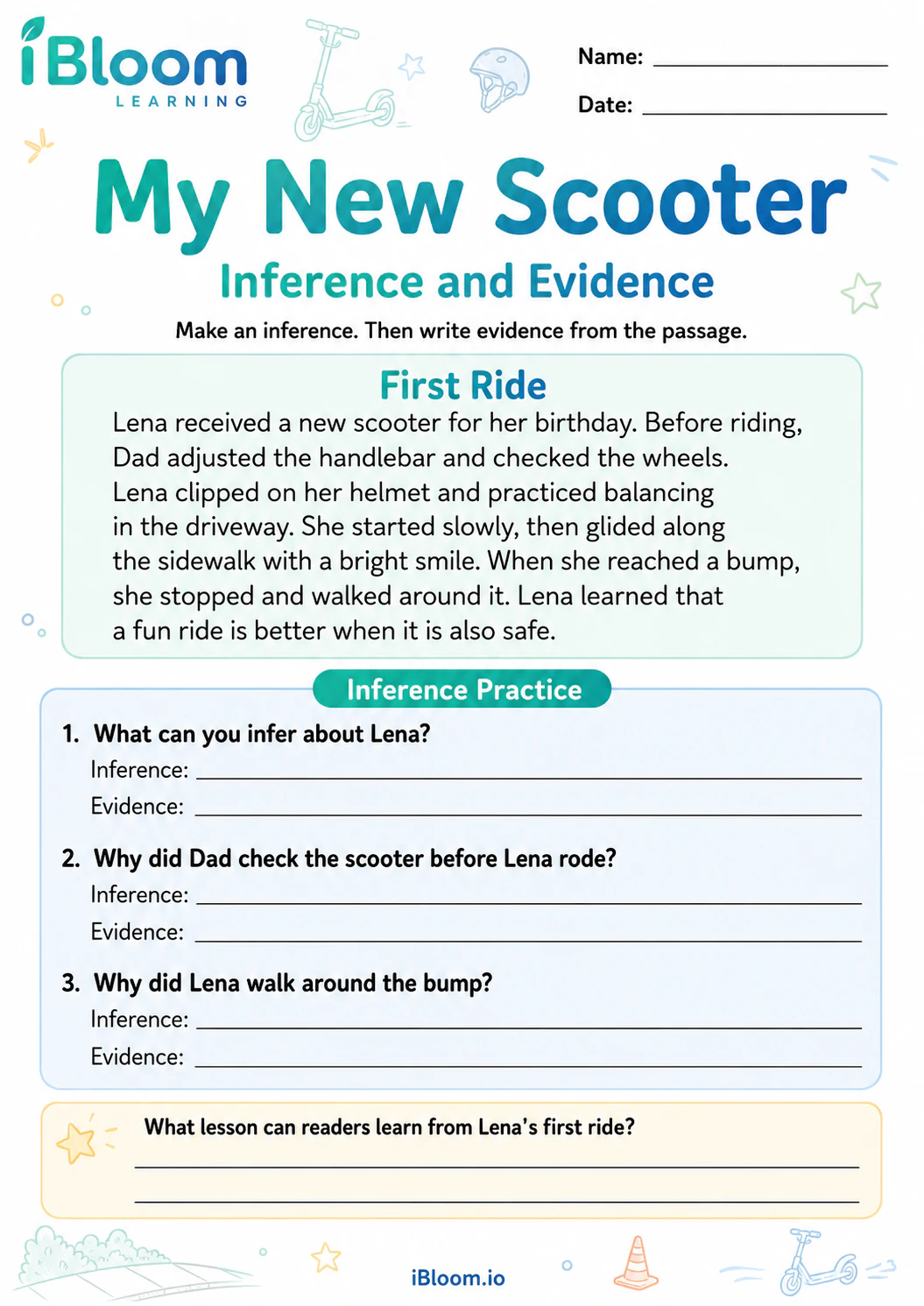
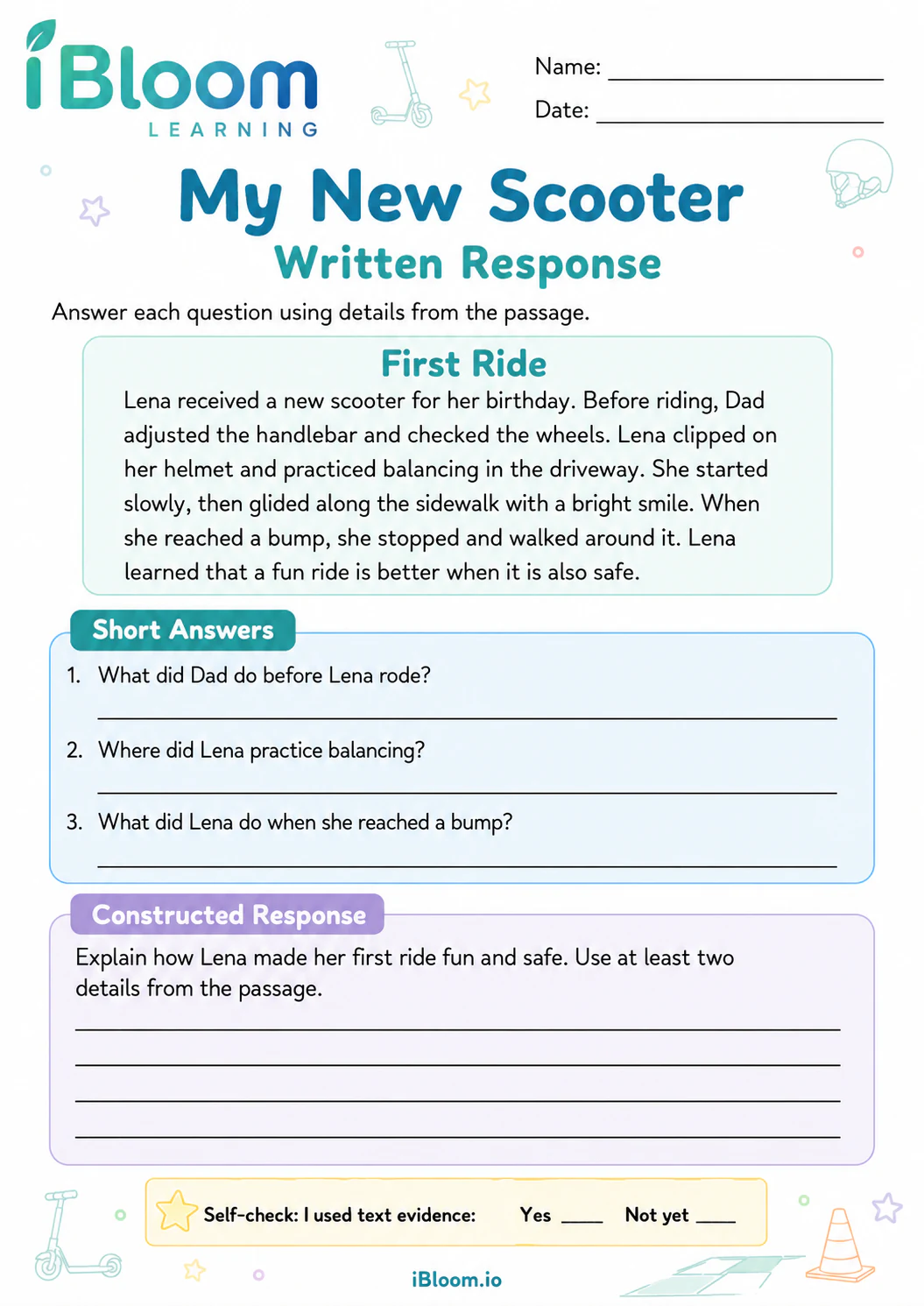
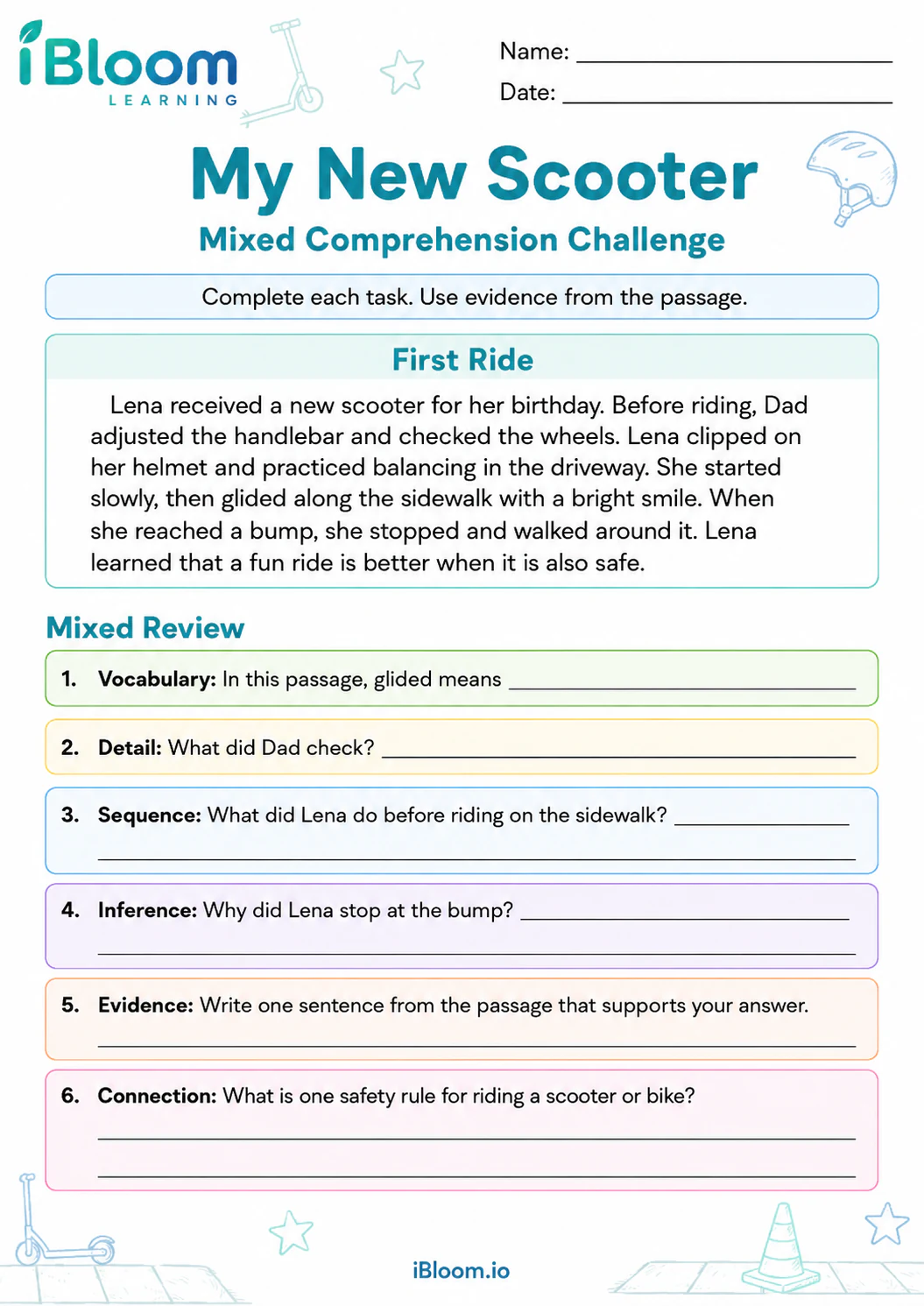
This free Grade 3 worksheet pairs My New Scooter with ten questions about its main idea, important details, and central message. Lena learns to balance, rides carefully, and walks her scooter around an obstacle while Dad stays nearby. Part A presents the complete story. Part B has two choices about the main idea and lesson. Part C asks for six short detail answers. In Part D, children recount the ride and explain its lesson with evidence. The work addresses Common Core RL.3.2 and RL.3.1. A separate answer key includes sample written responses.
Aligned to RL.3.2 and RL.3.1
How do readers find the main idea of the whole story?
Look across the beginning, middle, and ending. Lena wants to ride, practices with Dad, and makes a careful choice when she meets a bump. Together, those events show her learning to ride safely.
A birthday explains why she receives the scooter, but the ride occupies most of the story. Question 1 asks for an answer broad enough to include her practice and her choices.
Which details support the lesson?
The story includes several actions that make the ride safer. Lena clips on a helmet, rides slowly while watching for cracks, and walks around a bump she cannot cross safely.
Question 8 asks how Lena gets past the bump. Readers find the answer in the third paragraph. The other Part C questions collect details about the handlebar, helmet, balancing practice, wheel check, and cautious riding.
- 1Question: How does Lena pass the bump?
- 2Answer: Walks the scooter around it.
- 3Evidence: She stops, steps off, and walks the scooter around the obstacle.
What makes a strong written answer?
Question 9 asks for a short recount of how Lena learns and makes a careful choice. Question 10 asks for the lesson and two supporting details. The first response summarizes events; the second explains what those events teach.
A response about safety needs story evidence. “She wears a helmet and walks around a bump” gives two distinct actions that support the lesson. Different wording is welcome when it preserves those connections.
Read for events and meaning
- 1Read all three paragraphs before choosing the main idea.
- 2Name one important action from the beginning, middle, and end.
- 3Answer Parts B and C, returning to the paragraph that supports each response.
- 4Write a short recount for question 9 using events from the ride.
- 5For question 10, state the lesson and connect it to two actions before checking the key.
Mistakes to notice and fix
The mistake
Choosing “Lena gets a birthday gift” as the whole main idea.
The fix
Ask what happens after the gift arrives and include the ride in the answer.
The mistake
Saying Lena rides over the bump.
The fix
Reread the third paragraph: she stops, steps off, and walks around it.
The mistake
Writing “Be safe” with no supporting evidence.
The fix
Add two careful actions, such as wearing a helmet and walking around the obstacle.
Common Core alignment
Connect Lena’s careful actions to the lesson about enjoying a safe ride.
On this sheet: Students identify the central message and explain it using two details from Lena’s ride.
Show the official wordingHide the official wording
Recount stories, including fables, folktales, and myths from diverse cultures; determine the central message, lesson, or moral and explain how it is conveyed through key details in the text.
Use details in the scooter story to support answers.
On this sheet: Students locate stated actions and cite evidence about Lena’s choices.
Show the official wordingHide the official wording
Ask and answer questions to demonstrate understanding of a text, referring explicitly to the text as the basis for the answers.
What to practice next
Make more practice
Further reading
Questions parents and teachers ask
What is the difference between the main idea and the lesson?
The main idea tells what the story is mostly about: Lena learning to ride her scooter safely. The lesson states an idea readers can use beyond this ride: fun and safety can go together. The worksheet asks children to connect both answers to Lena’s actions.
Which details are strongest evidence for the lesson?
Lena wearing a helmet, moving slowly, watching for cracks, and walking around the bump all support the safety lesson. A birthday gift explains how the scooter arrives but offers less evidence for that lesson. In question 10, children choose two actions and connect them to their stated message.
Can children look back while answering?
Yes, looking back is part of the task. Common Core RL.3.1 asks readers to use the text as the basis for answers. Have children point to the sentence that supports each choice, then return to the whole story when deciding its main idea or lesson.
Do the written responses have to match the key exactly?
No, the key gives sample responses for the final two questions. Accept a recount that keeps Lena’s important actions in a sensible order and an explanation that supports the lesson with two story details. Ask for a revision if an answer invents events or contradicts the passage.
How can I help if my child chooses a small detail?
Ask whether the choice describes the whole ride or just one moment. For example, Dad checking the wheels happens before the ride, while learning safe riding includes practice and handling the bump. Have your child name one event from each paragraph, then choose wording that covers them together.