
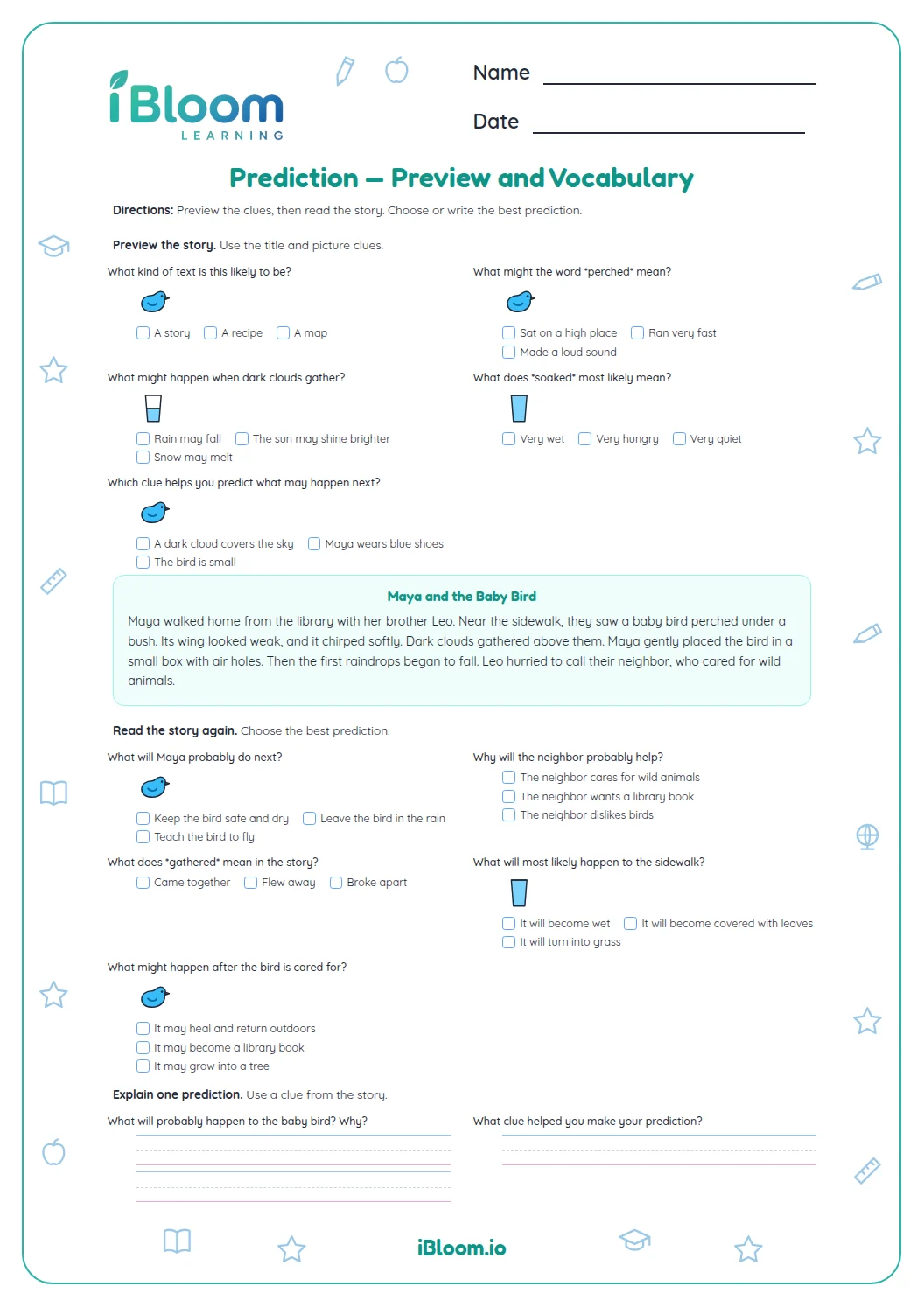
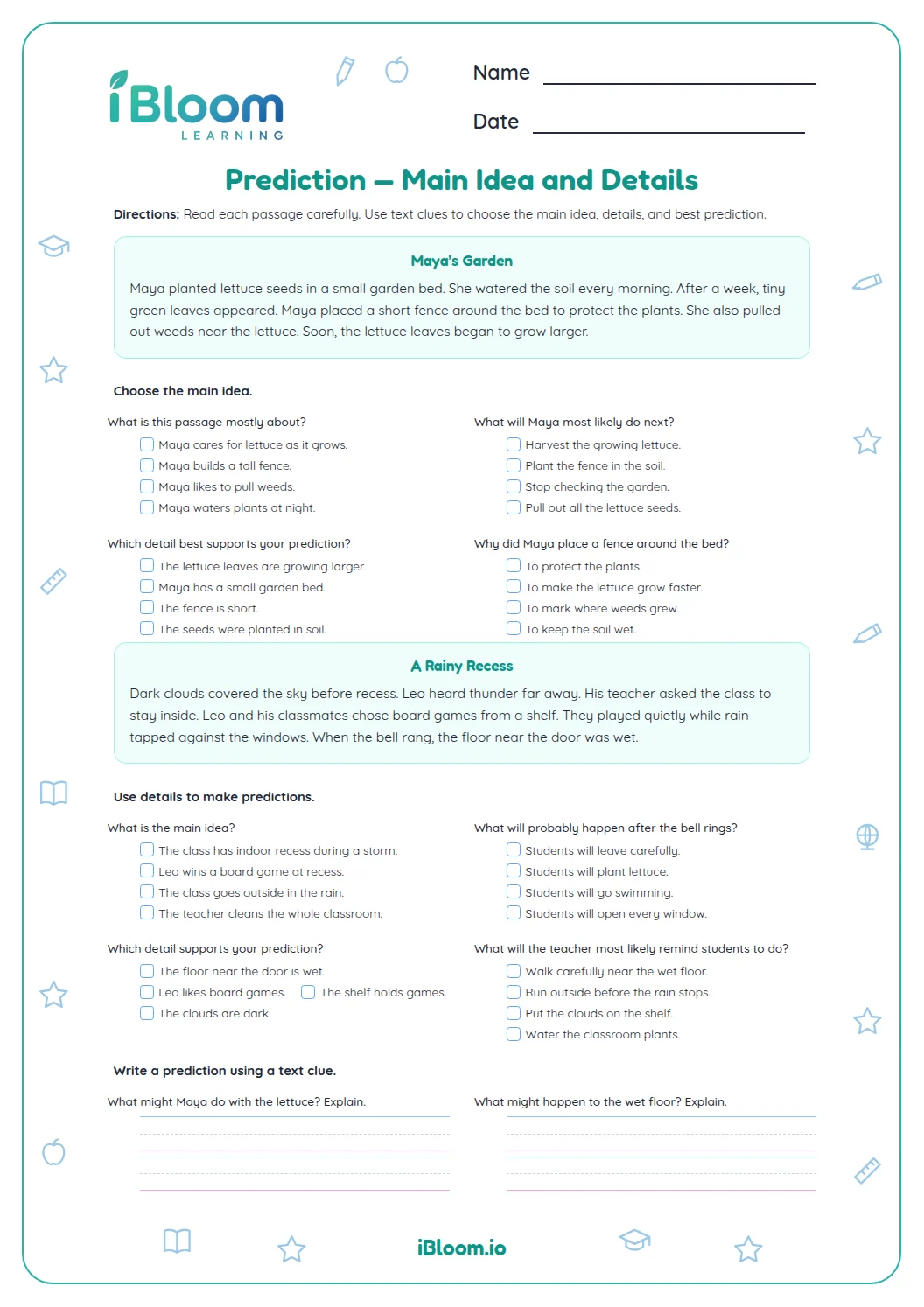

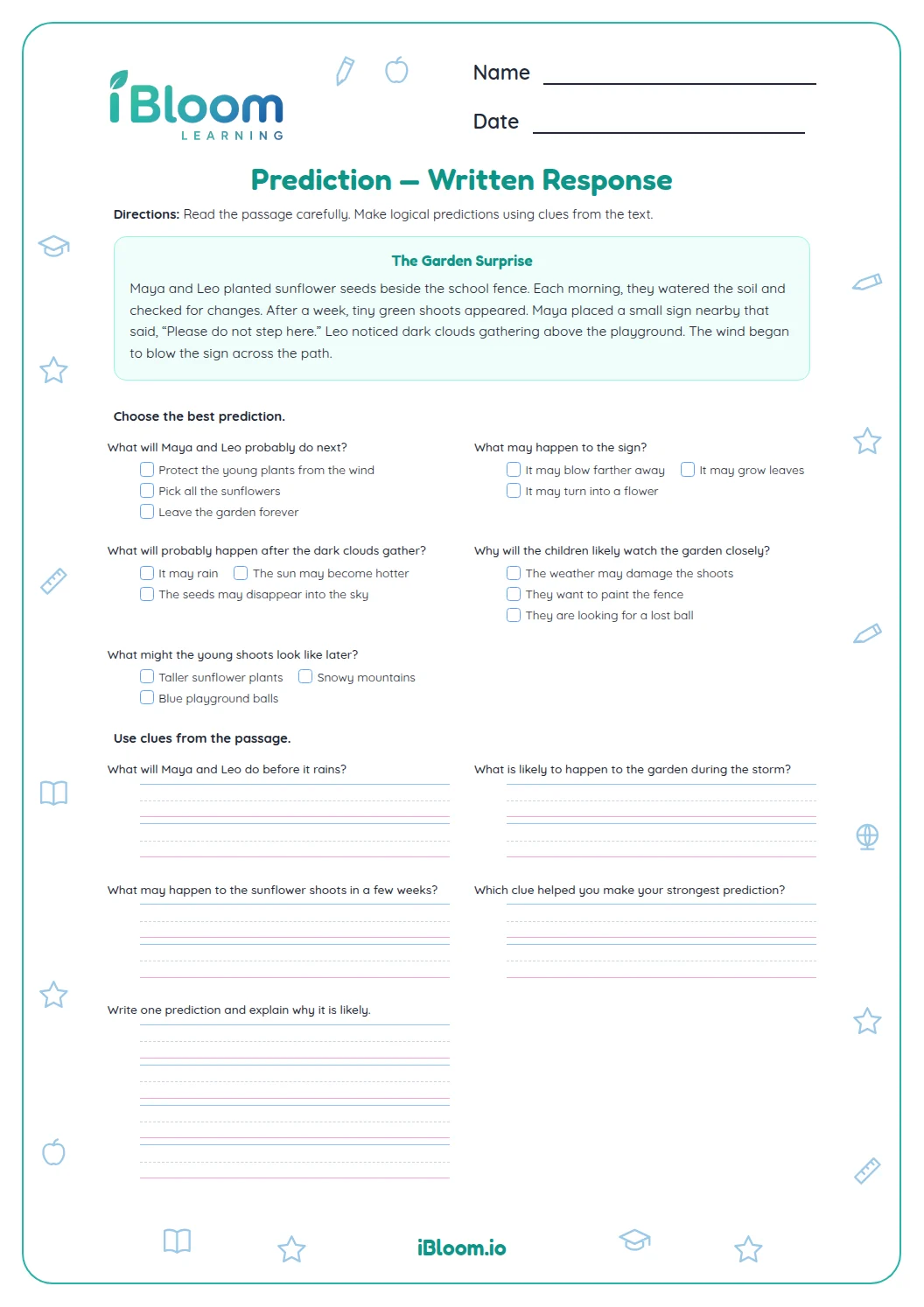
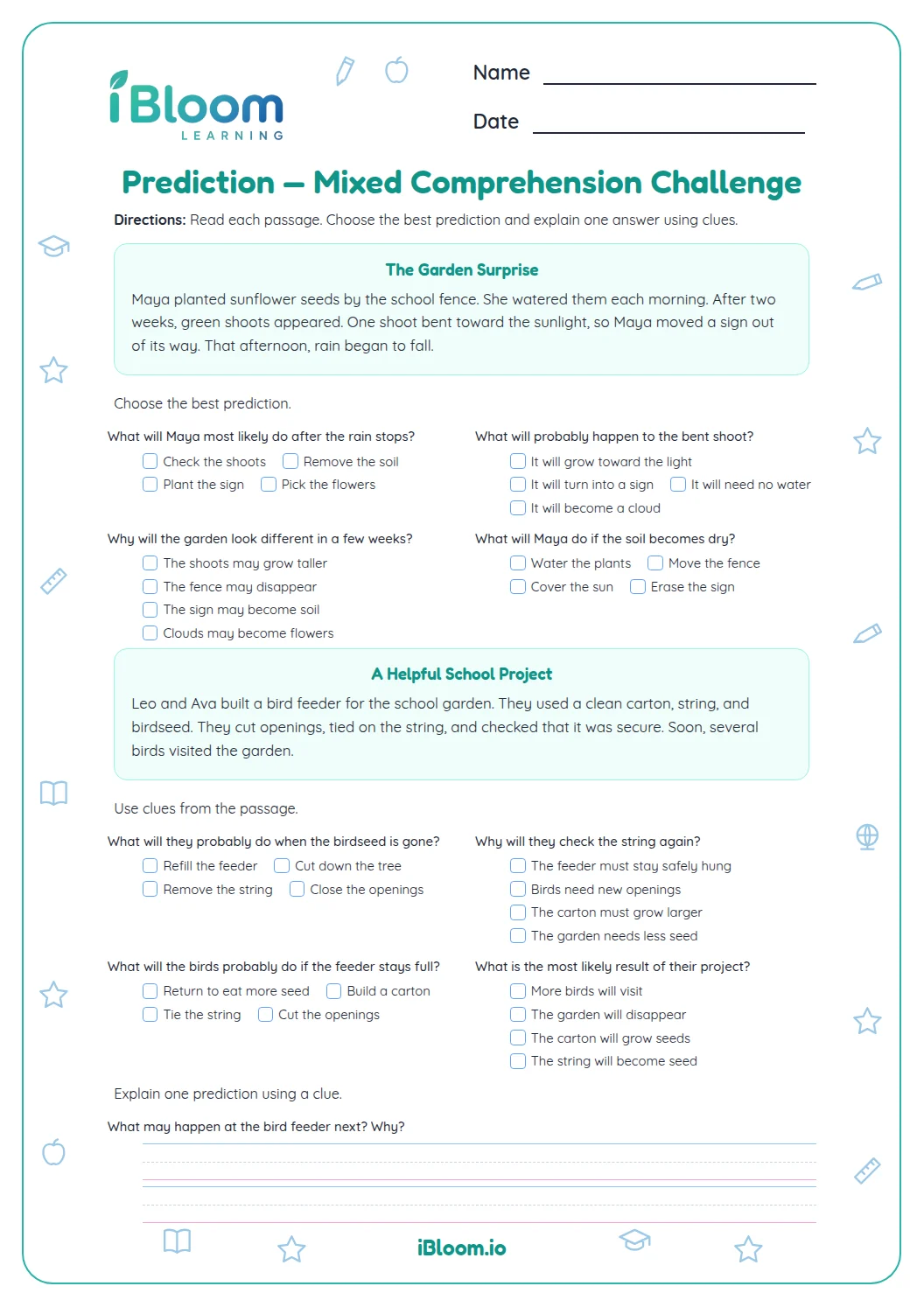




About this worksheet
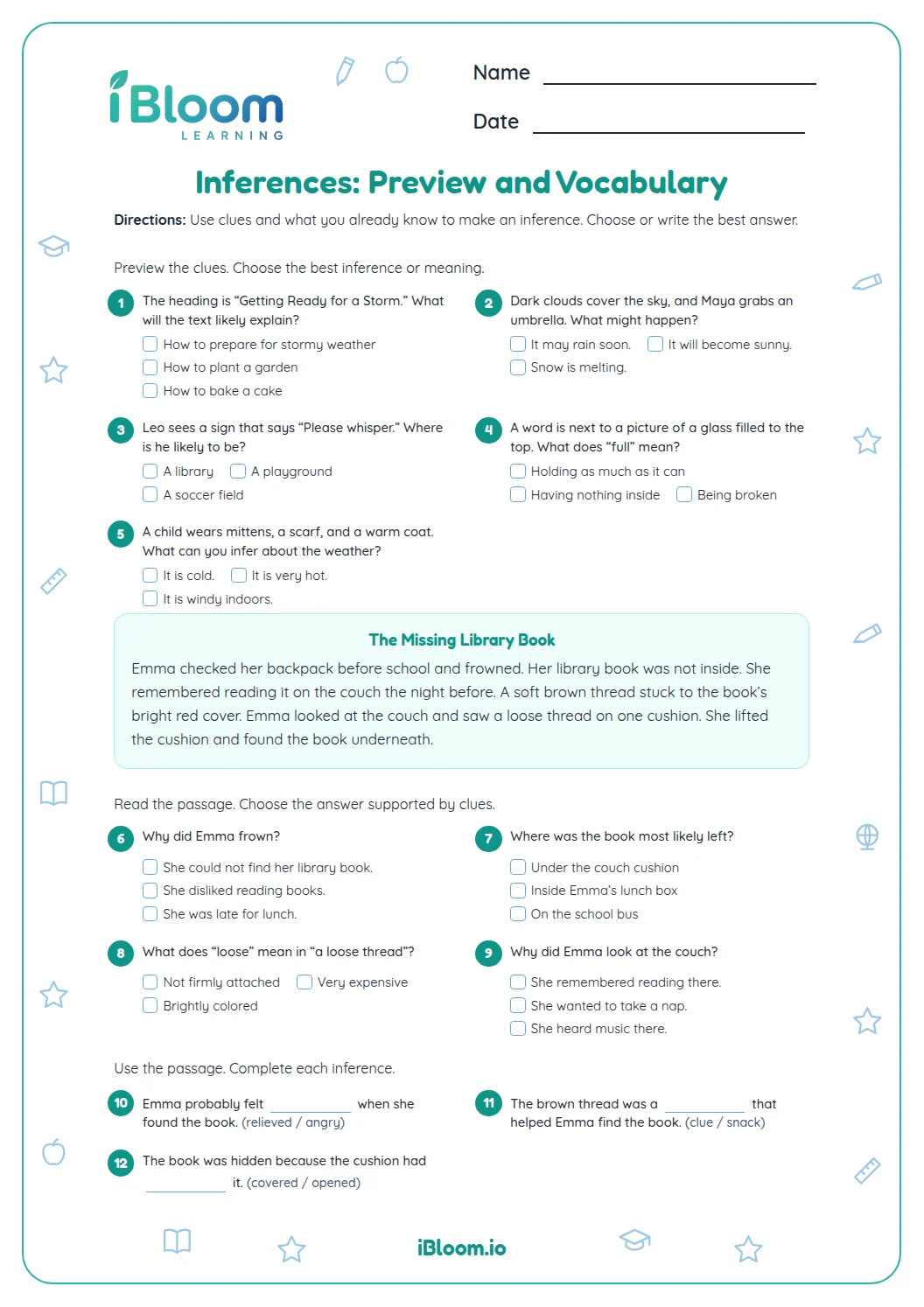
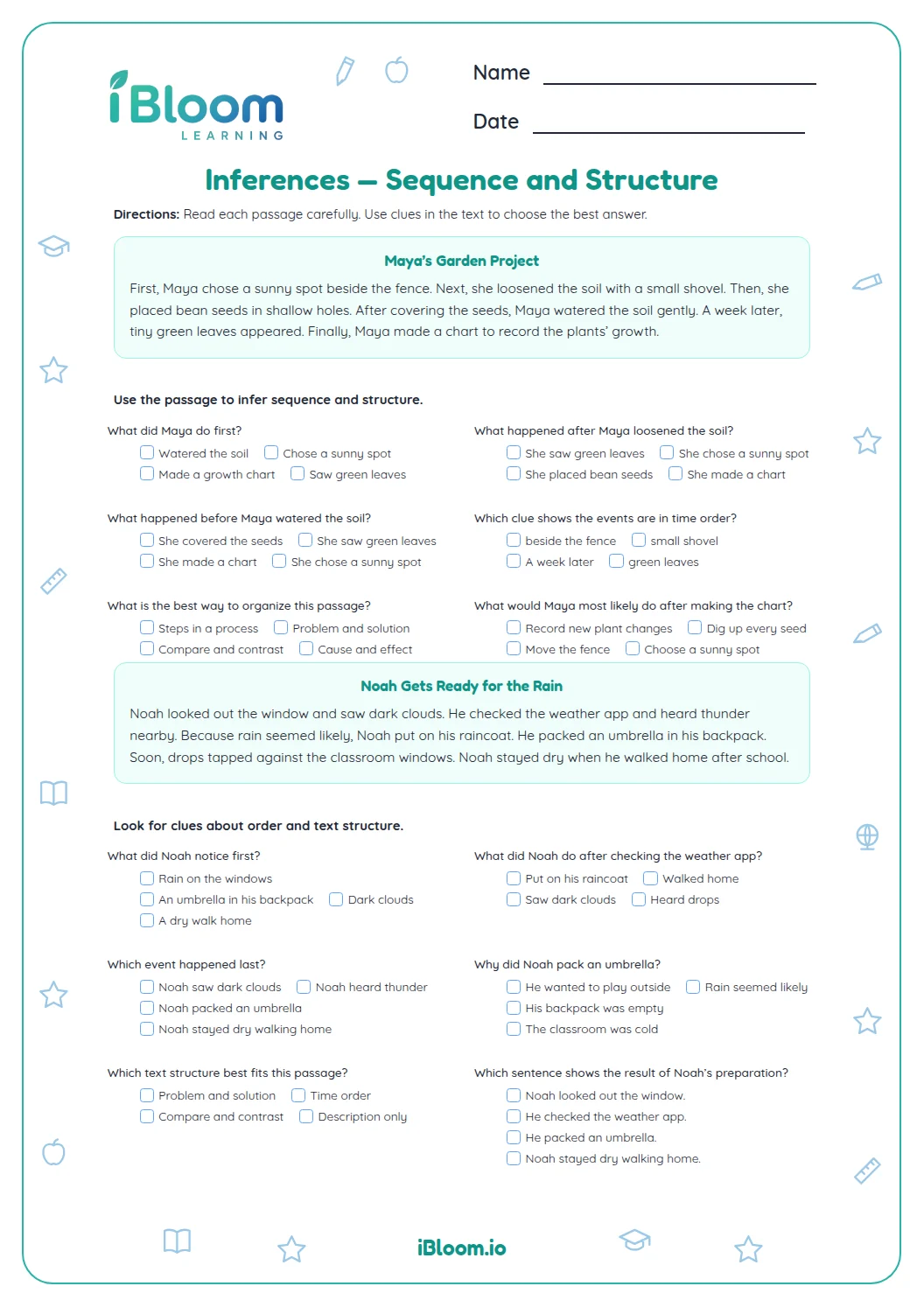
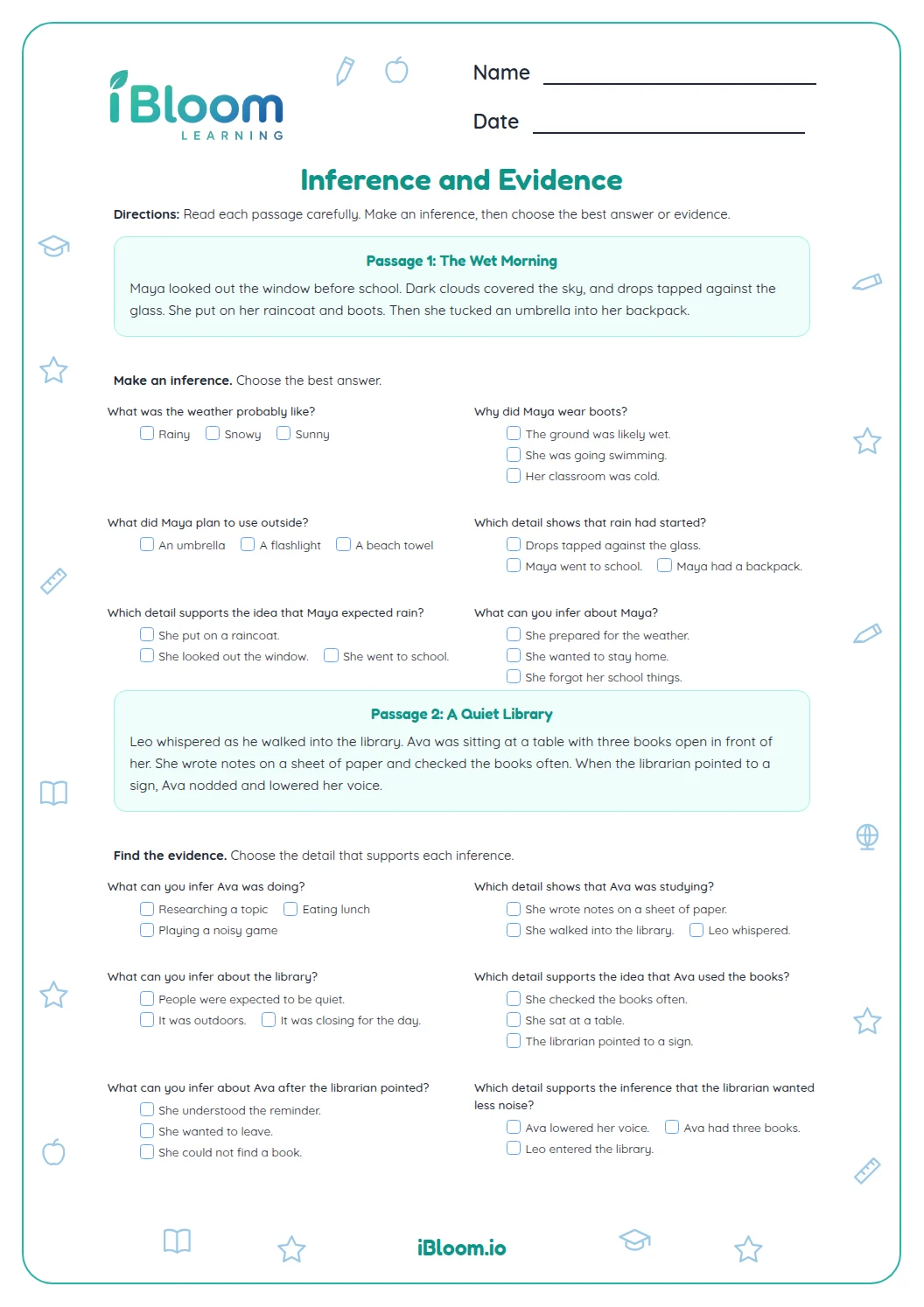
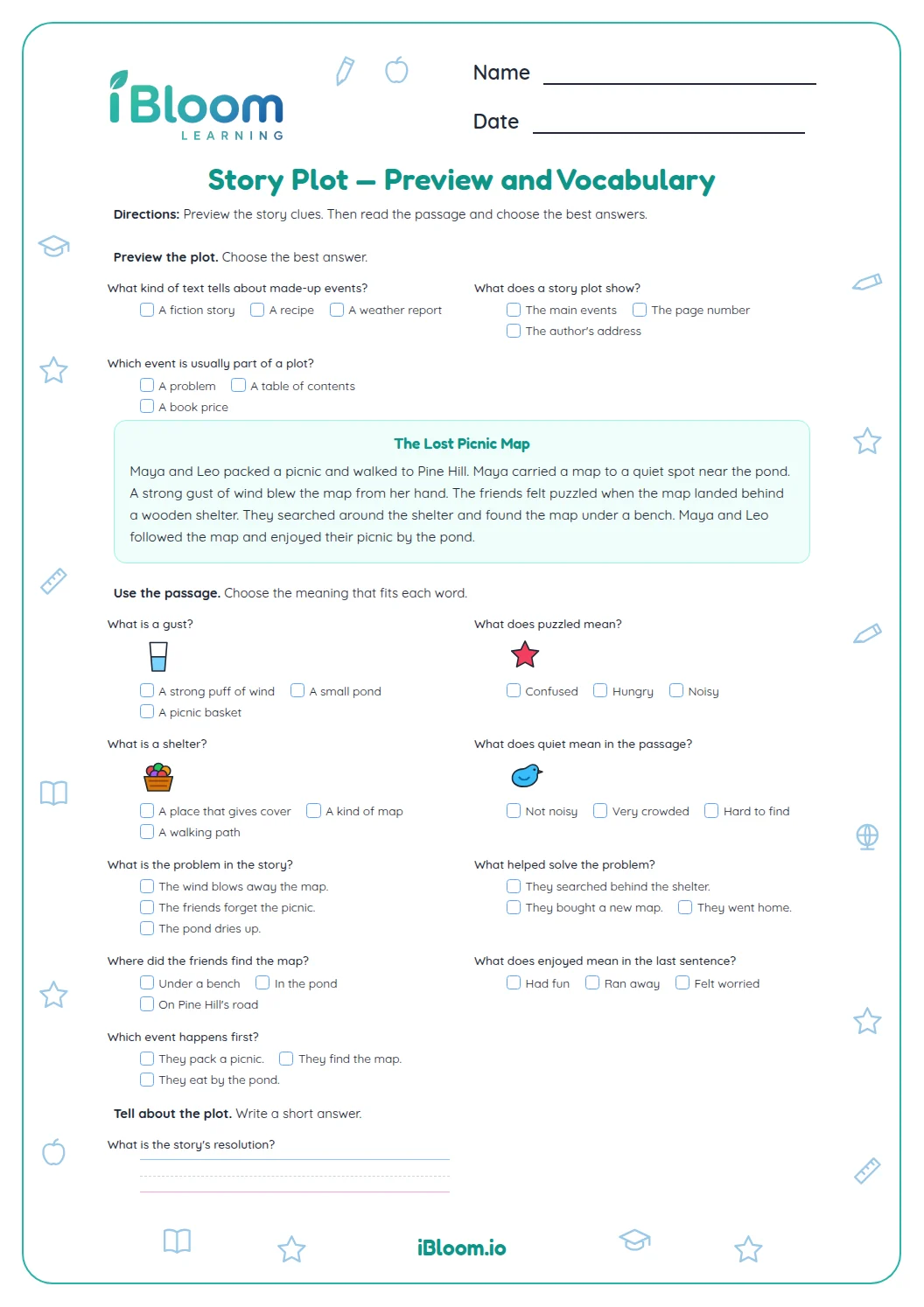
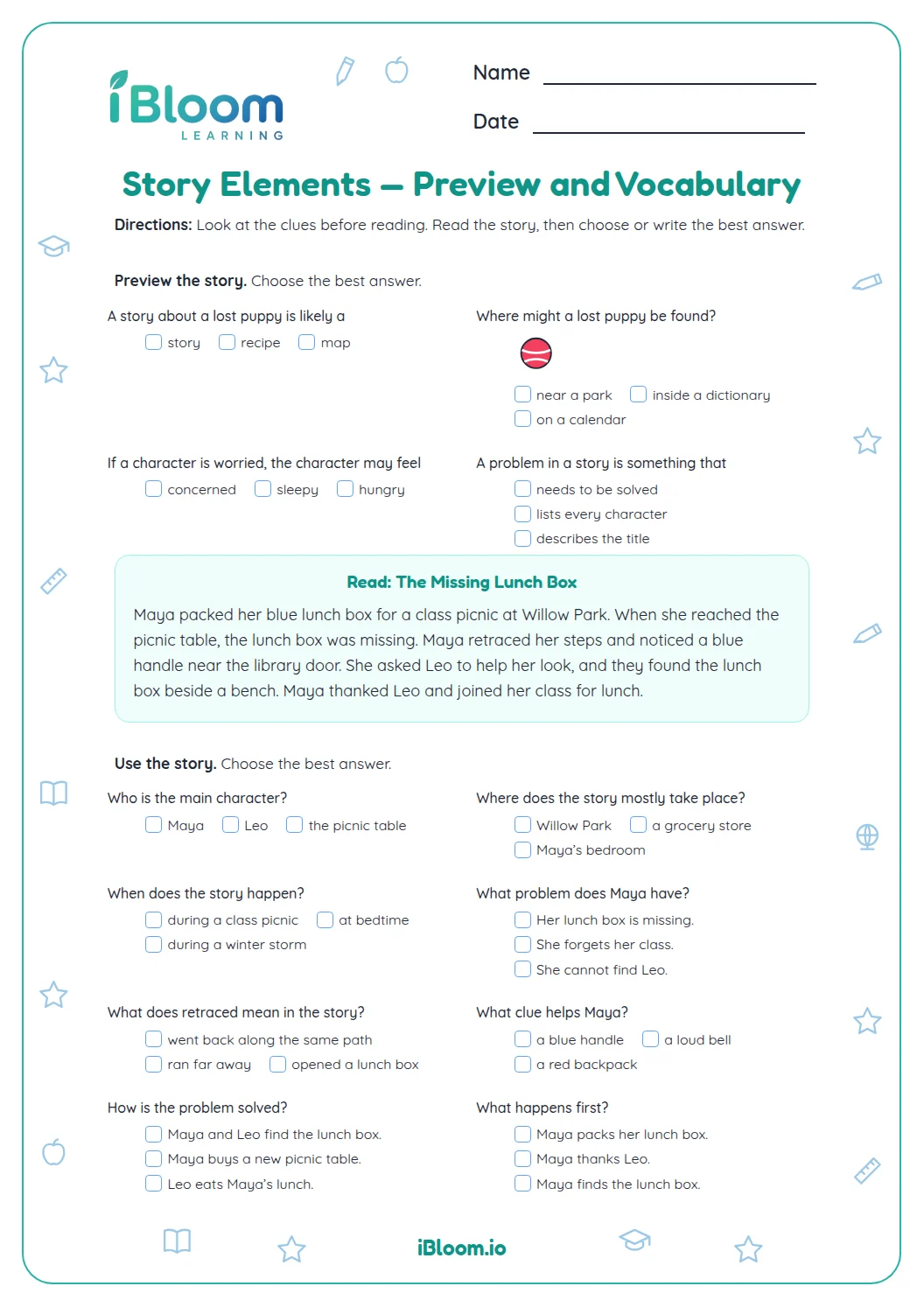
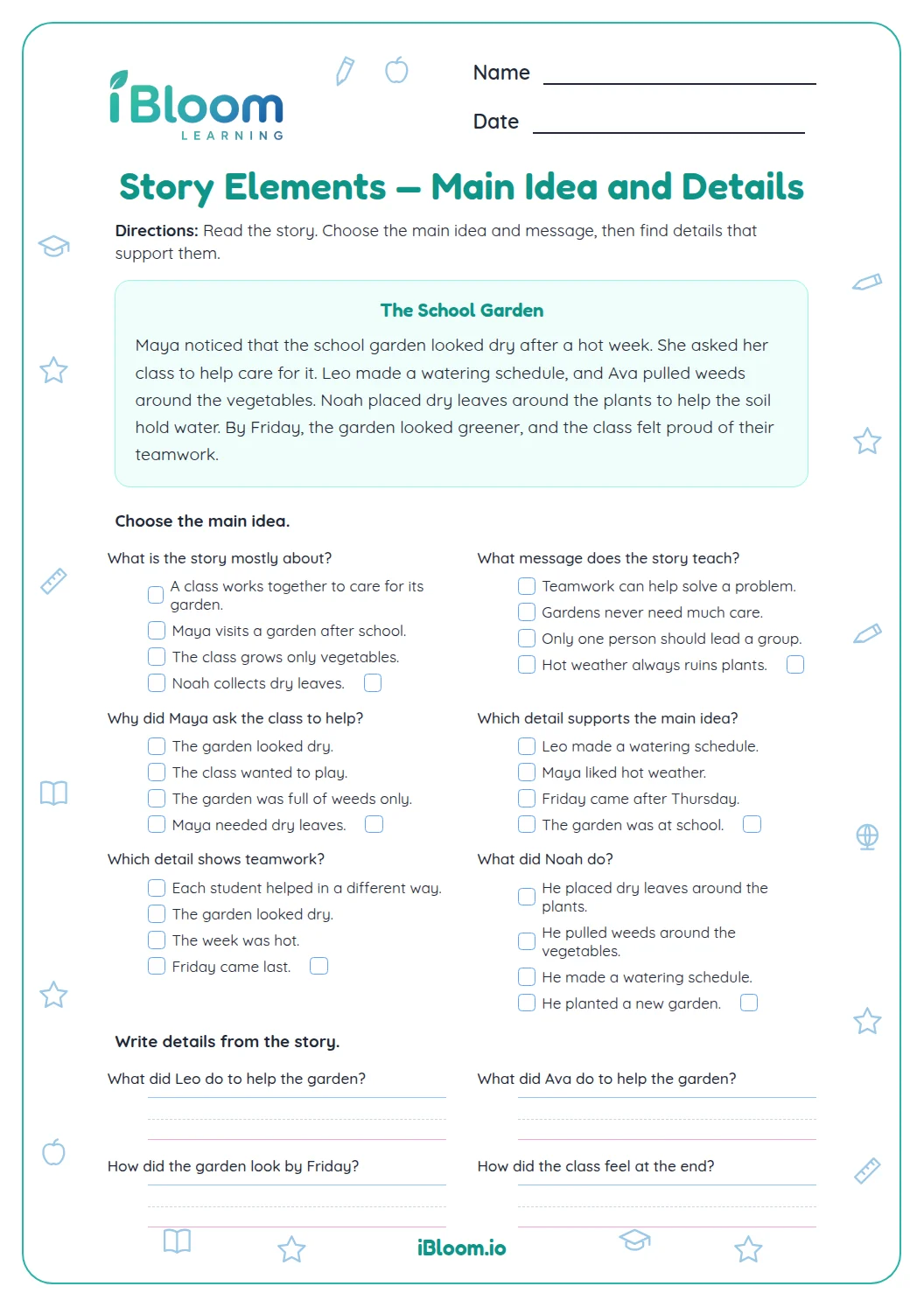
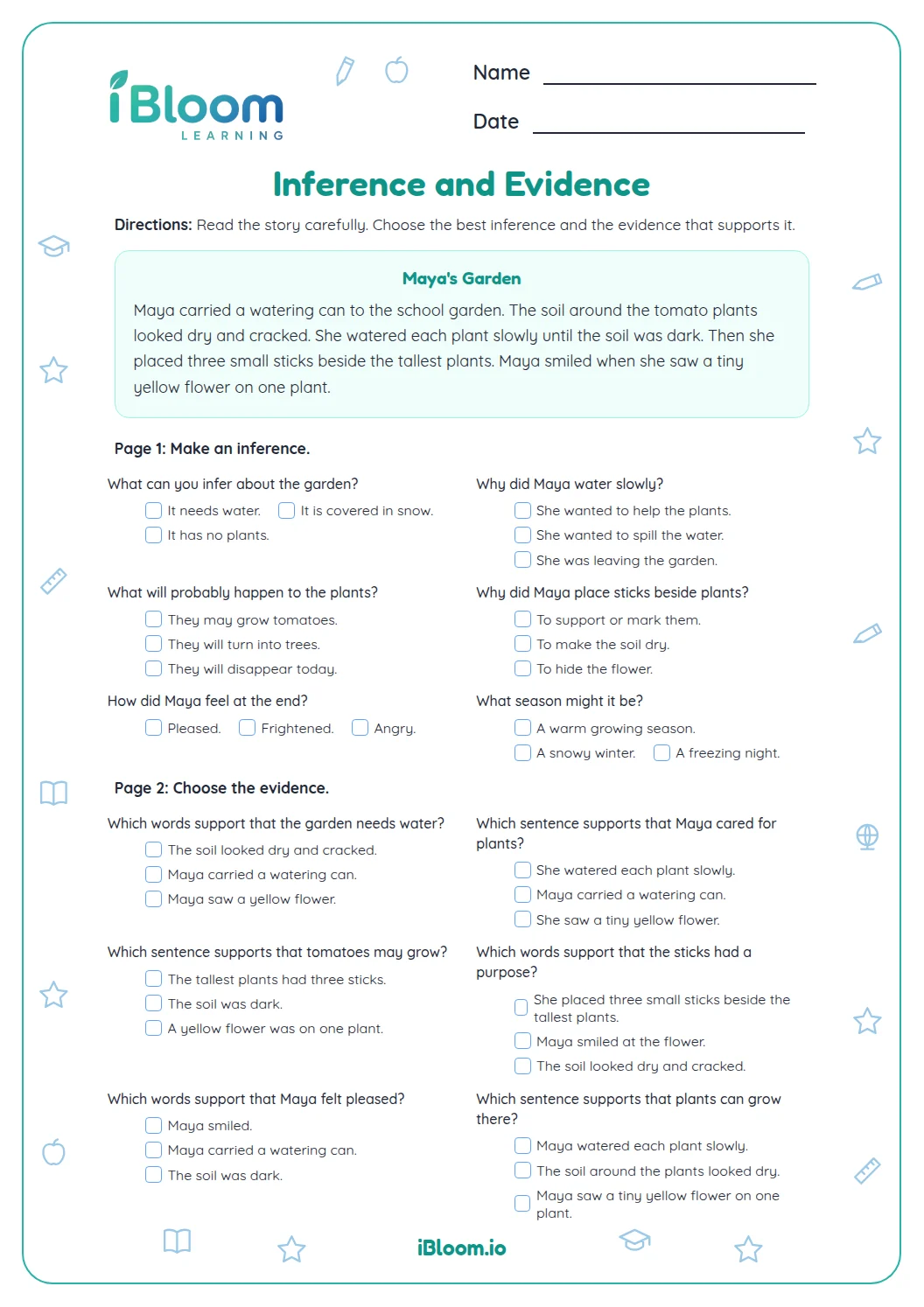
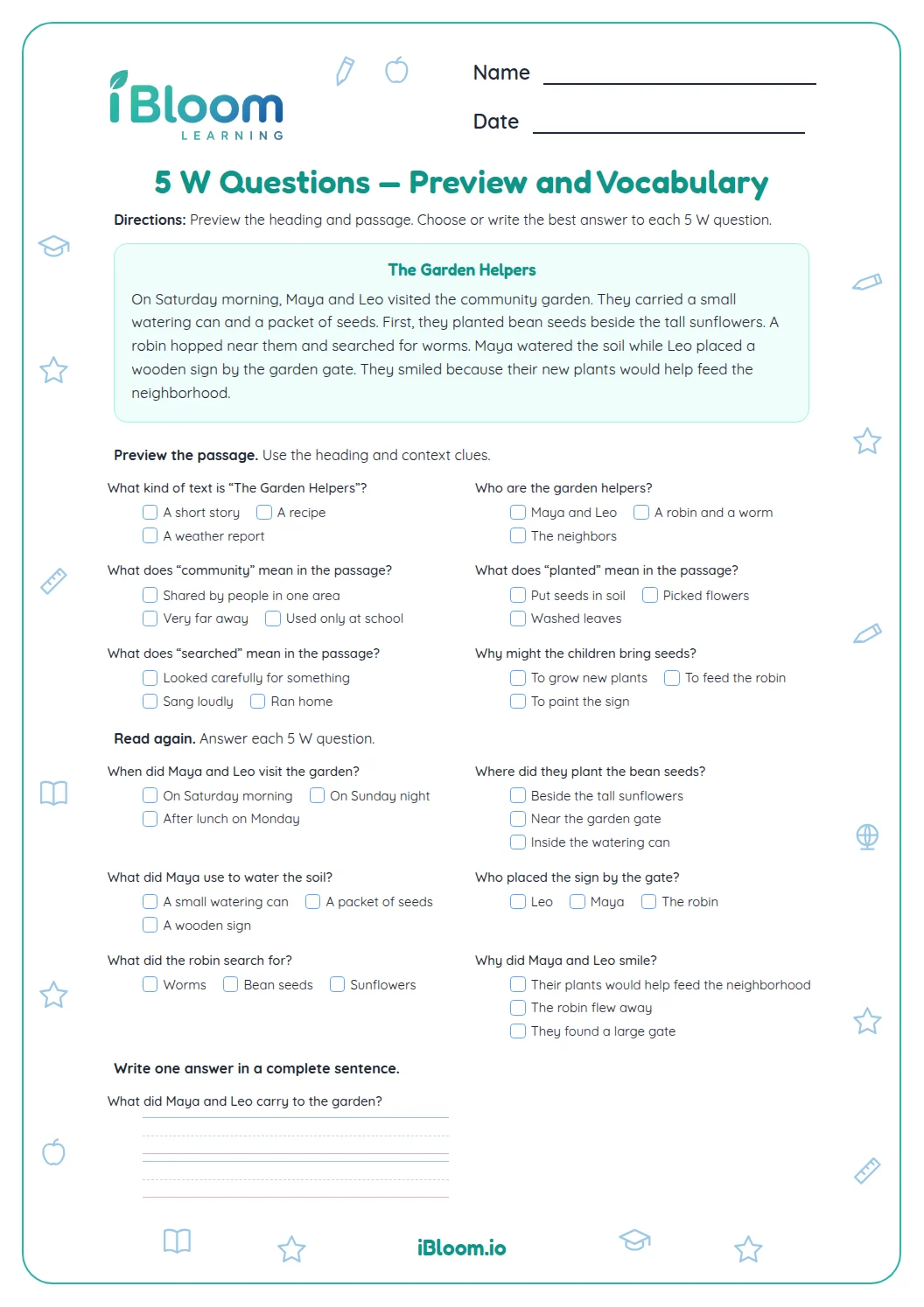
This Grade 3 printable pairs a short original story with questions on prediction, inference, and evidence. Readers consider what Nia and Grandpa may do next, infer why they move the activity, and connect each idea to a detail in the passage. The questions move from selecting a clue to explaining a response. A separate answer key is included.
Aligned to RL.3.1
What makes a prediction reasonable?
A prediction uses what has happened so far to suggest what could happen next. It is a possibility supported by clues, not a guess unrelated to the story.
How do readers infer feelings or causes?
Readers combine a detail with what they know. Dark clouds and Grandpa packing the crayons suggest he notices changing weather.
- 1Clue: The children thanked Nia and Grandpa.
- 2Inference: They enjoyed making bird pictures.
- 3Prediction: They may want to do it again.
How should a reader cite evidence?
Name a specific action, statement, or event from the passage. A brief detail makes the reasoning clear.
How to use this worksheet
- 1Read the passage once to understand what happens.
- 2Underline an action or statement that could be a clue.
- 3Make a likely prediction or inference.
- 4Check that the idea fits the whole passage.
- 5Use a specific detail to explain why it fits.
Common mistakes and quick fixes
The mistake
Making a prediction without a clue
The fix
Point to a sentence that supports the idea.
The mistake
Treating an inference as a stated fact
The fix
Use “probably” when the text suggests but does not directly tell.
The mistake
Choosing a detail that is true but unrelated
The fix
Ask how that detail supports the answer.
Common Core alignment
Support predictions and inferences with details stated in the story.
On this sheet: Readers use story details as evidence for each prediction and inference.
Show the official wordingHide the official wording
Ask and answer questions to demonstrate understanding of a text, referring explicitly to the text as the basis for the answers.
What to practice next
Make more practice
Further reading
Questions parents and teachers ask
How does a child support a prediction?
A prediction is a likely idea about what may happen next. Children should connect it to a detail in the passage, such as the children thanking Nia and Grandpa after the bird-making activity. Ask the reader to point to the clue and explain why it makes the prediction reasonable.
What is the difference between a prediction and an inference?
A prediction suggests what may happen next, while an inference explains something the passage implies. For example, readers infer that Grandpa notices changing weather when he packs the crayons after dark clouds gather. Both kinds of thinking should connect to details in the story.
What evidence does the worksheet ask readers to use?
Readers use actions and details from the park story, including the children thanking Nia, wind lifting pages, and dark clouds gathering. The evidence questions ask children to connect a specific clue with a prediction or inference rather than guess without support.
Can students answer in their own words?
Yes. The multiple-choice questions give a starting point, and an adult can invite the child to explain the choice aloud or point to the related sentence. The answer key lists the best supported answer for each question so the explanation can be checked together.
Does the answer key include predictions?
Yes. The separate key identifies the best supported choice for all 14 questions. Predictions can sometimes vary, so a child may explain another reasonable idea aloud by pointing to a clear story clue, even when the printed key lists one likely response.