

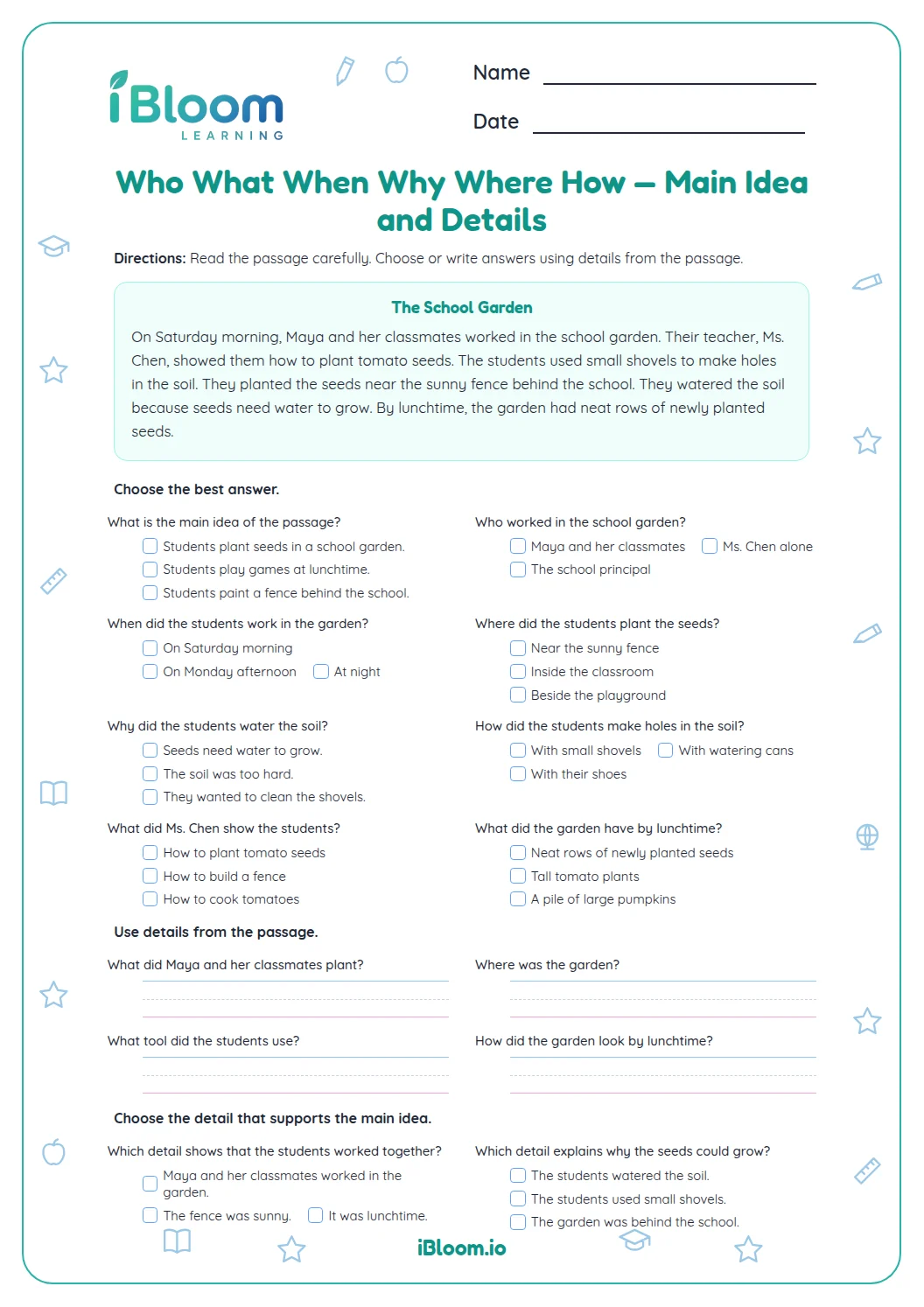
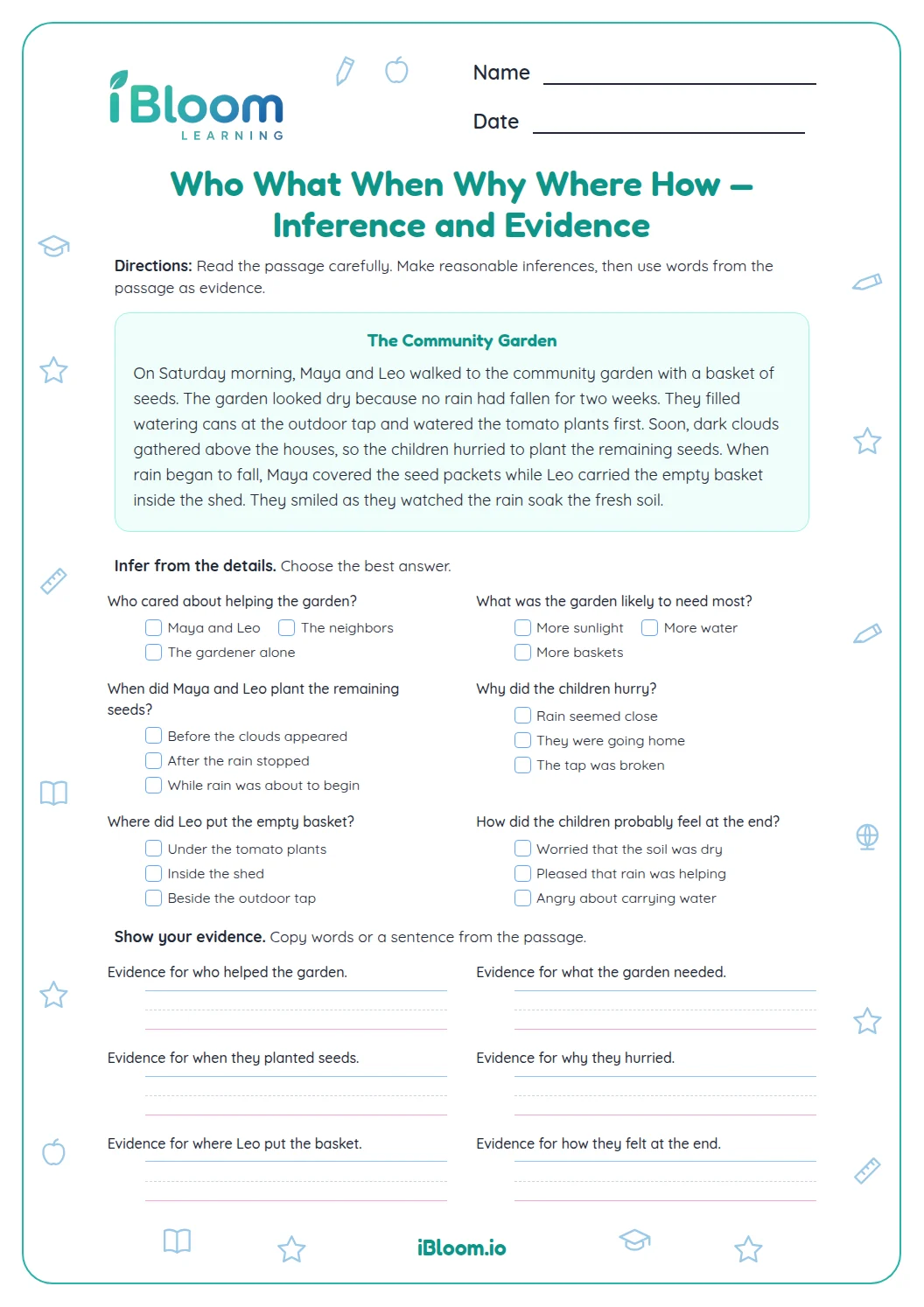
About this worksheet
This Grade 4 printable pairs an original informational passage about a school rain garden with 14 multiple-choice questions. Students identify the main idea and supporting details, then trace how changes to soil and plants affect rainwater and path puddles. The questions ask readers to return to the passage for evidence. The page practices CCSS RI.4.2 and includes a separate answer key.
Aligned to RI.4.2
What is the passage mostly about?
The passage describes a school garden project intended to help manage rainwater. Students change the hard soil, add compost, plant flowers and grasses, and guide roof water toward the garden. The main idea includes both the project and its purpose.
- 1The question asks what the passage is mostly about.
- 2Students improved a garden to manage rain.
- 3That answer includes the project and why the class made the changes.
Which changes led to smaller puddles?
The text links the garden changes to later observations: more water soaked into the garden, and path puddles were smaller during a later storm. Keep the cause (the changes) separate from the effects described afterward.
- Cause: students loosened soil and planted deep-rooted plants
- Effect: more rainwater soaked into the garden
- Observed result: smaller puddles on the path
How do details support the main idea?
A supporting detail gives evidence for the central idea. Reread the sentence around a detail and ask how it connects to the garden’s purpose; precise answers preserve what the passage says, including that puddles became smaller.
How to use this worksheet
- 1Read the passage once to learn what the class changed.
- 2Underline a sentence that states the project’s purpose.
- 3Mark causes and effects as you read the garden steps.
- 4Return to the text to find evidence for each answer.
- 5Check that the main idea covers the whole passage.
Common mistakes and quick fixes
The mistake
Choosing a small detail as the main idea.
The fix
Pick the choice that covers the problem, project and purpose.
The mistake
Reversing cause and effect.
The fix
Ask what happened first and what result followed.
The mistake
Assuming the passage says the path had no puddles.
The fix
Use the precise detail: puddles were smaller, not gone.
This worksheet gives focused practice with the reading and language skills named below.
Identify the rain-garden passage’s main idea and connect it with supporting details.
On this sheet:
Show the official wordingHide the official wording
Determine the main idea of a text and explain how it is supported by key details; summarize the text.
What to practice next
Further reading
Questions parents and teachers ask
What is the rain-garden passage mostly about?
Students changed a school garden to help manage rainwater. The passage explains the original puddle problem, the soil and plant changes, and what students observed during later storms. The questions ask readers to distinguish this central idea from smaller details such as the sign or the playground swings.
What happened to the path puddles after the garden changed?
The passage says the path puddles were smaller during the next storm. It does not say that all puddles disappeared. Students can use this precise result when answering cause-and-effect questions and when choosing details that support the passage’s main idea.
Which garden changes are connected to water soaking in?
The class loosened compacted soil, mixed in compost, planted native flowers and grasses, and made a channel to guide roof water into the bed. The passage explains that loose soil and deep roots can absorb more rainwater, linking the changes to the later observations.
How many questions are included?
There are 14 multiple-choice questions about the single rain-garden passage. They cover the main idea, supporting details, causes and effects, sequence, and a summary. Students can reread the text while working, then use the separate answer key to check each response.
What does “compacted soil” mean in the passage?
Compacted soil is soil pressed tightly together. The passage contrasts the hard, packed garden bed at the start with soil the students loosened and mixed with compost. That comparison helps explain why the changed garden could take in more rainwater.