








About this worksheet
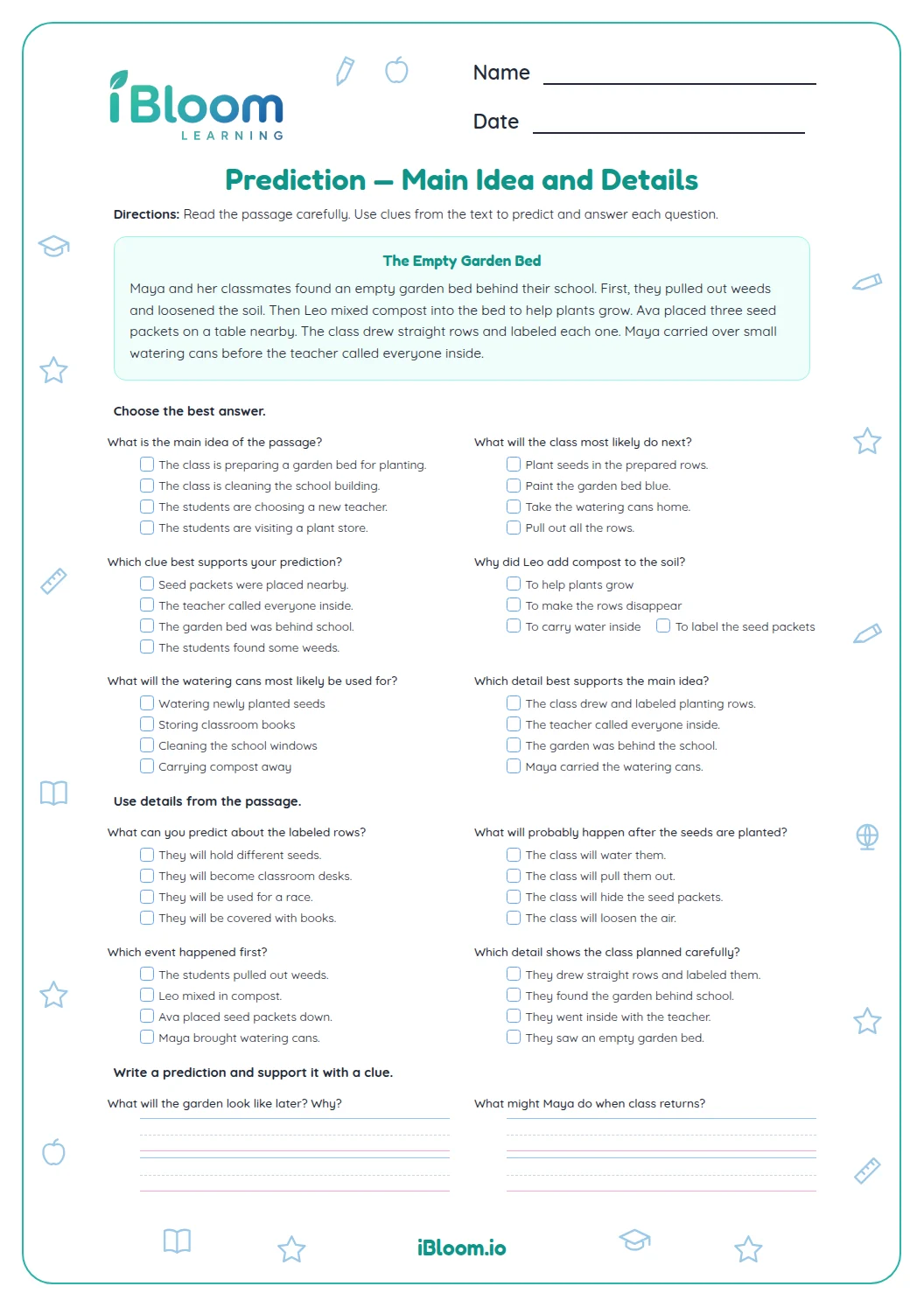
This Grade 4 reading worksheet uses an original passage about students planning a rain garden. Learners answer 14 questions by locating details, making inferences, and predicting what may happen next. Several responses ask for evidence, so students practice linking a reasonable idea to a specific clue. It aligns with CCSS RI.4.1 and includes a separate answer key with sample responses for open-ended items.
Aligned to RI.4.1
How do readers find evidence for a prediction?
Start with what the passage states, then use a detail to make a likely prediction. Questions 11 and 12 pair a prediction with the evidence that supports it.
- 111) The class may record suggestions for the garden.
- 212) The teacher gives them a notebook to collect ideas.
How is an inference different from a stated fact?
A stated fact appears directly in the passage. An inference combines details to explain something the author suggests. For example, the class’s observations, measurements, and planning show that students took an active role.
How can I use this worksheet?
- 1Read the passage once for the main events.
- 2Reread the lines named in each question.
- 3For an inference, combine a clue with what it suggests.
- 4For a prediction, describe a likely next event, not a certainty.
- 5Check that each written answer includes evidence when requested.
What mistakes should learners check?
The mistake
Answering before rereading the prompt.
The fix
Reread and underline the key words.
The mistake
Choosing an answer that is only partly supported.
The fix
Check every detail in the response against the question.
The mistake
Leaving a response unchecked.
The fix
Compare it with the key and correct one step at a time.
Curriculum alignment
Use details and examples to explain a text and support inferences.
On this sheet: Questions ask students to cite passage details and draw supported inferences and predictions.
Show the official wordingHide the official wording
Refer to details and examples in a text when explaining what the text says explicitly and when drawing inferences from the text.
What to practice next
Make more practice
Further reading
Questions parents and teachers ask
How does this worksheet teach prediction?
Students use clues in a passage to make reasonable predictions about what may happen next. Several questions also ask them to name the detail that supports the prediction, so an answer connects an idea to evidence. Ask the child to point to the sentence that supports the prediction.
What is the difference between an inference and a prediction?
An inference explains what a reader can conclude from details already in the text. A prediction uses those details to suggest what may happen later. This worksheet practices both and asks students to point to the clues behind their thinking.
How long is the reading passage?
The original passage has three short paragraphs about a school rain garden. It gives enough details about observations, planning, and a possible next step for students to practice making and supporting inferences. Reread the passage together and find the detail named in the answer.
Are written answers open ended?
Some responses can vary, especially predictions and explanations. The answer key gives sample answers, and a response is reasonable when it uses a passage detail and answers the question directly. Accept another answer when it fits a passage detail and answers the question.
What grade is this worksheet for?
It is written for Grade 4 readers. Students read a informational passage and answer 14 questions about explicit details, clues, inferences, and predictions. The answer key includes sample responses for questions with more than one reasonable answer. The answer key includes sample responses for questions with more than one reasonable answer.
How should a child check a prediction?
Ask whether the text gives a clue that makes the idea likely. A prediction should fit what the passage says, and a student should be able to point to the detail that led to it. Have the reader name the clue before deciding what may happen next.