


About this worksheet
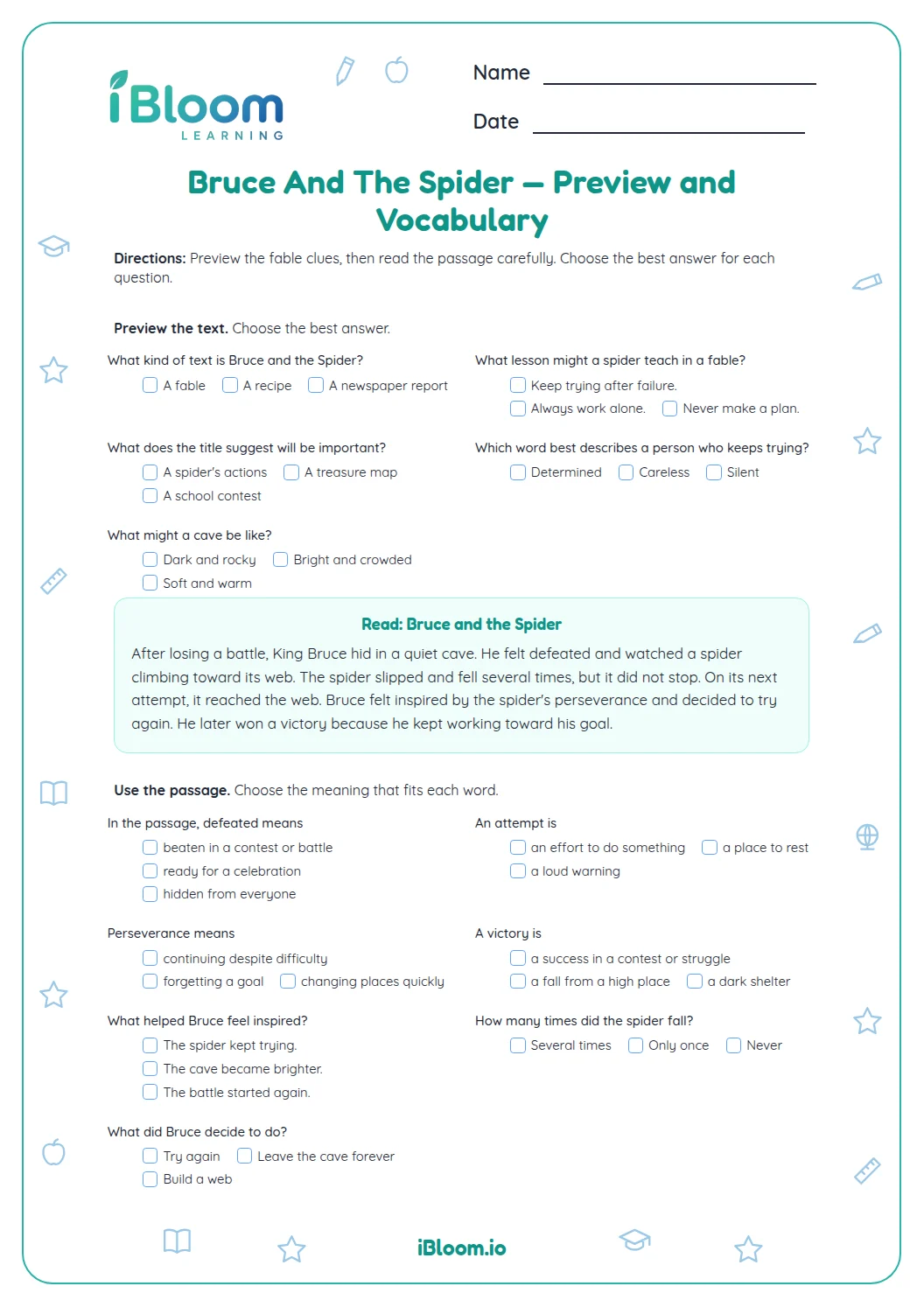
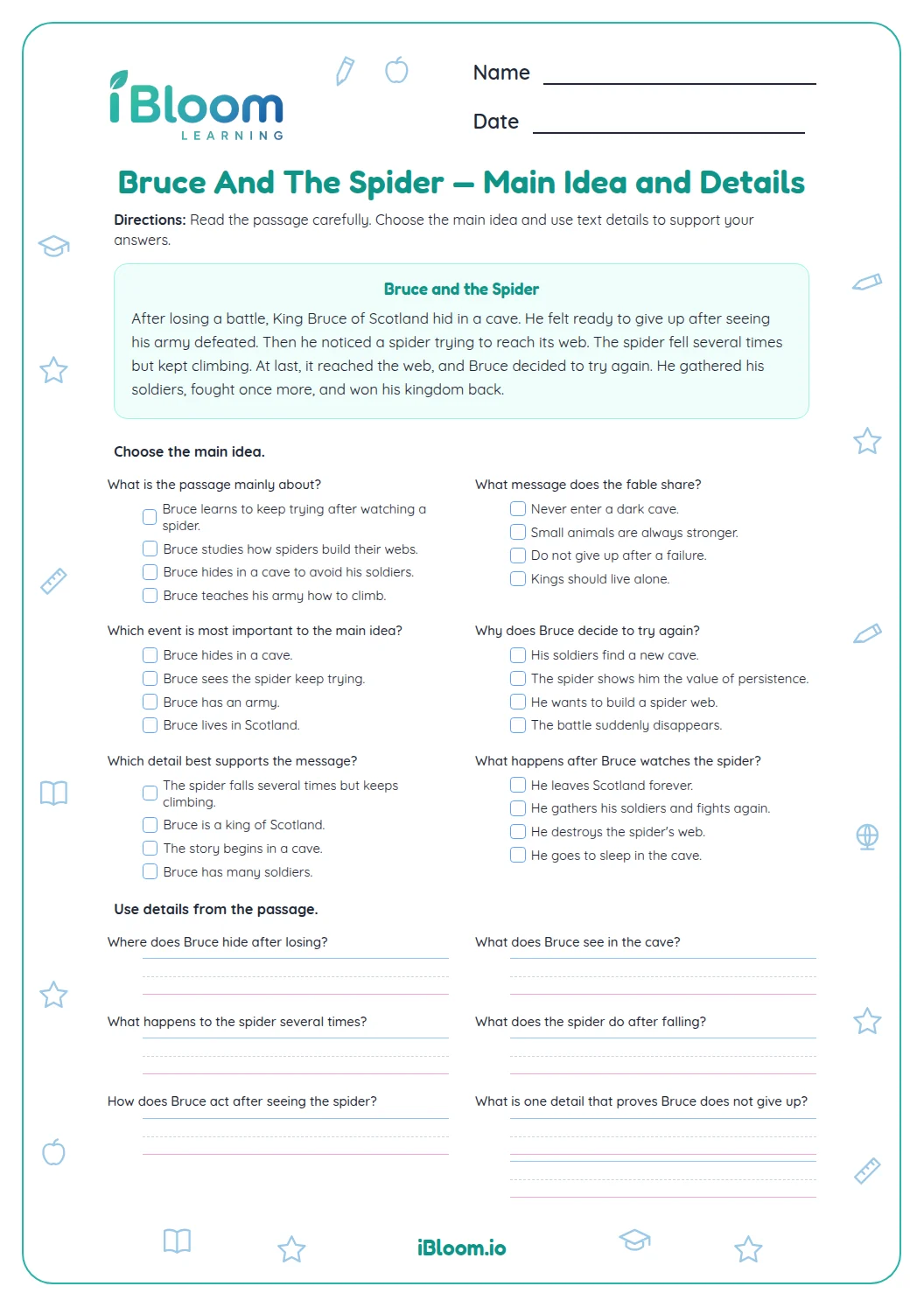
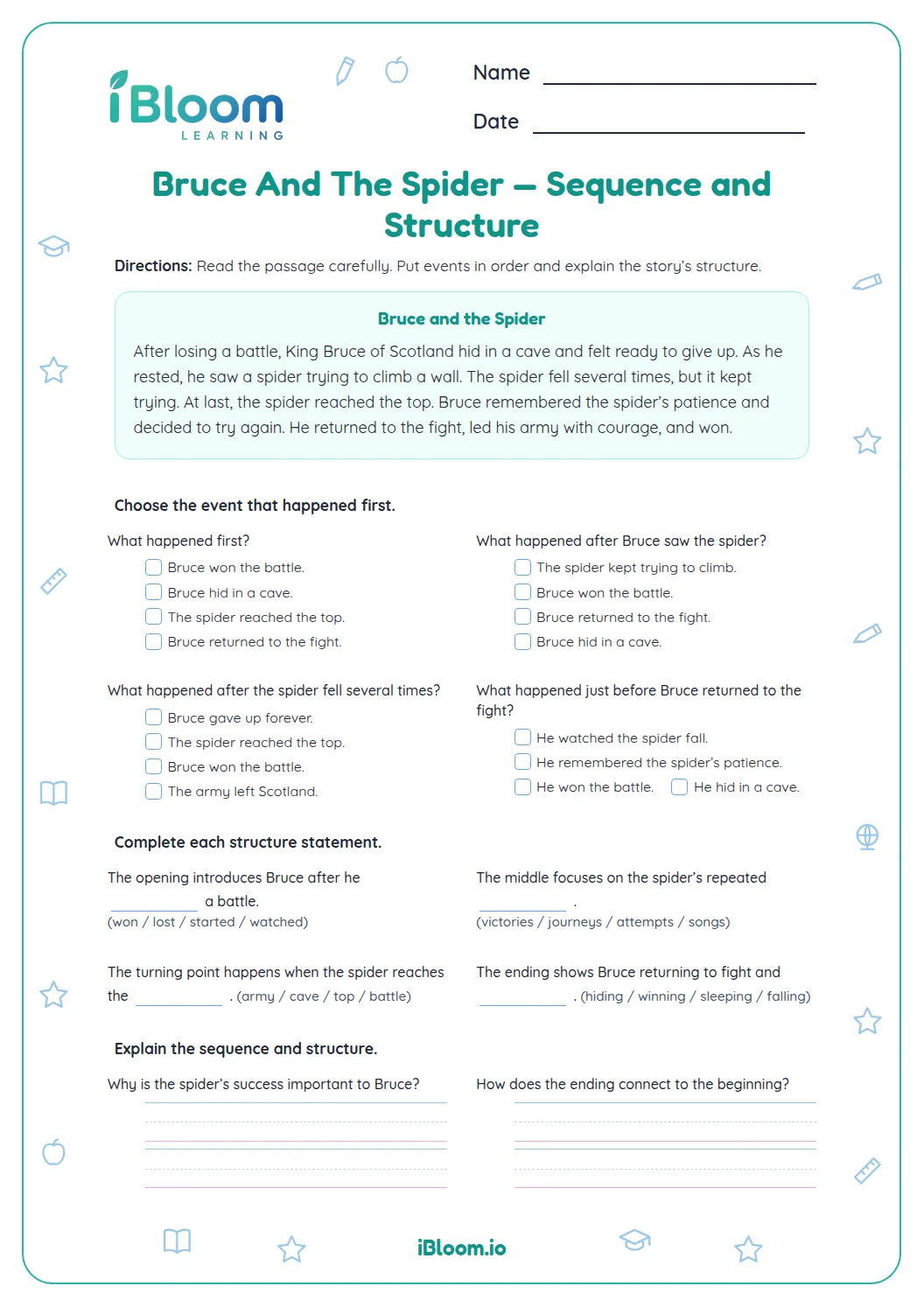
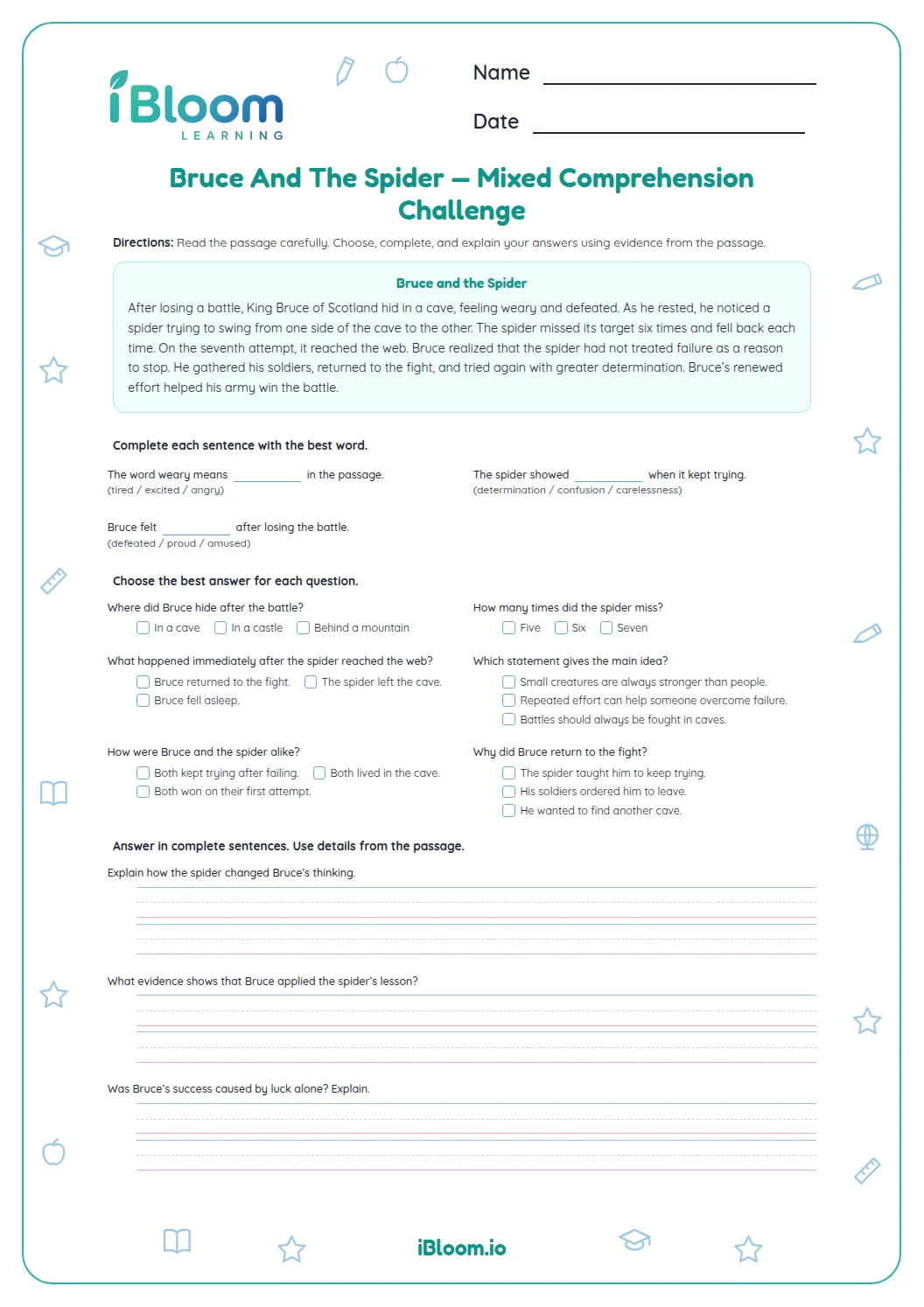
This Grade 5 reading page includes a four-paragraph retelling of Bruce and the Spider and 14 questions. Children recall events, use context clues, sequence actions, infer how the spider affects Bruce, and write responses supported by the passage. A separate key includes sample responses for open-ended questions.
Aligned to RL.5.1
What happens in the passage?
Bruce is discouraged after a defeat. In a cave, he watches a spider fail to reach a beam several times and then succeed. The sight helps Bruce decide to return to his people.
- 1Inference: Bruce decides to try again.
- 2Evidence: he leaves the cave and gathers his followers.
How do I support an inference?
An inference joins a clue from the passage with an idea about what it means. Here, the spider’s repeated attempts offer a clue to why Bruce changes his mind.
What makes a written response clear?
Answer the question in a complete sentence, then include a relevant event or action as evidence. The key gives sample wording while allowing other accurate responses.
How can I use this worksheet?
- 1Read the passage once to understand what happens.
- 2Reread the paragraphs named by the question.
- 3For an inference, connect an action with what it suggests.
- 4Use a specific event as evidence in written responses.
- 5Review the sample answers and improve any response missing evidence.
What mistakes should I watch for?
The mistake
Retelling an event without answering the question.
The fix
Use the key words in the question to shape the first sentence.
The mistake
Giving an inference with no story detail.
The fix
Add an action or event from the passage that supports the idea.
The mistake
Treating the lesson as a guaranteed outcome.
The fix
Explain that persistence can encourage another attempt, even when success is uncertain.
Common Core alignment
This practice connects the worksheet tasks to the standard below.
Quote accurately when explaining explicit meaning and inference.
On this sheet: Written responses refer to story events and evidence.
Show the official wordingHide the official wording
Quote accurately from a text when explaining what the text says explicitly and when drawing inferences from the text.
What to practice next
Make more practice
Further reading
Questions parents and teachers ask
What is the story about?
This original retelling follows Bruce after a defeat, as he watches a spider keep trying to reach a beam. Bruce decides to return to his followers. The story presents the spider as an example that influences his choice; readers use details in this version when answering.
How many questions are included?
There are 14 written-response questions about events, vocabulary, sequence, persistence, and character decisions. They are arranged in three question parts after the passage. Most answers can be written as a concise sentence grounded in the story. The separate key includes concise answer models.
What counts as a strong written response?
A strong response answers the question clearly and uses an accurate detail from the passage. For question 7, the text detail “It tried again” supports the idea that the spider persists after a fall. Other answers should stay consistent with the story.
Does the story say the spider succeeded on a particular numbered try?
No. This retelling says the spider slipped, tried again, and later caught the beam, but it gives no attempt count. Readers should describe the repeated effort without adding a number the passage does not provide. That preserves the uncertainty stated in the passage.
How should I use the answer key?
The key gives concise model answers for the 14 questions. Accept other wording when it answers the prompt accurately and matches a passage detail. For an inference, ask the learner to point to the event that supports the response. A correct response need not copy the key word for word.