








About this worksheet
This Grade 1 science worksheet helps children apply ideas about sound and pitch to familiar objects. Students compare high and low sounds, connect a vibrating ruler, string, drum, or bell with sound, and plan a simple fair test. The 15 questions move from choosing an example to explaining what changes during an investigation. The answer key includes concise responses for checking the science reasoning. The page aligns with NGSS 1-PS4-1 through observing vibrating materials and the sounds they make.
Aligned to 1-PS4-1
How can you tell a high pitch from a low pitch?
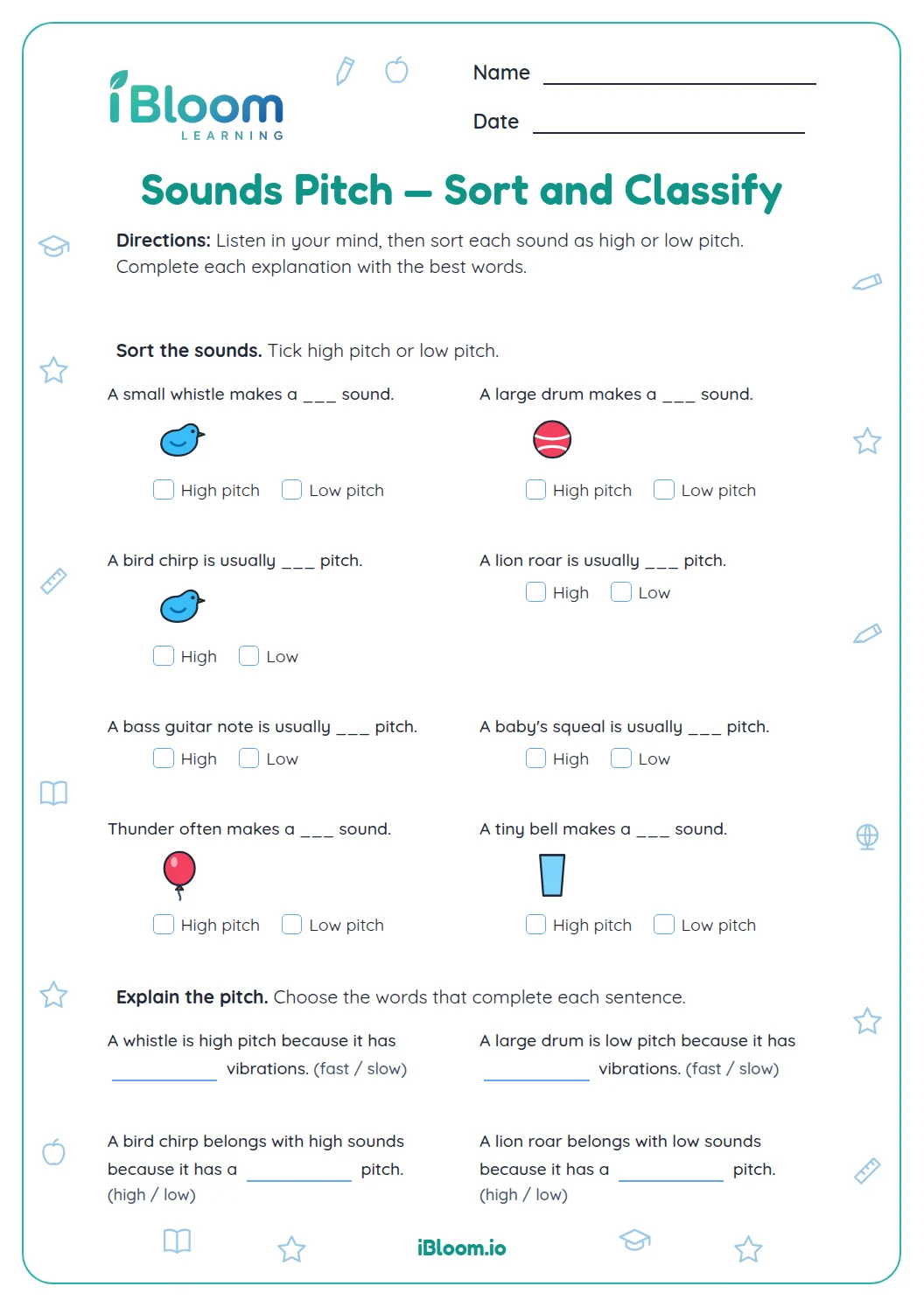
Pitch is how high or low a sound seems. Questions 1 and 8 compare a bird chirp, flute, and drum. Loudness is a separate feature: tapping a drum harder can make it louder without making its pitch higher.
- 1A flute plays above a drum in pitch. Which sound is higher?
- 2Answer: the flute. The question compares high and low, not loud and soft.
What does vibration have to do with sound?
A vibrating object moves back and forth. Students apply that idea to a plucked rubber band, a ruler hanging over a desk, a drum top, and a ringing bell. A gentle observation helps make an invisible sound source easier to understand.
- 1A drum is tapped harder. What changes most?
- 2Answer: loudness. A harder tap does not automatically mean higher pitch.
How can children compare sounds fairly?
Change one feature at a time and keep the other conditions steady. Question 13 asks what stays the same in a ruler test: how hard each ruler is plucked. That keeps the comparison focused on ruler length.
How to use this worksheet
- 1Read the choices aloud and talk about which sound seems high or low.
- 2Ask what object is moving when a sound begins.
- 3Answer each short question with the science idea or example that fits.
- 4For question 13, keep the plucking force the same while comparing ruler lengths.
- 5Use the key to discuss any answer that names the right observation in different words.
Common mistakes and quick fixes
The mistake
Mixing up pitch and loudness.
The fix
Ask whether the sound is high or low, then separately whether it is loud or soft.
The mistake
Saying sound comes from an object without movement.
The fix
Look for the vibrating part, such as a string or drum top.
The mistake
Changing two things in a comparison.
The fix
Keep plucking force the same while changing only ruler length.
Next Generation Science Standards
This page connects sound observations with a simple investigation about vibration and pitch.
Use observations of vibrating objects to explain how sounds begin.
On this sheet: Questions connect observable vibration with sounds made by strings, rulers, drums, and bells.
Show the official wordingHide the official wording
Plan and conduct investigations to provide evidence that vibrating materials can make sound and that sound can make materials vibrate.
What to practice next
Make more practice
Further reading
Questions parents and teachers ask
What does pitch mean?
Pitch describes how high or low a sound seems. On this page, students compare a bird chirp, a drum, and other familiar sounds. Loudness is separate: a sound can be loud or soft without changing from high pitch to low pitch.
How does a vibrating object make sound?
A vibrating object moves back and forth quickly and makes the surrounding air vibrate too. The worksheet asks students to connect that movement with sounds from a drum, rubber band, ruler, and bell. They can watch a ruler or string move as it sounds.
Does a louder sound always have a higher pitch?
No. Loudness and pitch describe different features of sound. A drum can be tapped softly or loudly without changing its basic low pitch. Students practice identifying the change in loudness separately from a change from a low note to a high note.
What is a fair test with rulers?
Change one feature at a time and keep the plucking force the same. For example, compare a short hanging ruler end with a longer end while plucking each equally. Then listen for a difference in pitch and repeat the comparison.
What materials can we use to explore sound?
A ruler, rubber band, bowl, drum, or bell can make a useful sound for observing vibration. Use objects safely and gently, and do not strike glass or other fragile items. Ask the child what moved and whether the sound seemed high or low.
How can I help my child answer the questions?
Invite your child to say what they would observe before choosing an answer. Ask, “What is moving?” and “Does that sound seem high or low?” The key gives concise sample responses for the short answers, so a clear equivalent observation is also acceptable.