




About this worksheet
This free printable is for Grade 1 students practicing pushes, pulls, and motion. It has 14 questions with a separate answer key. The examples build from the core idea to independent practice.
How can a push or pull change motion?
A force is a push or a pull. A force can make a still object move, slow or speed a moving object, or change its direction. The questions use everyday situations so students can connect the force with the motion that follows.
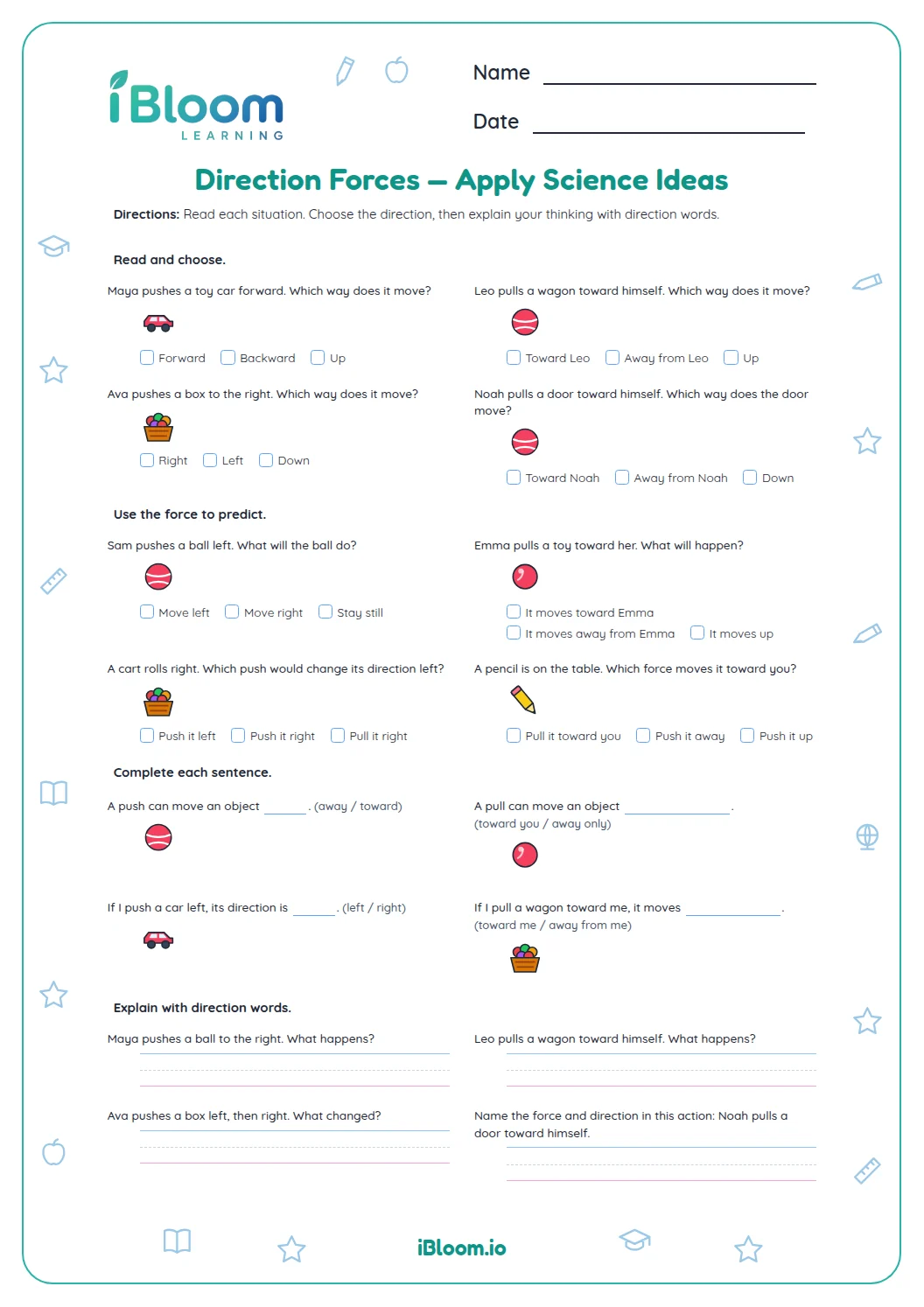
In question 1, the toy car is still. A push forward can start it moving forward.
- 1A toy car is still. Which push starts it forward?
- 2A forward push acts in the direction the car will start moving.
- 3Answer: Push forward.
How does force direction matter?
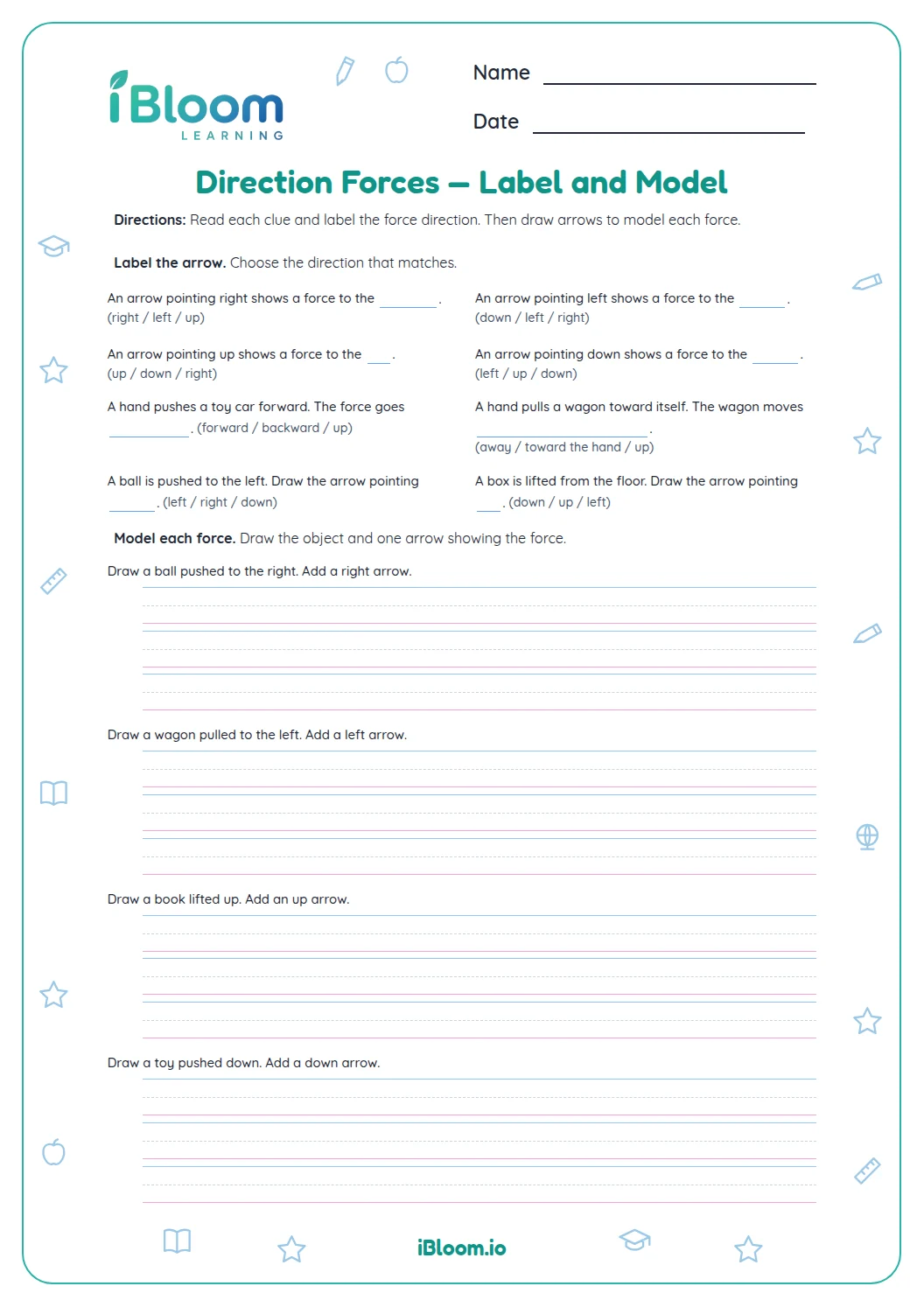
Think about where the force acts and which way it pushes or pulls. A push from the right can send a ball toward the left; a pull to the right can start a still cart moving right.
When an object is already moving, its motion and the new force both matter. Read whether the prompt says the object is still or already rolling.
What is on the printable?
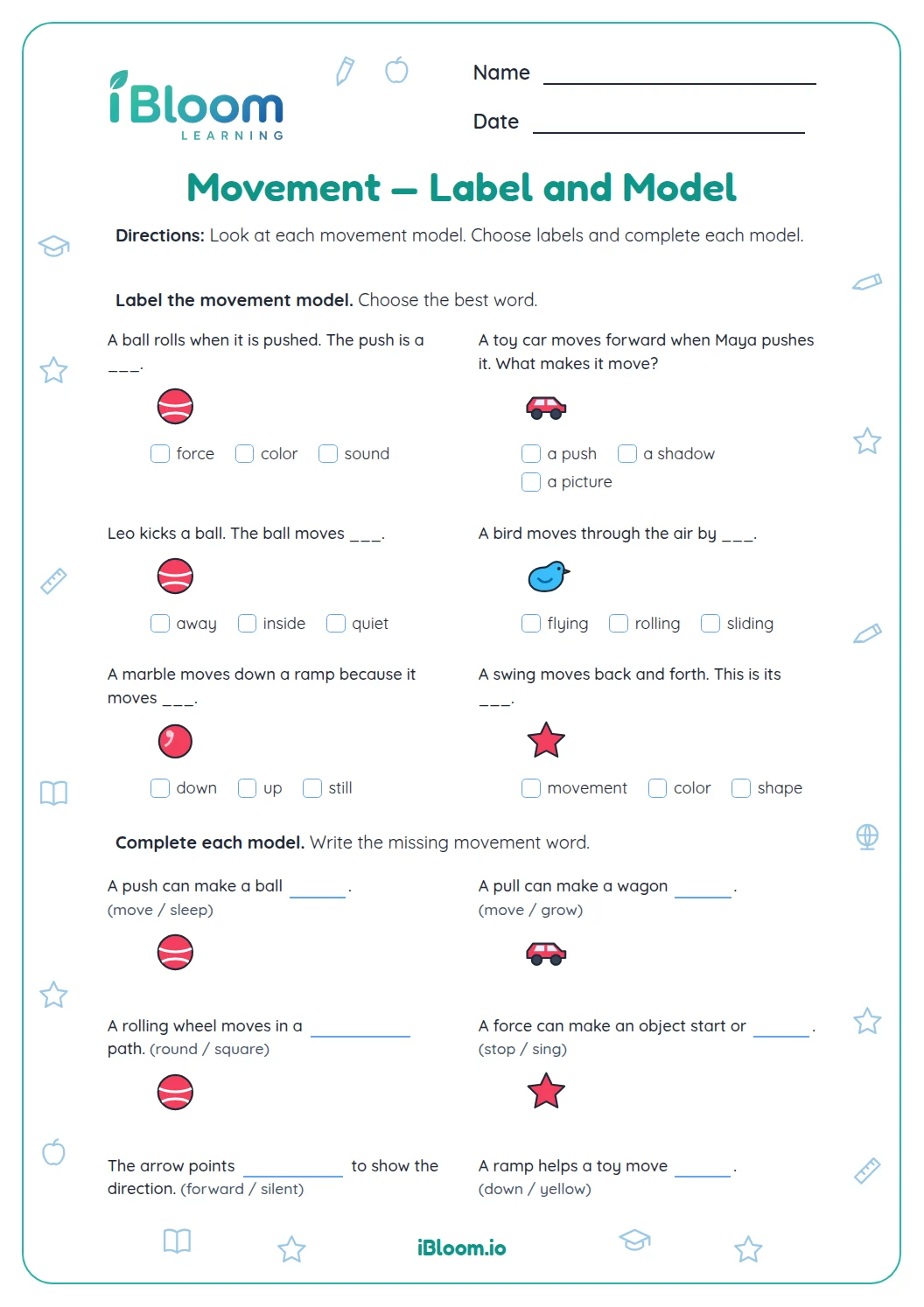
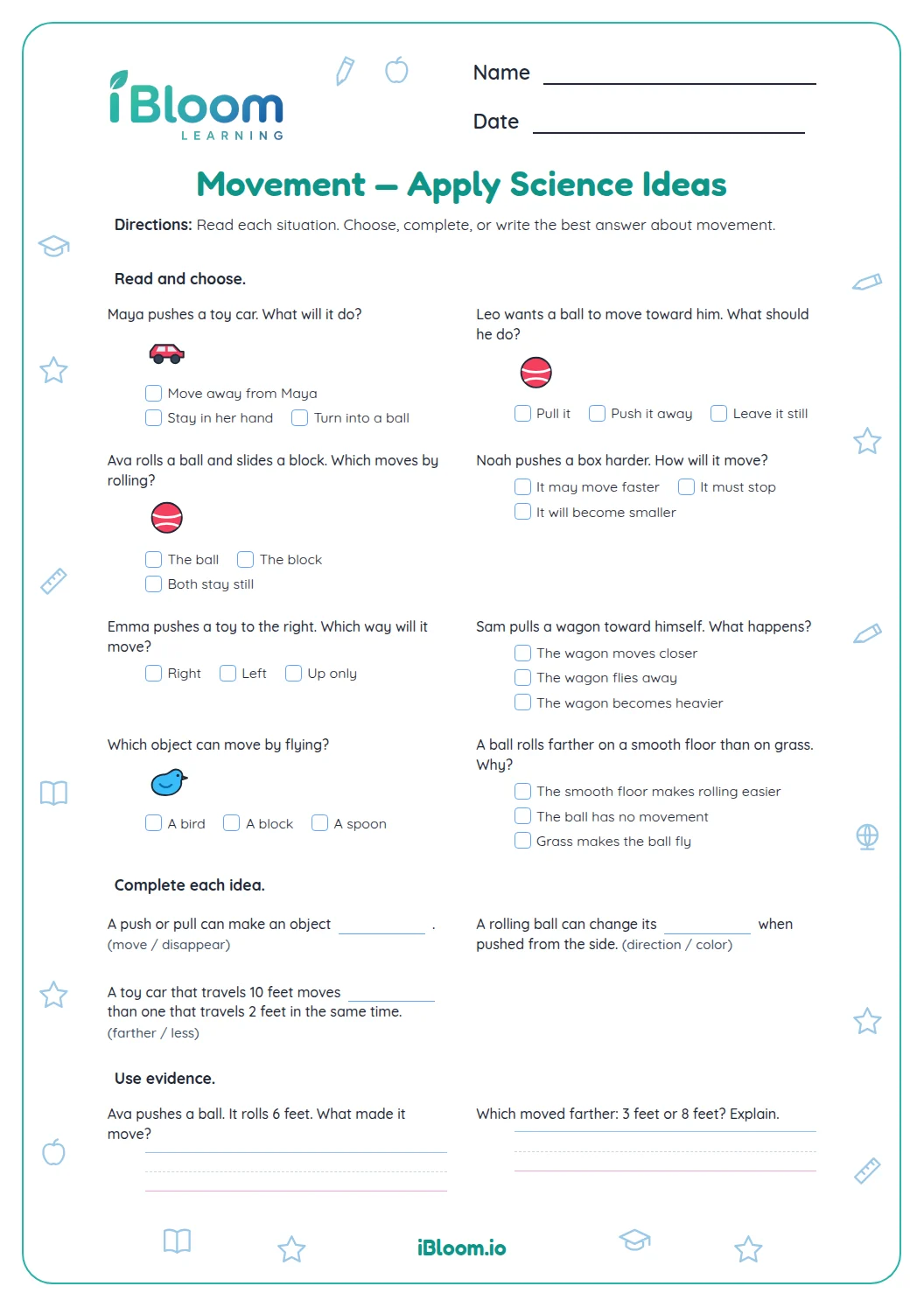
The worksheet has two parts and 14 multiple-choice questions. Part A predicts motion and identifies pushes and pulls; Part B applies those ideas to familiar objects. A separate answer key lists the answers.
- Part A: Questions 1–7 predict motion or identify a force.
- Part B: Questions 8–14 apply force and direction ideas.
- Answer key: one answer for each question.
How to use this worksheet
- 1Read whether the object is still or already moving.
- 2Name the force: is it a push or a pull?
- 3Notice the direction of the force.
- 4Choose the motion change that matches the situation.
- 5Use the answer key to check each choice.
Common mix-ups and quick fixes
The mistake
Mixing up a push and a pull.
The fix
A push moves away from you; a pull brings an object toward you.
The mistake
Ignoring the direction word.
The fix
Point in the direction named in the prompt before choosing.
The mistake
Assuming a moving object always keeps the same direction.
The fix
Check whether a new force can turn, slow, or speed it up.
What to practice next
Make more practice
Questions parents and teachers ask
What is a force?
A force is a push or a pull on an object. The questions show forces starting motion or changing the direction of moving objects. Students can name whether an action is a push or a pull and use the direction words in the situation to choose a result.
How many questions are on the sheet?
There are 14 questions across two worksheet pages, followed by a separate two-page answer key. The first part focuses on predicting motion and identifying pushes and pulls. The second part asks students to apply those ideas to more situations.
What should students notice first?
First decide whether the object is still or already moving. Then identify the push or pull and its direction. This keeps the answer tied to the details in the question, such as a cart starting from rest or a ball rolling before another force acts.
Can a force change direction?
Yes. A push or pull can change an object’s direction. For example, a force from the side can turn a moving ball. The worksheet asks students to connect the direction of a force with what may happen to the object.
Is an answer key included?
Yes. A separate answer key gives the correct choice for all 14 questions. Have students complete the worksheet first, then talk through the force and direction words for any answer they want to review. The key keeps each response paired with its question for quick checking.
How can I help if a child is unsure?
Use a toy car or ball and gently push it in different directions on a clear surface. Ask which way it moves, then compare that observation with the words in a worksheet question. A simple demonstration can make “push,” “pull,” and “direction” concrete.