


About this worksheet
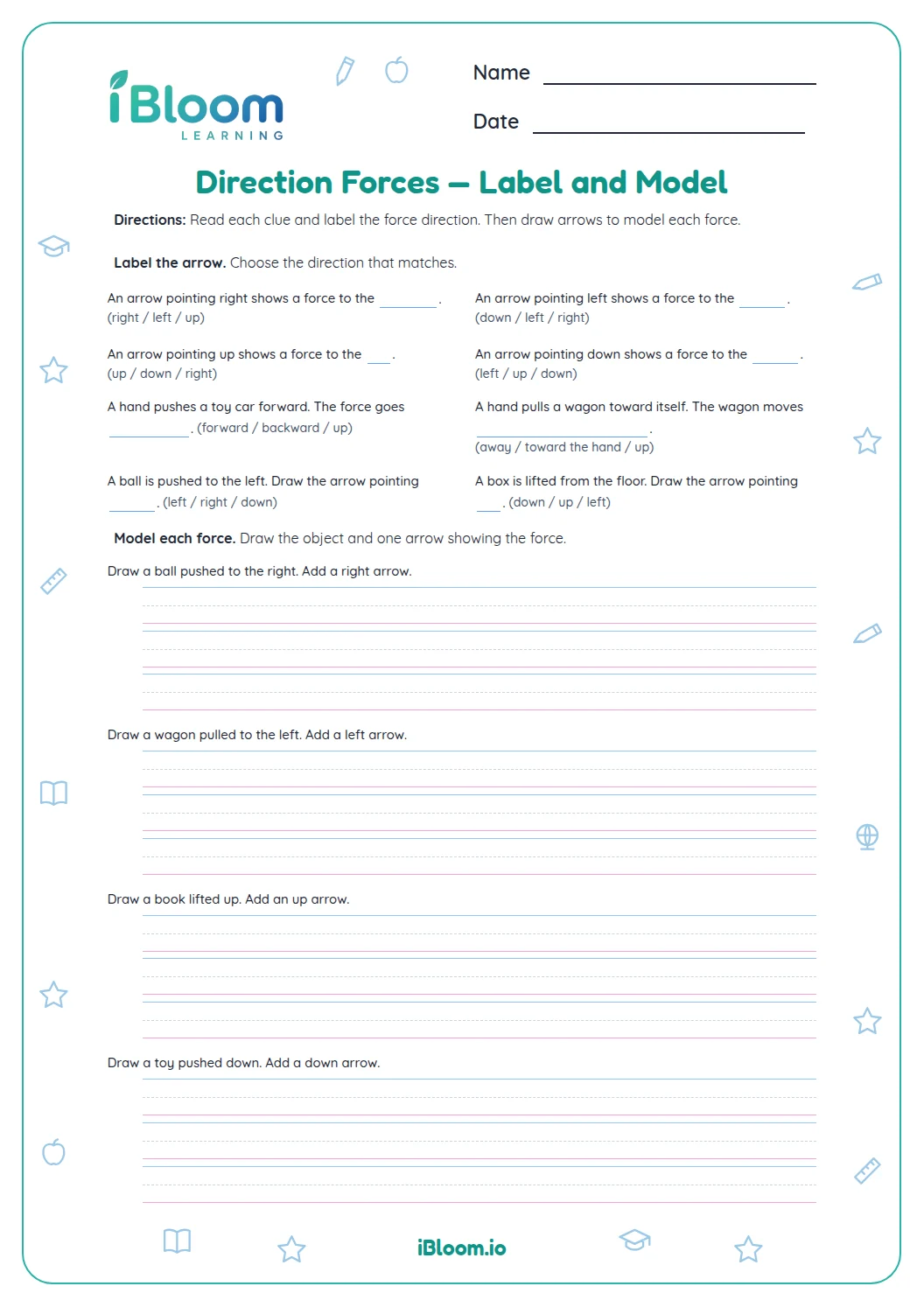
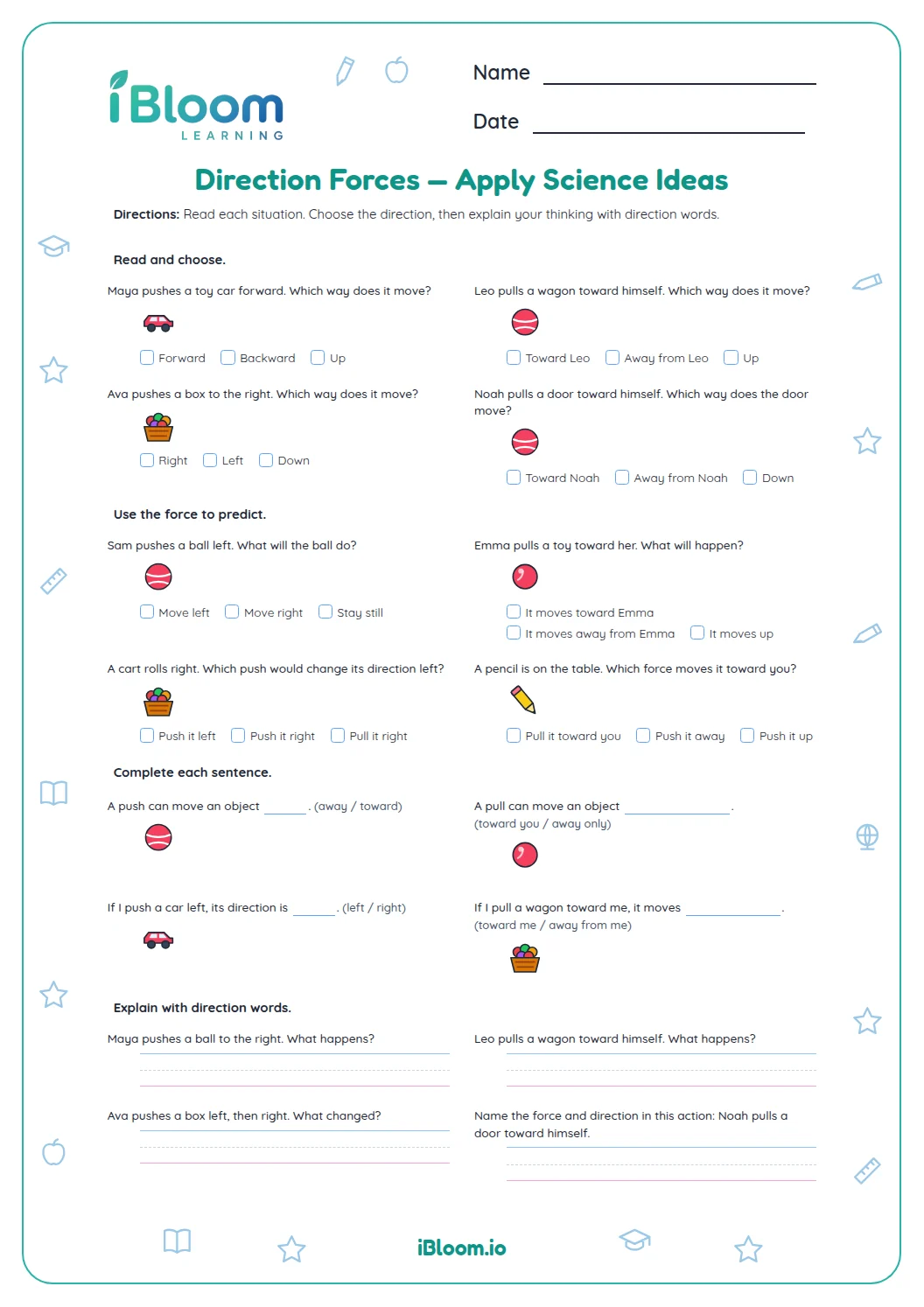
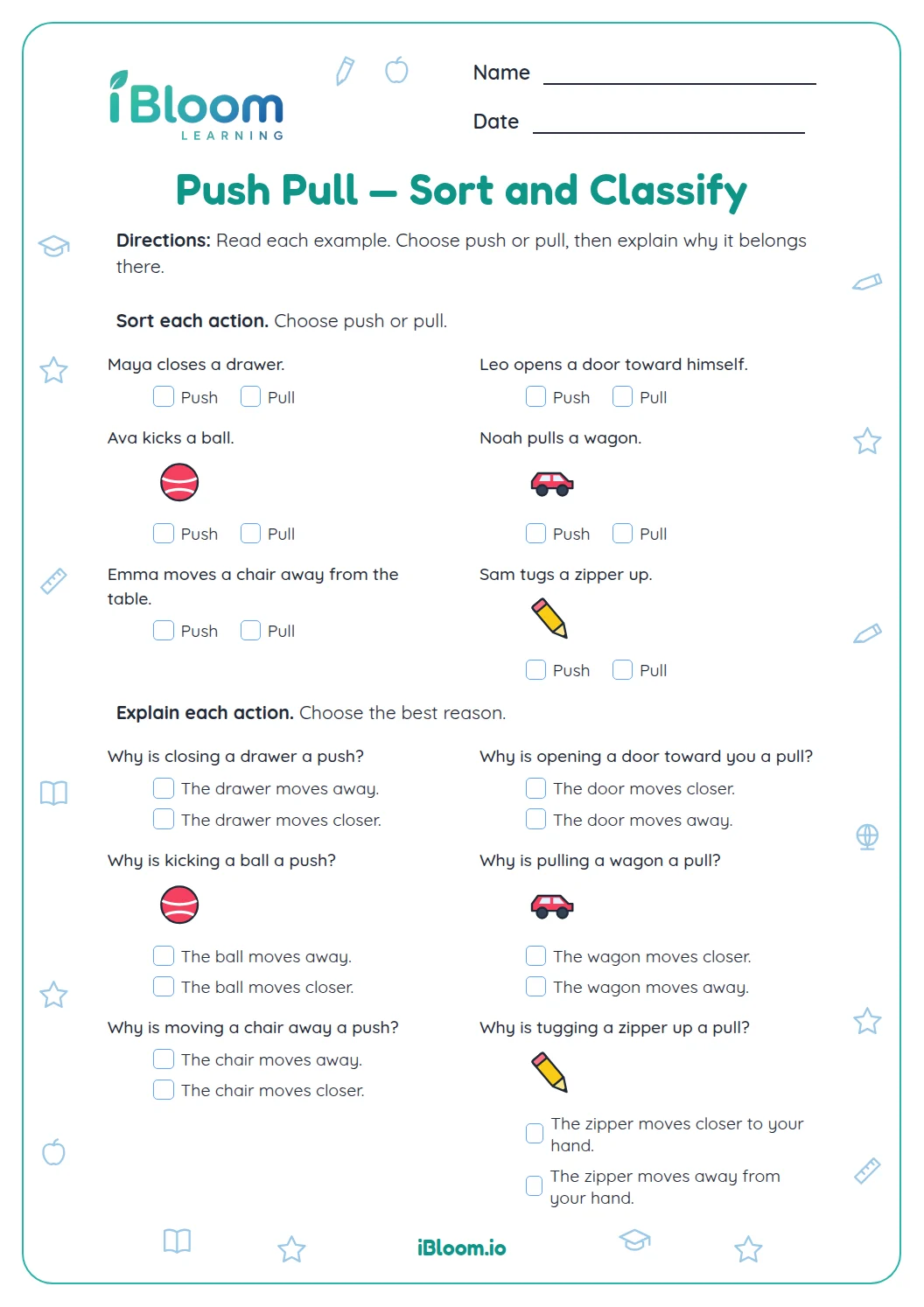
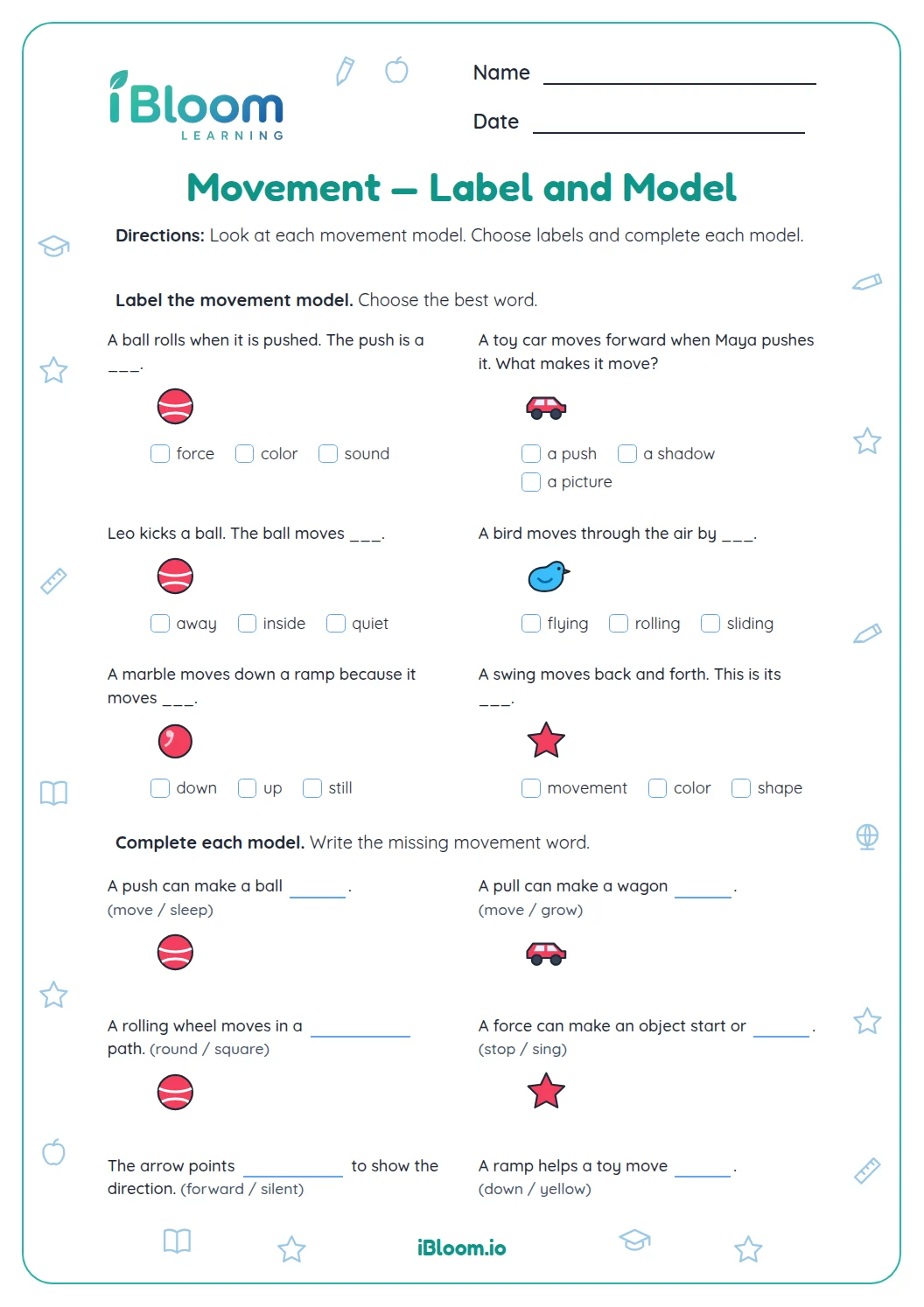
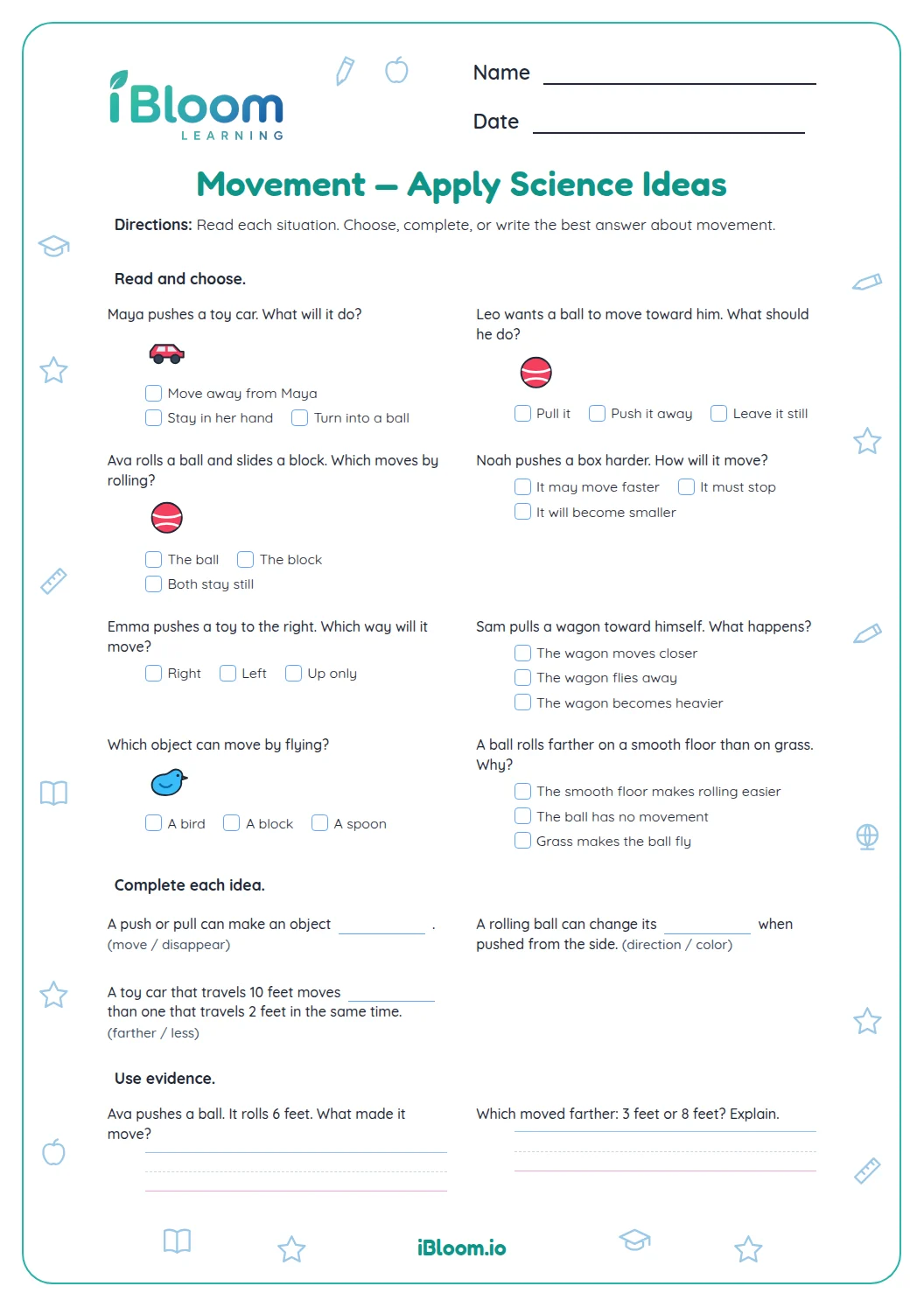
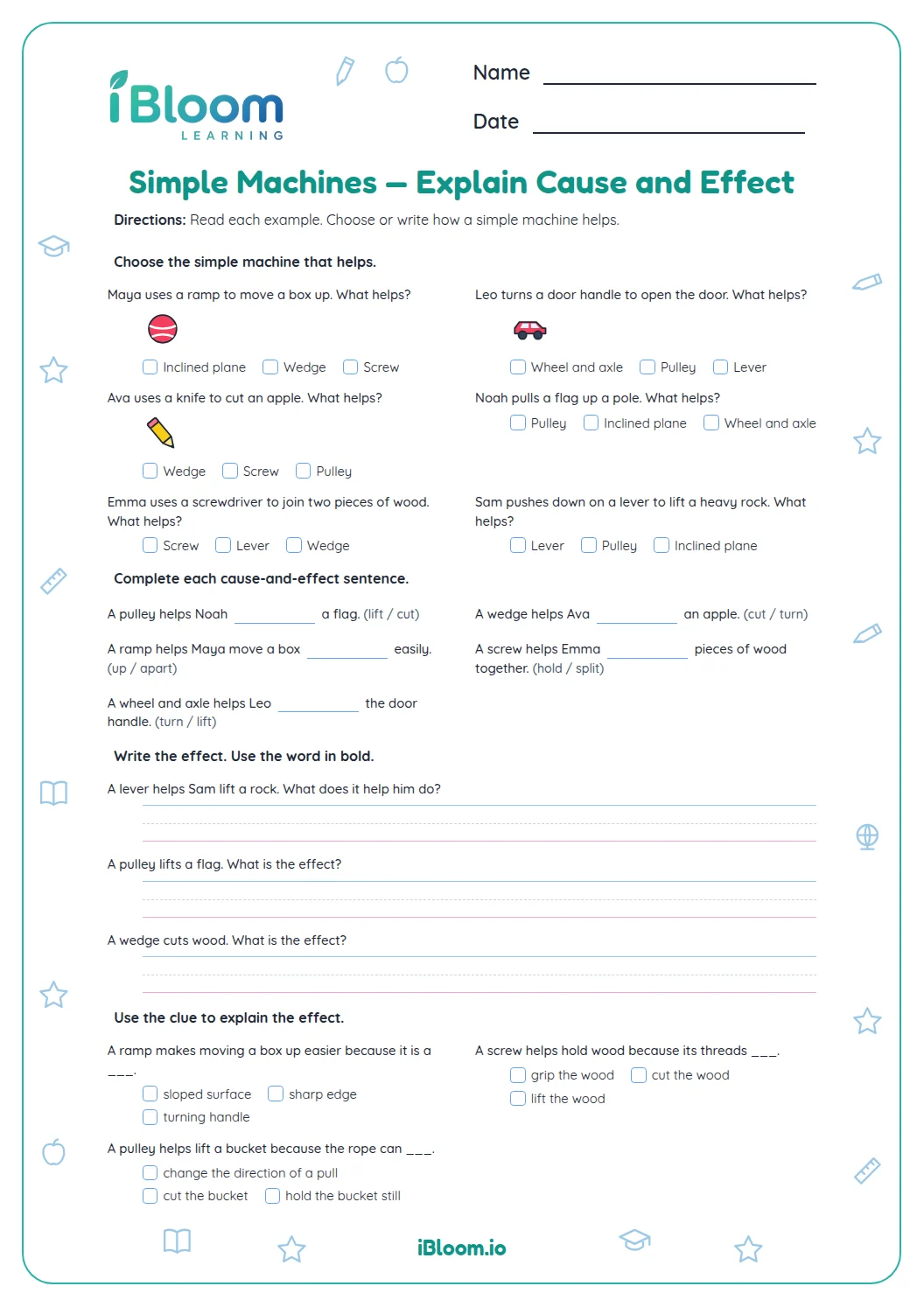
This Grade 1 science worksheet focuses on direction forces and their effects on motion. Children predict what happens when a ball, toy, or wagon is pushed or pulled, explain how contact changes motion, and apply the idea to new situations. The 15 questions move from multiple choice to short explanations, with a separate answer key.
What science idea does the sheet practice?
A push or pull can change an object’s motion. The questions use direct contact: pushing a resting toy, pulling a wagon, catching a rolling ball, and objects colliding. Learners connect each force direction to what the object does next.
How does the practice build?
Part A predicts outcomes in familiar situations. Part B names the cause and effect in brief events. Part C transfers the idea to new examples and asks children to describe a force and its result.
How do you explain a motion change?
Name the force first, then say what changed about the motion.
- 1A ball rolls into another ball.
- 2Cause: the moving ball pushes the second ball.
- 3Effect: the second ball can begin moving.
Why does direction matter?
A push or pull has a direction. A push from the side can turn a moving object, while a pull on a wagon handle draws it toward the person. The object’s motion after contact is the effect to describe.
How to use this worksheet
- 1Read what the object is doing before the force.
- 2Identify whether it is a push, pull, collision, or stopping action.
- 3Name the direction when the question gives one.
- 4State the motion effect: start, stop, speed change, or direction change.
- 5Check that your explanation links the force to that effect.
Common mistakes and quick fixes
The mistake
Saying every push makes an object go forward
The fix
Use the direction named in the event; a side push may turn an object.
The mistake
Calling a catch a pull
The fix
A hand stopping a moving ball pushes on it through contact.
The mistake
Naming the force but not the result
The fix
Finish with what changed: the object started, stopped, sped up, slowed, or turned.
What to practice next
Make more practice
Questions parents and teachers ask
Can a push make an object stop?
Yes. When a hand catches a moving ball, the hand pushes on it and changes its motion until it stops. Part A and Part B include stopping examples so children connect contact to a change, not just to starting motion. The child can observe the direction of motion before and after contact to describe the effect clearly.
How is a push different from a pull?
A push moves an object away from the force source, while a pull draws it toward the source. The worksheet uses a toy car pushed in a direction and a wagon pulled by its handle as familiar examples. A pull on a handle draws the wagon toward the person applying the force.
What should a cause-and-effect answer include?
Name the push or pull and then state the motion effect. For example, “The moving ball pushes the second ball, so the second ball can start moving.” This links the event to a result instead of naming only the force. A full answer names the action and the resulting change, such as stopping or turning.
How many questions are included?
There are 15 multiple-choice questions in three parts: five predictions, five force-effect questions, and five applications. The separate answer key marks each choice, so a parent can review the event and explain why the selected motion result fits.
Why does the sheet mention collisions?
When objects touch or collide, they push on one another. A moving ball can push another ball and change its motion. The collision prompts let children apply the same force-and-motion idea to an interaction between two objects. The worksheet uses simple contact examples so children can focus on what the push or pull changes.