

About this worksheet
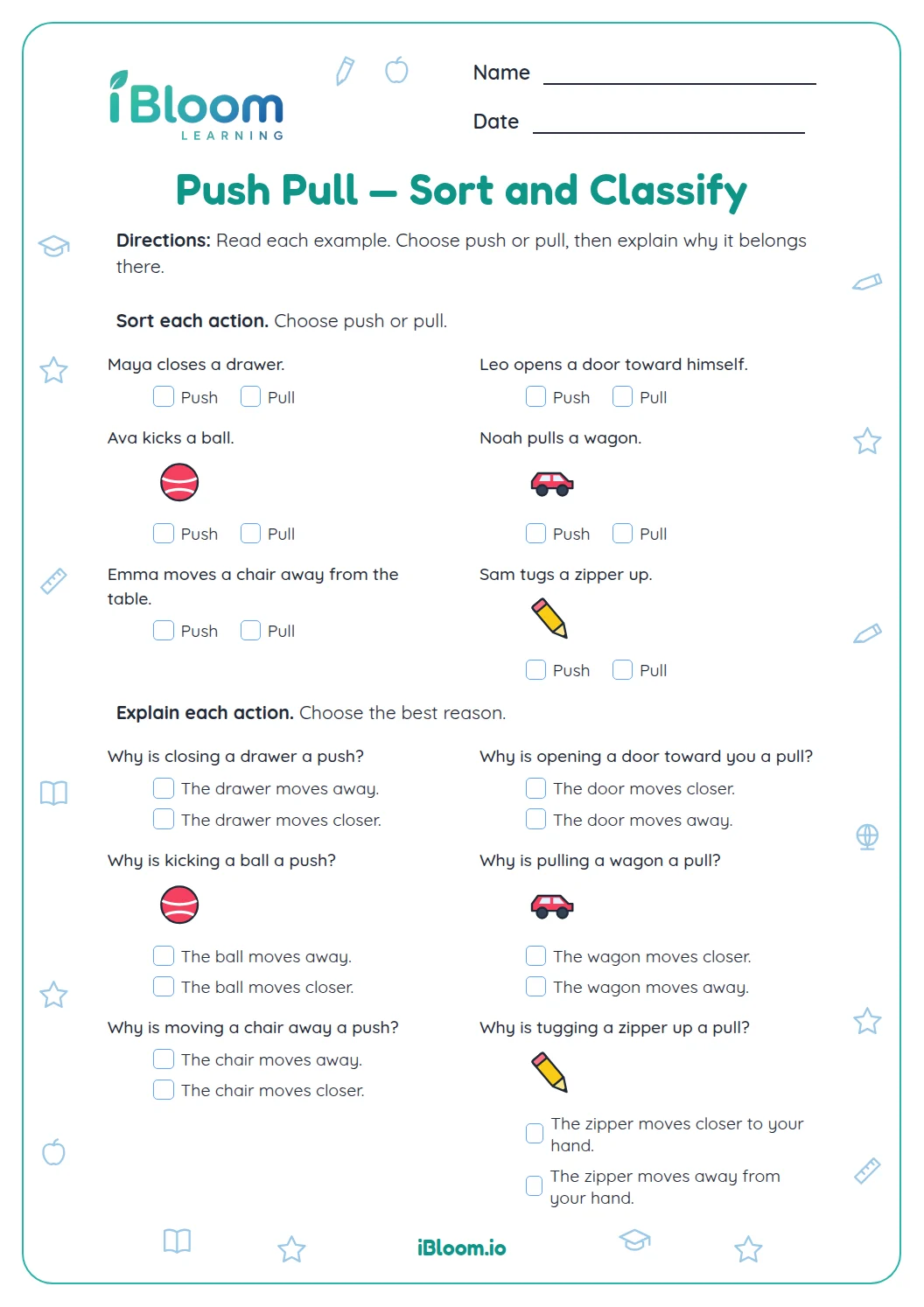
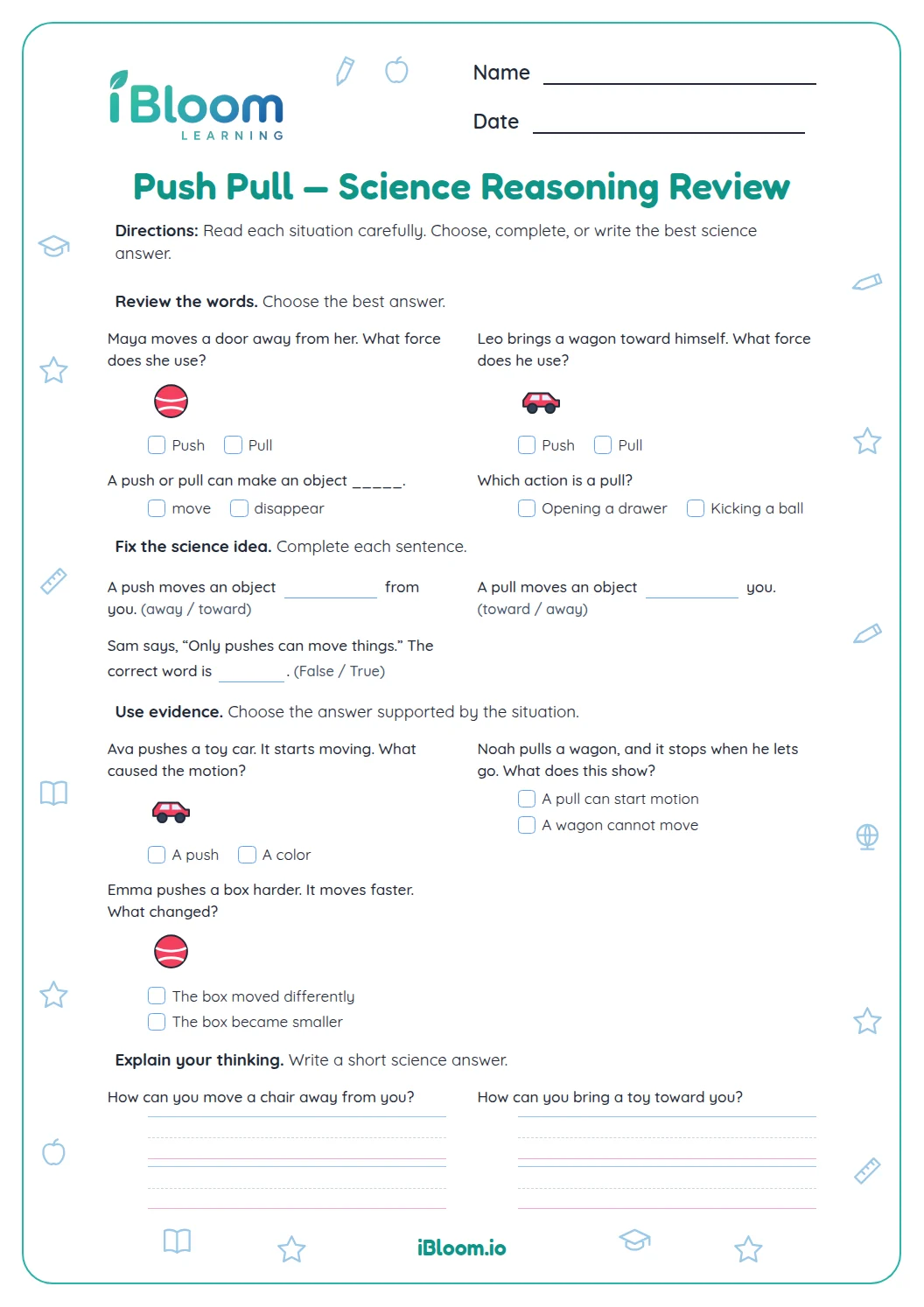
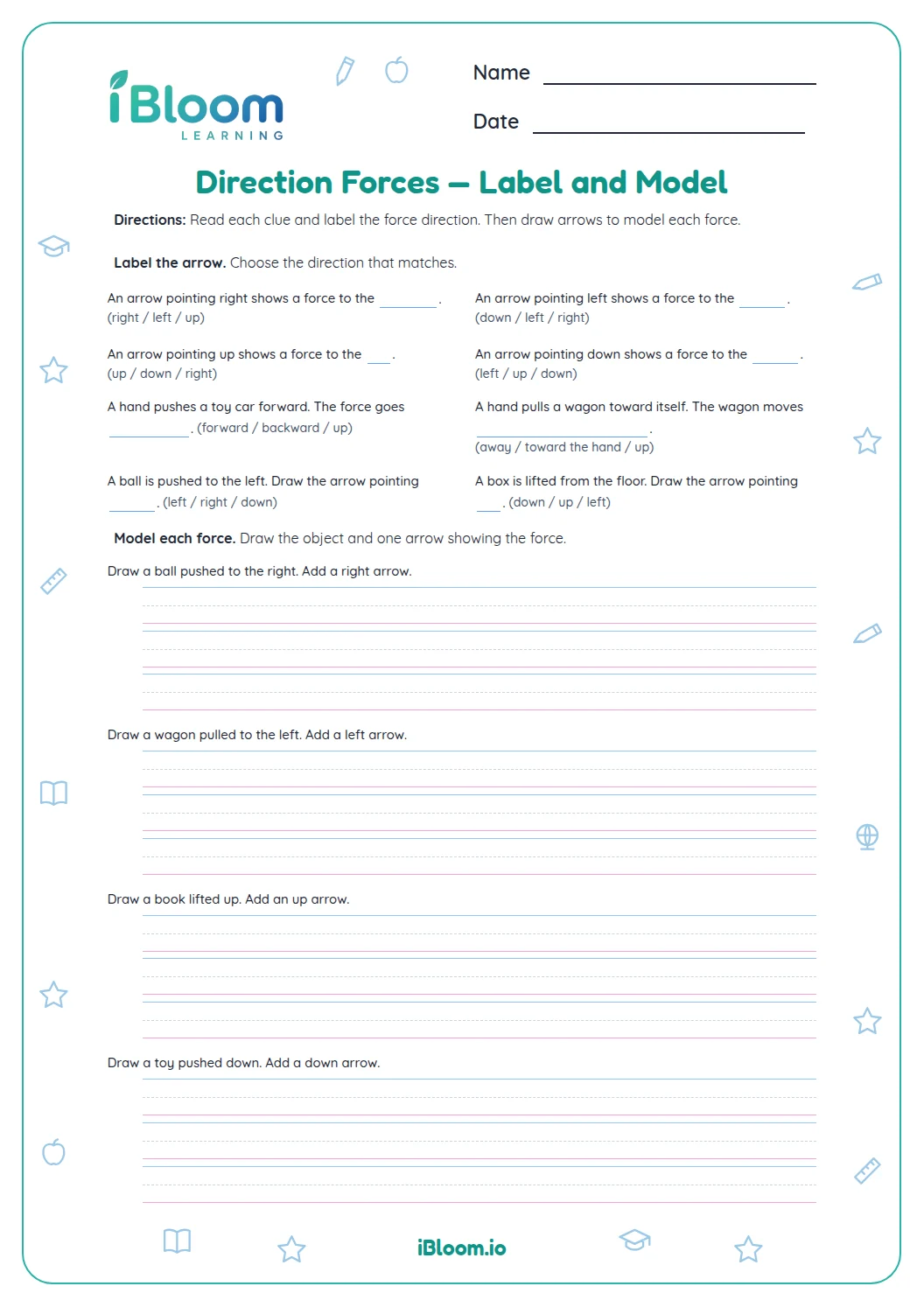
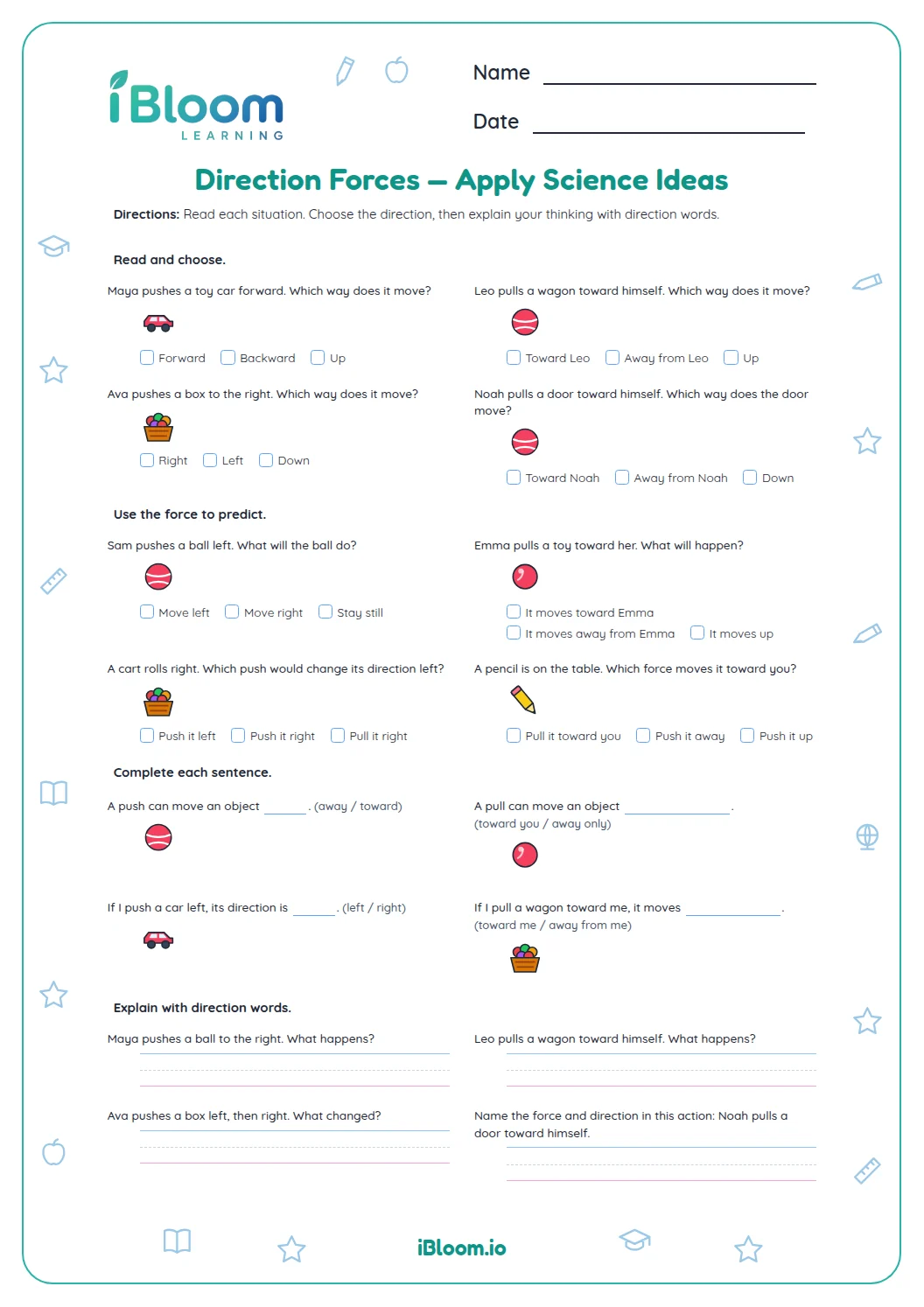
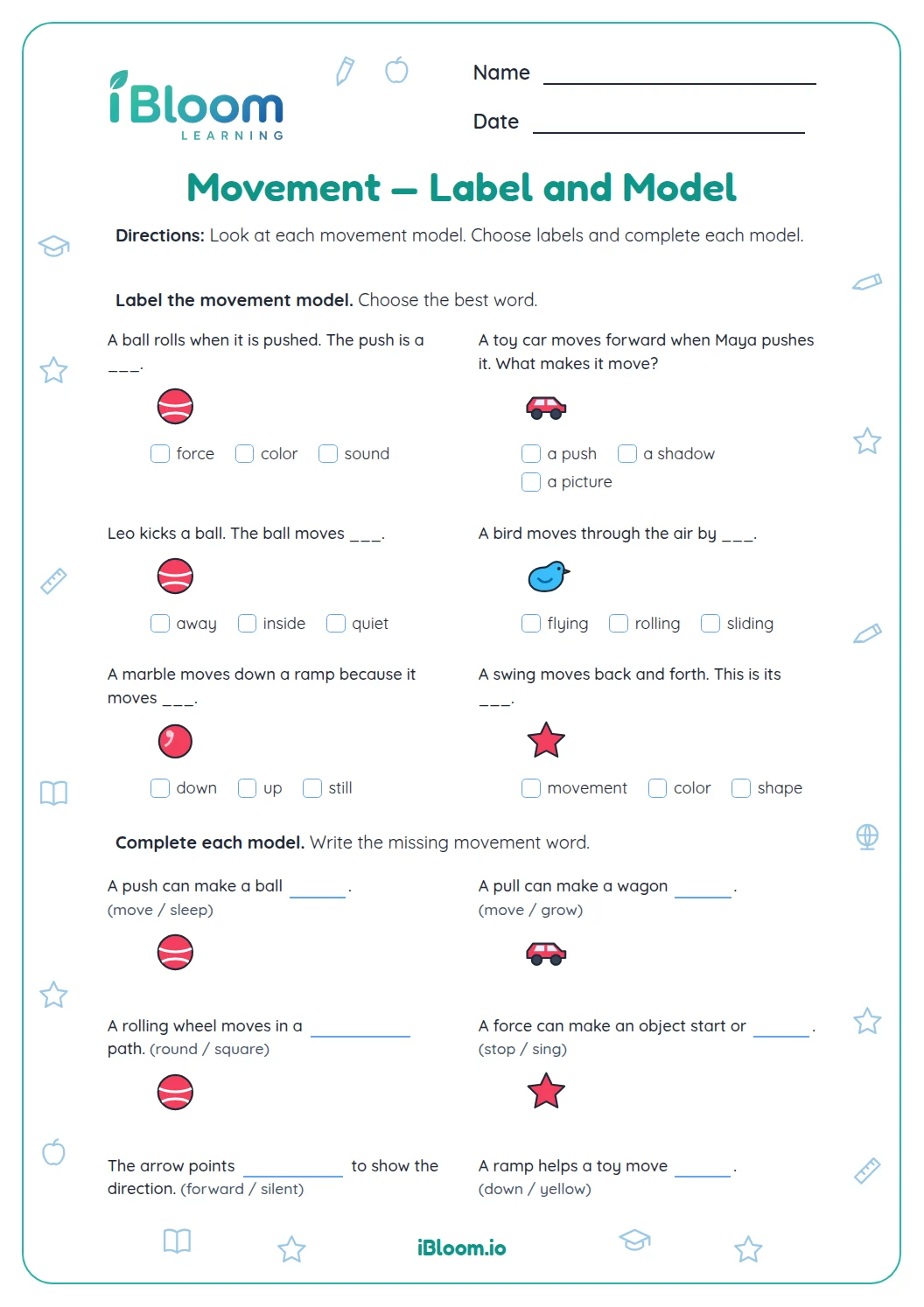
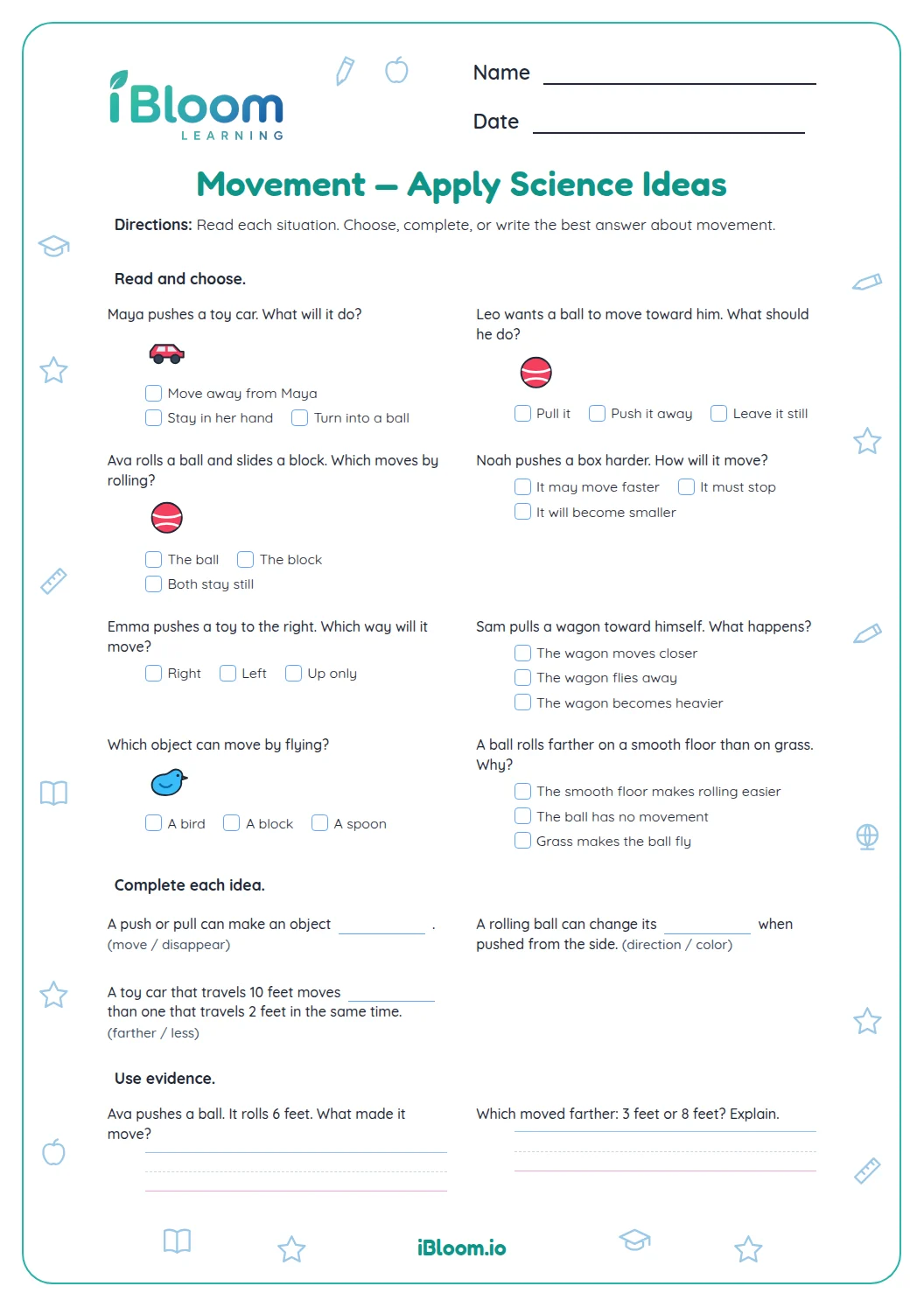
This Grade 1 printable applies pushes and pulls to familiar actions: pressing a door, tugging a wagon, and starting a ball rolling. Children identify a force and predict a simple effect on motion in 14 brief questions. The sheet connects to NGSS K-PS2-1, which asks young learners to compare how pushes and pulls affect an object’s motion. A separate answer key is included.
Aligned to K-PS2-1
How can you tell a push from a pull?
Think about the direction of the force. Pressing a drawer shut is a push; bringing it open by its handle is a pull.
- 1Tug a wagon closer.
- 2The wagon moves toward the child.
- 3That action is a pull.
What can a force do to an object?
A push or pull can start an object moving or change how it moves. Question 5 describes a still ball that rolls after a kick: the kick is a push that starts its motion.
How do you apply the idea?
Name the action, the force, and what happens next. In the final question, a push in the same direction as a toy’s motion makes it speed up.
How to use this worksheet
- 1Read what the person does to the object.
- 2Decide whether the action moves it away or brings it closer.
- 3Choose push or pull.
- 4For motion questions, look for what changes after the force.
Common mistakes and quick fixes
The mistake
Calling any rope action a push.
The fix
A tug on a rope pulls the attached object toward the person.
The mistake
Naming the force but not the object.
The fix
Say which object receives the push or pull.
The mistake
Assuming a force always makes an object move toward you.
The fix
Check the direction of the push or pull in the situation.
Next Generation Science Standards alignment
Students identify pushes and pulls and connect them to changes in motion.
Compare how pushes and pulls affect an object’s motion.
On this sheet: The examples ask students to identify pushes and pulls and reason about resulting motion.
Show the official wordingHide the official wording
Plan and conduct an investigation to compare the effects of different strengths or different directions of pushes and pulls on the motion of an object.
What to practice next
Further reading
Questions parents and teachers ask
What is a push and what is a pull?
A push moves an object away from the person or thing applying the force; a pull brings it closer. The worksheet uses familiar situations, such as pressing a door and tugging a wagon, for children to identify each force. They can act out the directions with a toy to check their ideas.
What can a push or pull do?
A push or pull can start an object moving or change its motion. For instance, a kick pushes a still ball and makes it roll. Children practice naming the force and describing what happens afterward. The examples connect an action with an observable result.
What situations are on the page?
The questions describe pressing a ball, pulling a wagon, opening or shutting a drawer, kicking a ball, moving a swing, and pushing a toy. Children choose the force or its effect on motion in brief situations. They can act out the safe examples with a toy to connect the action and result.
Does this science worksheet include an answer key?
Yes. The answer key provides the expected force choices and motion effects for all 14 questions. Different wording is fine when the answer correctly identifies a push or pull and explains its effect. Use it to review one missed item together.
Which questions compare how a force changes motion?
Question 9 considers equal tugs in opposite directions, and question 11 compares a stronger push with a ball rolling farther. Other items ask what moves when a push or pull is applied. Together they connect force direction or strength with a simple motion result.